Titan II Control Room, Tucson, Arizona
Tucson, AZ, USA
Panoramic Photo Collage w/3d
1990
43 x 27
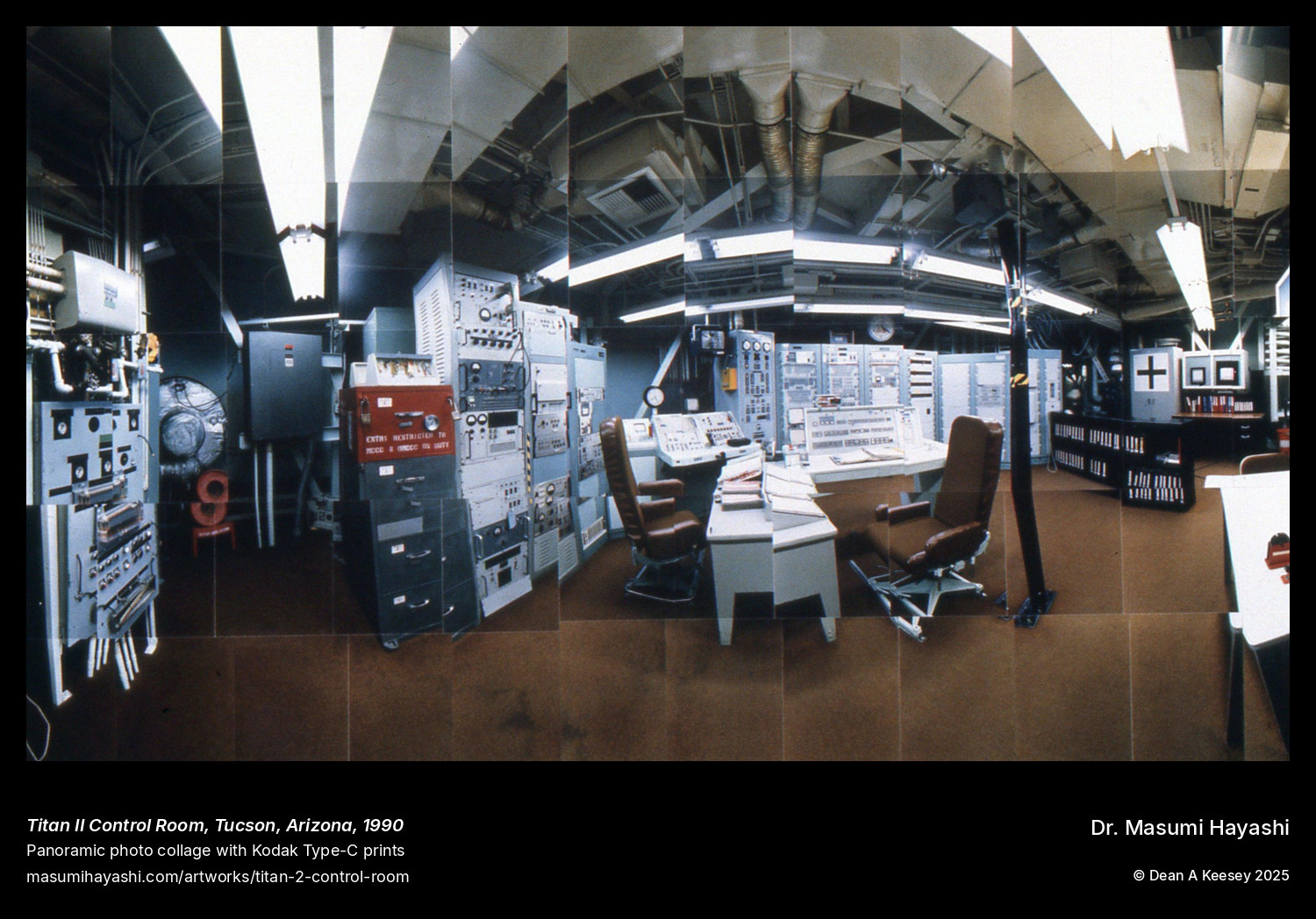
Twenty feet underground, two officers sat at consoles designed for launching nuclear warheads. Their workstation—a circular chamber packed with switches, dials, and monitoring systems—represented the human interface of America’s nuclear deterrent. From 1963 to 1987, two-person crews maintained 24-hour alert here, prepared to execute presidential launch orders within 58 seconds.
Hayashi documented this Titan II Launch Control Center in 1990, just four years after it opened as the Titan Missile Museum. The control room still looked operational—equipment intact, manuals in place, chairs positioned exactly where officers sat during Cold War shifts. Only the deactivated systems revealed this was now a museum rather than an active nuclear command post.
The space embodied Cold War nuclear strategy’s contradictions. Officers worked in extreme proximity for 24-hour shifts, yet launch required physical separation—keys positioned too far apart for one person to turn simultaneously. This “two-man rule” created an environment where mutual trust and surveillance coexisted. The chamber’s claustrophobic intensity reflected the psychological weight officers carried: their actions, if ordered, would trigger nuclear war.
Hayashi’s three-dimensional approach suited the subject perfectly. Photographing such a compressed, equipment-dense space challenged traditional methods. Her notation “w/3d” suggests she incorporated dimensional elements—perhaps layered mounting or physical objects—allowing viewers to experience the control room’s spatial reality more viscerally than flat photography permitted.
By preserving one Titan II facility instead of destroying all evidence, the United States acknowledged these sites as significant historical artifacts. Hayashi’s documentation captured this transition—from active nuclear weapons infrastructure to public museum—at a crucial moment before decades of tourism transformed the space. Her work provides irreplaceable visual testimony to the rooms where ordinary people prepared to execute civilization-destroying orders they hoped would never come.