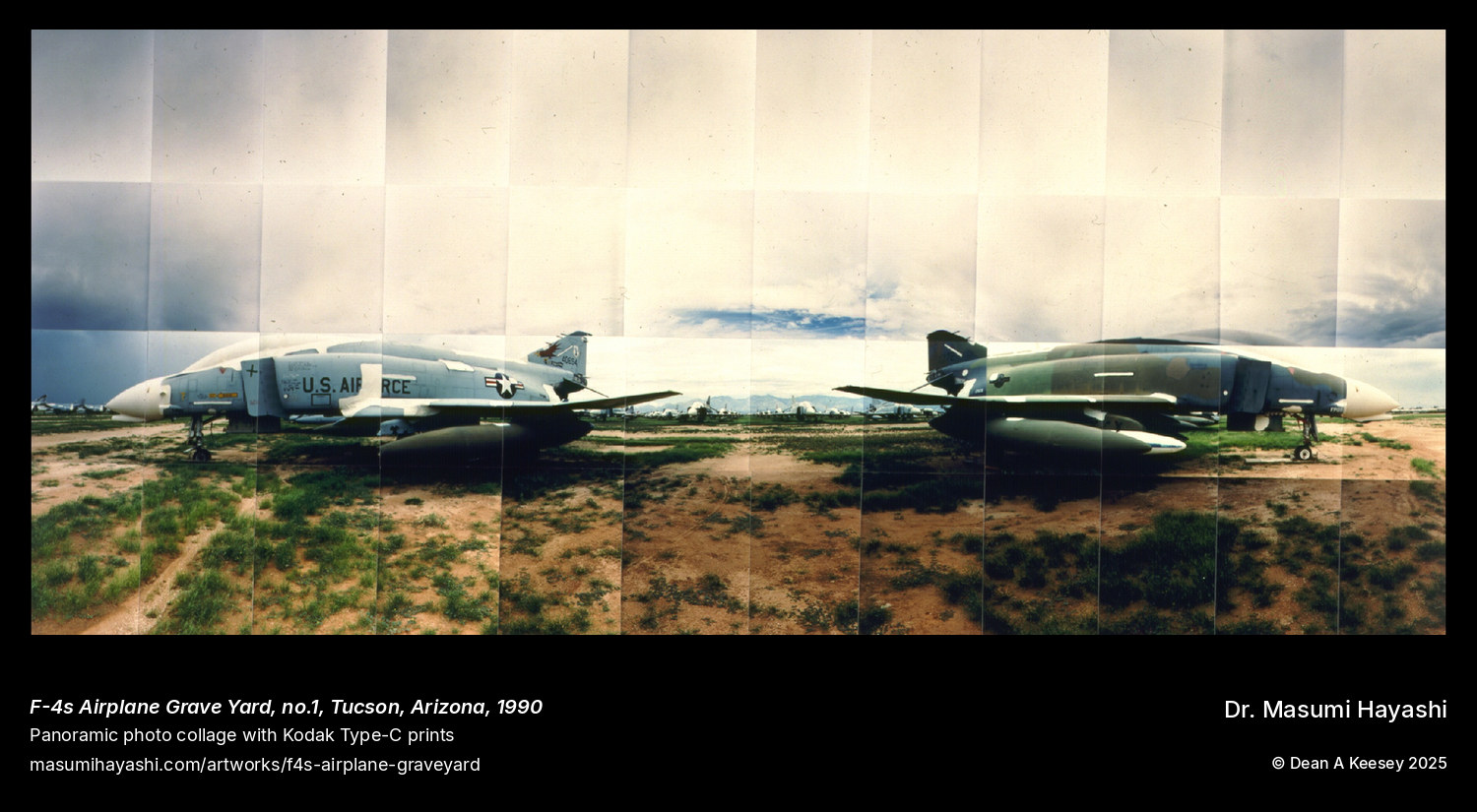
F-4's Airplane Graveyard, Tucson, Arizona
Tucson, AZ, USA
Panoramic Photo Collage
1990
39 x 18
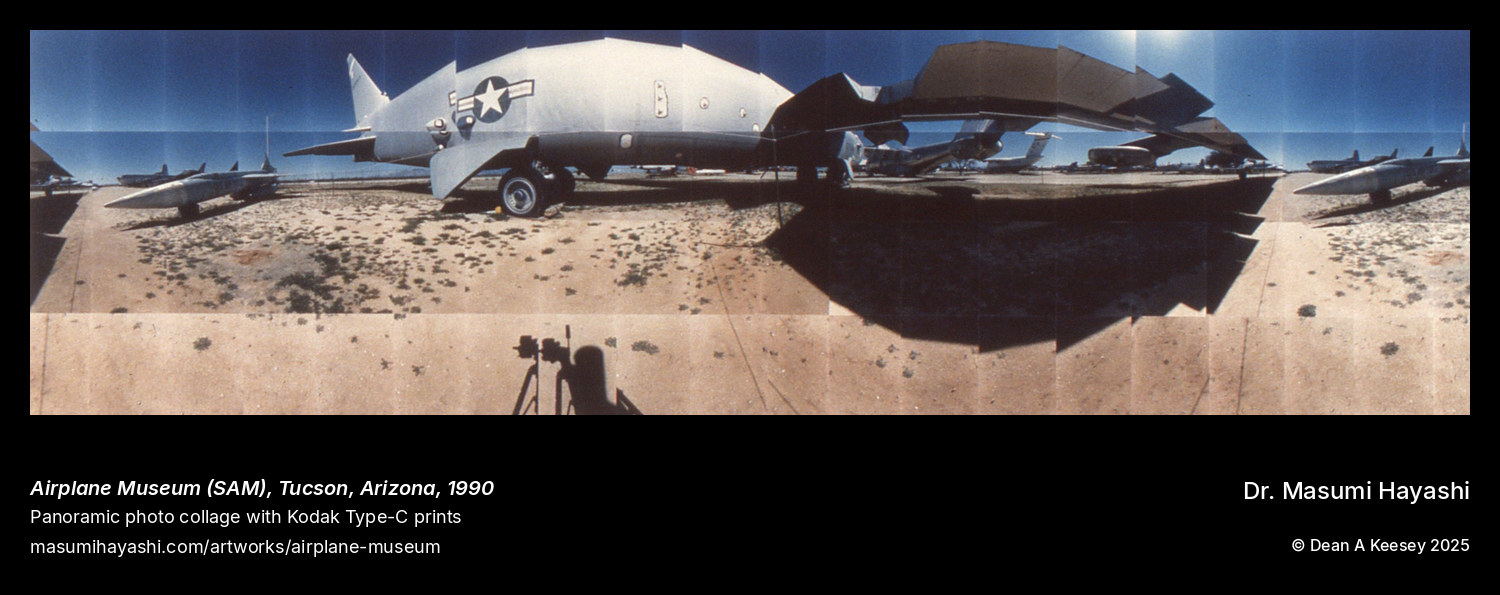
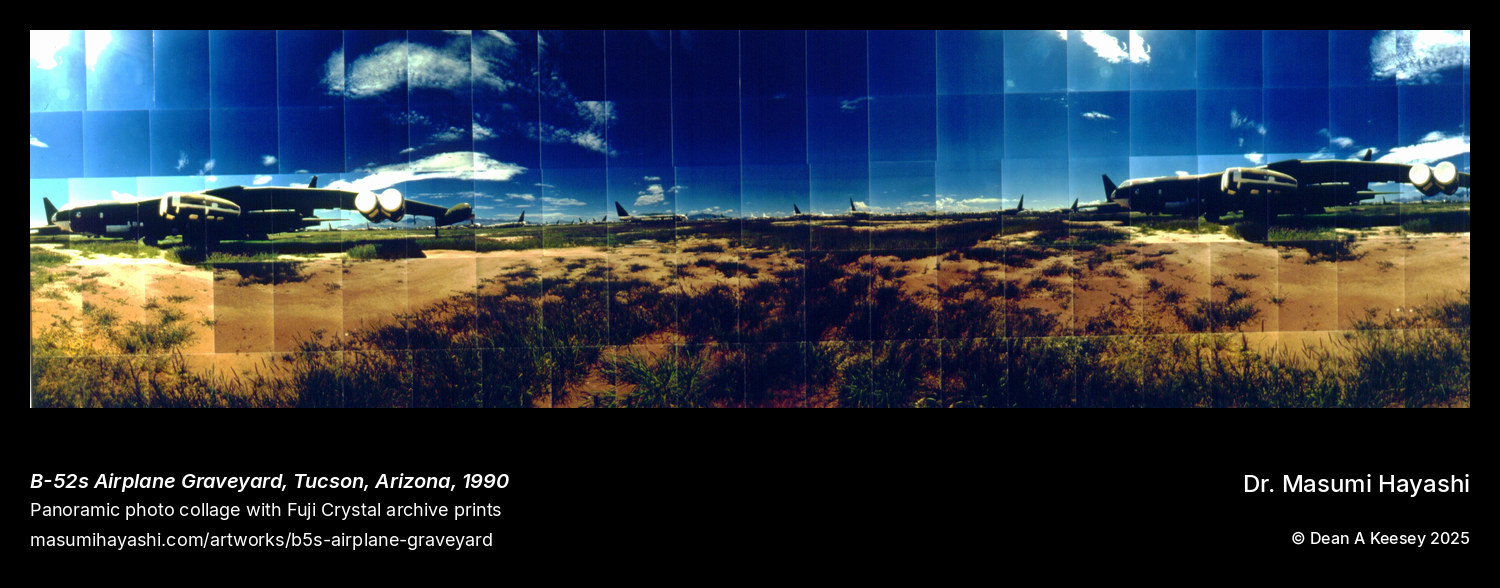
The F-4 Phantom II served as America’s workhorse fighter-bomber from the 1960s through 1990s—over 5,000 produced, flying combat missions in Vietnam, providing Cold War air defense, participating in conflicts from the Middle East to the Falklands. By 1990 when Masumi photographed Davis-Monthan’s Boneyard, F-4s were being rapidly replaced by fourth-generation fighters (F-15 Eagles, F-16 Fighting Falcons, F/A-18 Hornets). Hundreds flowed into storage, creating vast fields of identical aircraft arranged in mathematical precision.
These stored Phantoms represented technological obsolescence and geopolitical transformation. Defense budget reductions, force structure downsizing, decommissioning of aircraft designed for confrontation with a Soviet Union that was collapsing. The Cold War ending made visible as surplus weaponry.
The Boneyard’s geometric organization transforms military hardware into abstract pattern. Aircraft arranged in precise rows create compositions that appear more like industrial sculpture than functional weapons systems. Hayashi’s vertical format (unusual for her typically horizontal panoramas) emphasizes this geometric abstraction—columns of fighters receding toward desert horizon.
Many stored F-4s would become QF-4 drones for target practice, be reclaimed for parts, sold to allied nations, scrapped for aluminum, or preserved in museums as Cold War artifacts. The photograph captures the transitional moment—no longer active weapons, not yet scrap, suspended between military utility and historical memory.
Arizona’s dry climate preserves them. Low humidity prevents corrosion, hard desert surface creates natural parking, stable temperatures minimize material stress. Weapons systems can sit for decades, slowly weathering despite preservation efforts, waiting.