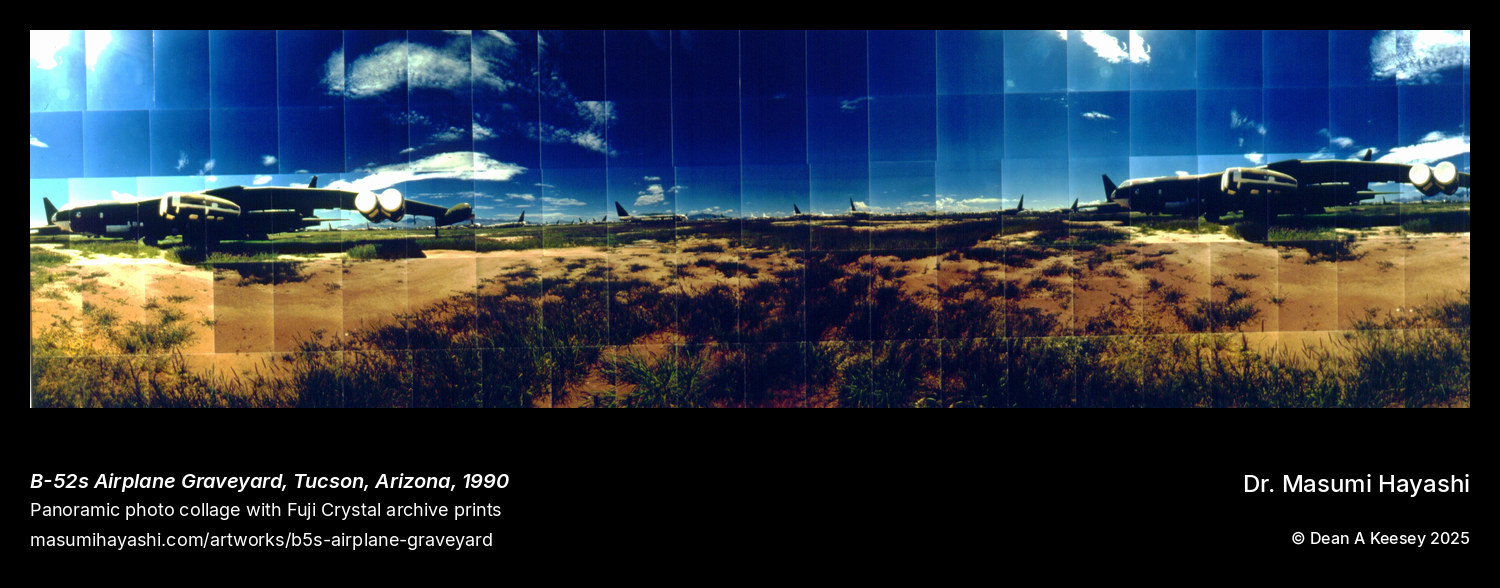
B-52's Airplane Graveyard, Tucson, Arizona
Tucson, AZ, USA
Panoramic Photo Collage
1990
26 x 78
Davis-Monthan Air Force Base, near Tucson, houses approximately 4,000 retired aircraft on 2,600 acres of desert hardpan—the world’s largest military aircraft storage facility, known as “The Boneyard.” Arizona’s climate provides ideal preservation: low humidity prevents corrosion, minimal rainfall reduces weathering, alkaline soil creates natural parking surface. Strategic bombers can sit for decades awaiting reactivation, parts harvesting, or scrapping.
Masumi photographed in 1990, at a crucial historical moment. The Berlin Wall had fallen months earlier, the Soviet Union would dissolve within the year, and the START I treaty would soon mandate destruction of hundreds of strategic bombers. These B-52 Stratofortresses—each capable of delivering nuclear weapons thousands of miles—were transforming from active military assets to obsolete Cold War relics.
The B-52s she documented embodied Strategic Air Command’s nuclear deterrence mission from the 1950s through 1990s. During the Cold War’s height, B-52s maintained continuous airborne alert—aircraft loaded with nuclear weapons flying 24-hour missions, ready to strike Soviet targets if ordered. This guaranteed that even if Soviet missiles destroyed American bases, surviving airborne bombers could execute retaliatory strikes. Mutually Assured Destruction, made physical.
Many stored B-52s faced eventual destruction under START I provisions requiring verifiable elimination. Treaties mandated that scrapped bombers be cut into pieces and left visible to Soviet reconnaissance satellites for 90 days—photographic proof of disarmament. The grim spectacle of B-52s chopped into sections, their severed wings displayed for satellite cameras.
Her panoramic format captures the scale: rows of massive aircraft extending to the horizon, aluminum skins gleaming in desert sun, instruments of strategic power rendered static, waiting.