Missile Garden (NASA)
Cape Canaveral, FL, USA
Panoramic photo collage with Kodak Type-C prints
1994
?? x ??
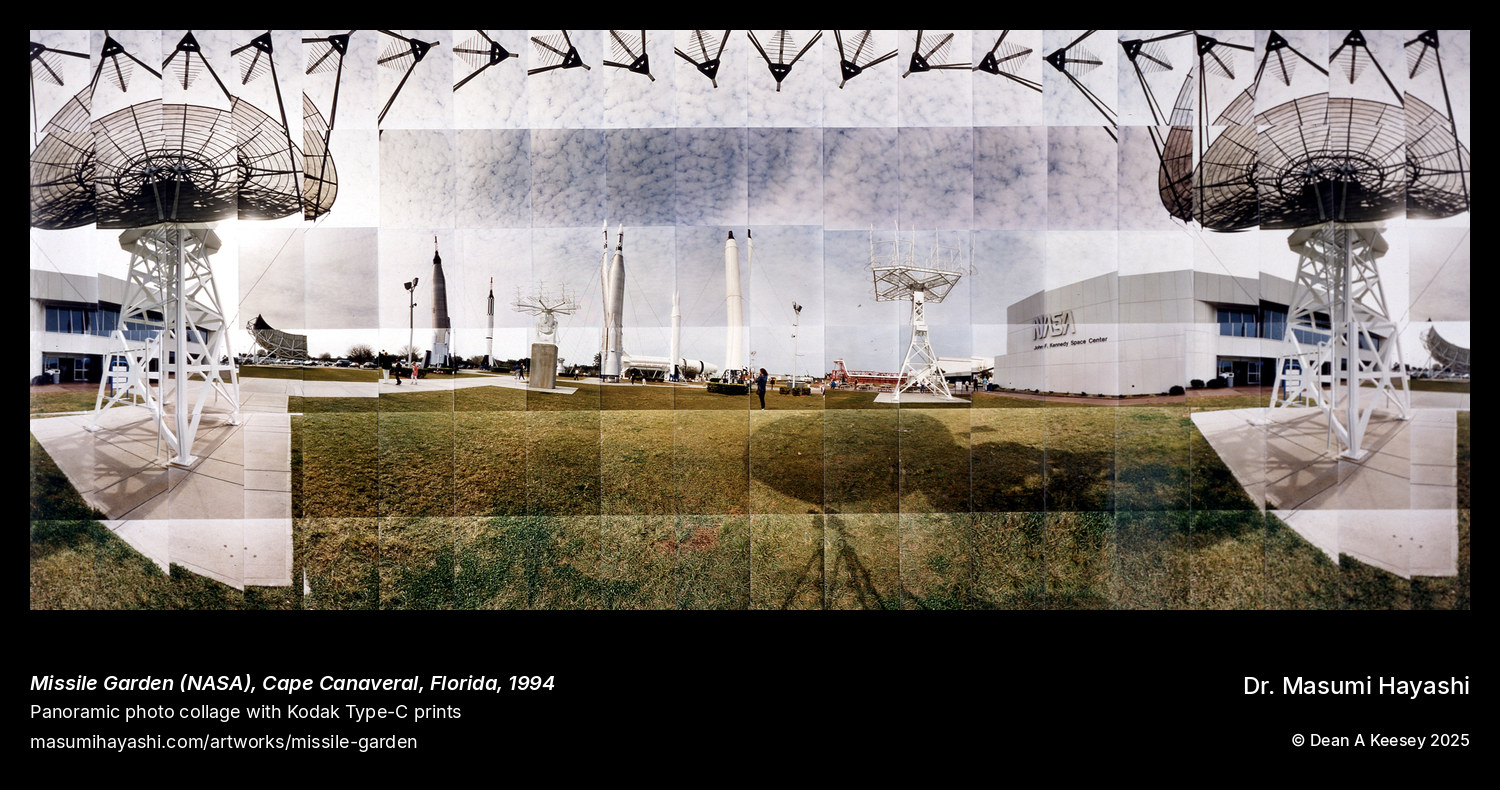
This panorama documents the Rocket Garden at Kennedy Space Center—the outdoor display where historic rockets and missiles stand like monuments to the Space Age’s technological ambition. The work captures the distinctive vertical sculptures created when launch vehicles are displayed upright, their engineering designed for vertical flight made permanent in static monument form.
Created in 1994, the work documents NASA’s effort to preserve space exploration history by displaying actual flight hardware. The Rocket Garden contains rockets spanning the American space program from its earliest Mercury-Atlas vehicles through later Gemini and Apollo-era launchers. Each rocket represents both technological achievement and the Cold War competition that drove space exploration.
The rockets’ dual nature—space exploration vehicles developed from military missile technology—connects this documentation to Hayashi’s broader interest in military infrastructure. The Saturn V that carried astronauts to the Moon descended from the same engineering tradition that produced intercontinental ballistic missiles capable of destroying cities. The Rocket Garden celebrates peaceful exploration while implicitly acknowledging warlike origins.
The photo collage technique proves particularly suited to documenting the Rocket Garden’s vertical forest of launch vehicles. Multiple perspectives capture the rockets’ varying heights and configurations, the assembled composition revealing the collection’s visual impact more effectively than single-frame photography.
NASA’s preservation of flight hardware makes tangible what would otherwise exist only in archives and memory. This panorama documents the material evidence of space exploration, the actual machines that carried Americans into orbit and to the Moon now serving as monuments to an era of technological confidence.