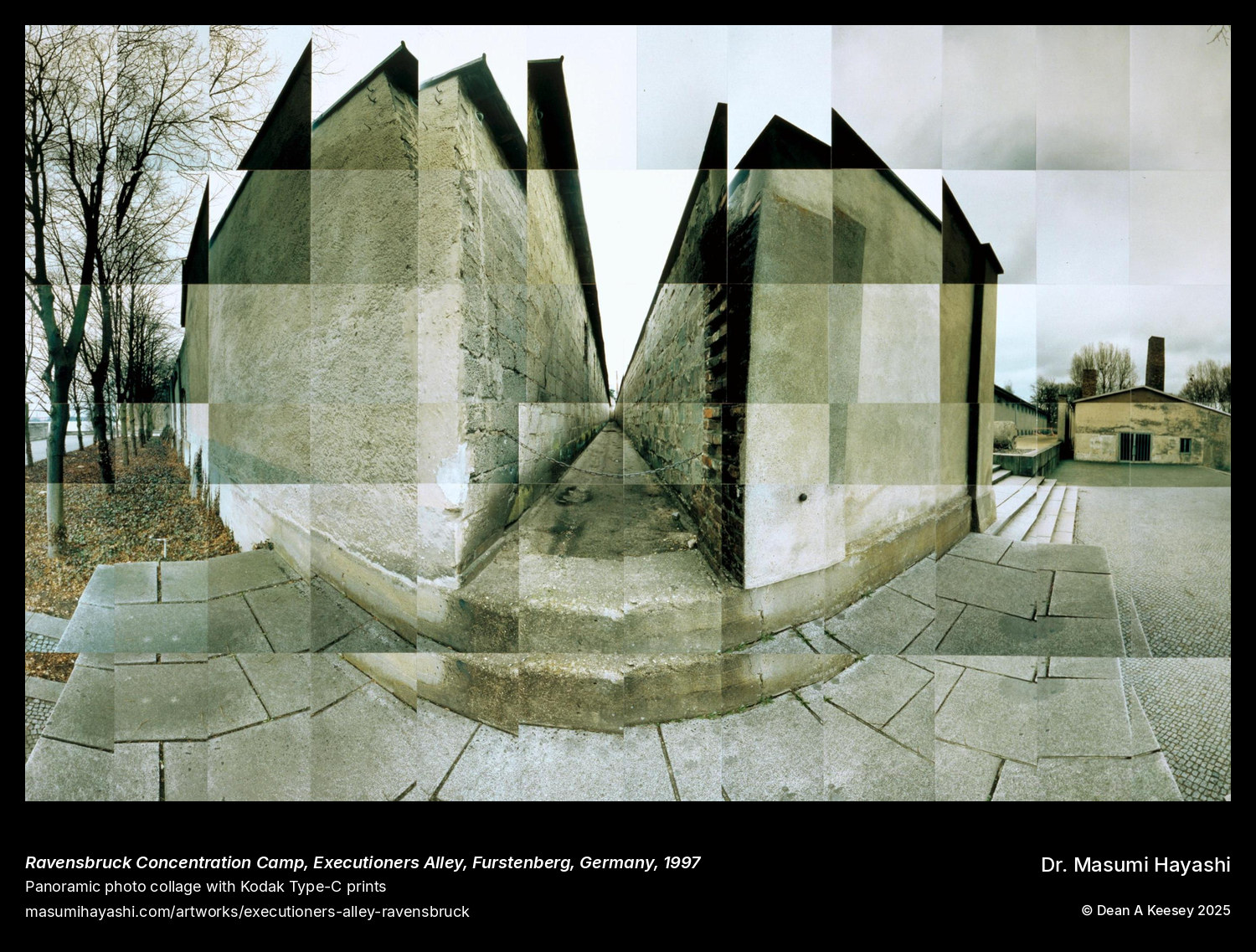
Executioners Alley, Ravensbruck Concetnration Camp
Furstenberg, n/a, Germany
Panoramic photo collage with Kodak Type-C prints
1997
29 x 43
This 29-by-43-inch horizontal panorama documents Executioners’ Alley at Ravensbrück concentration camp in Germany—the passage where the Nazis executed prisoners at the largest concentration camp built specifically for women. The moderate dimensions create concentrated focus on a space designed for murder within the broader camp infrastructure.
Created in 1997, the work represents Hayashi’s documentation of Nazi concentration camps alongside her documentation of Japanese American incarceration, drawing visual connections between parallel systems of state-sponsored imprisonment and murder. Ravensbrück held over 130,000 women and children from 1939 to 1945, and approximately 30,000 to 50,000 died there from execution, medical experiments, starvation, and overwork.
The “Executioners’ Alley” designation marks a space where shootings occurred—one of several killing methods employed at Ravensbrück, which also included a gas chamber installed in the camp’s final months. The naming itself represents post-war memorialization: transforming the perpetrators’ functional spaces into commemorative sites that name what occurred there.
The horizontal format captures the alley’s linear spatial character, the composition following the path where prisoners were led to their deaths. The photo collage technique fragments this execution space while revealing its architectural simplicity—utilitarian design serving murderous purpose.
Ravensbrück became a memorial site under East German administration and continues as such following reunification. This panorama documents the physical evidence of Nazi genocide, the spaces where state violence occurred preserved as testimony to what systematic hatred makes possible.