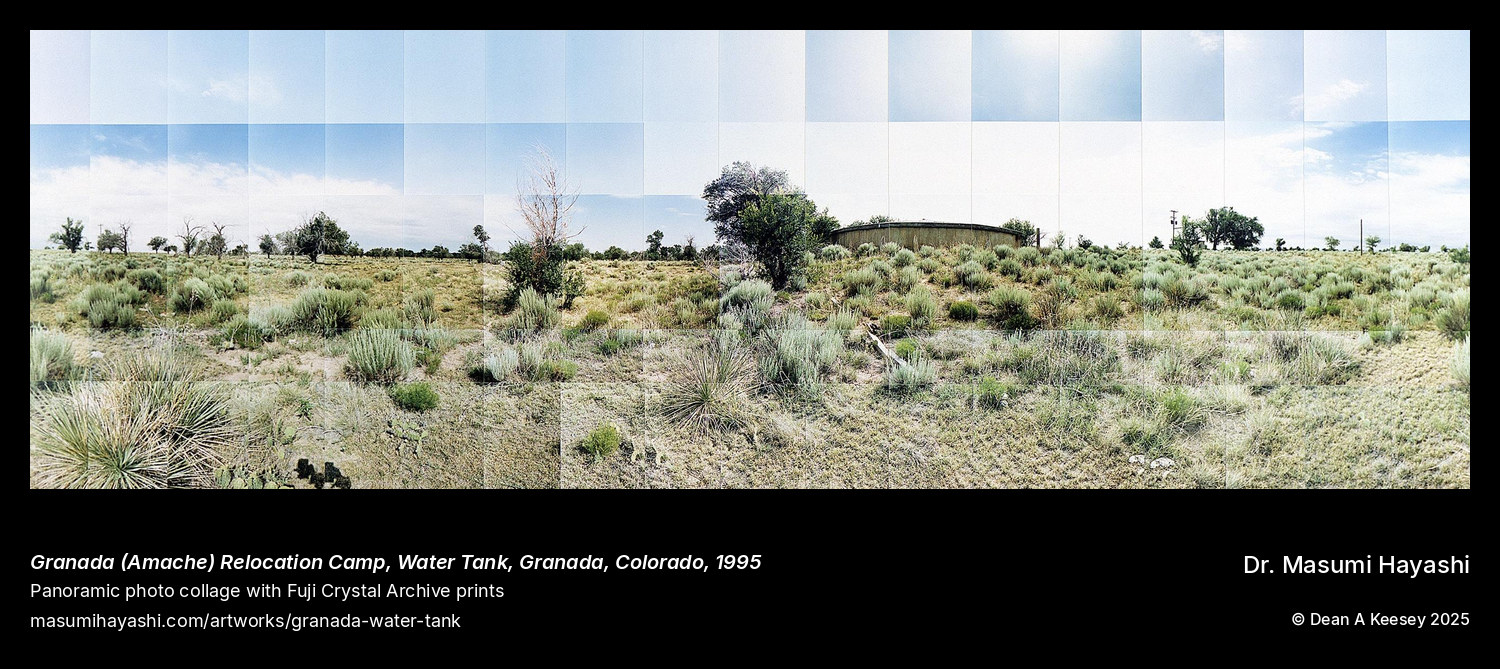
Granada (Amache) Internment Camp, Water Tank
Granada, Colorado, USA
Panoramic photo collage with Fuji Crystal Archive prints
1997
23" x 31"
Granada (Amache) Relocation Camp, Water Tank, Granada, Colorado
Overview
“Granada (Amache) Relocation Camp, Water Tank” documents the towering water storage infrastructure serving Colorado’s Camp Amache - the elevated tank providing essential water supply to 7,318+ imprisoned Japanese Americans in remote southeastern Colorado grasslands where water scarcity and harsh climate created survival challenges. Created in 1995, this 16-by-56-inch extreme vertical panorama (3.5:1 aspect ratio - nearly 5 feet tall but only 16 inches wide) employs dramatic narrow vertical format mirroring water tank’s own vertical architecture while emphasizing upward reach and engineered infrastructure dominating flat landscape.
The extreme vertical format positions this work among catalog’s tallest narrowest panoramas - 56 inches tall creates commanding presence approaching 5 feet while 16-inch width creates compressed vertical channel concentrating attention on tank’s architectural form, height, and isolation against sky. This format choice demonstrates systematic approach matching formats to subjects: extreme verticals for towers and vertical infrastructure (monuments, water tanks, smokestacks), moderate formats for foundations and horizontal remains.
The substantial 80% retention rate (only Edition 1 unframed in inventory, Editions 2-5 locations unknown) suggests strategic positioning for major institutional acquisition rather than broad commercial circulation. The high retention 30 years after creation indicates either limited market appeal for extreme narrow vertical requiring specialized installation spaces, or deliberate Foundation strategy reserving editions for significant museum placements when appropriate institutions emerge with collections focusing on Japanese American history, infrastructure photography, or Western landscape documentation.
Water Tanks: Essential Camp Infrastructure
Water storage tanks represented critical infrastructure enabling camp operations in harsh environments often lacking reliable local water sources. At Granada (operated August 1942-October 1945), the exposed southeastern Colorado grasslands faced severe water challenges: limited natural sources, extreme seasonal temperature variations affecting water quality, dust contamination from windswept plains, and infrastructure serving over 7,000 imprisoned people requiring massive daily water volumes for drinking, cooking, sanitation, agriculture, and basic survival.
The elevated water tank - raised on tower or platform to create gravity-fed pressure distribution - became iconic camp architecture: tall vertical structure visible across flat landscape, engineering solution providing pressurized water without electric pumps, and utilitarian infrastructure receiving same documentary attention as monuments or memorials. The tank’s survival through five decades (photographed 1995, 50 years post-closure) preserves engineering archaeology documenting camp’s basic life support systems and challenges maintaining adequate water supply for imprisoned population.
These water systems reveal camps’ inadequate infrastructure: minimal investment in prisoner facilities prioritizing cost over adequate supply, systems often failing during extreme weather requiring emergency repairs, and basic survival resources (water, heat, sanitation) frequently below standards required for non-imprisoned populations. The water tank testifies to internees’ resourcefulness maintaining facilities despite government neglect while documenting institutional violence through infrastructure archaeology.
Extreme Vertical Format and Infrastructure Documentation
The 16×56” extreme vertical creates dramatic upward emphasis potentially documenting: ground-to-top view of complete tower structure rising skyward, tank silhouette against Colorado sky emphasizing height and isolation, vertical infrastructure progression from ground foundation through tower supports to elevated storage tank, or compressed vertical channel eliminating landscape context to focus exclusively on engineered structure.
This narrow 16-inch width (among narrowest in catalog) creates challenging exhibition requirements - work demands tall wall spaces (nearly 5 feet) with sufficient surrounding clearance preventing visual crowding. These constraints limit potential venues to institutions with adequate wall heights, specialized galleries designed for vertical works, or collectors with appropriate residential architecture. The format’s installation challenges may explain high retention rate - limited market for works requiring specialized display infrastructure.
The extreme vertical’s documentary purpose mirrors subject’s functional purpose: water tank rises vertically to create pressure for distribution, photograph rises vertically to document that engineered height, and both emphasize vertical architecture dominating horizontal landscape. This formal coherence between subject and format demonstrates Hayashi’s systematic approach employing extreme formats when subjects demand monumental treatment rather than applying standard panoramic proportions across all works.
Collection Information
Year: 1995 Location: Granada, CO, USA (Granada Relocation Center - Camp Amache) Medium: Panoramic Photo Collage Dimensions: 16 × 56 inches Film Format: 4 × 6 Film Stock: Kodak Edition: 1 of 5
- Inventory - unframed
- [Location unknown]
- [Location unknown]
- [Location unknown]
- [Location unknown]
Note: “Granada (Amache) Relocation Camp, Water Tank” documents elevated water storage infrastructure using extreme 16×56” vertical format (nearly 5 feet tall, only 16” wide) mirroring tank’s vertical architecture. Created 1995, work emphasizes essential water infrastructure serving 7,318+ imprisoned people in harsh Colorado grasslands where water scarcity created survival challenges. Substantial 80% retention (4 editions) suggests strategic institutional positioning - extreme narrow vertical requires specialized exhibition spaces limiting commercial appeal but creating potential for major museum placements. Water tank represents infrastructure archaeology documenting basic camp life support systems and inadequate facilities prioritizing cost over adequate prisoner supply.