Rohwer
Rohwer War Relocation Center
Location: Rohwer, Arkansas
Operated: September 18, 1942 - November 30, 1945
Peak Population: 8,475
Rohwer Location & Map
Location: Mississippi River Delta, southeastern Arkansas Address: 33591 AR-1, McGehee, AR 71654 (cemetery and memorial site) Coordinates: 33.7978°N, 91.3547°W Elevation: Approximately 130 feet
Rohwer War Relocation Center was located in the agricultural flatlands of southeastern Arkansas:
- 10 miles west of McGehee, Arkansas
- Near the community of Rohwer
- In Desha County
- Approximately 110 miles southeast of Little Rock
- 30 miles from Jerome WRA camp
- Deep in the Mississippi River Delta cotton-growing region
Getting to Rohwer Historic Site
By Car: From McGehee, take Arkansas Highway 1 north for approximately 8 miles. The Rohwer Relocation Center Cemetery is on the east side of the highway, marked with signs.
Site Access:
- Cemetery: Open to public year-round during daylight hours
- Memorial: Accessible for respectful visitation
- Museum: Rohwer Heritage Site Museum in nearby building (check hours)
- Self-guided tour: Interpretive markers and brochures available
Annual Pilgrimage: Typically held in April, featuring educational programs, cultural activities, and memorial services.
Facilities:
- Preserved cemetery with 168 markers
- Memorial monument and honor roll
- Museum with exhibits and artifacts
- Interpretive signage throughout site
Historical Overview
Rohwer War Relocation Center opened on September 18, 1942, when the first group of Japanese Americans arrived from California. Built on 10,000 acres of former cotton plantation land, Rohwer imprisoned over 8,000 Japanese Americans during its three-year operation from September 1942 to November 1945.
Rohwer was one of two WRA camps in Arkansas (along with Jerome, 30 miles away). After Jerome closed in June 1944 due to severe health problems, Rohwer absorbed Jerome’s remaining population, becoming the sole Arkansas camp for the war’s final 18 months.
At its peak in March 1944, Rohwer held 8,475 people. The camp imprisoned primarily Japanese Americans from California (particularly the Los Angeles area and Central Valley) and approximately 2,000 from Hawaii, making it one of two mainland camps with significant Hawaiian populations.
Camp Layout and Architecture
Rohwer followed the standard WRA camp design:
Residential Area
The main camp consisted of:
- 36 residential blocks arranged in a grid pattern
- 504 barrack buildings total
- Central facilities: Administration building, hospital complex, warehouses, staff housing
- Perimeter security: 8 guard towers, barbed wire fencing, military police compound
Block Structure
Each of the 36 residential blocks typically contained:
- 14 residential barracks (20 x 120 feet, divided into 4-6 rooms per barrack)
- 1 mess hall (dining facility serving 250-300 people)
- 1 recreation hall (community building)
- 1 latrine/washroom building (communal toilets, sinks, and showers)
- 1 laundry building (communal washing facilities)
Construction
Barracks were constructed with:
- Green lumber (still wet, warped as it dried)
- Tar paper exterior covering
- Single-wall construction with no insulation
- Coal-burning or wood-burning stoves for heat
- Gaps between boards allowing humidity, insects, and weather inside
- Small windows providing minimal light and ventilation
Families were assigned to single rooms (typically 20 x 20 feet for average-sized families, smaller for couples or individuals) with no privacy, minimal furniture (army cots, light bulb, stove), and no running water in residential barracks.
Additional Facilities
- Hospital: 150-bed facility with surgical, medical, and dental services
- Schools: Elementary school and Rohwer High School
- Fire station: Essential due to fire risk from wooden structures
- Community buildings: Churches, temples, recreation facilities
- Agricultural areas: Thousands of acres cultivated around the camp
- Warehouses and motor pool: Central logistics
- Cemetery: Dedicated burial ground (still maintained today)
Timeline of Key Events
- September 18, 1942: First internees arrive at Rohwer from California
- Fall 1942: Camp fills rapidly; population reaches several thousand
- March 1944: Peak population of 8,475 reached
- Winter 1942-43: First winter in uninsulated barracks
- February 1943: Loyalty questionnaire administered, causing family divisions
- 1943-1944: Over 2,000 men volunteer for U.S. military service
- June 1944: Jerome camp closes; its population transferred to Rohwer
- 1944-1945: Rohwer becomes sole Arkansas camp
- January 1945: West Coast exclusion orders rescinded; some begin returning home
- Fall 1945: Accelerated closing process
- November 30, 1945: Last internees leave Rohwer; camp officially closes
- 1992: Rohwer Cemetery designated a National Historic Landmark
- 2013: Rohwer Heritage Site Museum opens
Daily Life and Community
Despite imprisonment in the Arkansas Delta, Rohwer’s internees established a functioning community:
Education
- Rohwer High School: Operated by internee and hired teachers
- Full academic curriculum with college preparatory courses
- Extracurricular activities: athletics, drama, music, yearbook
- Yearbooks published annually (preserved in archives)
- Athletic teams competed against local Arkansas schools
- Elementary schools: Separate schools for younger children
- Adult education: English classes, vocational training, cultural programs
- University students: Some granted leave to attend colleges in the Midwest and East
The Rohwer Outpost (Camp Newspaper)
The camp newspaper documented daily life and community:
- Published regularly throughout camp operation
- Written, edited, and produced by internees
- Covered camp events, policies, resettlement news, and war updates
- Featured creative writing, poetry, and art
- Now digitized and available for research
Agricultural Production
Rohwer’s location on former cotton plantation land enabled extensive agriculture:
- Thousands of acres cultivated: Vegetables, rice, soybeans
- Livestock operations: Hogs, poultry, dairy
- Food production: Supplied the camp and contributed to other WRA facilities
- Work crews: Internees worked long hours in hot, humid conditions
- Wages: $12-19 per month, far below civilian rates
The irony was profound: Japanese American farmers, many of whom had lost their own productive farms on the West Coast, labored on Arkansas land for minimal wages while imprisoned.
Cultural and Religious Life
- Buddhist and Christian services: Multiple congregations
- Traditional Japanese arts: Calligraphy, flower arrangement, dance, martial arts
- Crafts: Woodworking, carving, painting
- Theater and music: Drama productions, bands, orchestras, traditional performances
- Sports leagues: Baseball, basketball, football, sumo wrestling
- Community organizations: Women’s clubs, youth groups, Boy Scouts, Girl Scouts, veterans’ associations
Community Beautification
Despite the harsh environment, internees created:
- Gardens with vegetables and flowers
- Ornamental ponds and landscaping
- Wooden furniture and decorative items
- Art installations in community buildings
- Small acts of dignity and beauty amid confinement
Notable Internees and Military Service
Extraordinary Military Service
Rohwer had one of the highest rates of military volunteers among all WRA camps:
- Over 2,000 men volunteered for U.S. military service
- Most served in the 442nd Regimental Combat Team (most decorated unit of its size in U.S. history)
- Others served in Military Intelligence Service in the Pacific theater
- Women served in military auxiliary services
- Approximately 40 servicemen from Rohwer died in combat
The camp’s memorial honor roll lists all who served, with special recognition for those killed in action. This extraordinary service record—volunteering while families remained imprisoned—demonstrates remarkable patriotism and resilience.
Notable Individuals
- George Takei: Actor and activist, imprisoned at Rohwer as a child (ages 5-8)
- Later became famous for Star Trek and civil rights advocacy
- Has spoken extensively about his Rohwer experience
- Ruth Ozeki: Award-winning author (born at Rohwer in March 1945, shortly before closure)
- Paul Tsuneishi: Librarian of Congress and scholar
- Artists and writers: Many who documented camp life through art, poetry, and writing
Community Leaders
- Block managers who advocated for improved conditions
- Teachers who maintained educational quality
- Medical staff who provided care despite resource limitations
- Religious leaders who sustained spiritual communities
- Youth leaders who organized activities and maintained morale
Climate and Environmental Challenges
Rohwer’s Mississippi Delta location created significant environmental hardships:
Hot, Humid Summers
- Temperatures: Regularly 90-100°F with high humidity
- Heat index: Often exceeded 110°F
- Barracks: Became ovens; no air conditioning or effective cooling
- Sleeping: Difficult; many slept outside when possible
- Health impacts: Heat exhaustion, dehydration
Heavy Rainfall and Flooding
- Annual rainfall: Over 50 inches
- Flooding: Frequent; water surrounded barracks
- Mud: Constant problem, particularly during rainy seasons
- Drainage ditches: Required constant maintenance
- Standing water: Breeding ground for mosquitoes
Mosquitoes and Disease
- Mosquitoes: Constant plague, particularly in summer
- Malaria risk: While less severe than Jerome, still present
- DDT spraying: Attempted mosquito control with limited success
- Other illnesses: Dysentery, respiratory infections
- Health concerns: Ongoing throughout camp operation
Snakes, Insects, and Wildlife
- Snakes: Cottonmouths (water moccasins), copperheads, and rattlesnakes common
- Insects: Chiggers, ticks, flies, wasps
- Alligators: Present in surrounding wetlands
- Wildlife: Possums, raccoons, skunks
Mild but Damp Winters
- Temperatures: Rarely freezing, but damp and uncomfortable
- Heating: Coal or wood stoves inadequate for damp cold
- Mold and mildew: Pervasive due to humidity
- Respiratory problems: Common in damp conditions
Adaptations
Internees adapted by:
- Building raised wooden walkways
- Constructing screens for windows and doors
- Creating drainage around barracks
- Planting gardens to improve surroundings
- Community mutual aid during floods and storms
Loyalty Questionnaire and Division
The February 1943 loyalty questionnaire created profound trauma and division at Rohwer:
The Questionnaire
All adults were required to complete a questionnaire with two particularly controversial questions:
- Question 27: “Are you willing to serve in the armed forces of the United States on combat duty wherever ordered?”
- Question 28: “Will you swear unqualified allegiance to the United States of America and faithfully defend the United States from any or all attack by foreign or domestic forces, and forswear any form of allegiance or obedience to the Japanese emperor, or any other foreign government, power or organization?”
The Impossible Choice
For Issei (first generation immigrants ineligible for U.S. citizenship due to racist naturalization laws), Question 28 demanded they renounce Japanese citizenship without the ability to become American citizens—rendering them stateless.
For Nisei (second generation, U.S. citizens by birth), the questions presumed disloyalty while they were imprisoned without charge or trial.
Results at Rohwer
- Intense family conflicts over how to answer
- Some answered “no-no” in protest of continued imprisonment and the questionnaire itself
- Those classified as “disloyal” were transferred to Tule Lake Segregation Center
- Families chose to relocate to Tule Lake together to avoid separation
- Deep resentment and trauma that lasted for generations
Despite this injustice and the impossible position created by the questionnaire, over 2,000 men from Rohwer volunteered for military service—demonstrating extraordinary patriotism in the face of profound injustice.
Absorption of Jerome Population (June 1944)
In June 1944, when nearby Jerome camp closed due to severe health problems, Rohwer absorbed Jerome’s remaining population:
The Transfer
- Additional internees: Jerome’s population transferred 30 miles to Rohwer
- Second forced relocation: After already being forcibly removed from the West Coast
- Crowding: Rohwer’s population increased significantly
- Integration challenges: Combining two camp communities
- Shared trauma: Both populations had experienced injustice
Impact on Rohwer
- Increased strain on facilities and resources
- Need to accommodate additional families
- Some improvements made to infrastructure
- Rohwer became sole Arkansas camp for final 18 months of war
- Combined communities maintained resilience
Art and Cultural Production at Rohwer
Rohwer had a particularly vibrant artistic and cultural life:
Visual Arts
- Henry Sugimoto: Created over 100 paintings documenting Rohwer life (now in archives)
- George Matsusaburo Hibi: Artist who taught classes and created work
- Student art programs: Classes in drawing, painting, and crafts
- Yearbook art: Student illustrations and designs
Performing Arts
- Theater productions: Drama club performed plays and variety shows
- Music: Bands, orchestras, choirs, traditional Japanese music
- Dance: Both Western and traditional Japanese forms
Writing and Poetry
- Internees documented experiences through writing
- Poetry expressing pain, resilience, and hope
- Letters describing camp life (preserved in archives)
- Contributions to camp newspaper
Crafts and Woodworking
- Furniture created from scrap wood
- Decorative items and gifts
- Traditional Japanese crafts
- Artistic expression despite limited materials
Cemetery and Memorial
Rohwer Cemetery
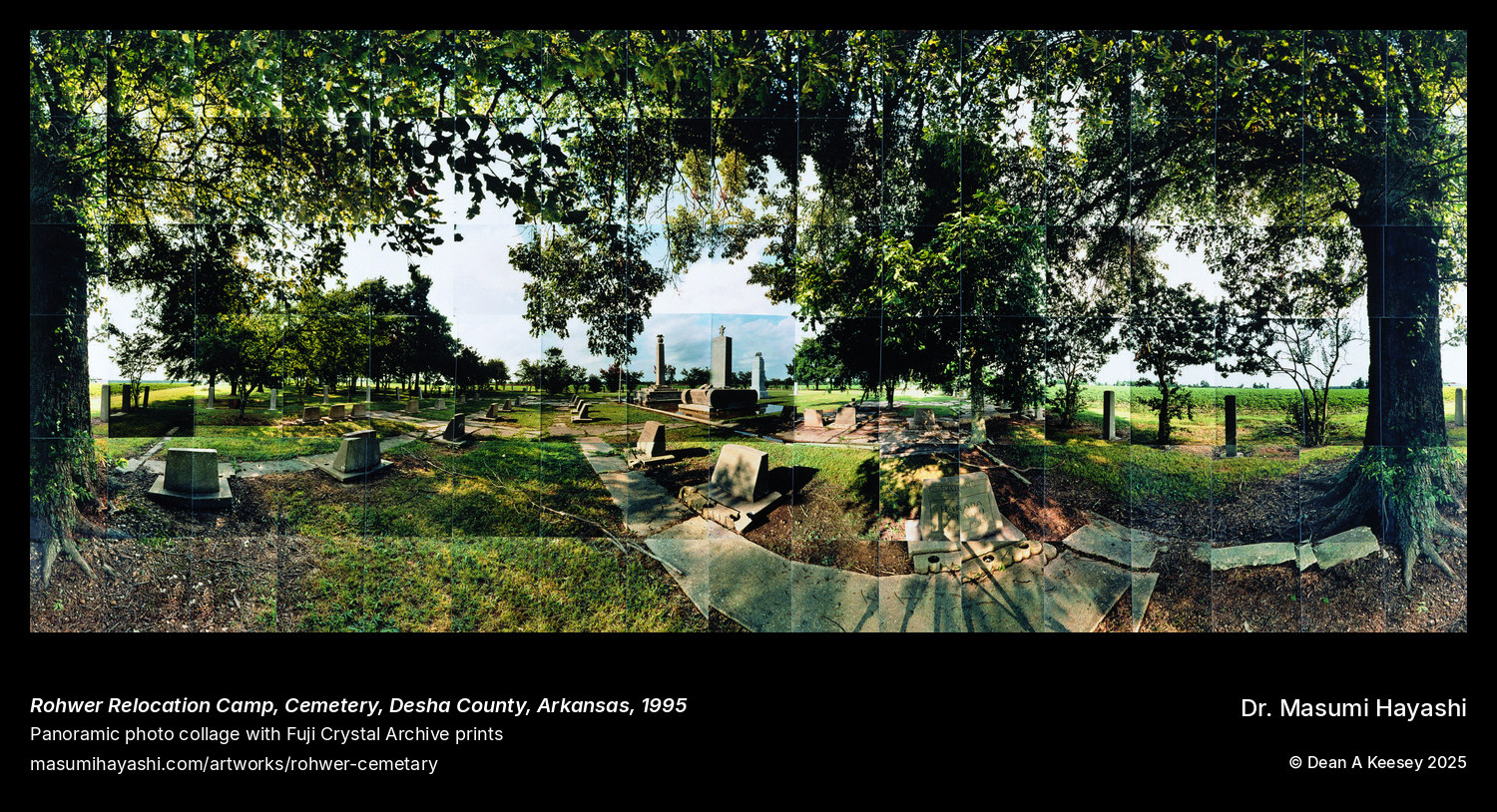
The Rohwer Cemetery is the most significant remaining element of the camp:
Location: Original cemetery site, now a National Historic Landmark
Grave Markers: 168 markers honoring:
- Internees who died during incarceration (from illness, accidents, natural causes)
- Military servicemen from Rohwer killed in combat
- Infants and elderly who died during confinement
Memorial Monument:
- Central monument with honor roll listing all servicemen
- Special recognition for those killed in action
- Dedication plaques and interpretive panels
Maintenance:
- Well-maintained by local community and preservation groups
- Annual ceremonies and pilgrimages
- Respectful visitation encouraged year-round
Significance
The cemetery provides tangible evidence of:
- Lives lost during incarceration
- Military sacrifice despite injustice
- Ongoing commitment to remembrance
- Community care for the site across generations
Closure and Aftermath
Camp Closing (November 1945)
As the war ended, Rohwer began closing operations:
- January 1945: West Coast exclusion orders rescinded; some begin returning home
- Spring-Summer 1945: Accelerated closing process
- November 30, 1945: Last internees depart; camp officially closes
Challenges of Release
Internees faced severe challenges upon release:
- Many had lost homes, businesses, and property during 3+ years of incarceration
- Anti-Japanese sentiment remained high, particularly on West Coast
- Limited resources for resettlement
- No government compensation for losses until 1988 Civil Liberties Act
- Some chose to settle in Arkansas or other interior states rather than face hostility
What Happened to the Site
After closure:
- Most buildings demolished or sold as surplus
- Some barracks moved to nearby communities and used as housing or storage
- Agricultural land returned to cultivation
- Cemetery preserved by local community
- Site largely forgotten except for cemetery
Present Day - Preservation and Interpretation
National Historic Landmark Status
In 1992, the Rohwer Relocation Center Cemetery was designated a National Historic Landmark, ensuring federal recognition and protection.
What Remains
Original Elements:
- Cemetery: 168 grave markers and memorial monument (best-preserved element)
- Concrete foundations: Scattered across former camp site
- Some sewer system remnants: Underground infrastructure
- Altered landscape: Former camp area now farmland
Reconstructed/Interpretive:
- Honor roll: Names of all military servicemen
- Interpretive markers: Throughout cemetery and site
- Museum exhibits: In nearby Rohwer Heritage Site Museum
Rohwer Heritage Site Museum
Opened in 2013 through Arkansas State University:
- Exhibits: Artifacts, photographs, personal items, documents
- Educational programs: School groups, researchers, public visitors
- Oral histories: Video testimonies from former internees
- Research resources: Archives and reference materials
- Community partnership: Collaboration with former internees and descendants
Preservation Efforts
- Arkansas State University: Ongoing research and interpretation project
- Community volunteers: Maintain cemetery and site
- Annual pilgrimage: Brings together former internees, descendants, and supporters
- Educational outreach: Programs for schools and public
Annual Pilgrimage
Held each April, the Rohwer Pilgrimage includes:
- Cemetery memorial service
- Educational programs and panel discussions
- Cultural performances and activities
- Recognition of military servicemen
- Intergenerational dialogue
Access and Visitation
- Cemetery: Open year-round during daylight hours
- Museum: Check website for current hours
- Self-guided tours: Brochures and interpretive markers available
- Group tours: Available by arrangement
- Respectful visitation: This is a site of trauma, death, and remembrance
Geographic and Historical Context
Arkansas’s Two Camps
Arkansas was unique in having two WRA camps (Rohwer and Jerome), both in the Mississippi Delta region. After Jerome closed in 1944, Rohwer became the sole Arkansas camp.
Mississippi River Delta
The Delta environment created unique challenges:
- Former cotton plantation land
- Flat, low-lying terrain prone to flooding
- Hot, humid climate
- Rich agricultural soil but challenging conditions
- Isolated from major population centers
Local Arkansas Communities
Relationships with nearby towns were complex:
- Some local residents opposed the camps
- Others saw economic opportunities in camp construction and operations
- Limited integration (some Japanese American students attended local schools)
- Post-war, some former internees settled in Arkansas
- Educational efforts in recent decades to preserve history
George Takei Connection
Actor and activist George Takei’s imprisonment at Rohwer (ages 5-8) has brought national attention to the site. His advocacy work and public speaking about his Rohwer experience have educated millions about the camps.
Significance in Masumi Hayashi’s Work
Masumi Hayashi, born in 1945 at Arizona’s Gila River concentration camp, photographed Rohwer as part of her comprehensive documentation of all ten War Relocation Authority sites.
Visual Documentation
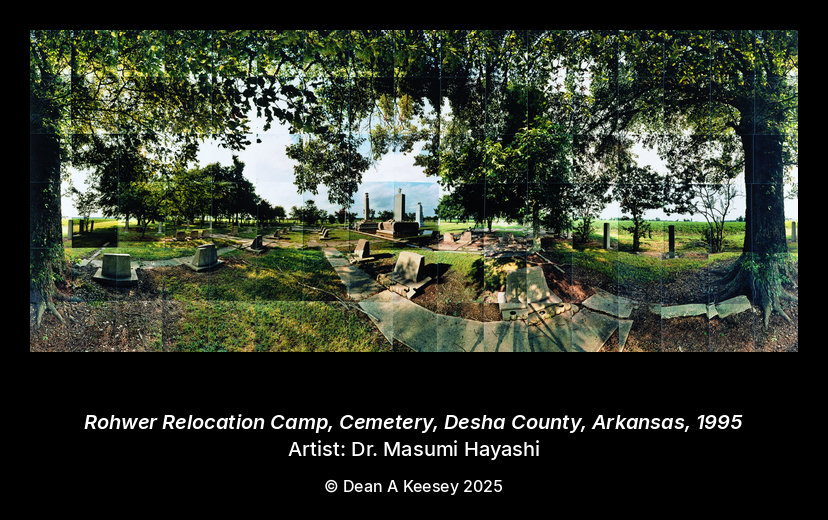
Her panoramic photo collages of Rohwer capture:
- Cemetery: The preserved grave markers and memorial
- Landscape: The Delta farmland where the camp once stood
- Absence: What is no longer visible but historically present
- Memory: Visual record ensuring the site is not forgotten
Artistic Approach
Hayashi’s work at Rohwer emphasizes:
- Preservation and erasure: The cemetery remains while the camp is gone
- Agricultural transformation: Cotton fields where barracks once stood
- Material traces: What little physical evidence remains
- Dignity: Honoring those buried in the cemetery
Panoramic Technique
Her distinctive panoramic format:
- Captures the flat Delta landscape
- Fragments and reassembles the view, mirroring fractured communities
- Emphasizes both the scale of the site and the intimacy of the cemetery
- Forces viewers to scan and engage actively with the space
Legacy Preservation
By photographing Rohwer and the other nine camps, Hayashi:
- Created essential visual archive before further deterioration
- Transformed abstract history into visceral, physical reality
- Honored those buried at Rohwer
- Ensured that even as physical evidence disappears, photographic record remains
Her work complements preservation efforts by Arkansas State University and community organizations, ensuring Rohwer’s history remains visible.
Educational Significance
Rohwer serves as a crucial educational site:
Best-Preserved Arkansas Camp
- Cemetery provides tangible connection to history
- Museum offers interpretation and education
- Accessible to visitors year-round
- Active research and preservation programs
George Takei’s Advocacy
- National visibility through Takei’s speaking and writing
- Reaches audiences who might not otherwise learn about camps
- Personal testimony brings history to life
- Ongoing educational impact
Constitutional Lessons
- Demonstrates fragility of rights during wartime
- Illustrates consequences of racism and fear
- Honors resilience and patriotism despite injustice
- Framework for discussing contemporary civil liberties
Military Service Record
- Over 2,000 volunteers from one camp
- Demonstrates loyalty despite profound injustice
- Honors sacrifice of those killed in combat
- Challenges assumptions about loyalty and citizenship
Arkansas Japanese American Memorial
The Arkansas Japanese American Memorial, located in McGehee, serves as a regional memorial for both Rohwer and Jerome camps. Features include:
- Educational panels and interpretive displays
- Recognition of all internees imprisoned in Arkansas
- Honoring military servicemen from both camps
- Acknowledgment of constitutional failures and injustice
This page honors all who were imprisoned at Rohwer, the approximately 40 servicemen from Rohwer who gave their lives in World War II, and the ongoing efforts to preserve this history and defend civil liberties for all Americans.
Gallery
External Resources
- Rohwer National Historic Landmark ↗
National Park Service information about the Rohwer Cemetery and memorial
- Rohwer Heritage Site and Museum ↗
Arkansas State University project preserving Rohwer history with museum and educational programs
- Densho Encyclopedia - Rohwer ↗
Comprehensive historical documentation and personal stories from Rohwer
- Butler Center for Arkansas Studies - Japanese American Internment ↗
Arkansas historical resources on both Jerome and Rohwer camps
Explore More
American Concentration Camps
Explore the full project: photography, oral histories, family albums, and historical context documenting the incarceration of 120,000 Japanese Americans.
View the Complete Project →Oral Histories
Listen to internees share their memories of evacuation, camp life, and resilience during this period.
Listen to Interviews →Family Album
View photographs taken by internees themselves, documenting daily life inside the camps.
View Family Stories →All Ten Camps
Learn about the other War Relocation Authority concentration camps across the Western United States.
Explore All Camps →Historical Context
Archives, educational materials, and recommended reading about the Japanese American incarceration.
View Resources →