Poston
Colorado River War Relocation Center
Location: Poston, Arizona
Operated: May 8, 1942 - November 28, 1945
Peak Population: 17,814
Poston Location & Map
Location: Colorado River Indian Reservation, La Paz County, Arizona Address: Approximately 12 miles south of Parker, Arizona Coordinates: 33.7947°N, 114.3283°W (Poston I approximate location) Elevation: Approximately 300 feet
Poston War Relocation Center encompassed three separate camps spread across 71,000 acres of desert land on the Colorado River Indian Reservation:
- Poston I (Main Camp): Northernmost camp, largest of the three
- Poston II: Located approximately 3 miles south of Poston I
- Poston III: Southernmost camp, approximately 6 miles south of Poston I
The camps were situated in the Colorado River valley, approximately 165 miles northwest of Phoenix and 12 miles south of the town of Parker.
Getting to Poston Memorial Site
Access: The former camp sites are located on sovereign Colorado River Indian Tribes (CRIT) lands. A memorial monument and historical markers are accessible to the public along Mohave Road.
Annual Pilgrimage: The Poston Community Alliance organizes an annual pilgrimage event, typically held in April, which includes visits to the memorial, educational programs, and cultural activities.
Visitor Information: Contact the Colorado River Indian Tribes or Poston Preservation Fund for current access policies and pilgrimage dates.
Historical Overview
Poston was the first War Relocation Authority camp to open, receiving its initial group of internees on May 8, 1942—just two months after President Franklin D. Roosevelt signed Executive Order 9066. Over the course of its operation from 1942 to 1945, Poston imprisoned over 17,000 Japanese Americans at its peak, making it the largest of the ten WRA camps.
The camp was officially named the “Colorado River War Relocation Center,” but became universally known as Poston after the local post office designation. The facility was one of only two WRA camps located on American Indian reservation lands (along with Gila River in Arizona), highlighting the intersection of federal control over indigenous territories and the mass incarceration of Japanese Americans.
Camp Layout and Architecture
Poston’s unique structure consisted of three geographically separate camps spread across a vast desert area:
Poston I (Main Camp)
- Capacity: Approximately 10,000 internees
- Blocks: 36 residential blocks
- Facilities: Central administration, main hospital, high school, warehouses
- Population source: Primarily from Southern California (Los Angeles, Orange, San Diego counties)
Poston II
- Capacity: Approximately 5,000 internees
- Blocks: 18 residential blocks
- Facilities: Elementary school, mess halls, community buildings
- Location: Approximately 3 miles south of Poston I
- Population source: Primarily from Central California
Poston III
- Capacity: Approximately 3,000 internees
- Blocks: 12 residential blocks
- Facilities: Elementary school, basic services
- Location: Approximately 6 miles south of Poston I
- Population source: Mixed origins, later arrivals
Each block in all three camps contained:
- 12-15 residential barracks (20 x 120 feet, divided into 4-6 rooms)
- 1 mess hall (dining facility)
- 1 recreation hall
- 1 latrine/washroom building (communal facilities)
- 1 laundry facility
The barracks were constructed of tar-paper covered wood frames with no insulation—wholly inadequate for the extreme desert climate. Internees called the structures “ovens” during summer months when interior temperatures could exceed 120°F.
Timeline of Key Events
- May 8, 1942: First internees arrive at Poston I
- July 1942: Poston II opens
- November 1942: Poston III opens
- November 14-24, 1942: Poston Strike—largest organized resistance in WRA camp history
- March 1943: Peak population of 17,814 reached, making Poston the third-largest city in Arizona
- January 1943: First military volunteers recruited for 442nd Regimental Combat Team
- 1943: Following loyalty questionnaire, several hundred internees transferred to Tule Lake
- 1944: Agricultural production peaks with thousands of acres under cultivation
- September 1945: Poston III closes
- November 28, 1945: Poston I and II close; last internees depart
The Poston Strike (November 1942)
The Poston Strike of November 1942 represented the largest organized resistance in any WRA camp and revealed deep tensions between camp administration, military police, and imprisoned communities.
Causes
On November 14, 1942, two internees were arrested and jailed in Parker, Arizona, accused of beating a man suspected of being an informer (inu) for the administration. The removal of internees from camp to outside authorities sparked outrage over:
- Lack of due process
- Fears of mob violence in Parker
- Broader frustrations with camp conditions, inadequate medical care, and food shortages
- Resentment of informants reporting on fellow internees
The Strike Action
- Participants: Thousands of internees, primarily at Poston I
- Duration: November 14-24, 1942 (10 days)
- Form: Work stoppage, mass meetings, negotiations
- Demands: Return of arrested men to camp jurisdiction, improvement of camp conditions, investigation of informants
Resolution
The strike ended after intense negotiations:
- A committee of internees investigated the beating incident
- The two arrested men were returned to camp
- Some improvements to camp conditions were promised
- Tensions remained, but overt resistance subsided
The Poston Strike demonstrated that even in conditions of complete confinement, Japanese Americans refused to accept injustice passively. It also highlighted the impossible position of camp administrators trying to maintain control over a fundamentally unjust system.
Daily Life and Community
Despite imprisonment in one of the most extreme desert environments in North America, Poston’s internees built functioning communities across all three camps:
Education
- Elementary schools in all three camps
- Poston High School (at Poston I)—one of the largest high schools in Arizona by 1943
- Adult education programs
- Vocational training
- Art and music programs
Agricultural Production
Poston became one of the most agriculturally productive WRA camps:
- Thousands of acres cultivated by internee labor
- Produced vegetables, melons, cotton, and other crops
- Supplied food to the camp and other WRA facilities
- Employed advanced irrigation techniques despite harsh conditions
- Hog and cattle raising operations
Cultural and Community Life
- Newspapers: “Poston Chronicle” and “Poston Press Bulletin”
- Religious services: Buddhist and Christian congregations
- Sports leagues: Baseball, basketball, football, sumo wrestling
- Art programs: Drawing, painting, crafts, woodworking
- Theater and music: Drama groups, bands, traditional Japanese performances
- Community organizations: Women’s clubs, youth groups, veterans’ associations
Work and Economy
By 1943, thousands of internees worked in various capacities:
- Camp administration and services (approximately $16-19 monthly)
- Agricultural production ($12-16 monthly for field work)
- Skilled positions: carpenters, mechanics, medical staff
- Teaching and social services
- Camouflage net production for military
The wages were far below civilian standards, with professional positions paying less than unskilled labor in the outside economy.
Notable Internees and Contributions
Military Service
Despite imprisonment, over 600 men from Poston volunteered for military service, primarily in the 442nd Regimental Combat Team and Military Intelligence Service. The 442nd became the most decorated unit of its size in U.S. military history.
Cultural Figures
Poston imprisoned numerous individuals who would later achieve prominence:
- Artists and writers who documented camp life
- Community leaders who fought for redress and reparations in later decades
- Educators who preserved Japanese American culture and history
Community Builders
- Block managers and councils who worked to improve living conditions
- Teachers who maintained educational quality despite inadequate resources
- Medical staff who provided care in understaffed facilities
- Agricultural experts who transformed desert into productive farmland
Climate and Environmental Hardships
Poston’s location in the Sonoran Desert created extreme environmental hardships that made it one of the harshest camp sites:
Extreme Heat
- Summer temperatures: Regularly exceeded 115°F
- Record high: Approximately 125°F
- Nighttime: Often remained above 90°F, making sleep difficult
- Barracks: Tar-paper structures became ovens, with interior temperatures exceeding 120°F
- Adaptations: Internees slept outside, built evaporative coolers, dug below-ground sleeping areas
Desert Conditions
- Minimal rainfall: 3-4 inches annually
- Dust storms: Frequent, covering everything in fine sand
- Harsh sun: Intense UV exposure with minimal shade
- Wildlife: Scorpions, rattlesnakes, Gila monsters, tarantulas
- Sparse vegetation: Primarily creosote bush and mesquite
- Water challenges: Despite proximity to Colorado River, water was rationed
Health Impacts
The extreme climate caused:
- Heat exhaustion and heat stroke
- Respiratory problems from dust
- Skin conditions from sun exposure
- Dehydration
- Difficulty for elderly and very young
The environmental extremes were not accidental—they served to isolate internees and make escape attempts dangerous or fatal.
Resistance and Loyalty Crisis
The Loyalty Questionnaire (1943)
The controversial loyalty questionnaire administered in early 1943 created profound divisions within Poston:
Questions 27 and 28 forced impossible choices:
- Question 27: Willingness to serve in the U.S. armed forces
- Question 28: Willingness to forswear allegiance to Japan
For Issei (first generation, ineligible for U.S. citizenship due to racist laws), Question 28 demanded they renounce Japanese citizenship without ability to become American citizens—rendering them stateless.
Results at Poston:
- Intense family conflicts over how to answer
- Several hundred internees classified as “disloyal” and transferred to Tule Lake Segregation Center
- Some families relocated together to Tule Lake to avoid separation
- Deep resentment of the questionnaire’s presumption of disloyalty
Other Forms of Resistance
- Work slowdowns and strikes
- Refusal to cooperate with certain administrative demands
- Cultural preservation as resistance (language schools, Buddhist services)
- Documentation through art, writing, and photography
- Legal challenges (though limited by confinement)
Present Day - Memorial and Preservation
Site Status Today
Following the camp’s closure in November 1945, the War Relocation Authority removed valuable infrastructure, leaving primarily concrete foundations, portions of the sewer system, and scattered debris. Today:
- Land ownership: Remains within sovereign Colorado River Indian Tribes territory
- Access: Controlled by CRIT; memorial sites accessible with permission
- Physical remains: Concrete foundations, sewer remnants, scattered artifacts
- Natural reclamation: Desert vegetation has reclaimed much of the developed area
Poston Memorial Monument
A memorial monument stands at the former Poston I site, honoring:
- All Japanese Americans imprisoned at Poston
- Military servicemen from Poston who fought in WWII
- The resilience and dignity maintained despite injustice
The monument was dedicated through community efforts and serves as a focal point for annual pilgrimages.
Preservation Efforts
- Poston Preservation Fund: Non-profit organization dedicated to preserving history and supporting education
- Annual Pilgrimage: Held each April, bringing together former internees, descendants, and supporters
- Educational programs: Partnerships with schools and museums
- Documentation projects: Oral histories, archival research, archaeological surveys
- Advocacy: Efforts to secure National Historic Site designation
Archaeological Protection
Portions of the site have been surveyed and documented by archaeologists:
- Foundation remnants mapped
- Artifact collections for educational purposes
- Protection of cemetery and memorial areas
- Ongoing research into daily life material culture
Geographic and Historical Context
Location on Indigenous Land
Poston’s location on the Colorado River Indian Reservation represents the intersection of two histories of displacement and confinement:
- CRIT: Established in 1865, consolidating Mohave and Chemehuevi peoples (later Hopi and Navajo)
- Japanese Americans: Forcibly removed from West Coast homes, imprisoned on tribal lands
The federal government leased 71,000 acres from CRIT, promising agricultural development and compensation. After the war, promised improvements were not fully delivered, and CRIT received minimal lasting benefit from the camp infrastructure.
Arizona’s Two Reservation Camps
Both Arizona camps (Poston and Gila River) were located on American Indian reservations, making them unique among the ten WRA sites. This choice reflected:
- Federal control over reservation lands
- Availability of large, isolated areas
- Reduced political opposition from white landowners
- Exploitation of already marginalized communities
Agricultural Transformation
Despite the harsh desert environment, Poston became one of the WRA system’s major agricultural producers:
- Thousands of acres brought under cultivation
- Advanced irrigation systems developed
- Crops including vegetables, melons, cotton, alfalfa
- Livestock operations
This transformation demonstrated what could have been achieved for CRIT with proper investment—making the government’s post-war neglect of promised development even more egregious.
Significance in Masumi Hayashi’s Work
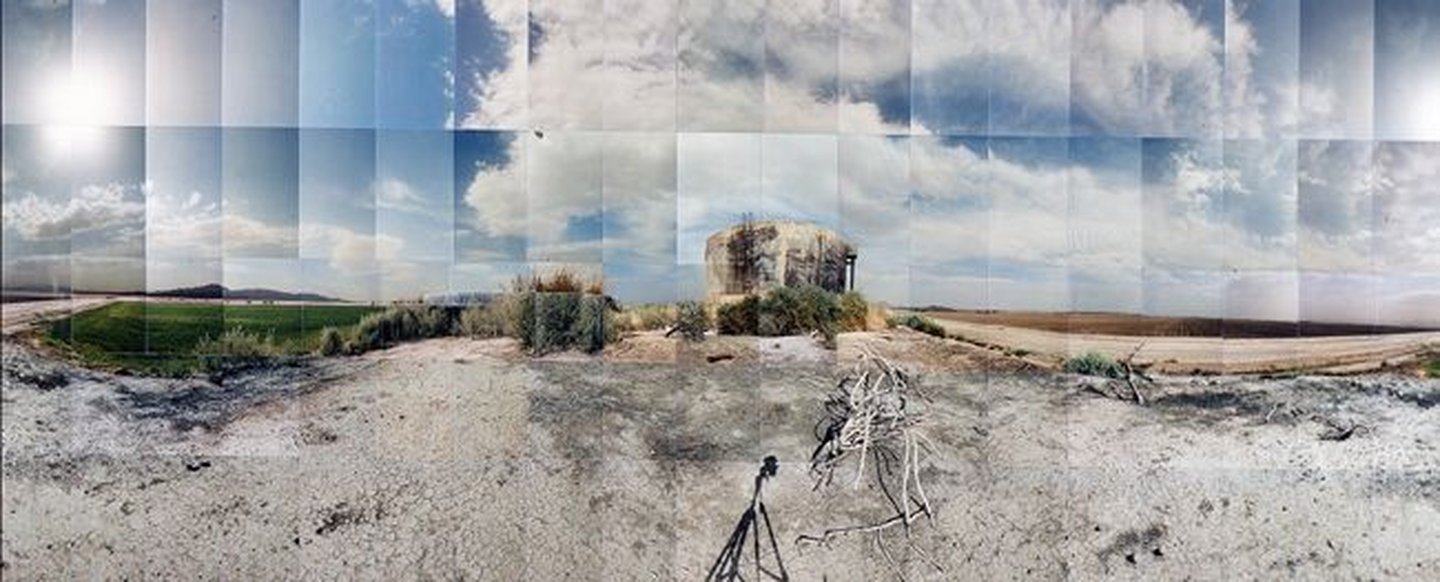
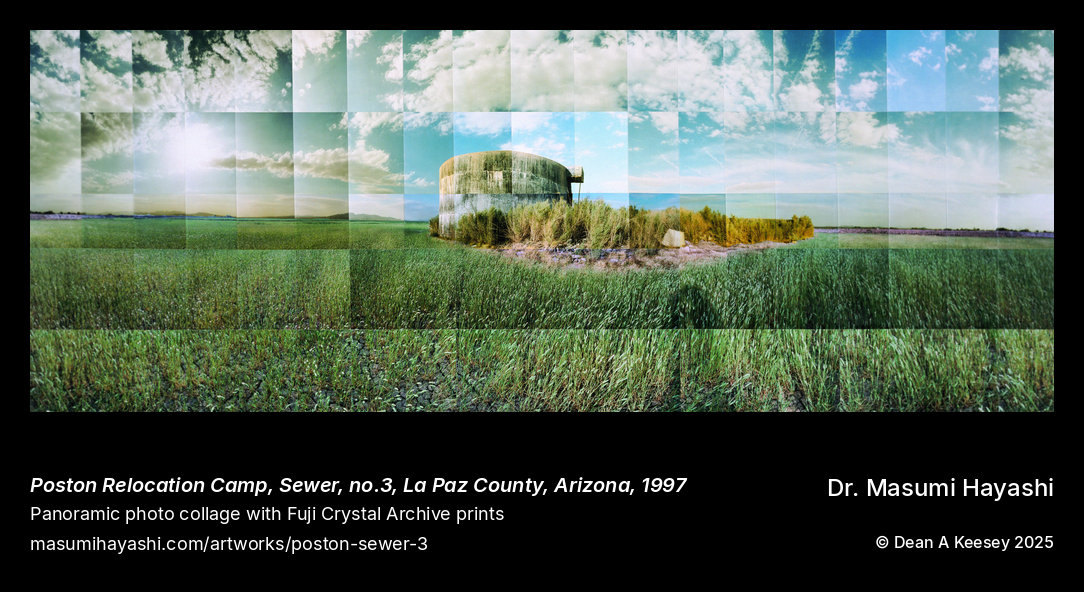
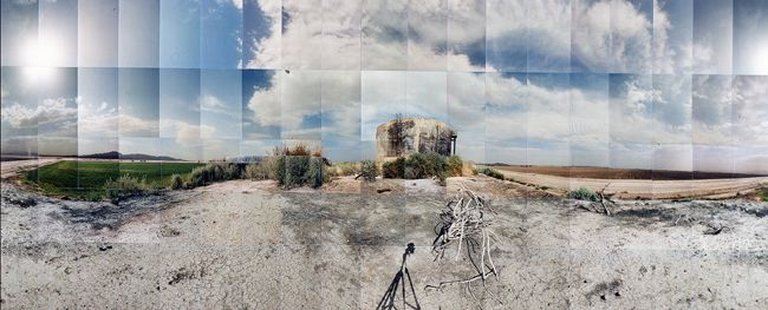
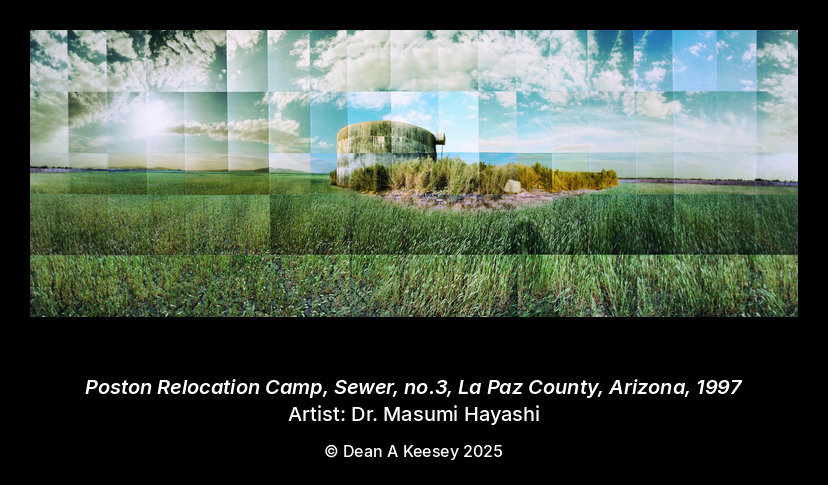
Masumi Hayashi, born in 1945 at Gila River (Arizona’s other reservation camp), photographed Poston as part of her comprehensive documentation of all ten War Relocation Authority sites. Her panoramic photo collages of Poston capture:
Visual Documentation
- Sewer systems: Concrete remnants of infrastructure left behind
- Foundations: Traces of barracks where 17,814 people once lived
- Desert landscape: The harsh environment that made Poston one of the most difficult camps
- Memorial sites: Monuments honoring those imprisoned and those who served
Artistic Approach
Hayashi’s panoramic format reflects:
- The vast scale of Poston (largest camp, three separate sites)
- The expansive desert landscape
- The fragmentation of communities and families
- The contrast between human construction and natural reclamation
Her work transforms these sites from historical abstractions into visceral physical spaces, forcing viewers to confront the material reality of mass incarceration.
Legacy and Memory
By photographing Poston and the other nine camps, Hayashi created an essential visual archive ensuring these sites cannot be forgotten. Her work insists that we remember:
- Over 17,000 people imprisoned at Poston alone
- The environmental extremes they endured
- The community they built despite injustice
- The physical traces that remain in the desert
Even as time and nature erase the physical evidence, Hayashi’s photographs preserve the memory of what happened at Poston.
This page honors all who were imprisoned at Poston, the Colorado River Indian Tribes whose land was used for incarceration, and the ongoing efforts to preserve this history and ensure such injustice never happens again.
Gallery
External Resources
- Poston Memorial Monument ↗
Preservation efforts and annual memorial events
- Colorado River Indian Tribes ↗
Information about the tribal community that maintains the former camp sites
- National Archives - Poston Records ↗
Official government records and documentation
Explore More
American Concentration Camps
Explore the full project: photography, oral histories, family albums, and historical context documenting the incarceration of 120,000 Japanese Americans.
View the Complete Project →Oral Histories
Listen to internees share their memories of evacuation, camp life, and resilience during this period.
Listen to Interviews →Family Album
View photographs taken by internees themselves, documenting daily life inside the camps.
View Family Stories →All Ten Camps
Learn about the other War Relocation Authority concentration camps across the Western United States.
Explore All Camps →Historical Context
Archives, educational materials, and recommended reading about the Japanese American incarceration.
View Resources →