Jerome
Jerome War Relocation Center
Location: Jerome, Arkansas
Operated: October 6, 1942 - June 30, 1944
Peak Population: 8,497
Jerome Location & Map
Location: Mississippi River Delta, southeastern Arkansas Address: Former site near Jerome and Dermott, Arkansas (unincorporated areas) Coordinates: 33.6850°N, 91.4450°W (approximate center) Elevation: Approximately 130 feet
Jerome War Relocation Center was located in the swampy lowlands of southeastern Arkansas:
- 15 miles southeast of McGehee, Arkansas
- Near the small communities of Jerome and Dermott
- In Chicot and Drew Counties
- Approximately 115 miles southeast of Little Rock
- 30 miles from Rohwer WRA camp
- Deep in the Mississippi River Delta region
Getting to Jerome Historical Site
Access Challenges: Unlike many other WRA camp sites, Jerome has minimal preserved structures or formal interpretation. The site is now:
- Privately owned farmland
- No public access facilities or visitor center
- Historical markers in nearby communities
- Difficult to locate without specific knowledge
Historical Markers:
- Arkansas Japanese American Memorial in McGehee
- Historical markers in Jerome and Dermott
- Interpretive signs along highways
Visiting Rohwer: For a more accessible experience of Arkansas camps, visit Rohwer Relocation Center Memorial (30 miles away), which has preserved elements and better public access.
Historical Overview
Jerome War Relocation Center opened on October 6, 1942, when the first group of Japanese Americans arrived from California. The camp was built hastily on swampy, undeveloped land in the Mississippi River Delta—some of the least hospitable terrain chosen for any WRA camp.
Jerome was unique among the ten camps for several reasons:
- Shortest operation period: Closed after only 21 months (October 1942 - June 1944)
- Swampland location: Built on malarial swamps creating severe health problems
- Early closure: Health and maintenance issues led to closure and transfer to Rohwer
- Complete demolition: Virtually nothing remains of the original site today
At its peak in February 1943, Jerome held 8,497 people. The camp imprisoned primarily Japanese Americans from California (particularly the Los Angeles area and Central Valley) and approximately 2,000 from Hawaii.
Camp Layout and Architecture
Jerome followed the standard WRA camp design, adapted poorly to swampy conditions:
Residential Area
The main camp consisted of:
- 36 residential blocks arranged in rows
- 504 barrack buildings total
- Central facilities: Administration, hospital, warehouses, staff housing
- Perimeter security: Guard towers, barbed wire fencing, military police compound
Block Structure
Each of the 36 residential blocks typically contained:
- 14 residential barracks (20 x 120 feet, divided into 4-6 rooms per barrack)
- 1 mess hall (dining facility)
- 1 recreation hall (community building)
- 1 latrine/washroom building (communal toilets, sinks, and showers)
- 1 laundry building (communal washing facilities)
Construction Issues
Jerome’s construction was particularly problematic:
- Swampy ground: Buildings sank and shifted in the soft, wet soil
- Poor drainage: Standing water surrounded barracks
- Inadequate foundations: Wood in contact with wet ground rotted quickly
- Green lumber: Warped and shrunk, creating gaps
- Tar paper: Deteriorated rapidly in humid conditions
- No insulation: Single-wall construction
Internees described walking on wooden planks between buildings to avoid deep mud. During rainy periods (frequent in Arkansas), the camp became a quagmire.
Additional Facilities
- Hospital: Constantly treating malaria, dysentery, and other diseases
- Schools: Elementary and high school (despite difficulties)
- Fire station: Essential due to fire risk from wooden structures
- Agricultural areas: Attempted cultivation of surrounding land
- Warehouses and motor pool: Struggled with mud and flooding
Timeline of Key Events
- October 6, 1942: First internees arrive at Jerome from California
- Late 1942: Camp fills rapidly; construction incomplete when internees arrive
- February 1943: Peak population of 8,497 reached
- Winter 1942-43: Severe health problems from malaria and other diseases
- 1943: Loyalty questionnaire administered; some classified as “disloyal” transferred to Tule Lake
- 1943: Agricultural production attempted despite swampy conditions
- Spring 1944: Decision made to close Jerome due to health and maintenance problems
- June 30, 1944: Jerome officially closes; all internees transferred to Rohwer (30 miles away)
- Post-closure: Buildings demolished or sold; site returned to private ownership
- Present: Virtually no structures remain; site is private farmland
Daily Life in the Swamps
Life at Jerome was particularly difficult due to environmental conditions:
Health Challenges
Jerome had the worst health conditions of any WRA camp:
- Malaria: Endemic in the swamps; internees contracted malaria at high rates
- Mosquitoes: Constant plague; DDT spraying attempted with limited success
- Dysentery: From poor water quality and sanitation
- Respiratory illnesses: From mold, humidity, and poor ventilation
- Skin conditions: From constant moisture and insect bites
- Hospital overcrowded: Treating preventable diseases
- Limited medical supplies: Chronic shortages
The health crisis was a primary factor in the decision to close Jerome early.
Environmental Hardships
- Mud: Constant, deep mud making walking difficult
- Flooding: Frequent; water surrounded and sometimes entered barracks
- Humidity: Oppressive; mold and mildew pervasive
- Snakes: Cottonmouths, copperheads, and rattlesnakes common
- Alligators: Present in surrounding swamps
- Insects: Mosquitoes, chiggers, ticks, flies
- Heat: Summer heat and humidity combination was brutal
Attempted Community Building
Despite these conditions, internees tried to establish normal life:
Education:
- Elementary schools operated
- High school classes held
- Teachers struggled with inadequate facilities
- Students persevered despite difficulties
Cultural Activities:
- Jerome Community News (camp newspaper)
- Buddhist and Christian religious services
- Traditional Japanese arts and crafts
- Theater and music programs
- Sports leagues (baseball fields became mud pits in rain)
Work:
- Camp services (mess halls, hospitals, schools)
- Agricultural attempts (largely unsuccessful due to swamps)
- Maintenance work (constant battle against mud, rot, and flooding)
- Wages: $12-19 per month
Community Organizations:
- Women’s clubs
- Youth groups
- Religious congregations
- Block councils
Food and Mess Halls
- Poor quality food common
- Difficulty keeping food fresh in humidity
- Frequent shortages
- Long lines in mud to reach mess halls
- Meals served on metal trays
- No privacy or family dining
Notable Aspects of Jerome
Hawaiian Internees
Approximately 2,000 of Jerome’s internees came from Hawaii, making it one of two mainland camps with significant Hawaiian populations (along with Rohwer). Hawaiian internees faced particular hardships:
- Far from home (over 3,000 miles)
- Separated from families
- Unaccustomed to continental climate extremes
- Different cultural backgrounds from mainland Japanese Americans
Military Service
Despite the harsh conditions and injustice, many Jerome internees volunteered for military service:
- 442nd Regimental Combat Team
- Military Intelligence Service
- Demonstrated loyalty while families remained in swamps
Loyalty Questionnaire Crisis (1943)
The February 1943 loyalty questionnaire created divisions at Jerome:
- Families torn apart by conflicting responses
- Some answered “no-no” in protest
- Those deemed “disloyal” transferred to Tule Lake
- Questions 27 and 28 forced impossible choices
- Deep resentment and trauma
Art and Documentation
Despite difficulties, some internees documented Jerome through:
- Art and drawings
- Photography (when cameras were allowed)
- Diaries and letters
- Newspaper articles
- Poetry and writing
These materials, now in archives, provide crucial documentation of conditions at Jerome.
Why Jerome Closed Early
Jerome was the only WRA camp to close before the end of the war (June 1944, while the war continued until August 1945). Multiple factors contributed:
Health Crisis
- Malaria epidemic impossible to control
- Hospital overwhelmed
- Cost of medical care escalating
- Long-term health damage to internees
- Negative publicity about conditions
Maintenance Problems
- Buildings sinking and rotting in swampy ground
- Constant flooding requiring drainage efforts
- Deteriorating infrastructure difficult and expensive to maintain
- Fire hazards from deteriorating electrical systems
Availability of Rohwer
- Rohwer (30 miles away) had lower population
- Could absorb Jerome’s population
- Slightly better conditions at Rohwer
- More economical to consolidate operations
WRA Economics
- Operating two camps in Arkansas was expensive
- Consolidating to Rohwer saved money
- Jerome’s infrastructure was failing and would require major investment
- Easier to abandon Jerome than fix it
Transfer to Rohwer (June 1944)
In June 1944, all remaining Jerome internees were transferred to Rohwer:
- Forced to move again after establishing community
- Thirty-mile transfer to another Arkansas camp
- Families relocated with their belongings
- Some improvements at Rohwer (slightly better drainage)
- But still imprisoned in Arkansas swampland
The forced relocation from Jerome to Rohwer added another layer of trauma—being uprooted again after already being forcibly removed from their homes on the West Coast.
Closure and Complete Demolition
After the June 1944 closure:
Immediate Post-Closure
- Buildings were demolished or sold as surplus
- Some materials salvaged and used elsewhere
- Site returned to private ownership
- Virtually complete removal of all structures
What Remains Today
Unlike other WRA camps, Jerome has minimal physical evidence:
- Almost no structures: Complete demolition
- Some concrete foundations: Buried or overgrown
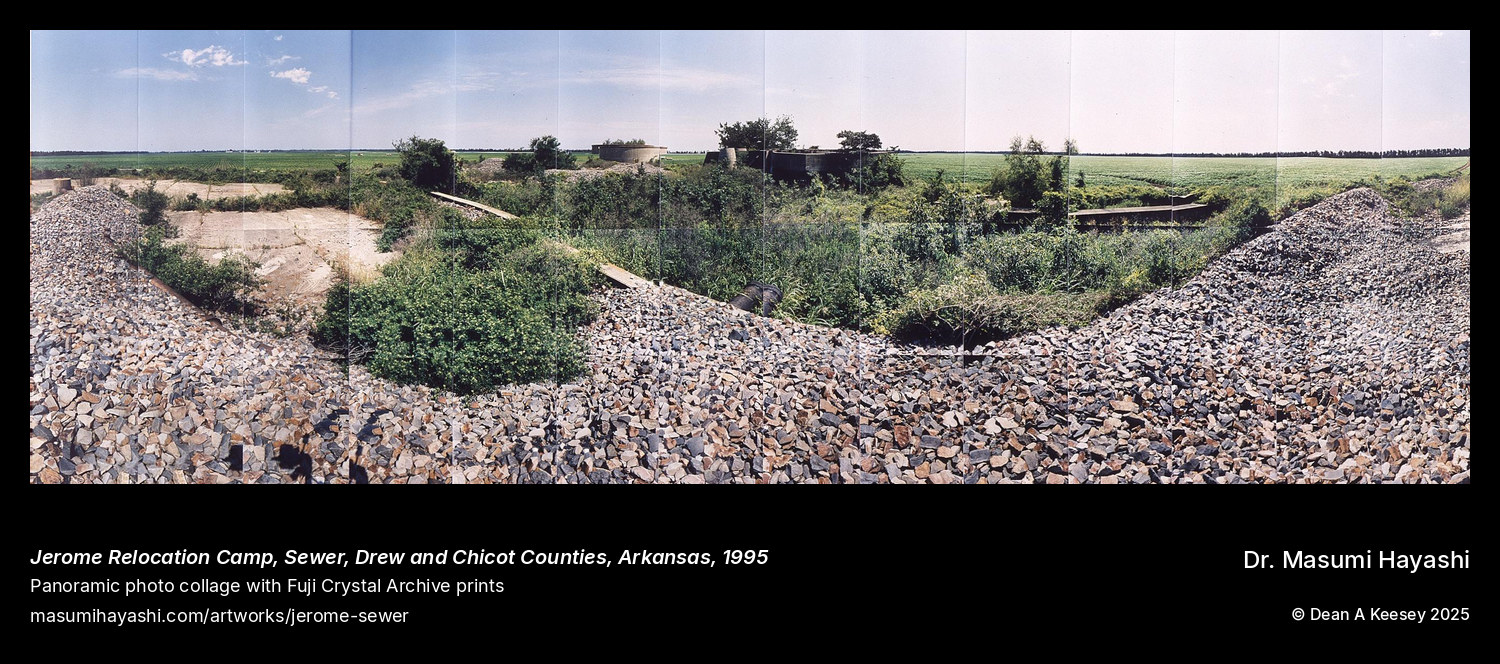
- Portions of sewer system: Underground remnants
- Altered landscape: Drainage and agricultural development changed the terrain
- Private farmland: Site is not publicly accessible
- Historical markers: In nearby communities, not at the site itself
Challenges for Preservation
- Private ownership makes access difficult
- Swampy conditions continue to degrade any remaining materials
- Limited public awareness of Jerome compared to other camps
- No organized preservation society specifically for Jerome
- Overshadowed by Rohwer (which has better preservation)
Present Day - Limited Preservation
No National Historic Site Status
Unlike several other camps, Jerome does not have National Historic Site designation. Reasons include:
- Minimal physical remains
- Private land ownership
- Lack of local infrastructure for interpretation
- Focus on Rohwer for Arkansas camp interpretation
Historical Markers and Memorials
- Arkansas Japanese American Memorial: Located in McGehee (near both Jerome and Rohwer)
- Historical markers: In Jerome and Dermott communities
- Educational efforts: By Butler Center for Arkansas Studies and other organizations
Rohwer as Interpretive Site
Most interpretation of Arkansas camps focuses on Rohwer, which has:
- Better preserved elements
- Cemetery with monuments
- Ongoing preservation efforts
- More accessible location
Visitors interested in Arkansas camps are typically directed to Rohwer rather than Jerome.
Archival Documentation
The primary preservation of Jerome’s history is through archives:
- National Archives records
- WRA photographs and documents
- Personal papers and diaries of internees
- Oral histories collected by Densho and other organizations
- Camp newspapers (digitized)
- Art and drawings created by internees
Geographic and Historical Context
Arkansas and the Two Camps
Arkansas was unique in having two WRA camps (Jerome and Rohwer), both in the same region of southeastern Arkansas. Reasons included:
- Availability of undeveloped land
- Federal government control or easy acquisition
- Distance from strategic areas
- Political willingness of Arkansas officials
Mississippi River Delta
The Delta environment created unique challenges:
- Flat, low-lying land prone to flooding
- Hot, humid climate
- Malarial swamps
- Rich agricultural soil (when drained) but challenging to work
- Isolated from major population centers
Local Arkansas Communities
Relationships with nearby towns were complex:
- Some local residents opposed the camps
- Others saw economic opportunities
- School integration attempted (Japanese American students attending local schools) with mixed results
- Some lingering memories and relationships between former internees and local communities
Post-War Legacy in Arkansas
- Some former internees returned to Arkansas after the war
- Small Japanese American community established
- Educational efforts to preserve history
- Recognition of injustice by state officials in recent decades
Significance in Masumi Hayashi’s Work
Masumi Hayashi, born in 1945 at Arizona’s Gila River concentration camp, photographed Jerome as part of her comprehensive documentation of all ten War Relocation Authority sites.
Challenge of Photographing Jerome
Jerome presented unique challenges for Hayashi:
- Minimal physical remains to photograph
- Private farmland with limited access
- Landscape altered by agriculture and development
- Evidence of the camp nearly erased
What She Captured
Despite these challenges, Hayashi’s photographs of Jerome document:
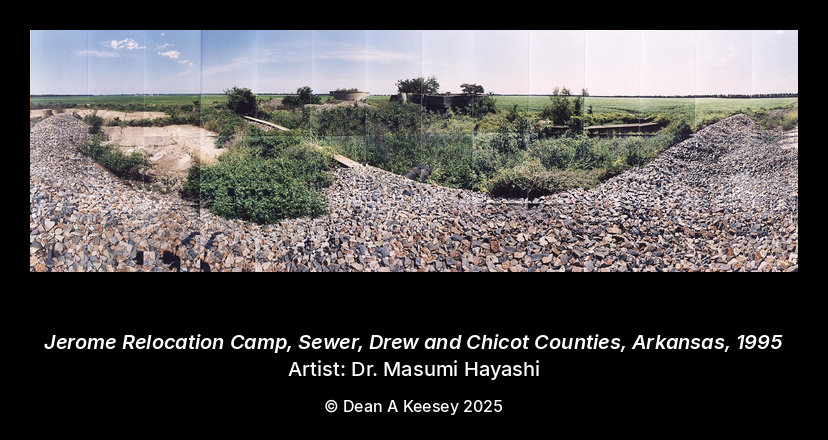
- Sewer remnants: Underground infrastructure that survived
- Altered landscape: The swampy terrain now converted to farmland
- Absence: The almost complete erasure of the camp
- Memory: Preserving visual record of a site nearly forgotten
Artistic Significance
Hayashi’s Jerome photographs are particularly important because:
- They may be the only artistic documentation of the site’s current state
- They preserve evidence of a camp nearly erased from the landscape
- They demonstrate the varying degrees of preservation across the ten camps
- They insist that Jerome not be forgotten, despite its physical absence
Panoramic Technique at Jerome
Her distinctive panoramic approach at Jerome emphasizes:
- Absence and erasure: What is no longer there
- Altered landscape: The transformation from camp to farmland
- Memory work: Reconstructing what existed through fragments
- Historical accountability: Refusing to let complete erasure equal complete forgetting
Educational Significance
Despite minimal physical remains, Jerome’s history offers important lessons:
Health and Environmental Justice
- Government chose unsuitable site despite known health risks
- Internees subjected to preventable diseases
- Health impacts lasted long after release
- Environmental racism in site selection
Erasure and Memory
- Physical erasure of the camp doesn’t erase the history
- Importance of documentation, oral histories, and archives
- Danger of forgetting the camps with fewer physical remains
- Need for multiple forms of preservation (not just physical sites)
Shortest-Lived Camp
- Even the “temporary” camps like Jerome lasted nearly two years
- Forced relocation from Jerome to Rohwer added trauma
- Demonstrates the chaotic and unjust nature of the entire system
Comparative Study
- Comparing Jerome (worst health conditions) to other camps
- Understanding site selection criteria and their impacts
- Learning from the range of experiences across ten camps
Arkansas Japanese American Memorial
The Arkansas Japanese American Memorial, located in McGehee, serves as a regional memorial for both Jerome and Rohwer camps. The memorial includes:
- Educational panels and interpretive displays
- Recognition of all internees
- Honoring military servicemen from both camps
- Acknowledgment of the injustice
The memorial helps ensure that even though Jerome has been physically erased, its history is not forgotten.
This page honors all who were imprisoned at Jerome, particularly those who suffered from the severe health conditions created by the swampland location, and ensures that this chapter of history is remembered despite the near-complete physical erasure of the camp.
Gallery
External Resources
- Densho Encyclopedia - Jerome ↗
Comprehensive historical documentation and personal stories from Jerome
- Butler Center for Arkansas Studies - Japanese American Internment ↗
Arkansas historical resources on both Jerome and Rohwer camps
- National Archives - Jerome Records ↗
Official government records and documentation
Explore More
American Concentration Camps
Explore the full project: photography, oral histories, family albums, and historical context documenting the incarceration of 120,000 Japanese Americans.
View the Complete Project →Oral Histories
Listen to internees share their memories of evacuation, camp life, and resilience during this period.
Listen to Interviews →Family Album
View photographs taken by internees themselves, documenting daily life inside the camps.
View Family Stories →All Ten Camps
Learn about the other War Relocation Authority concentration camps across the Western United States.
Explore All Camps →Historical Context
Archives, educational materials, and recommended reading about the Japanese American incarceration.
View Resources →