Granada (Amache)
Granada War Relocation Center
Location: Granada, Colorado
Operated: August 27, 1942 - October 15, 1945
Peak Population: 7,318
Granada (Amache) Location & Map
Location: Southeastern Colorado, Prowers County Address: County Road 23.5, approximately 1 mile west of Granada, CO 81041 Coordinates: 38.0464°N, 102.3086°W Elevation: Approximately 3,500 feet
Granada War Relocation Center, known as Amache, is located on the high plains of southeastern Colorado:
- Approximately 1 mile west of Granada, Colorado
- 16 miles east of Lamar, Colorado
- 120 miles east of Pueblo
- 175 miles southeast of Denver
- 17 miles north of the Oklahoma border
- 22 miles west of the Kansas border
Getting to Amache National Historic Site
By Car: From U.S. Highway 50, turn south at Granada onto Highway 385, then west on County Road 23.5 (Main Street). The site entrance is approximately 1 mile west of town.
Visitor Access: As of 2022, Amache is a National Historic Site managed by the National Park Service. The site is open to visitors year-round during daylight hours.
Facilities:
- Self-guided walking tour with interpretive markers
- Restored barracks and other structures
- Cemetery with monument
- Museum in Granada (seasonal hours)
Events: Annual Amache Pilgrimage held in May, featuring educational programs, cultural activities, and memorial services.
Historical Overview
Granada War Relocation Center—known to internees and history as Amache—opened on August 27, 1942, when the first group of Japanese Americans arrived from California. Named after Amache Ochinee Prowers, a Cheyenne woman who married rancher John Wesley Prowers in the 1860s, the camp imprisoned over 7,000 Japanese Americans at its peak.
The camp was located on 10,500 acres of high plains rangeland leased from private landowners and the Granada Relocation District. The developed area covered approximately 640 acres (one square mile), with guard towers, barbed wire fencing, and military police controlling all movement in and out.
Amache was the only WRA camp in Colorado and became the tenth-largest city in the state during its operation, demonstrating the massive scale of the forced removal and incarceration program.
Camp Layout and Architecture
Granada/Amache was organized in a standard War Relocation Authority layout:
Residential Area
The main camp consisted of:
- 29 residential blocks arranged in a grid pattern
- 504 barracks buildings total
- Central facilities: administration building, warehouses, staff housing
- Perimeter security: 8 guard towers, barbed wire fencing, military police station
Block Structure
Each of the 29 residential blocks typically contained:
- 12 residential barracks (20 x 120 feet, divided into 6 rooms per barrack)
- 1 mess hall (dining facility)
- 1 recreation hall (community building)
- 1 latrine/washroom building (communal toilets and showers)
- 1 laundry building (communal washing facilities)
Construction
Barracks were constructed of:
- Wooden frames covered with tar paper
- Single-wall construction with no insulation
- Pot-bellied coal stoves for heating (inadequate for Colorado winters)
- No running water in residential barracks
- Small windows providing minimal light and ventilation
Families of varying sizes were assigned to single rooms (12 x 20 feet to 20 x 24 feet), with no privacy and minimal furniture beyond army cots and a light bulb.
Additional Facilities
- Hospital complex: 150-bed facility with operating room and dental clinic
- Schools: Elementary school and Granada-Amache High School
- Silk-screen shop: For educational posters and materials
- Agricultural areas: Surrounding the main camp, worked by internee labor
- Cemetery: Dedicated burial ground (still maintained today)
Timeline of Key Events
- August 27, 1942: First internees arrive at Amache from Merced Assembly Center
- September-October 1942: Majority of population arrives, primarily from California
- February 1943: Peak population of 7,318 reached, making Amache Colorado’s 10th-largest city
- January 1943: First military volunteers recruited for 442nd Regimental Combat Team
- 1943: Loyalty questionnaire administered, causing family conflicts and divisions
- 1943-1944: Over 900 internees volunteer for U.S. military service
- 1944: Agricultural production peaks; silk-screen shop produces thousands of educational posters
- September 1945: Camp begins closing operations
- October 15, 1945: Last internees leave Amache; camp officially closes
- 2006: Amache designated a National Historic Landmark
- March 18, 2022: Amache becomes a National Historic Site (first NPS site in Colorado focusing on WWII Japanese American incarceration)
Daily Life and Community
Despite imprisonment on the Colorado high plains, Amache’s internees established a vibrant community:
Education
- Granada-Amache High School: Operated by internee and hired teachers
- Full curriculum including academics, vocational training, and extracurricular activities
- Yearbooks published annually (preserved in archives)
- Athletic teams competed against local Colorado schools
- Elementary schools: Separate schools for younger children
- Adult education: English language classes, vocational training, cultural programs
The Granada Pioneer (Camp Newspaper)
The camp newspaper documented daily life, camp policies, and community news:
- Published regularly throughout camp operation
- Written and produced by internees
- Provided information on resettlement opportunities, military service, and camp events
- Now digitized and available for research
Agricultural and Industrial Work
- Farming: Internees cultivated vegetables, sugar beets, and other crops on thousands of acres
- Silk-screen shop: Produced over 250,000 educational posters for schools nationwide, employing dozens of internees and generating revenue
- Livestock: Hog and poultry raising operations
- Camp maintenance: Internees worked in mess halls, hospitals, schools, and administrative roles
- Wages: Ranged from $12/month (unskilled) to $19/month (professional), far below market rates
Cultural and Religious Life
- Buddhist and Christian services: Regular religious gatherings
- Traditional Japanese arts: Calligraphy, flower arrangement, martial arts
- Theater and music: Drama productions, bands, traditional performances
- Sports leagues: Baseball, basketball, football, sumo wrestling
- Community organizations: Women’s clubs, youth groups, scouts
Silk-Screen Shop Success
The Amache silk-screen shop became one of the camp’s most successful enterprises:
- Produced educational posters for schools across the United States
- Employed skilled artists and designers
- Generated revenue that benefited the broader internee community
- Demonstrated the talent and productivity of imprisoned Japanese Americans
Notable Internees and Military Service
Military Service (Outstanding Record)
Amache had the highest percentage of military volunteers among all WRA camps:
- Over 900 men volunteered for U.S. military service (from a peak population of 7,318)
- Most served in the 442nd Regimental Combat Team (most decorated unit of its size in U.S. history)
- Others served in Military Intelligence Service in the Pacific theater
- 31 servicemen from Amache died in combat
The camp’s memorial monument honors these servicemen, including:
- Names of all who served
- Special recognition for those killed in action
- Annual memorial services during May pilgrimage
Notable Individuals
- James Hishinuma: Artist who created the camp’s recreation center murals
- Minoru Yasui: Civil rights attorney who challenged the constitutionality of curfew and exclusion orders (his family was imprisoned at Amache)
- Ralph Carr: Colorado Governor (not imprisoned but notable) who publicly opposed internment, welcomed Japanese Americans, and defended their constitutional rights—losing his political career as a result
Community Leaders
- Block managers and councils who advocated for improved conditions
- Teachers who maintained educational quality
- Medical staff who provided care despite resource limitations
- Religious leaders who sustained spiritual communities
Climate and Environmental Hardships
Amache’s location on the Colorado high plains created severe environmental challenges:
Extreme Temperature Variations
- Summer: Temperatures regularly exceeded 100°F
- Winter: Temperatures frequently dropped below 0°F
- Daily swings: Could vary 40-50°F between day and night
- Barracks: Single-wall construction with no insulation made both extremes unbearable
- Heating: Pot-bellied coal stoves provided inadequate warmth in winter
High Plains Weather
- Wind: Constant, strong winds (30-40 mph common)
- Dust storms: Frequent, covering everything in fine dust
- Low humidity: Contributed to health problems, particularly respiratory issues
- Precipitation: Low annual rainfall (approximately 16 inches)
- Tornadoes: Occasional severe weather threats
- Snow: Winter blizzards with blowing and drifting snow
Health Impacts
Environmental conditions caused:
- Respiratory illnesses exacerbated by dust
- Heat exhaustion in summer
- Hypothermia risk in winter
- “Valley fever” (coccidioidomycosis) and other dust-borne illnesses
- Difficulty for elderly, young children, and those with chronic conditions
Adaptations
Internees adapted by:
- Building windbreaks and shelters
- Creating gardens using scarce water
- Sewing extra blankets and clothing
- Constructing insulated spaces within barracks
- Community mutual aid during extreme weather
Loyalty Questionnaire and Division
The February 1943 loyalty questionnaire created profound trauma and division at Amache:
The Questionnaire
All internees aged 17 and older were required to complete a questionnaire with two particularly controversial questions:
- Question 27: “Are you willing to serve in the armed forces of the United States on combat duty wherever ordered?”
- Question 28: “Will you swear unqualified allegiance to the United States of America and faithfully defend the United States from any or all attack by foreign or domestic forces, and forswear any form of allegiance or obedience to the Japanese emperor, to any other foreign government, power or organization?”
The Impossible Choice
For Issei (first generation immigrants ineligible for U.S. citizenship due to racist naturalization laws), Question 28 demanded they renounce Japanese citizenship without the ability to become American citizens—rendering them stateless persons.
For Nisei (second generation, U.S. citizens by birth), the questions presumed disloyalty and demanded proof of loyalty while they were imprisoned without charge or trial.
Results at Amache
- Families torn apart by differing responses
- Some answered “no-no” in protest of the questionnaire itself
- Some answered “yes-yes” hoping to prove loyalty
- Those classified as “disloyal” were transferred to Tule Lake Segregation Center
- Deep resentment and trauma that lasted for generations
Despite this, over 900 men from Amache volunteered for military service—the highest rate among all WRA camps.
Closure and Aftermath
Camp Closing (October 1945)
As the war ended, Amache began closing operations:
- September 1945: First large groups depart for resettlement
- October 15, 1945: Last internees leave; camp officially closes
- Post-closure: Infrastructure dismantled or sold as surplus
Challenges of Release
Internees faced severe challenges upon release:
- Many had lost homes, businesses, and property during incarceration
- Anti-Japanese sentiment remained high in many communities
- Limited resources for resettlement
- No government compensation for losses
- Some chose to stay in Colorado rather than return to hostile West Coast communities
What Happened to the Site
After closure:
- Most buildings demolished or sold for salvage
- Some barracks moved to Granada and used as housing or businesses
- Agricultural land returned to private ownership
- Cemetery maintained by community volunteers
- Site gradually overgrown and forgotten by many
Present Day - National Historic Site
National Park Service Designation (2022)
On March 18, 2022, Amache became a National Historic Site—a major milestone in preservation efforts:
- First NPS site in Colorado focused on WWII Japanese American incarceration
- Managed by: National Park Service in partnership with local community
- Significance: Ensures permanent federal protection and interpretation
Preserved and Reconstructed Elements
Original Structures:
- Cemetery with over 100 grave markers
- Memorial monument honoring military servicemen
- Water tank (prominent landmark)
- Concrete foundations throughout the site
- Root cellars and storm shelters
Reconstructed/Restored:
- Multiple barracks (one fully reconstructed, others in progress)
- Guard tower (reconstructed)
- Cemetery entrance
- Interpretive signage and walking trails
Museum:
- Amache Museum in Granada (seasonal hours)
- Artifacts, photographs, and personal items from internees
- Educational exhibits and research materials
University of Denver Amache Project
Since 2008, the University of Denver has conducted archaeological research and preservation work:
- Annual field schools: Students excavate and document the site
- Digital archives: Photographs, documents, and oral histories digitized and preserved
- 3D modeling: Creating virtual reconstructions of camp buildings
- Community partnerships: Working with former internees, descendants, and local community
- Educational outreach: Publications, presentations, and teaching materials
Amache Preservation Society
Community-led organization dedicated to:
- Site preservation and maintenance
- Annual May pilgrimage event
- Educational programs for schools and public
- Advocacy for resources and recognition
- Cemetery care and monument upkeep
Annual Pilgrimage
Held each May, the Amache Pilgrimage brings together:
- Former internees and their descendants
- Community members and supporters
- Students and educators
- Researchers and historians
Activities include:
- Cemetery memorial service
- Site tours and educational programs
- Cultural performances
- Panel discussions with survivors
- Recognition of military servicemen
Access and Visitation
- Open year-round during daylight hours
- Self-guided tours with interpretive markers
- Group tours available through NPS and Amache Preservation Society
- Educational programs for schools and organizations
- Respectful visitation encouraged: This is a site of trauma and remembrance
Geographic and Historical Context
Colorado and Governor Ralph Carr
Colorado’s experience differed somewhat from other Western states due to Governor Ralph Carr’s courageous stance:
- Publicly opposed internment and mass removal
- Welcomed Japanese Americans to Colorado
- Defended constitutional rights in speeches and writing
- Lost his political career as a result of his principled stand
Despite Carr’s opposition, the federal government established Amache in Colorado. After the war, some Japanese Americans resettled in Colorado, building thriving communities in Denver and other cities.
High Plains Location
Amache’s high plains location created unique challenges:
- Isolation from major population centers
- Extreme weather and temperature variations
- Agricultural potential but water scarcity
- Sparse population and limited infrastructure
The location choice reflected the WRA’s goals of:
- Isolating Japanese Americans from strategic coastal areas
- Using inexpensive marginal land
- Minimizing political opposition
- Facilitating labor exploitation for agricultural production
Post-War Colorado Japanese American Community
Some former Amache internees chose to remain in Colorado after release:
- Established businesses in Denver and other cities
- Built strong community organizations
- Contributed to Colorado’s cultural diversity
- Maintained connections to Amache through pilgrimage events
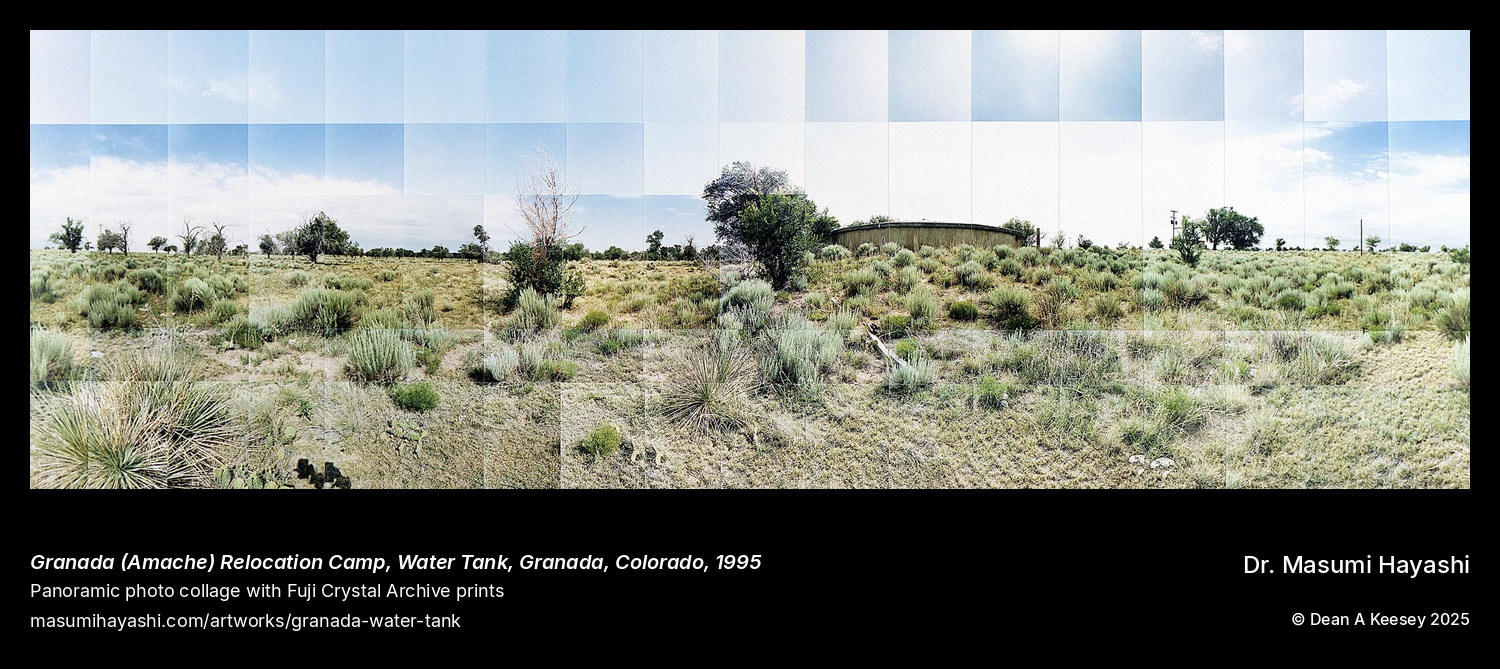
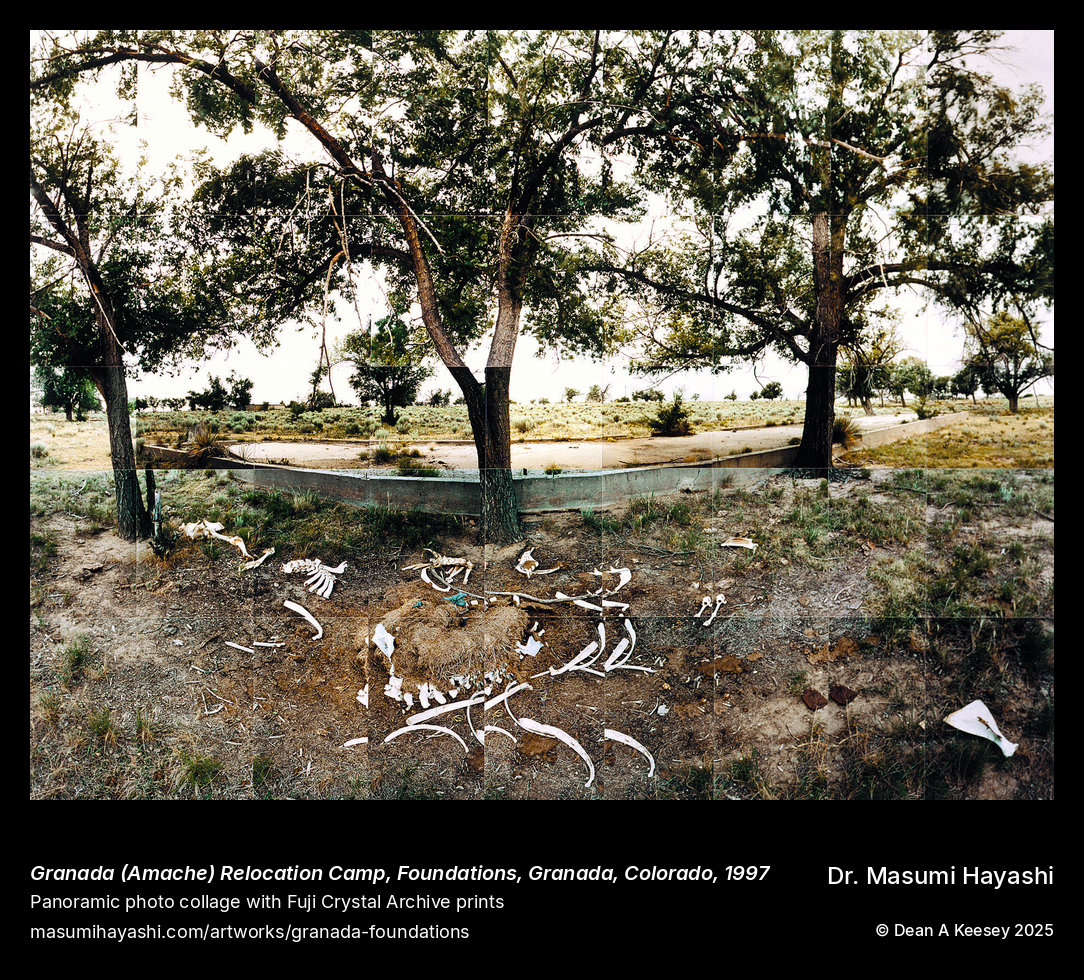
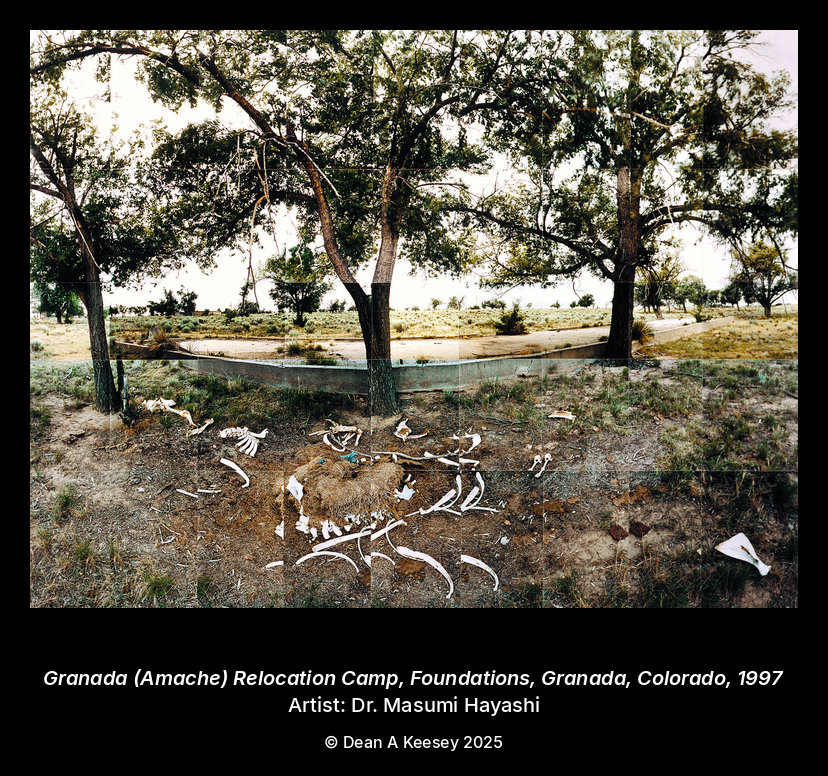
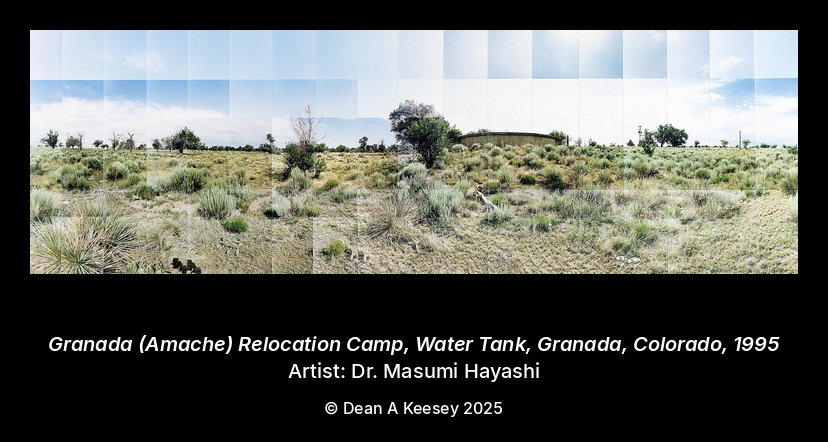
Significance in Masumi Hayashi’s Work
Masumi Hayashi, born in 1945 at Arizona’s Gila River concentration camp, photographed Amache as part of her comprehensive documentation of all ten War Relocation Authority sites.
Visual Documentation
Her panoramic photo collages of Amache capture:
- Water tank: Prominent landmark visible across the plains
- Foundations: Concrete remnants where barracks once stood
- Cemetery: Memorial to those who died during incarceration
- Landscape: The vast high plains environment that isolated internees
Artistic Approach
Hayashi’s work at Amache emphasizes:
- Scale: The expansive high plains stretching to the horizon
- Absence: Empty land where thousands once lived
- Fragmentation: Her panoramic technique mirrors fractured communities
- Memory: Preserving what physical remnants remain
Legacy Preservation
By photographing Amache and the other nine camps, Hayashi created an essential visual archive:
- Documents sites before further deterioration
- Transforms abstract history into visceral physical reality
- Forces viewers to confront the material traces of injustice
- Ensures that even as time erases evidence, the photographic record remains
Her work complements the preservation efforts of the University of Denver, Amache Preservation Society, and now the National Park Service—ensuring that Amache’s history remains visible and undeniable.
Educational Significance
Amache serves as a crucial educational site because:
Preservation Quality
- Best-preserved of the ten WRA camp sites
- Extensive archaeological documentation
- Reconstructed structures providing tangible connection to history
- Active research and interpretation programs
Community Engagement
- Strong partnerships between former internees, descendants, scholars, and local community
- Annual pilgrimage fostering intergenerational dialogue
- University programs training next generation of preservationists
- National Park Service interpretation reaching broad audiences
Constitutional Lessons
- Demonstrates the fragility of constitutional protections during wartime
- Illustrates the consequences of racism, war hysteria, and political failure
- Honors the resilience and patriotism of Japanese Americans despite injustice
- Provides framework for discussing contemporary civil liberties issues
Amache stands as physical evidence that this happened—not in some distant place or time, but in Colorado, within living memory, to American citizens and legal residents whose only “crime” was their Japanese ancestry.
This page honors all who were imprisoned at Amache, the 31 servicemen from Amache who gave their lives in World War II, and the ongoing efforts to preserve this history and defend civil liberties for all Americans.
Gallery
External Resources
- Amache National Historic Site - National Park Service ↗
Official National Park Service site for Amache, designated as a National Historic Site in 2022
- Amache Preservation Society ↗
Preservation efforts, educational programs, and annual pilgrimage information
- University of Denver Amache Project ↗
Archaeological research, digital archives, and student involvement in site preservation
- Densho Encyclopedia - Amache ↗
Comprehensive historical documentation and personal stories from Amache
Explore More
American Concentration Camps
Explore the full project: photography, oral histories, family albums, and historical context documenting the incarceration of 120,000 Japanese Americans.
View the Complete Project →Oral Histories
Listen to internees share their memories of evacuation, camp life, and resilience during this period.
Listen to Interviews →Family Album
View photographs taken by internees themselves, documenting daily life inside the camps.
View Family Stories →All Ten Camps
Learn about the other War Relocation Authority concentration camps across the Western United States.
Explore All Camps →Historical Context
Archives, educational materials, and recommended reading about the Japanese American incarceration.
View Resources →