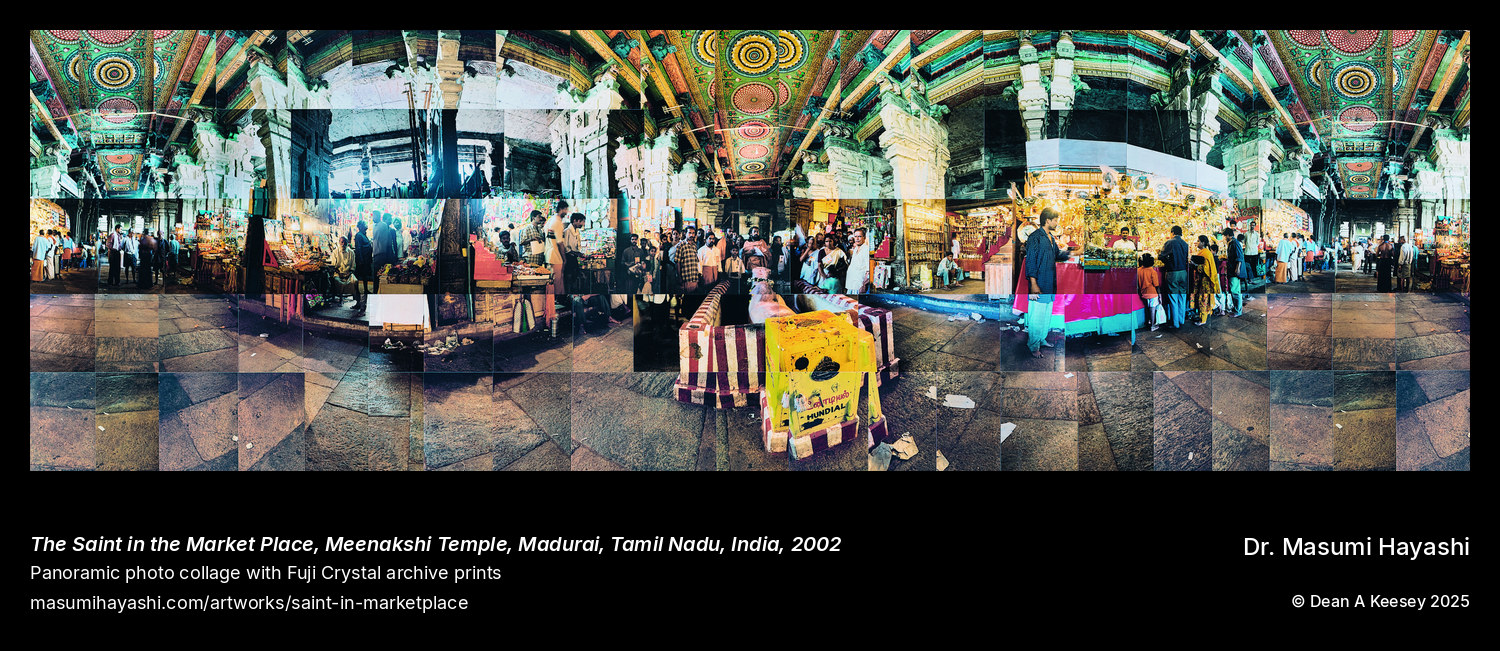
The Saint in the Market Place, Meenakshi Temple, Madurai, Tamil Nadu, India
Madurai, Tamil Nadu, India
Panoramic Photo Collage
2002
49" x 29"
The Saint in the Market Place, Meenakshi Temple, Madurai, Tamil Nadu, India
Overview
“The Saint in the Market Place, Meenakshi Temple” captures the distinctive integration of sacred and commercial life within India’s great pilgrimage temples. Created in 2002 during Masumi Hayashi’s multi-year documentation of Tamil Nadu’s Dravidian temple architecture, this 49-by-29-inch work documents Madurai’s Meenakshi Amman Temple—a 45-acre complex attracting 15,000 daily visitors where goddess worship, ritual devotion, and vibrant marketplace activity interweave seamlessly. The work’s title encapsulates a fundamental characteristic of Indian temple culture: the coexistence of spiritual renunciation and commercial transaction, holy persons and merchants, sacred ritual and everyday economic exchange within unified devotional space.
As the second work in Hayashi’s Meenakshi trilogy (following “Man & God, Hall of a Thousand Pillars,” 2001), this piece shifts focus from architectural monumentality to human presence within sacred space. Where the earlier work documented the 985-pillar hall’s overwhelming architectural scale, “The Saint in the Market Place” explores the temple as living social institution—a space where saints and sadhus coexist with flower vendors, pilgrims mingle with tourists, and the boundary between sacred and commercial proves porous or nonexistent. This thematic shift demonstrates Hayashi’s comprehensive approach to temple documentation, recognizing that sacred architecture functions not as static monument but as dynamic social space hosting complex interactions between devotion, commerce, community, and tradition.
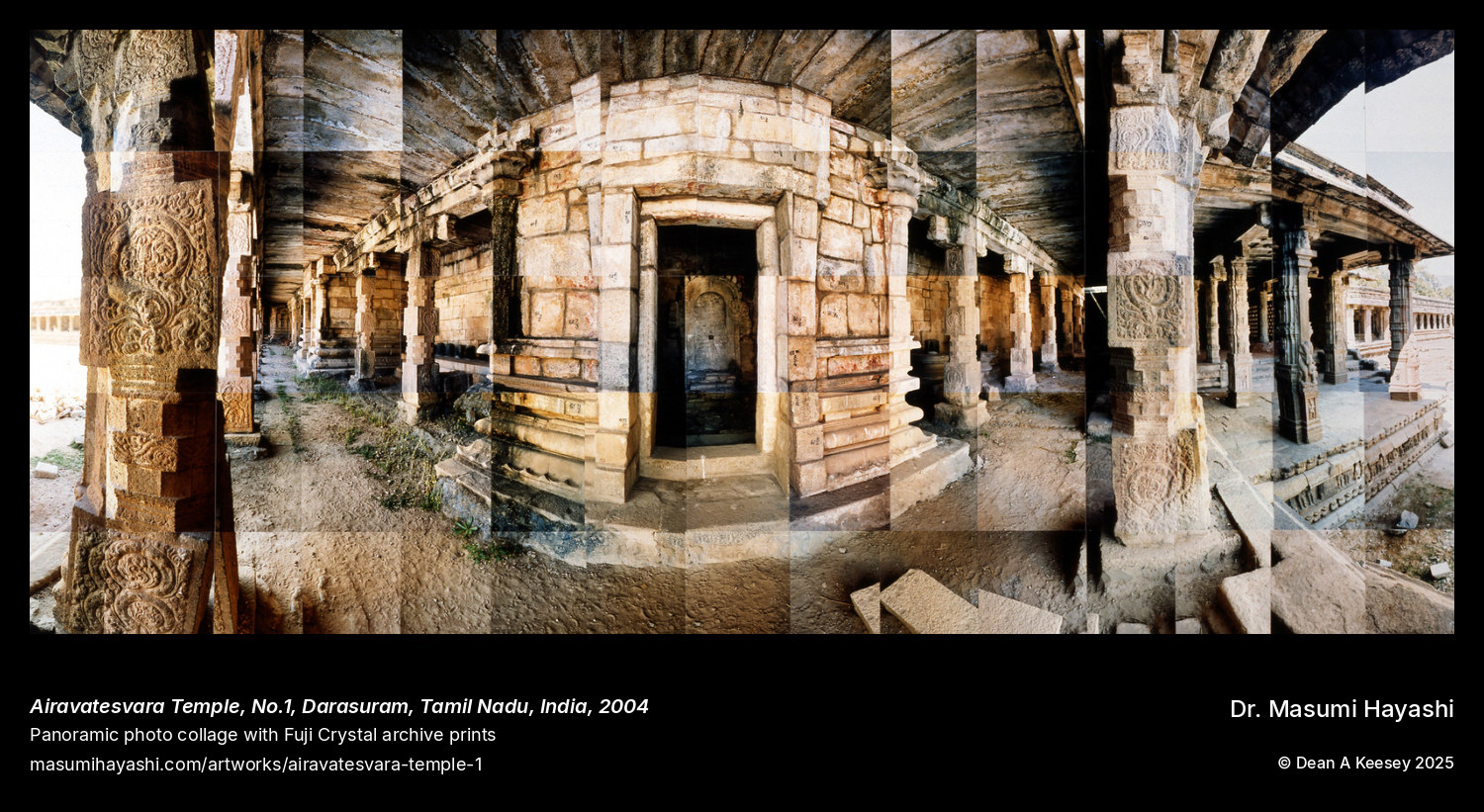
The 2002 creation date positions this work within Hayashi’s intensive Indian temple documentation period, the same year producing “Muthiah Ayyanar Temple” (Tamil folk religion) and “Ellora Caves, Cave 32” (Jain rock-cut architecture), and two years preceding the 2004 Tamil Nadu campaign (Airavatesvara, Rameswaram, Norbulingka). This chronological concentration suggests sustained engagement with Indian sacred architecture across multiple religious traditions, regional variations, and architectural typologies—from monumental Nayak-period complexes to intimate village shrines, from free-standing temples to rock-cut caves.
The work’s institutional significance amplified dramatically through the 2014 donation of Edition 1 to the Cleveland Museum of Art—Hayashi’s home city and the site of her long teaching career at Cleveland State University. This placement brings major South Indian Dravidian temple documentation to a Midwestern museum, providing public access to goddess-centered Hindu worship traditions and demonstrating the Foundation’s strategic approach to museum acquisitions in institutions with direct connections to Hayashi’s biography and career.
Historical and Cultural Context
Meenakshi Amman Temple: Sacred Heart of Madurai
The Meenakshi Amman Temple stands among India’s greatest Hindu temple complexes, its origins reaching to literary references from the 6th century BCE while its current magnificent form emerged through Nayak dynasty patronage during the 16th-17th centuries. The temple’s presiding deity—the goddess Meenakshi (“fish-eyed one”), a form of Parvati—represents the divine feminine (Shakti) ruling the ancient Tamil capital of Madurai alongside her consort Sundareshwar (Shiva). This goddess-centered temple structure, where Meenakshi often takes ritual precedence over Shiva, reflects Tamil Hinduism’s distinctive theological traditions and the region’s strong goddess worship heritage.
The temple’s architectural scale overwhelms conventional description: 14 gopuram gateway towers (the tallest reaching 52 meters), 4,500 ornately carved pillars distributed across numerous halls, an estimated 33,000 sculptural elements covering every surface, and the sacred Pottramarai Kulam (Golden Lotus Tank) for ritual ablution. The entire 45-acre complex functions simultaneously as active worship center, major employer, economic engine, and pilgrimage destination, with continuous ritual activity and commercial transaction defining daily temple life.
The site’s continuous religious function over millennia—surviving destruction during Malik Kafur’s 1310 CE invasion and subsequent rebuilding under Thirumalai Nayak’s 17th-century patronage—establishes the temple as living heritage rather than archaeological monument. Daily pujas (worship services), annual festivals (particularly the Meenakshi Thirukalyanam celebrating the goddess’s marriage to Shiva, attracting over one million pilgrims), and constant pilgrim flow maintain unbroken devotional traditions while generating the vibrant temple economy Hayashi’s title references.
The Saint and the Market: Integrated Temple Economy
The work’s title—“The Saint in the Market Place”—encapsulates a central characteristic of Indian temple culture that often confounds Western expectations of sacred space as separated from commercial activity. Within Meenakshi Temple’s vast precincts, holy men (sadhus, priests, pilgrims in religious ecstasy) coexist seamlessly with flower vendors, coconut sellers, incense merchants, and stalls selling prasad (blessed food), religious images, and ritual objects. This integration reflects traditional Indian understanding of temples as comprehensive social institutions rather than exclusively spiritual venues.
The temple economy employs thousands: hereditary priests performing elaborate rituals, musicians and dancers for ceremonial occasions, maintenance workers caring for the vast complex, elephant keepers (temple elephants blessing devotees for donations), and countless vendors supplying the material requirements of Hindu worship—flowers for offerings, coconuts to break before deities, incense and camphor for arati ceremonies, turmeric and kumkum for devotional markings, sacred ash (vibhuti) for blessing, religious texts and images, and sweets for distribution as prasad.
This commercial activity within sacred space serves essential religious function. Hindu worship requires specific material offerings: fresh flower garlands woven daily, particular incense formulations, precisely prepared foods for prasad, silk garments for deity images, oil for lamps, and numerous other ritual requirements. The temple marketplace provides these necessities while creating economic opportunity for surrounding communities, the boundary between commercial transaction and religious offering becoming indistinct within devotional practice.
The presence of saints and sadhus—wandering renunciants who have abandoned material attachments—within this commercial bustle creates striking visual contrasts while demonstrating Hinduism’s capacity to accommodate seemingly contradictory religious paths within unified sacred space. The marketplace supports the renunciant through alms while the renunciant’s presence reminds merchants and pilgrims of spiritual values transcending commercial exchange.
Goddess Meenakshi: Divine Feminine Sovereignty
The temple’s dedication to goddess Meenakshi as primary deity rather than her consort Shiva reflects Tamil Nadu’s strong Shakti worship traditions and represents relatively unusual theological organization within Hinduism. Temple mythology presents Meenakshi as born to the Pandyan king as a three-breasted warrior princess who ruled as sovereign before meeting Shiva, marrying him when her third breast disappeared, and continuing to rule Madurai as co-regent with her divine consort. This narrative emphasizes female sovereignty and divine feminine power rather than relegating the goddess to subordinate consort status.
The annual Meenakshi Thirukalyanam festival, celebrating the goddess’s marriage to Shiva over 10-12 days each April-May and attracting over one million pilgrims, demonstrates the temple’s central role in Tamil Hindu religious life. The festival’s elaborate processions, music, dance, drama, and culminating celestial wedding ceremony involve the entire city in celebrations that honor both divine feminine power and the sacred marriage uniting masculine and feminine principles.
This goddess-centered theology influenced Dravidian temple architecture and ritual practice. While many Hindu temples position the male deity’s shrine as central with the goddess’s shrine peripheral, Meenakshi Temple’s organization foregrounds the goddess’s sanctum while Sundareshwar’s shrine, though magnificent, occupies secondary position. This spatial hierarchy reflects theological priorities while demonstrating regional variations within broader Hindu temple traditions.
Format and Technical Analysis
Vertical Panoramic Strategy
The 49-by-29-inch dimensions create a moderately vertical format (1.69:1 aspect ratio), relatively unusual in Hayashi’s practice, which tends toward horizontal panoramas or extreme verticals. This moderate vertical emphasis suggests documentation focusing on human presence, crowd scenes, or architectural elements with vertical organization—gopuram towers rising above marketplace activity, pillar halls’ vertical elevations, or the compression of human figures within confined temple spaces.
The vertical orientation differs significantly from “Man & God, Hall of a Thousand Pillars” (53×19.5 inches, horizontal), the first Meenakshi work. Where that horizontal format spread laterally to encompass the pillar hall’s vast breadth, this vertical compression might emphasize human scale, crowded marketplace conditions, or the relationship between ground-level commercial activity and soaring architectural elements above. The format shift between related works demonstrates Hayashi’s adaptive photographic strategies, matching format to specific subject characteristics within the same temple complex.
The 49-inch width provides substantial horizontal coverage despite the work’s overall vertical emphasis, suggesting the format balances vertical architectural or human elements with sufficient lateral breadth to establish spatial context. This balance prevents the extreme compression of the narrowest vertical works (like “City of the Dead” at 17 inches width) while maintaining vertical emphasis distinguishing it from predominantly horizontal compositions.
Capturing Temple Chaos: Photographic Strategies
Documenting the vibrant, chaotic complexity of active Indian temple life presents distinctive photographic challenges. Unlike the relatively controlled conditions of temple architecture documentation—where patient waiting might yield moments of clear architectural view—capturing marketplace activity requires engagement with constant human movement, variable lighting conditions, crowded spaces limiting photographic positions, and the challenge of representing simultaneous activities and interactions within unified visual field.
The panoramic photo collage technique offers particular advantages for these documentary challenges. Multiple photographs assembled into panoramic views can capture sequential moments and spatial relationships impossible within single frames, potentially representing the temporal dimension of market activity through spatial distribution across the panoramic width. The technique also allows documentation of extensive crowded spaces where single viewpoints provide insufficient coverage, the assembled panorama encompassing the full breadth of marketplace activity and human presence.
The moderate vertical format might facilitate documentation of relationship between architectural elements (gopuram towers, pillar halls, temple roofs) and ground-level human activity (vendors, pilgrims, saints, merchants). This vertical stacking—architecture above, human activity below, or progressive vertical layers of spatial depth—could create visual hierarchy emphasizing the integration of monumental architecture and everyday human presence that defines living temple spaces.
Capturing “The Saint” Among Marketplace Crowds
The title’s specificity—“The Saint in the Market Place”—suggests the image focuses on identifiable holy figure within marketplace context. This compositional emphasis creates photographic challenges: how to establish visual prominence for individual figure within crowded, visually complex environment? How to create formal relationship between saint (representing spiritual renunciation) and marketplace (representing material transaction) that communicates their coexistence without forcing artificially simplified interpretations?
Hayashi’s panoramic approach might address these challenges by providing extensive spatial context surrounding the central figure, the wide view establishing the saint’s physical presence within marketplace activity while allowing viewers to perceive the visual complexity, simultaneous activities, and spatial relationships defining temple life. Rather than isolating the saint through tight framing or shallow depth of field, the panoramic potentially embeds the figure within rich contextual detail, communicating integration rather than separation.
Series Context and Comparative Analysis
Meenakshi Trilogy: Comprehensive Temple Documentation
“The Saint in the Market Place” forms the middle work in a three-part Meenakshi documentation:
- “Man & God, Hall of a Thousand Pillars” (09023, 2001): 53×19.5 inches horizontal, documenting the 985-pillar hall’s architectural monumentality
- “The Saint in the Market Place” (09035, 2002): 49×29 inches vertical, exploring human presence and marketplace activity
- “Madonna and Child, Meenakshi Temple” (09021, 2003): Religious iconography and goddess worship traditions
This trilogy demonstrates systematic multi-perspective documentation of a single temple complex, each work emphasizing different aspects: architectural space, social function, and religious iconography. The chronological spread (2001-2003) suggests multiple photographic visits or extended engagement with the site, the trilogy emerging through sustained investigation rather than single documentary session.
The trilogy’s formal variation—horizontal architectural documentation, vertical human-focused composition, and iconographic study—prevents repetitive treatment while ensuring comprehensive coverage. This multi-work approach mirrors Hayashi’s treatment of other significant sites (Okunoin cemetery pair, Airavatesvara horizontal/vertical perspectives, Dharamsala institutional documentation), establishing systematic documentation methodology across the Sacred Architectures series.
Sacred and Commercial Integration Across the Series
While most Sacred Architectures works document temple architecture and devotional space, “The Saint in the Market Place” uniquely emphasizes the economic and commercial dimensions of temple function. This thematic distinctiveness enriches the series’ conceptual range, acknowledging that sacred architecture operates within complex social, economic, and cultural systems extending beyond purely religious or aesthetic concerns.
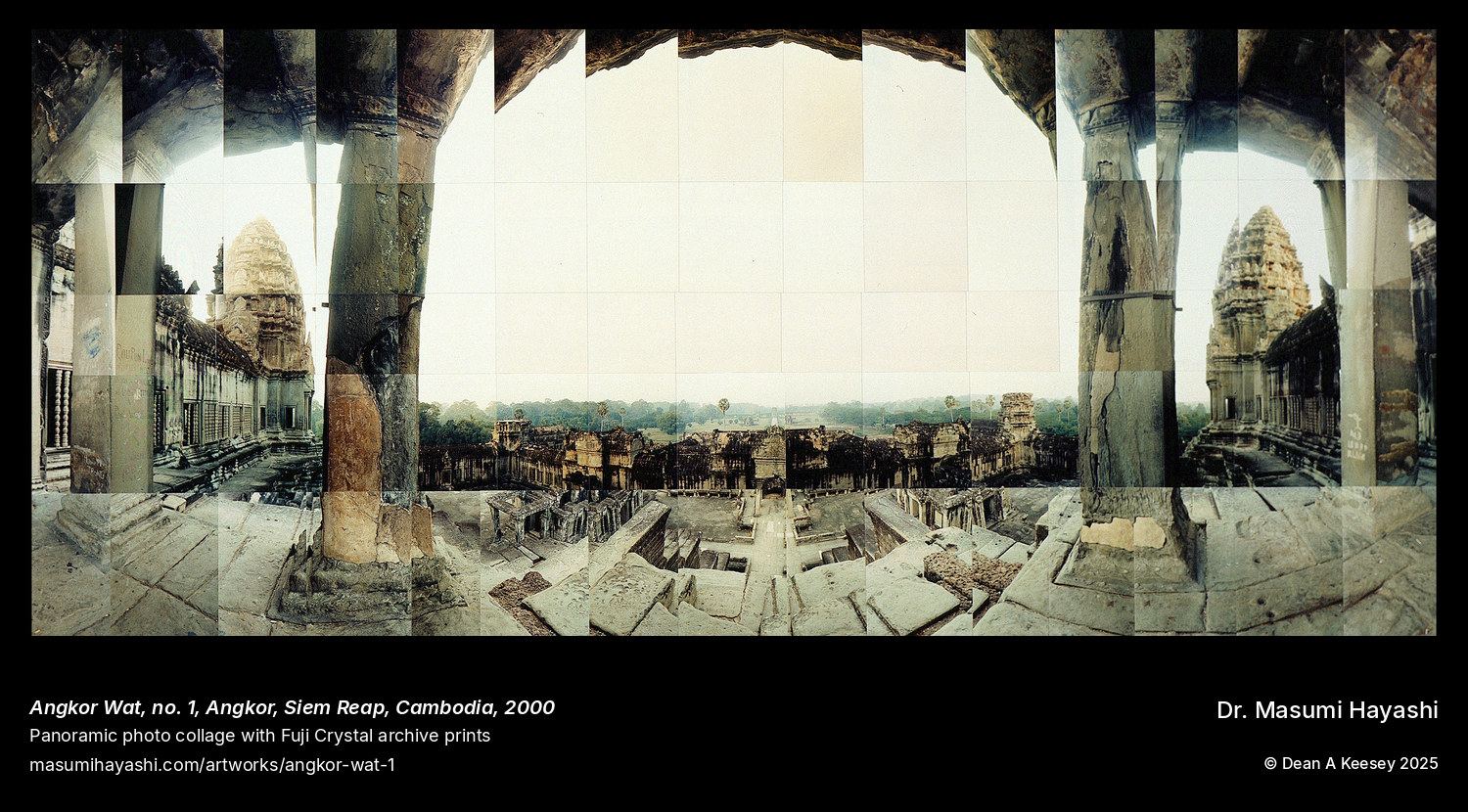
Other series works hint at these broader contexts—“Muthiah Ayyanar Temple” documenting village religious economy, Angkor works suggesting temple complexes as political and administrative centers—but “The Saint in the Market Place” explicitly foregrounds temple economic function through its title and presumed content. This thematic expansion demonstrates Hayashi’s sophisticated understanding of sacred architecture as embedded within comprehensive social systems rather than isolated aesthetic or devotional phenomena.
The work also contributes to the series’ documentation of living religious traditions versus archaeological monuments. While some works document abandoned or primarily tourist-oriented sites, “The Saint in the Market Place” captures active devotional practice and economic function, the 15,000 daily visitors and vibrant marketplace demonstrating unbroken religious continuity rather than heritage preservation.
Cleveland Museum of Art Context
The 2014 donation of Edition 1 to the Cleveland Museum of Art creates institutional context distinctive within the Sacred Architectures series. While several works found placement in major museums (Smithsonian, Cleveland Museum), the biographical connection between Hayashi and Cleveland (her home city, teaching location at Cleveland State University) adds significance to this particular placement.
The donation brings major South Indian Dravidian temple documentation to a Midwestern audience with limited direct exposure to Hindu goddess worship traditions, Tamil religious culture, or the integration of sacred and commercial activity characteristic of Indian temple life. The work’s educational potential—teaching about goddess-centered Hinduism, Dravidian architecture, living pilgrimage traditions, and the intersection of devotion and economy—enhances its institutional value beyond purely aesthetic appreciation.
The Cleveland Museum’s Asian art collection provides curatorial context for the work while Hayashi’s local reputation (as Cleveland State University faculty member and practicing artist) creates community connection transcending typical museum-donor relationships. The placement thus serves multiple functions: honoring Hayashi’s regional legacy, enriching the museum’s South Asian holdings, and providing public access to important cultural documentation.
Edition Status and Institutional Context
Current Edition Locations
The edition tracking reveals unusual “1 of 4” edition size (smaller than the typical five-edition runs) with documented placements:
Editions 3-4: Listed as “packets” (likely unprinted or print-ready files)
The smaller edition size might reflect market considerations (limiting availability to enhance value), production costs, or intentional scarcity for significant works targeted for museum placement. The “packets” notation for Editions 3-4 suggests these remain unprinted, the Foundation retaining flexibility to produce additional impressions if institutional interest warrants.
The Cleveland Museum placement of Edition 1 establishes provenance and validates institutional interest, potentially enhancing remaining editions’ value and placement potential. Edition 2’s retention in unframed condition provides options for future framing choices matching potential acquisition contexts—museums might prefer specific framing standards, while private collectors might select custom framing coordinating with collection display conditions.
Institutional Placement Potential
The work’s distinctive characteristics position it favorably for institutional collections focused on:
- South Asian art and culture: Museums building Hindu temple documentation, goddess worship traditions, Tamil religious heritage
- Religious studies: Academic collections teaching comparative religion, Hindu devotional practices, sacred space theory
- Cultural anthropology: Institutions exploring intersections of religion and economy, sacred and commercial integration, pilgrimage studies
- Photographic documentation: Collections emphasizing documentary photography, architectural photography, or contemporary approaches to cultural preservation
- Hayashi retrospectives: Museums developing comprehensive Hayashi collections across her multiple series
The Cleveland Museum donation creates precedent for comparable Midwestern or regional museum placements, institutions connecting to Hayashi’s biography and career. The educational dimensions—teaching about unfamiliar religious traditions and cultural practices to audiences lacking direct exposure—enhance the work’s institutional utility beyond aesthetic value.
Conservation and Display Considerations
The 49-by-29-inch vertical format presents moderate conservation challenges, requiring professional museum-quality framing for chromogenic print protection. The dimensions work effectively in various exhibition contexts: substantial enough for gallery impact without requiring exceptional wall space, suitable for vertical display in areas with height constraints, and manageable for rotation between exhibition and climate-controlled storage.
The vertical orientation creates distinctive display dynamics compared to the series’ predominantly horizontal works. Gallery installations might employ vertical works to provide visual variety, break up horizontal sequences, or emphasize specific thematic content deserving formal distinction. Paired display with the horizontal “Man & God, Hall of a Thousand Pillars” would create productive formal and thematic dialogue between architectural monumentality and human presence within the same temple complex.
Cultural Significance and Artistic Achievement
“The Saint in the Market Place, Meenakshi Temple” represents Masumi Hayashi’s sophisticated engagement with the complex social dimensions of sacred architecture. Beyond documenting monumental Dravidian temple forms, the work acknowledges temples as living institutions integrating devotion, commerce, community, and tradition within unified spatial and social frameworks. The title’s emphasis on saint and marketplace coexistence challenges Western assumptions about sacred space as separated from economic activity, presenting instead the Indian temple tradition’s distinctive integration of spiritual and material, renunciation and transaction, holy presence and commercial exchange.
The work’s positioning within the Meenakshi trilogy demonstrates comprehensive documentary methodology: architectural monumentality (the thousand-pillar hall), human social function (marketplace activity), and religious iconography (Madonna and Child) combining to create multidimensional temple representation impossible within single perspectives. This systematic multi-work approach elevates Hayashi’s practice beyond isolated documentary moments toward sustained investigative engagement with architecturally, socially, and religiously complex subjects.
As documentation of goddess-centered Hindu worship, the work contributes to the Sacred Architectures series’ religious diversity, ensuring representation of divine feminine traditions alongside the predominantly male deity-focused temples characterizing much Hindu, Buddhist, and Jain architecture. The Meenakshi Temple’s theological distinctiveness—goddess as sovereign rather than subordinate consort—receives visual documentation, preserving photographic evidence of spatial hierarchies reflecting theological priorities.
The 2014 Cleveland Museum of Art placement amplifies the work’s cultural significance by providing public access to major South Indian temple documentation in a Midwestern institutional context. This geographic displacement—bringing Tamil Hindu goddess worship traditions to Cleveland audiences—serves educational functions while honoring Hayashi’s biographical and professional connections to the city. The work thus operates simultaneously as artistic achievement, cultural documentation, educational resource, and institutional tribute to a regionally significant artist’s career.
Collection Information
Year: 2002 Location: Madurai, Tamil Nadu, India Medium: Panoramic Photo Collage Dimensions: 49 × 29 inches Edition: 1 of 4
- Cleveland Museum of Art (donated 2014)
- Inventory - unframed
- Packets (unprinted)
Note: Edition 1 donated to Cleveland Museum of Art in 2014, eight years after Hayashi’s death (2006), representing Foundation’s strategic museum placement in artist’s home city. Edition 2 retained unframed in Foundation inventory. Editions 3-4 listed as “packets,” likely indicating print-ready files held for future printing if institutional interest warrants.