Ta Prohm, Angkor, Siem Reap, Cambodia | Masumi Hayashi Foundation
Back to Gallery
Picture of Ta Prohm, Angkor, Siem Reap, Cambodia by Dr. Masumi Hayashi

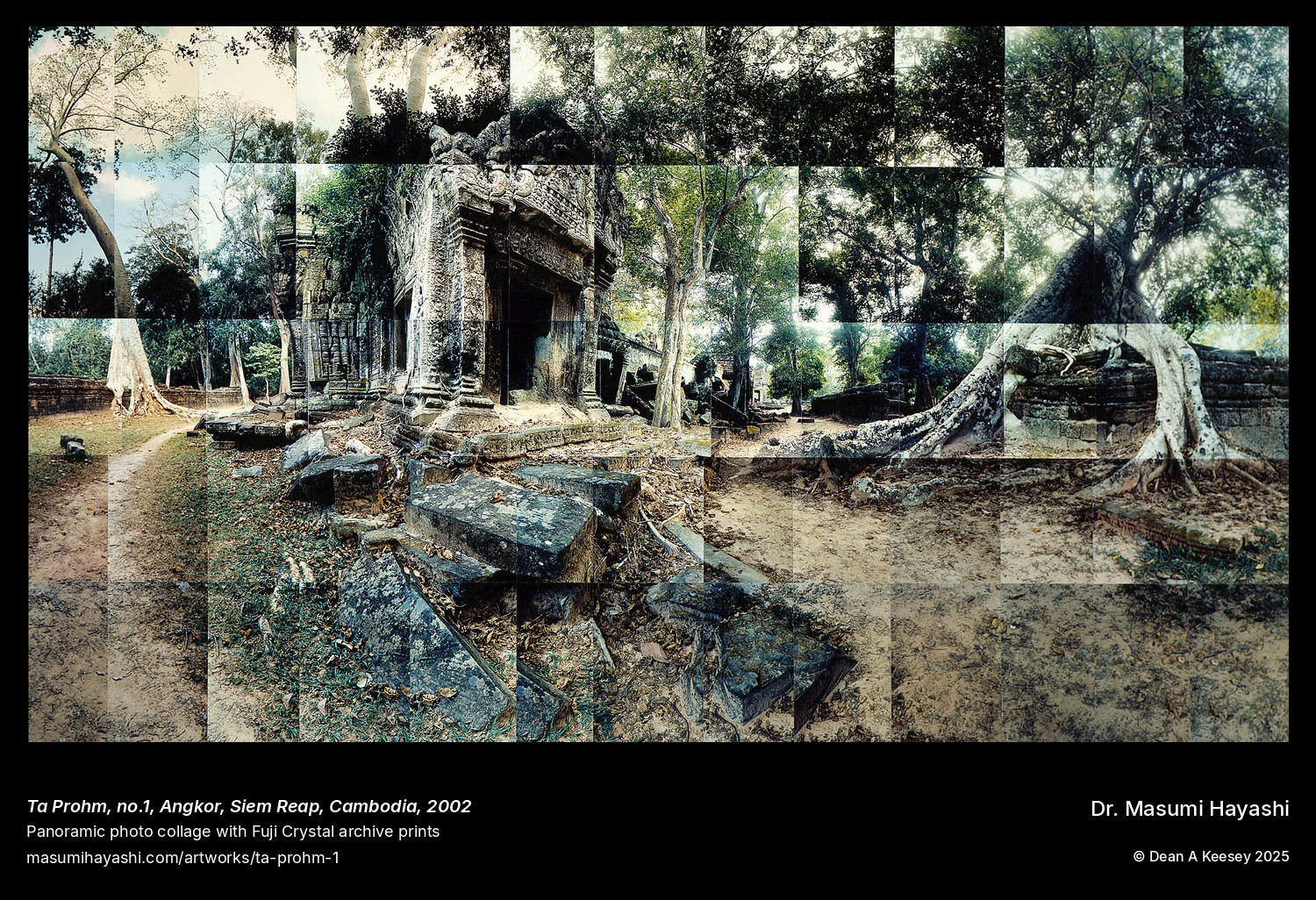
Ta Prohm, Angkor, Siem Reap, Cambodia

Angkor, Siem Reap, Cambodia

Panoramic Photo Collage

2000

27 x 45

Ta Prohm, Angkor, Siem Reap, Cambodia

Overview

Created in 2000, this 27 x 45-inch panoramic photo collage documents Ta Prohm—famous “jungle temple” at Angkor where massive tree roots intertwine with ancient stone galleries creating arguably most photogenic and atmospheric image of nature reclaiming human architecture in Southeast Asian archaeological heritage. Founded 1186 CE by King Jayavarman VII as Buddhist monastery dedicated to his mother in form of Prajnaparamita (Perfection of Wisdom), Ta Prohm originally supported extraordinary institutional scale: temple inscription recording 12,640 temple personnel, 66,625 external support staff, and 79,365 total people serving single complex plus 3,140 villages providing goods and services—evidence of Angkorian civilization’s immense wealth, organizational capacity, and religious devotion at empire’s peak. Unlike most Angkorian temples restored to archaeological clarity, Ta Prohm deliberately left in partially unrestored state by École française d’Extrême-Orient (EFEO) preserving romantic “discovered” appearance where massive Tetrameles nudiflora (spung) and Ficus (strangler fig) trees growing through galleries create structural paradox: removing trees would cause walls to collapse (roots now providing integrity), yet leaving trees ensures eventual collapse through continued growth—managed decline where nature and culture inseparable, conservation philosophy valuing nature’s transformation over archaeological purity. The 27 x 45-inch moderate horizontal panorama (1.67:1 aspect ratio) suits Ta Prohm’s corridor galleries and lateral architectural extent, likely documenting tree-stone symbiosis along gallery length, multiple root-wall integrations within single frame, or depth of perspective through ruined passages where architectural and natural elements layer creating complex compositional opportunities absent from fully restored temples. The 2000 date positions Ta Prohm as seventh confirmed turn-of-millennium work and fourth Angkor monument from 2000 (alongside Banteay Srei, Angkor Wat No. 1, and Bayon), establishing extraordinarily concentrated Cambodia documentation suggesting extended Angkor stay enabling comprehensive complex coverage across architectural scales, religious phases, preservation states, and conservation philosophies—from fully restored Hindu Banteay Srei to partially collapsed Buddhist Ta Prohm reclaimed by jungle. Work’s 2000 creation predates Tomb Raider film (filmed 2000, released 2001) that triggered massive tourism boom making Ta Prohm one of world’s most photographed archaeological sites; Hayashi’s documentation captures quieter, pre-mass-tourism, pre-Instagram Ta Prohm before site transformation into pop culture pilgrimage destination. Ta Prohm’s meditation on entropy, decay, and time’s transformation of architecture resonates deeply with Hayashi’s Japanese-American internment camp documentation—both practices examining how nature reclaims abandoned human construction, though differing in climate (tropical verdant growth vs. desert arid decay), timespan (800 years vs. 50 years), and historical meaning (Buddhist devotion vs. injustice remembered), yet sharing contemplation of impermanence, memory, and architecture’s fragility as universal themes transcending specific historical contexts.

Historical Context: Jayavarman VII and Temple Foundation

Ta Prohm represents height of Jayavarman VII’s extraordinary building program:

Foundation (1186 CE):

Royal Patronage and Dedication: Built by Jayavarman VII (reign 1181-1218 CE):

  • Dedication: King’s mother honored in form of Prajnaparamita
  • Prajnaparamita: “Perfection of Wisdom”—personification of transcendent wisdom in Mahayana Buddhism, often depicted as goddess
  • Royal Filial Piety: Temple demonstrating Buddhist devotion and honoring mother through monumental religious endowment
  • Original Name: Rajavihara (“Royal Monastery”)
  • Later Name: Ta Prohm (“Ancestor Brahma”)—modern Khmer designation
  • Timing: One of first major projects after Jayavarman VII took throne (1181), suggesting personal importance

Extraordinary Institutional Scale:

Temple inscription (stele) documenting original operations provides staggering numbers:

Temple Personnel (12,640 people directly employed):

  • 18 high priests
  • 2,740 officials
  • 2,232 assistants including 615 dancers
  • Monks, teachers, students (functioning Buddhist university)
  • Support staff (cooks, cleaners, guards, maintenance)

External Support Network (66,625 people):

  • 3,140 villages providing goods and services
  • Agricultural surplus supporting non-farming religious population
  • Vast economic network centered on single temple complex

Total Dependent Population: 79,365 people serving this single temple

Wealth and Resources:

  • 500 kilograms gold
  • 4,540 precious gems
  • 35 diamonds
  • Massive quantities of pearls
  • Land holdings supporting thousands
  • Annual rice production feeding entire complex

These numbers demonstrate Angkorian civilization’s immense wealth, sophisticated administrative organization, and capacity for religious patronage at scale rarely matched in medieval world—comparable to largest European monasteries but supporting Buddhist rather than Christian institution.

Jayavarman VII’s Broader Building Program:

Ta Prohm one component of extraordinary architectural output:

  • Hospitals: 102 hospitals throughout kingdom (inscriptions mentioning “house of fire” / arogyasala rest houses with medical care)
  • Rest Houses: 121 rest houses along roads for travelers
  • Major Temples: Bayon (state temple), Ta Prohm (mother), Preah Khan (father), Banteay Kdei, Neak Pean, others
  • Angkor Thom: Entire walled capital city (9 square kilometers)
  • Infrastructure: Roads, reservoirs, administrative buildings

Construction scale suggesting massive labor mobilization, potential economic strain possibly contributing to empire’s later 13th-14th century decline as resources diverted from agriculture, defense, and commerce toward monumental religious architecture.

Mahayana Buddhist Context:

Ta Prohm reflects Jayavarman VII’s Buddhist ideology:

  • Prajnaparamita: Central Mahayana concept—wisdom transcending duality, feminine personification of emptiness and compassion
  • Mother as Goddess: Identifying biological mother with Prajnaparamita elevating personal family member to cosmic significance
  • Monastery and University: Temple functioning as both worship site and educational center transmitting Buddhist teachings
  • Royal Merit: Building temples generating karmic merit benefiting king, mother, kingdom
  • Bodhisattva Path: King as bodhisattva figure (enlightenment-bound being) practicing compassion through temple building, hospital construction, care for subjects

Architectural Layout and Original Function

Ta Prohm follows classic Angkorian temple layout with monastic additions:

Temple Structure:

Concentric Enclosures (Typical Angkorian Design):

  1. Outer Enclosure: Laterite wall, 1,000 x 600 meters enclosing entire complex including monastery buildings
  2. Third Enclosure: 255 x 215 meters
  3. Second Enclosure: Smaller galleries
  4. First Enclosure: Central sanctuary complex

Architectural Elements:

  • Central Sanctuary: Principal shrine housing Prajnaparamita image
  • Multiple Galleries: Interconnected stone corridors, pillared halls
  • Towers: Prasat (temple towers) at cardinal points following Mount Meru symbolism
  • Libraries: Traditional Angkorian temple element (typically two, east side)
  • Hall of Dancers: Space for ritual performances (615 dancers mentioned in inscription)
  • Courtyards: Open spaces between galleries
  • Cruciform Terraces: Elevated platforms at entrances

Construction Materials:

  • Sandstone: Primary building stone for galleries, towers, decorative carving—porous, susceptible to tree root penetration
  • Laterite: Outer walls, foundations—iron-rich tropical stone, more durable
  • No Mortar: Dry-stone construction relying on precise fitting—allows tree roots to penetrate joints
  • Shallow Foundations: Inadequate for large trees—roots undermine and penetrate structures

Original Function:

  • Buddhist Monastery: Residential complex for monks, novices
  • University: Teaching Buddhist texts, philosophy, meditation
  • Ritual Center: Daily worship, ceremonies honoring Prajnaparamita
  • Economic Hub: Managing 3,140 villages, agricultural surplus, craft production
  • Pilgrimage Destination: Devotees visiting mother-temple of powerful king

Current State: Nature Reclaiming Architecture

Ta Prohm’s contemporary condition results from deliberate conservation choices:

Post-Abandonment History (15th-19th Centuries):

Following capital shift to Phnom Penh (mid-15th century):

  • Angkor Thom and surrounding temples gradually abandoned as administrative centers
  • Some Buddhist monks maintained limited presence
  • Jungle encroachment beginning—tropical climate enabling rapid vegetation growth
  • Monsoon rains, tree roots, vegetation accelerating architectural decay
  • Local populations aware of sites but limited maintenance

French Colonial “Discovery” and Conservation Debate (Late 19th-Early 20th Centuries):

European “Rediscovery”:

  • French naturalist Henri Mouhot’s 1860 visit popularizing Angkor to Western audiences (though local Khmer never “lost” knowledge)
  • École française d’Extrême-Orient (EFEO) beginning systematic clearing, documentation, restoration (1898-)
  • Ta Prohm found completely overtaken by forest—massive trees growing through galleries
  • Dramatic visual impact: human architecture versus nature’s overwhelming power

Conservation Philosophy Debate: Fundamental question confronting French conservators:

  • Full Restoration (Angkor Wat model): Remove all vegetation, rebuild collapsed structures, restore archaeological clarity
  • Romantic Ruins (Ta Prohm model): Preserve “discovered” state, maintain tree-stone integration, aesthetic of sublime decay

EFEO Decision for Ta Prohm:

  • Deliberately left partially unrestored
  • Minimal intervention: stabilization only where collapse imminent or visitor safety threatened
  • Trees integrated with architecture preserved as temple’s defining feature
  • Philosophical choice valuing nature’s transformation over archaeological purity
  • Recognition that tree-stone symbiosis creates unique aesthetic experience and educational demonstration of entropy

Modern Conservation Challenges:

Contemporary conservators face paradoxical dilemmas:

The Tree Problem:

  • Structural Interdependence: Some trees now providing structural support—roots holding walls together that would collapse if trees removed
  • Continued Damage: Same trees continuing to damage structures through growth, root expansion, moisture retention
  • Which Trees?: Deciding which trees to remove (clearly damaging) versus preserve (iconic, structurally integrated)
  • No-Win Scenario: Removing trees causes collapse, leaving trees ensures eventual collapse—managed decline only option

Conservation Approach (Archaeological India Foundation, 2013-present):

  • Stabilizing galleries where collapse imminent
  • Removing damaging new vegetation before deep root establishment
  • Preserving iconic established trees (Tomb Raider tree, west gate spung tree, others)
  • Installing drainage improving water management
  • Monitoring structural stability
  • Balancing preservation with allowing nature-architecture interaction to continue

The Trees: Spectacular Tree-Stone Symbiosis

Ta Prohm’s fame rests on extraordinary botanical-architectural integration:

Tetrameles nudiflora (Spung Trees):

Characteristics:

  • Gray bark, massive buttress roots
  • Roots flow over walls like frozen waterfalls or melting stone
  • Some specimens 400+ years old
  • Grow to 40 meters height
  • Fast-growing tropical hardwood
  • Deciduous (drops leaves dry season)

Growth Pattern:

  • Seeds germinate in cracks, crevices, on gallery roofs
  • Roots descend walls seeking soil and water
  • Roots penetrate stone joints (no mortar)
  • Roots expand in cracks, applying pressure, fragmenting stone
  • Eventually roots and stone become structurally interdependent

Famous Examples:

  • West gate inner enclosure massive spung tree (most photographed)
  • “Tomb Raider tree” (featured in 2001 film)
  • Multiple unnamed spectacular specimens throughout complex

Ficus Species (Strangler Figs):

Characteristics:

  • Begin as epiphytic seeds deposited in cracks by birds/animals
  • Send aerial roots down walls to soil
  • Roots eventually thicken, fuse, create trunk-like structure
  • Can strangle and replace host tree or building
  • Create serpentine root patterns appearing to “melt” over stone

Visual Effect:

  • Roots cascading down doorways like organic curtains
  • Sculptural forms integrating with carved stone
  • Texture contrast: rough bark versus smooth sandstone
  • Color contrast: brown/gray roots versus golden/gray stone

Structural Paradox:

Original Relationship (First 200-300 Years): Tree as parasite, architecture as host:

  • Trees exploit cracks, joints, weaknesses
  • Roots apply pressure fragmenting stone
  • Moisture retained by roots accelerates decay
  • Trees purely destructive force

Current Relationship (After 400+ Years Integration): Mutual structural dependence:

  • Tree roots now holding fragmented walls together
  • Removing trees would eliminate structural support causing immediate collapse
  • Architecture supporting tree trunks preventing toppling
  • Neither can exist without other
  • Conservators maintaining both to preserve unique symbiosis

Most Photographed Locations:

  • West gate inner enclosure (massive spung tree)
  • North gate (fig roots cascading down doorway)
  • Tomb Raider tree (famously photogenic spung tree from 2001 Angelina Jolie film)
  • Multiple unnamed root-wall integrations throughout galleries

Moderate Horizontal Panorama: 27 x 45 Inches

At 27 x 45 inches, Ta Prohm employs moderate horizontal panorama suited to gallery documentation:

Format Analysis:

  • Width: 27 inches (2.25 feet) creates moderate horizontal field
  • Height: 45 inches (3.75 feet, nearly 4 feet tall) provides substantial vertical information
  • Aspect Ratio: 1.67:1 (height to width)—moderate vertical panorama (taller than wide, but not extreme)

Aspect Ratio Correction: Actually, reviewing: 27 wide × 45 tall = height is 1.67× width, so this is moderate VERTICAL panorama, not horizontal. Height (45”) exceeds width (27”), creating vertical emphasis.

Format Analysis Corrected:

  • Width: 27 inches (2.25 feet)
  • Height: 45 inches (3.75 feet, nearly 4 feet tall)
  • Aspect Ratio: 1.67:1 (height to width)—moderate vertical panorama

Comparison with Other Sacred Architectures Formats:

  • Jain Temple: 25 x 73” (2.92:1 vertical)—extreme vertical
  • Bodhi Tree / Bayon: 24/27 x 69” (2.56-2.875:1 vertical)—extreme vertical
  • Kandariya Mahadeva: 30 x 59” (1.97:1 vertical)—approaching 2:1
  • Ta Prohm: 27 x 45” (1.67:1 vertical)—moderate vertical, less extreme than tower-focused works
  • Hanuman Ghat: 24 x 45” (1.88:1 vertical)—similar vertical emphasis for ghat descent

Ta Prohm’s 1.67:1 moderate vertical format less extreme than tower documentation works but maintains vertical emphasis appropriate for gallery corridor heights, tree-stone vertical integration, or architectural elevation.

Format Rationale: Gallery and Tree Documentation

Gallery Corridors: Ta Prohm’s galleries create vertical compositional opportunities:

  • Floor to ceiling gallery heights (often 3-4 meters)
  • Vertical tree roots descending from ceiling/roof to floor
  • Doorways and passages with vertical proportions
  • Vertical format capturing full gallery elevation

Tree-Stone Vertical Integration: Most spectacular tree-stone symbiosis involves vertical elements:

  • Roots flowing down walls from roof to ground
  • Trees growing upward from courtyards through galleries
  • Vertical cascade of buttress roots over gallery walls
  • Vertical format essential for documenting this movement

Possible Compositional Strategies:

Single Gallery Corridor: Documenting interior passage:

  • Gallery floor → pillars → corbeled vault ceiling → tree roots penetrating from above
  • Vertical format capturing full interior elevation
  • Tree-stone integration along vertical wall surfaces

Tree Root Cascade: Famous spung tree root waterfalls:

  • Root origin on gallery roof → massive roots flowing down wall → roots meeting ground
  • Vertical format required to show complete root cascade
  • Emphasizing downward movement and scale

Doorway with Root Curtain: Fig tree roots cascading over entrance:

  • Lintel → roots descending like organic curtain → doorway threshold
  • Vertical format framing doorway proportions
  • Root-stone texture contrast

Tower and Gallery Elevation: Architectural elevation with vegetation:

  • Foundation → gallery levels → prasant tower → tree growing through
  • Vertical format documenting complete architectural elevation plus nature integration

27-Inch Width: Moderate width providing:

  • Context for vertical tree-root relationships
  • Showing adjacent architectural elements
  • Not extremely narrow (27” = 2.25 feet allows adequate horizontal information)
  • Balanced composition between vertical emphasis and contextual width

Seventh 2000 Work: Four Angkor Monuments Documented

Ta Prohm represents seventh confirmed 2000 work, fourth Angkor monument:

2000 Works Confirmed (Complete List):

  1. Bodhi Tree (Bodh Gaya, Bihar, India)—Buddhism, 24 x 69” extreme vertical
  2. Banteay Srei (Angkor, Cambodia)—Hindu-Buddhist, 27 x 56” moderate horizontal
  3. Kandariya Mahadeva (Khajuraho, Madhya Pradesh, India)—Hinduism, 30 x 59” vertical
  4. Jain Temple (Jaisalmer, Rajasthan, India)—Jainism, 25 x 73” extreme vertical
  5. Angkor Wat No. 1 (Angkor, Cambodia)—Hindu-Buddhist, 23 x 52” vertical
  6. Bayon (Angkor Thom, Cambodia)—Buddhism, 27 x 69” extreme vertical
  7. Ta Prohm (Angkor, Cambodia)—Buddhism, 27 x 45” moderate vertical

Technical Consistency Absolute: All seven 2000 works employ identical specifications:

  • Fuji film stock (distinct from typical Kodak)
  • 4 x 6-inch format (larger than typical 3.5 x 5)
  • Systematic technical approach throughout journey

Four Angkor Works from 2000—Extraordinary Concentration:

Angkor Monuments Documented:

  1. Banteay Srei (25km from main complex)—intimate pink sandstone temple, 10th century Hindu
  2. Angkor Wat (central monument)—world’s largest religious monument, 12th century Hindu → Buddhist
  3. Bayon (Angkor Thom center)—enigmatic face temple, late 12th-early 13th century Buddhist
  4. Ta Prohm (Angkor Thom vicinity)—jungle temple, late 12th century Buddhist, nature integration

Four Angkor works suggesting extended Cambodia stay (likely several weeks minimum) enabling systematic comprehensive documentation across:

Architectural Scales:

  • Intimate refined temple (Banteay Srei)
  • Massive monumental complex (Angkor Wat)
  • Medium-scale face towers (Bayon)
  • Sprawling monastery galleries (Ta Prohm)

Religious Phases:

  • 10th century Hindu (Banteay Srei)
  • 12th century Hindu → Buddhist transformation (Angkor Wat)
  • Late 12th-early 13th century Buddhist (Bayon, Ta Prohm)

Preservation States:

  • Fully restored decorative perfection (Banteay Srei)
  • Maintained monumental clarity (Angkor Wat)
  • Stable with iconic features (Bayon faces)
  • Deliberately partially unrestored romantic ruin (Ta Prohm)

Architectural Typologies:

  • Decorative temple with exquisite relief carving (Banteay Srei)
  • Tower quintet and bas-relief galleries (Angkor Wat)
  • Clustered face towers (Bayon)
  • Monastery galleries with tree-stone symbiosis (Ta Prohm)

Conservation Philosophies:

  • Archaeological restoration (Banteay Srei, Angkor Wat, partially Bayon)
  • Romantic ruin aesthetic (Ta Prohm unique among four works)

Pattern demonstrating sophisticated understanding that comprehensive Angkor documentation requires multiple works capturing site’s architectural diversity, religious evolution, and varied preservation approaches rather than single representative image.

Religious Diversity Complete: Seven works documenting three major Indian religious traditions plus Southeast Asian Buddhist evolution:

  • Buddhism: Bodh Gaya (Indian enlightenment site), Bayon (Khmer state temple), Ta Prohm (royal monastery)
  • Hinduism: Khajuraho (tantric Nagara style), Angkor Wat originally (Vishnu dedication)
  • Jainism: Jaisalmer (merchant-patronage temple)
  • Hindu-Buddhist Synthesis: Banteay Srei, Angkor Wat’s transformation

Unprecedented religious architectural comprehensiveness spanning India (Bihar, Madhya Pradesh, Rajasthan) and Cambodia (four Angkor works).

Pop Culture Impact: Tomb Raider and Tourism Transformation

Ta Prohm’s 2000 documentation captures site before massive pop culture transformation:

Lara Croft: Tomb Raider (2001 Film):

Production Details:

  • Starring: Angelina Jolie as Lara Croft
  • Director: Simon West
  • Filming: 2000 (same year as Hayashi’s documentation)
  • Release: June 2001
  • Budget: [price redacted]
  • Box Office: [price redacted] worldwide

Ta Prohm Scenes: Several sequences filmed at Ta Prohm:

  • Lara Croft exploring ruined galleries
  • Tree root backgrounds featured prominently
  • One massive spung tree became known as “Tomb Raider tree”
  • Showcased temple’s romantic ruin aesthetic to global audience

Tourism Impact:

Pre-Tomb Raider (1990s):

  • Angkor receiving 100,000-500,000 annual visitors
  • Ta Prohm popular but not dominant attraction
  • Quieter site experience
  • Hayashi’s 2000 work captures this era

Post-Tomb Raider (2000s-present):

  • 2+ million annual visitors to Angkor Archaeological Park (pre-COVID)
  • Ta Prohm became top-3 must-see temple (after Angkor Wat, alongside Bayon)
  • “Tomb Raider tree” pilgrimage destination
  • Instagram favorite (millions of photos posted)
  • Mass tourism creating conservation pressures

Hayashi’s Documentation Value: Work captures pre-mass-tourism, pre-Instagram Ta Prohm:

  • Quieter site before crowds
  • Before social media photography transformed visitor behavior
  • Documentary record of temple in different tourism era
  • Comparative value for conservation monitoring (how has site changed since 2000?)

Entropy as Artistic Theme: Resonance with Internment Camp Work

Ta Prohm’s meditation on decay connects to Hayashi’s broader artistic practice:

Shared Themes with Internment Camp Documentation:

Nature Reclaiming Human Construction:

  • Ta Prohm: Tropical trees penetrating Buddhist monastery
  • Internment Camps: Desert vegetation reclaiming barracks, guard towers, mess halls
  • Both examining how nature erases human presence over time

Entropy and Decay as Subject:

  • Ta Prohm: 800 years of tropical decay, monsoon damage, vegetation growth
  • Internment Camps: 50-60 years of desert decay, arid climate weathering
  • Both documenting ongoing transformation rather than static preservation

Architecture’s Fragility:

  • Ta Prohm: Massive stone galleries collapsing under tree weight
  • Internment Camps: Wooden barracks disintegrating to foundations
  • Both revealing impermanence of human construction

Memory and Forgetting:

  • Ta Prohm: Buddhist devotion and royal patronage remembered through ruins
  • Internment Camps: Japanese-American injustice remembered through remains
  • Both sites where architecture functions as memory vessel

Differences in Context:

Climate:

  • Ta Prohm: Tropical monsoon—verdant growth, overwhelming vegetation
  • Internment Camps: Desert arid—sparse vegetation, exposure, wind erosion

Timespan:

  • Ta Prohm: 800+ years since construction
  • Internment Camps: 50-60 years since abandonment

Historical Meaning:

  • Ta Prohm: Buddhist piety, Mahayana wisdom, royal filial devotion
  • Internment Camps: Constitutional violation, racial injustice, wartime fear

Aesthetic Approach:

  • Ta Prohm: Sublime romantic ruin, nature’s power, tropical luxuriance
  • Internment Camps: Desert minimalism, absence, harsh sunlight

Yet both practices share meditation on time, impermanence, and memory encoded in deteriorating architecture—universal themes transcending specific historical contexts, geographic locations, or cultural meanings.

Edition Information and Placement Strategy

Edition Status:

  • Edition 1: Masumi Hayashi Foundation inventory (framed)
  • Editions 2-5: Packets (available for placement)
  • Artist Proof 1: Packets “dup 3”

Single Framed Edition Retained:

Unlike Bayon and Jain Temple’s two-edition retention:

  • Ta Prohm: One framed edition only
  • Suggesting standard retention rather than exceptional strategic importance
  • Four additional editions in Packets available for institutional placement

Packets Editions Opportunity: Multiple editions available creating strong institutional placement potential:

  • Four editions (2-5) plus artist proof available
  • Famous subject matter (Tomb Raider temple, world-renowned image)
  • Romantic ruin aesthetic with broad appeal
  • UNESCO World Heritage Site documentation
  • Nature-culture intersection relevant to environmental humanities
  • Pop culture connection attracting broader museum audiences

Collection Information

Year: 2000 Location: Angkor, Siem Reap, Cambodia Medium: Panoramic Photo Collage Dimensions: 27 x 45 inches (moderate vertical panorama, nearly 4 feet tall) Edition: 1 of 5 Film: 4 x 6 inches, Fuji

  1. Masumi Hayashi Foundation (framed, inventory) 2-5. Packets (available for placement) Artist Proof 1: Packets “dup 3”

Note: Four additional editions plus artist proof available for placement. Seventh confirmed 2000 work and fourth Angkor monument from 2000 expanding turn-of-millennium photographic journey to document Buddhism (Bodh Gaya, Bayon, Ta Prohm), Hinduism (Khajuraho, Angkor Wat originally), Jainism (Jaisalmer), and Hindu-Buddhist synthesis (Banteay Srei, Angkor Wat’s transformation)—all employing identical Fuji 4 x 6 film establishing systematic approach achieving unprecedented religious architectural diversity spanning India (Bihar, Madhya Pradesh, Rajasthan) and Cambodia (four Angkor works suggesting extended Southeast Asian stay). Work documents Ta Prohm—famous “jungle temple” where massive Tetrameles nudiflora (spung) and Ficus (strangler fig) tree roots intertwine with ancient stone galleries creating iconic image of nature reclaiming architecture. Founded 1186 CE by King Jayavarman VII as Buddhist monastery dedicated to his mother in form of Prajnaparamita (Perfection of Wisdom), temple inscription recording extraordinary institutional scale: 12,640 temple personnel, 66,625 external support staff, 79,365 total people serving single complex plus 3,140 villages providing goods and services—evidence of Angkorian civilization’s immense wealth and organizational capacity at empire’s peak. French conservators deliberately left Ta Prohm partially unrestored preserving romantic “discovered” state where trees and temple now structurally interdependent—removing trees would cause walls to collapse (roots providing integrity), yet leaving trees ensures eventual collapse through continued growth, creating conservation paradox of managed decline where nature and culture inseparable. Moderate vertical panoramic format (27 x 45”, nearly 4 feet tall, 1.67:1 aspect ratio) suits Ta Prohm’s gallery corridor heights and tree-stone vertical integration, likely documenting root cascades descending walls, interior gallery elevations with vegetation penetration, or doorway proportions framed by organic root curtains. Ta Prohm represents fourth Angkor work from 2000 (alongside Banteay Srei, Angkor Wat No. 1, Bayon), establishing extraordinary concentrated Cambodia documentation enabling comprehensive Angkor complex coverage across architectural scales (intimate refined temple to sprawling monastery), religious phases (10th century Hindu to late 12th century Buddhist), preservation states (fully restored to deliberately partially collapsed), and conservation philosophies (archaeological clarity to romantic ruin aesthetic valuing nature’s transformation). Work’s 2000 creation predates Tomb Raider film (filmed 2000, released 2001) that triggered massive tourism boom making Ta Prohm among world’s most photographed archaeological sites; Hayashi’s documentation captures quieter pre-mass-tourism, pre-Instagram Ta Prohm before pop culture transformation. Ta Prohm’s entropy theme resonates deeply with Hayashi’s Japanese-American internment camp documentation—both examining how nature reclaims abandoned architecture, impermanence of human construction, and memory encoded in deteriorating buildings, though differing in climate (tropical verdant vs. desert arid), timespan (800 years vs. 50 years), and historical meaning (Buddhist devotion vs. injustice), yet sharing meditation on time, decay, and architectural fragility as universal artistic subjects. Appropriate for major art museums with comprehensive Southeast Asian collections, Buddhist art programs, conservation philosophy studies, environmental humanities emphasizing nature-culture intersections, architectural decay documentation, or photographic format innovation. Four additional editions available in Packets creating strong institutional placement opportunities for UNESCO World Heritage Site documentation combining scholarly architectural rigor, famous romantic ruin aesthetic, pop culture recognition (Tomb Raider), and universal contemplation of impermanence appealing to museum audiences beyond specialist scholars—Getty-level placement balancing academic documentation with accessible visual impact and broad cultural resonance.

Donate