Royal Bhutan Temple, Bodh Gaya, Bihar, India | Masumi Hayashi Foundation
Back to Gallery
Picture of Royal Bhutan Temple, Bodh Gaya, Bihar, India by Dr. Masumi Hayashi

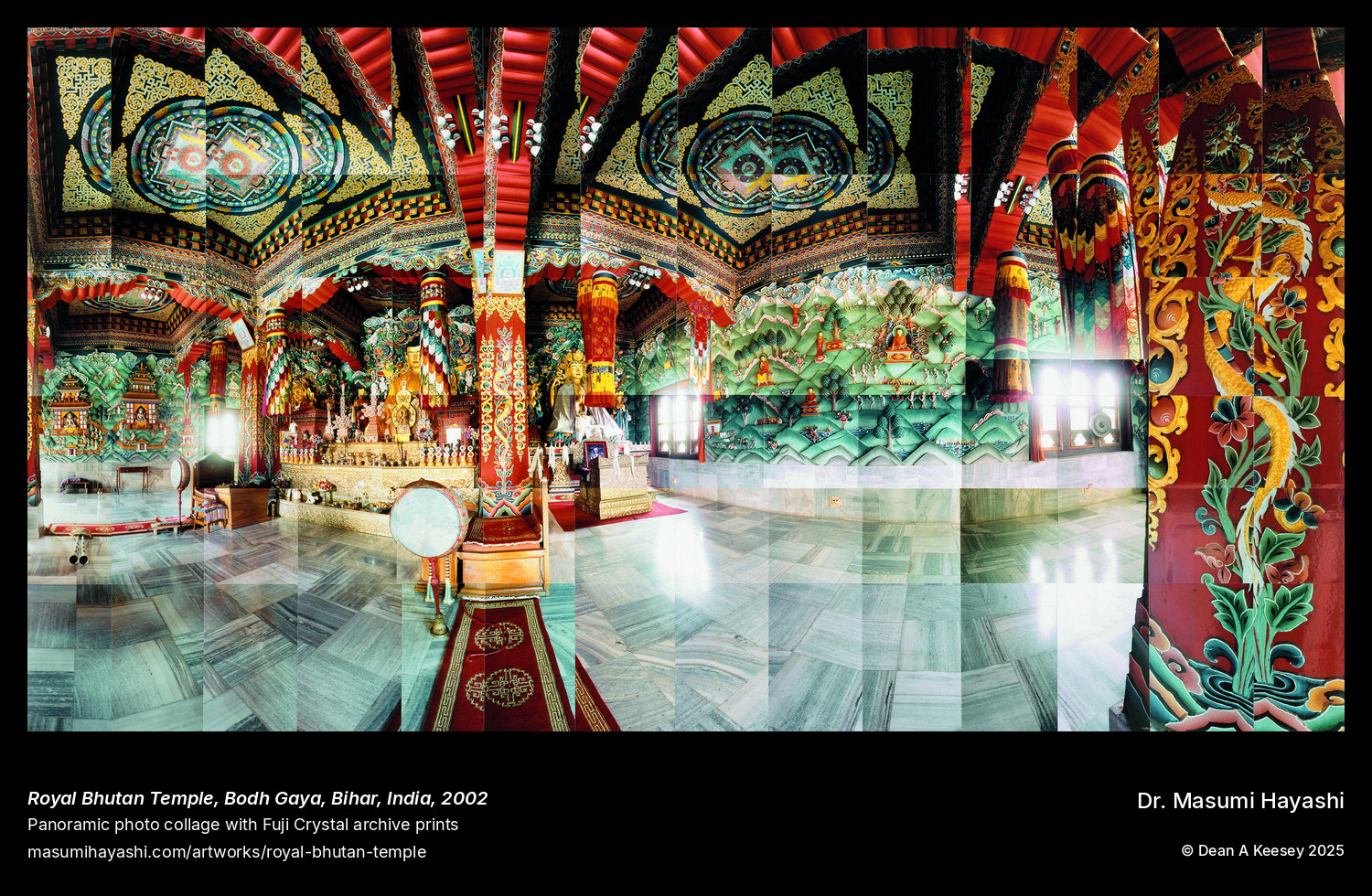
Royal Bhutan Temple, Bodh Gaya, Bihar, India

Bodh Gaya, Bihar, India

Panoramic Photo Collage

2000

27 x 50

Royal Bhutan Temple, Bodh Gaya, Bihar, India

Overview

“Royal Bhutan Temple, Bodh Gaya” documents one of the many international Buddhist temples surrounding the Mahabodhi Temple complex at Bodh Gaya, Bihar—the site where Siddhartha Gautama attained enlightenment under the Bodhi tree circa 6th century BCE, becoming the Buddha. Created in 2000 during Masumi Hayashi’s turn-of-millennium photographic journey through India and Cambodia, this 27-by-50-inch vertical panorama represents the twelfth work discovered from that pivotal 2000 expedition—a journey now documented to include seven Indian sites and five Cambodian temples, all sharing the technical specification of Fuji 4×6 film stock.

The Royal Bhutan Monastery, constructed in the 1990s with support from the royal family of Bhutan, exemplifies the distinctive Bhutanese architectural tradition transplanted to Buddhism’s most sacred geographical location. Built in traditional Bhutanese style with characteristic fortress-like appearance, colorful woodwork, and sloping walls, the temple stands among dozens of international Buddhist structures—Thai, Japanese, Tibetan, Vietnamese, Chinese—each nation’s architectural interpretation of Buddhist devotion coexisting within walking distance of the ancient Mahabodhi Temple and sacred Bodhi tree. This architectural pluralism at Bodh Gaya creates a unique landscape where diverse Buddhist national and cultural traditions gather around shared origin narrative.

The 2000 creation date and Fuji 4×6 film specification position this work firmly within the turn-of-millennium journey, now revealed to be more extensive than previously understood. The journey’s Indian component documented seven sites across four states—Bihar (Bodh Gaya: Bodhi Tree + Royal Bhutan Temple), Madhya Pradesh (Khajuraho: Kandariya + Lakshmana temples), Rajasthan (Jaisalmer: Jain Temple + Kund Pava Square), and Uttar Pradesh (Varanasi: River Ganges)—before proceeding to Cambodia’s Angkor complex. The double documentation of Bodh Gaya (the sacred Bodhi Tree and this Bhutanese temple) parallels the journey’s pattern of multiple works at significant sites (two Khajuraho temples, two Jaisalmer works), suggesting sustained photographic engagement with locations of particular religious or architectural significance.

The work’s edition history reveals significant family placement—Edition 1 held by Dance & Connie Hayashi-Smith (Masumi’s daughter and son-in-law)—while three editions remain in Foundation inventory, an unusually high retention rate suggesting either strong institutional interest anticipated or Foundation preference for maintaining flexibility in future placements of this work documenting Buddhism’s most sacred geographical site.

Historical and Cultural Context

Bodh Gaya: Buddhism’s Sacred Origin

Bodh Gaya holds unparalleled status within Buddhist tradition as the location of Siddhartha Gautama’s enlightenment under the Bodhi tree, the event transforming ascetic seeker into Buddha (“awakened one”) and establishing the foundational experience Buddhist practice seeks to replicate. The site’s significance transcends sectarian Buddhist divisions—Theravada, Mahayana, Vajrayana traditions all recognize Bodh Gaya’s supreme importance—making it the single most significant pilgrimage destination within Buddhism, analogous to Mecca for Muslims or Jerusalem for multiple Abrahamic traditions.

The Mahabodhi Temple complex, originally constructed by Emperor Ashoka in the 3rd century BCE and rebuilt in its current form during the 5th-6th centuries CE, marks the precise location where Buddha sat in meditation beneath the original Bodhi tree. The current tree descends from the original through documented botanical lineage: cuttings taken to Sri Lanka in 3rd century BCE, then returned to Bodh Gaya centuries later when the original tree suffered damage, establishing continuous living connection to the enlightenment event across 2,500 years.

UNESCO’s 2002 World Heritage inscription (two years after Hayashi’s documentation) recognizes the Mahabodhi Temple as “first temple built by Emperor Asoka in the 3rd century BCE, and the present temple dates from the 5th-6th centuries CE” and acknowledges it as “one of the earliest Buddhist temples built entirely in brick, still standing in India, from the late Gupta period.” The inscription emphasizes the site’s significance as the place where “Buddha Sakyamuni attained supreme and perfect enlightenment,” establishing it as “the most important pilgrimage place and sacred site for millions of Buddhist followers around the world.”

International Buddhist Temples at Bodh Gaya

The proliferation of international Buddhist temples surrounding the Mahabodhi complex represents a distinctive 20th-century phenomenon, as newly independent Asian nations and Buddhist revival movements worldwide sought physical presence at Buddhism’s sacred origin. These temples serve multiple functions: pilgrimage accommodation for national communities, cultural representation of diverse Buddhist traditions, architectural demonstration of national Buddhist identity, and permanent presence at the religion’s most sacred geographical location.

The Royal Bhutan Monastery, inaugurated in the 1990s and still relatively new at the time of Hayashi’s 2000 documentation, exemplifies this international temple development. Funded through Bhutanese royal patronage and designed in traditional Bhutanese architectural style, the monastery functions as national representation within the international Buddhist community at Bodh Gaya. The structure’s characteristic features—fortress-like appearance with sloping walls, elaborate woodwork painted in traditional Bhutanese colors (red, gold, white), and architectural forms referencing Bhutan’s distinctive Drukpa Kagyü Buddhist tradition—create visual distinction from neighboring Thai, Japanese, Tibetan, and Chinese temples, each nation’s architectural vocabulary expressing Buddhist devotion through culturally specific forms.

This architectural diversity within compact geographical area creates unique landscape where Buddhist pluralism manifests spatially. A pilgrim can walk from Thai temple (ornate, colorful, Southeast Asian Buddhist aesthetic) to Japanese temple (minimalist, Zen-influenced design) to Tibetan monastery (fortress-like structures, prayer wheels, colorful prayer flags) to Bhutanese monastery within minutes, experiencing Buddhism’s geographical and cultural diversity concentrated around shared sacred origin. This spatial concentration of architectural difference united by religious commonality offers profound demonstration of Buddhism’s capacity to adapt to diverse cultural contexts while maintaining core doctrinal and devotional continuity.

Bhutanese Buddhist Architecture and Identity

Bhutanese architecture reflects the kingdom’s unique religious and political history as a Himalayan Buddhist nation maintaining independence and cultural continuity while neighboring regions experienced colonial occupation, communist revolution, or secular modernization. Bhutan’s dzong fortress-monasteries—massive structures combining religious, administrative, and defensive functions—established architectural vocabulary adapted in contemporary temple construction both within Bhutan and in international Bhutanese Buddhist structures like the Royal Bhutan Monastery at Bodh Gaya.

Characteristic features of Bhutanese architecture include: massive sloping walls (structural stability for earthquake-prone Himalayan regions), minimal use of nails in construction (traditional wood joinery techniques), elaborate carved and painted woodwork (particularly windows, doors, and supporting brackets), fortress-like appearance (referencing dzong traditions), and distinctive color schemes (red, gold, white, black with symbolic religious meanings). These architectural elements create immediately recognizable Bhutanese aesthetic distinguishable from other Himalayan Buddhist traditions (Tibetan, Ladakhi, Sikkimese) despite shared environmental conditions and religious frameworks.

The Royal Bhutan Monastery’s construction at Bodh Gaya in the 1990s coincided with Bhutan’s gradual opening to outside world while maintaining cultural preservation policies. The monastery functions as international representation of Bhutanese Buddhism at the religion’s most sacred site, architectural assertion of Bhutanese identity within global Buddhist community, and pilgrimage accommodation for Bhutanese visitors to Bodh Gaya. The structure’s traditional architectural vocabulary—transplanted from Himalayan mountain valleys to Bihar’s tropical plains—demonstrates Bhutanese commitment to cultural continuity even in radically different geographical contexts.

Format and Technical Analysis

Vertical Panoramic Strategy

The 27-by-50-inch dimensions create a 2.00:1 aspect ratio (exactly 2:1), a substantial vertical format emphasizing upward architectural movement while maintaining moderate width allowing contextual spatial information. This vertical emphasis suits Bhutanese temple architecture’s characteristic vertical development: sloping walls rising from broad bases to narrower upper stories, ornate window arrangements stacked vertically, and fortress-like profiles emphasizing height and defensive appearance.

The format’s 27-inch width provides sufficient lateral breadth to encompass substantial architectural facades while the 50-inch height—among the taller works in the Sacred Architectures series though not reaching the extreme 73-inch heights of the Jaisalmer works—allows documentation of multiple-story structures from ground to roofline. This moderate vertical emphasis balances architectural comprehensiveness with manageable physical dimensions for conservation and display.

The vertical orientation aligns this work with other moderately vertical panoramas in the series: “Airavatesvara Temple #2” (23×50 inches, 2.17:1, same height but narrower), “Man & God, Meenakshi Temple” (53×19.5 inches, horizontal but documenting vertical pillar hall elements), and extreme verticals like “Jain Temple, Jaisalmer” (25×73 inches, 2.92:1). The Royal Bhutan work’s exact 2:1 proportion creates visual simplicity—the height precisely double the width—potentially generating formal clarity and balanced vertical emphasis.

Fuji 4×6 Film: Turn-of-Millennium Journey Signature

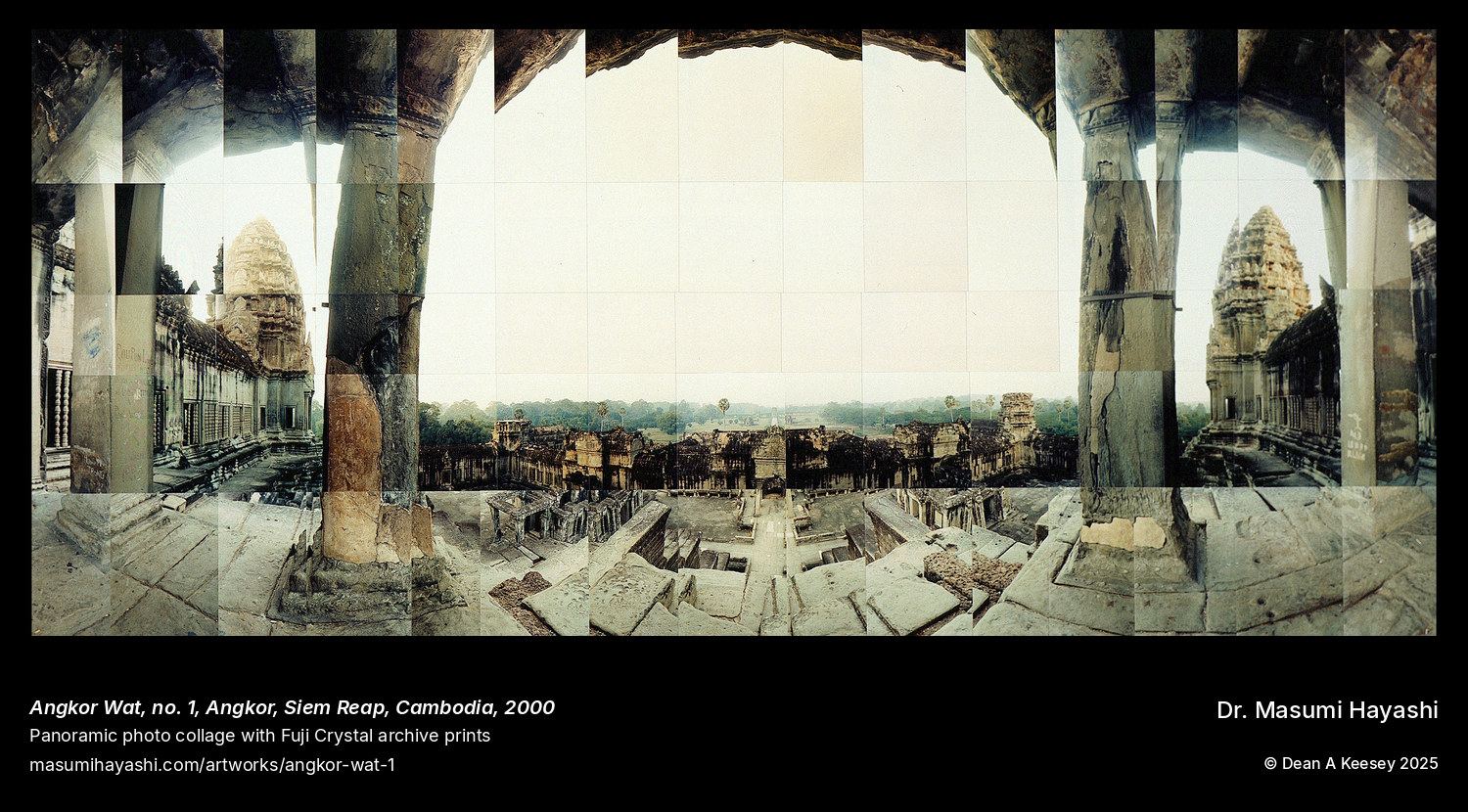
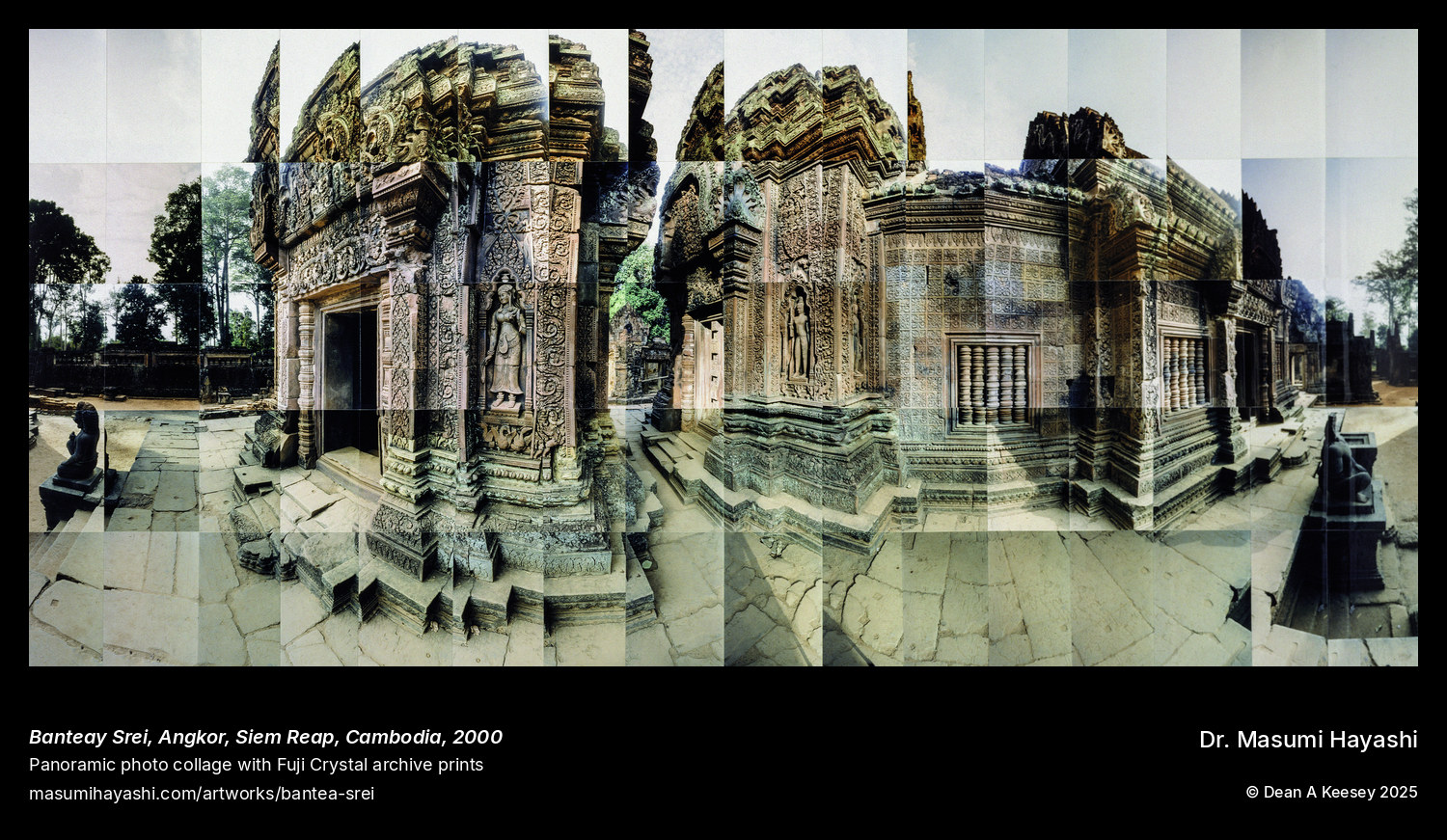
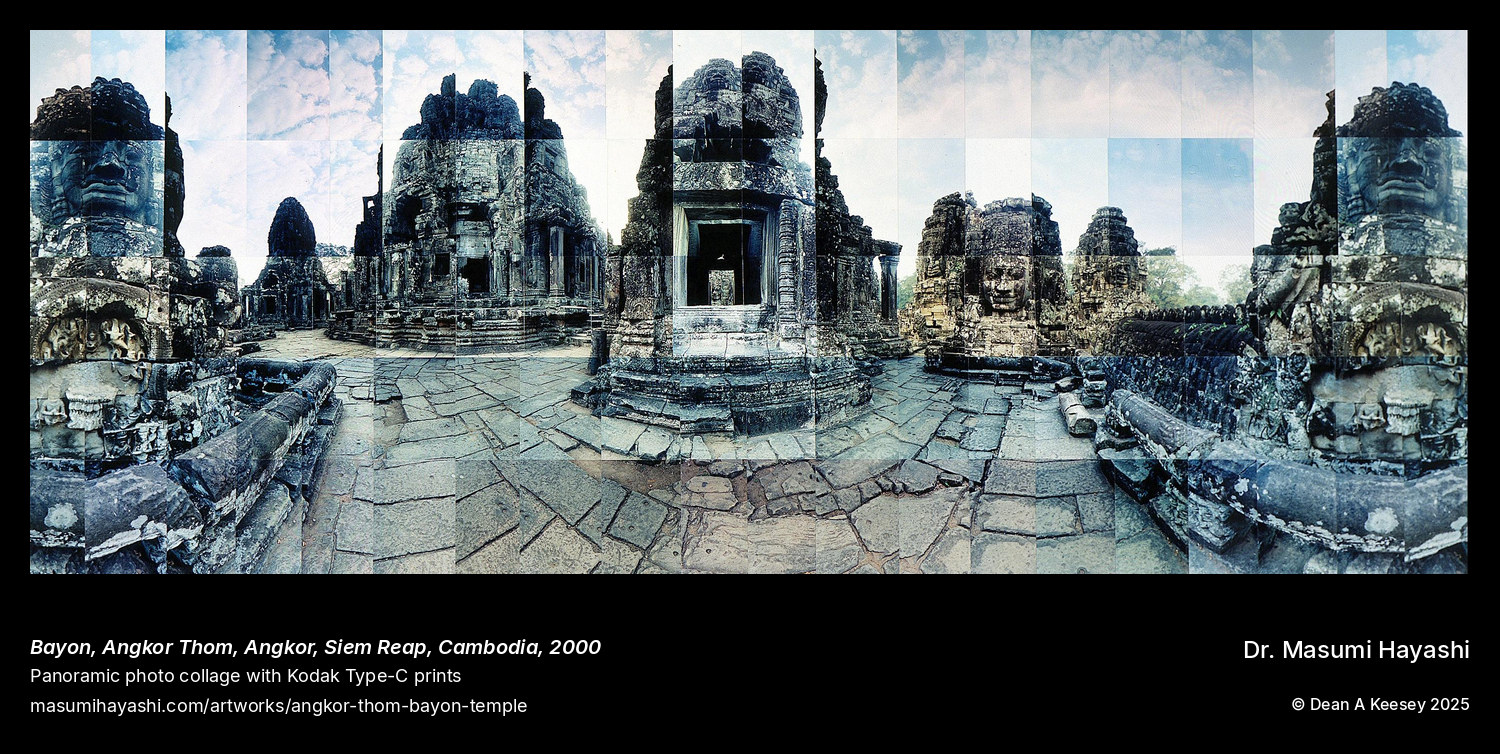
The Fuji 4×6 film specification serves as technical fingerprint identifying works from the 2000 turn-of-millennium journey, now documented to include twelve works: seven Indian sites (Bodh Gaya’s Bodhi Tree and Royal Bhutan Temple, Khajuraho’s Kandariya Mahadeva and Lakshmana temples, Jaisalmer’s Jain Temple and Kund Pava Square, Varanasi’s River Ganges) and five Cambodian temples (Banteay Srei, Angkor Wat No. 1, Bayon, Ta Prohm, Preah Khan).

This consistent film specification across geographically diverse sites spanning northern India (Bihar, Madhya Pradesh, Rajasthan, Uttar Pradesh) and Cambodia (all Angkor-region temples) confirms these works as coordinated photographic campaign rather than separate unrelated projects. The Fuji film choice—producing characteristically warm color palettes with rich saturation in reds and yellows—would capture both the colorful Bhutanese architectural painting and the warm tones of Bihar’s tropical light, maintaining visual consistency across the journey’s varied architectural subjects and geographical locations.

The 4×6 film format (medium format, larger than 35mm but smaller than large-format view cameras) balances several considerations: sufficient negative size for quality enlargement to 50-inch heights, portable equipment practical for extensive travel across Indian subcontinent and Southeast Asia, and reasonable film costs allowing extensive shooting at multiple sites. The format choice reflects practical photography under challenging travel conditions while maintaining technical quality sufficient for museum-scale enlargements.

Bodh Gaya Dual Documentation

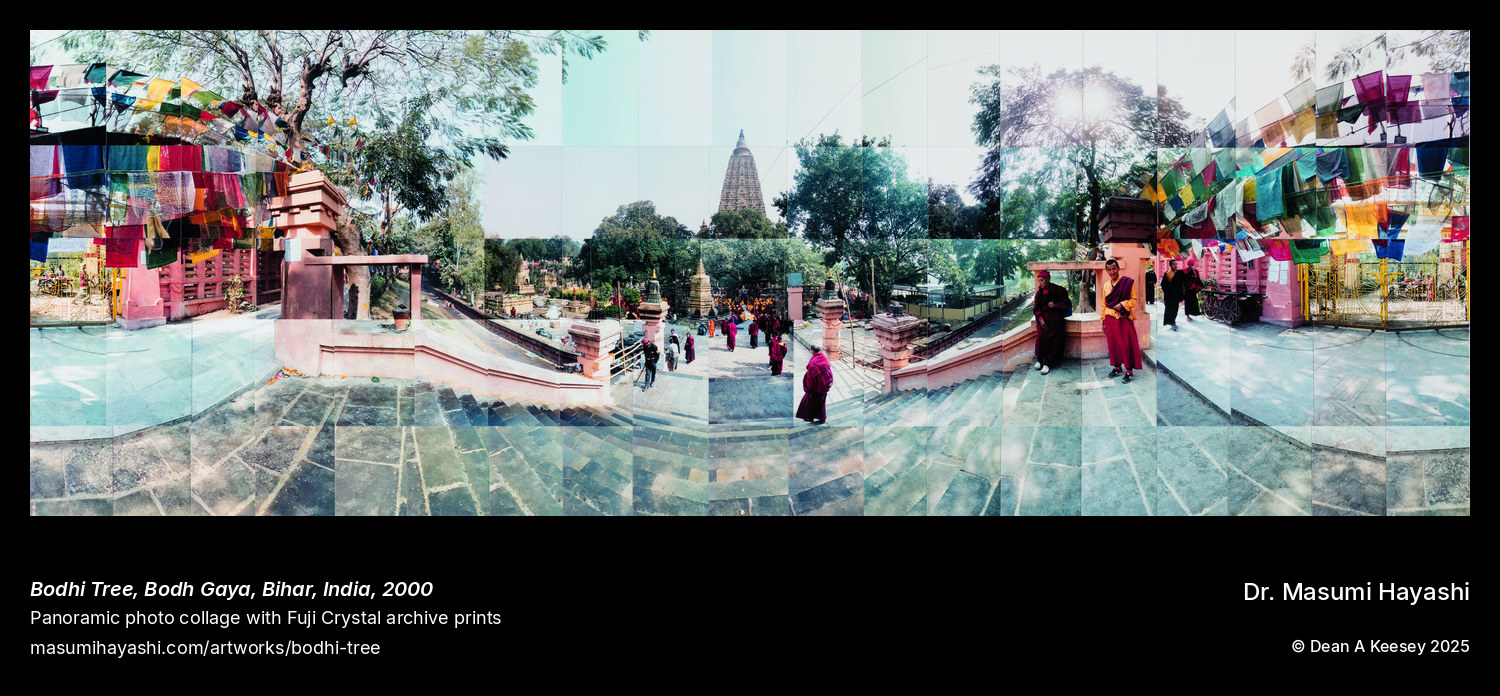
The existence of two Bodh Gaya works from the 2000 journey—the Bodhi Tree and this Royal Bhutan Temple—establishes systematic dual documentation of this supremely sacred Buddhist site. This pattern mirrors the journey’s treatment of other significant locations: two Khajuraho temples (Kandariya and Lakshmana, both UNESCO World Heritage Chandela masterpieces), two Jaisalmer works (Jain Temple and Kund Pava Square, both extreme verticals documenting different aspects of the desert fort city).

The dual Bodh Gaya documentation likely emphasizes different aspects: the Bodhi Tree work presumably documenting the sacred tree and immediate Mahabodhi Temple vicinity (the ancient pilgrimage site’s religious core), while this Royal Bhutan Temple work explores the contemporary international Buddhist presence surrounding the ancient sacred geography. This thematic differentiation—ancient sacred origin versus contemporary global Buddhist community—provides complementary perspectives on Bodh Gaya’s layered significance as both historical enlightenment site and living international pilgrimage center.

Series Context and Comparative Analysis

2000 Turn-of-Millennium Journey: Expanded Documentation

The discovery of the Royal Bhutan Temple as twelfth work from the 2000 journey significantly expands understanding of that pivotal photographic expedition’s scope and systematic organization:

India Component (7 works across 4 states):

  • Bihar: Bodhi Tree + Royal Bhutan Temple (Bodh Gaya, Buddhism’s sacred origin)
  • Madhya Pradesh: Kandariya Mahadeva + Lakshmana (Khajuraho, UNESCO Chandela temples)
  • Rajasthan: Jain Temple + Kund Pava Square (Jaisalmer, desert fort city)
  • Uttar Pradesh: River Ganges (Varanasi, Hindu sacred river)

Cambodia Component (5 works, all Angkor region):

  • Banteay Srei, Angkor Wat No. 1, Bayon, Ta Prohm, Preah Khan

This expanded journey reveals systematic documentation of major Buddhist, Hindu, and Jain sacred sites across northern India and Cambodia’s Khmer temple complexes. The inclusion of Bodh Gaya’s Buddhist temples alongside Khajuraho’s Hindu architecture, Jaisalmer’s Jain monuments, and Varanasi’s Hindu sacred geography demonstrates comprehensive approach to documenting South and Southeast Asian religious architecture across multiple traditions.

The journey’s pattern of multiple works at significant sites (two at Bodh Gaya, two at Khajuraho, two at Jaisalmer) suggests sustained photographic engagement with locations of particular religious, architectural, or cultural significance. This multi-work documentation parallels Hayashi’s later practice with the Meenakshi trilogy (2001-2003), Airavatesvara horizontal/vertical pair (2004), and Okunoin cemetery duo (1996), establishing systematic multi-perspective investigation as characteristic methodology.

International Buddhist Architecture at Sacred Sites

The Royal Bhutan Temple work represents unique subject within the Sacred Architectures series: contemporary architecture at ancient sacred site, national Buddhist expression in international context, and relatively recent construction (1990s) documenting living religious community rather than historical monument. This contemporaneity distinguishes the work from most series subjects documenting temples centuries or millennia old.

The work’s exploration of international Buddhist presence at Bodh Gaya complements the series’ broader documentation of Buddhist sacred architecture across multiple national and sectarian traditions: Japanese Buddhist temples and cemeteries (Okunoin, various Kyoto sites), Tibetan exile institutions (Norbulingka, Tsuglagkhang in Dharamsala), Cambodian Khmer Buddhism (Angkor temples), and now Bhutanese Himalayan Buddhism. This diverse Buddhist documentation demonstrates the religion’s geographical spread and cultural adaptation while all traditions recognize Bodh Gaya’s supreme significance.

The juxtaposition of new Bhutanese architecture and ancient Mahabodhi site creates temporal layering—2,500-year sacred geography receiving contemporary architectural interpretation—that enriches the series’ investigation of how sacred sites evolve while maintaining religious continuity. The Royal Bhutan Monastery represents living Buddhist practice engaging with foundational enlightenment narrative through contemporary architectural expression in traditional cultural vocabulary.

Family Edition Placement

Edition 1’s placement with Dance & Connie Hayashi-Smith (Masumi’s daughter and son-in-law) creates distinctive provenance within the Sacred Architectures series. Family retention of first editions suggests personal significance or preference for this work documenting Buddhism’s most sacred site. The placement also ensures the work remains within family stewardship while Foundation retains three additional editions (two framed, one unframed) providing institutional placement flexibility.

This family edition pattern appears occasionally across Hayashi’s work but remains relatively uncommon, most editions either retained in Foundation inventory for future institutional placement or distributed to museums, private collectors, or other contexts. The family retention of the Royal Bhutan work might reflect personal connection to Buddhist subject matter, appreciation for Bhutanese architectural beauty, or sentimental value attached to the 2000 millennium journey’s documentation of supremely sacred Buddhist geography.

Edition Status and Institutional Context

Current Edition Locations

The edition tracking reveals unusual distribution with strong Foundation retention:

This retention of three editions from a five-edition run (60% retention rate) significantly exceeds typical patterns where most works show zero to one edition retained. The high retention suggests either:

  1. Strong anticipated institutional interest (reserving multiple editions for potential museum placements)
  2. Foundation preference for maintaining flexibility (framed and unframed options)
  3. Limited distribution to date (work not yet widely marketed or placed)
  4. Strategic holding for future Bodh Gaya-focused exhibitions or Buddhist art collections

The two framed editions provide immediate placement readiness for institutional acquisitions while the unframed edition allows custom framing matching specific institutional requirements or collector preferences. The packets notation for Edition 4 maintains printing flexibility if demand warrants additional impressions.

Institutional Placement Potential

The work’s distinctive characteristics position it favorably for institutional collections focused on:

  • Buddhist art and architecture: Museums building Buddhist architectural documentation, pilgrimage site photography, contemporary Buddhist practice
  • South Asian studies: Collections emphasizing Indian sacred geography, Buddhist historical sites, religious pluralism
  • Bhutanese culture: Institutions documenting Himalayan Buddhist traditions, Bhutanese art and architecture, contemporary Bhutanese cultural expression
  • Contemporary religious architecture: Collections exploring modern religious building, traditional architectural vocabulary in new contexts
  • UNESCO World Heritage: Institutions collecting photographic documentation of Bodh Gaya (inscribed 2002, two years after this work’s creation)
  • Comparative religious architecture: Academic collections teaching Buddhist architectural diversity, national expressions of shared religious tradition

Museums with existing Bodh Gaya-related collections (Buddhist art, Indian archaeology, pilgrimage studies) might particularly value this contemporary perspective complementing historical artifacts. The work’s documentation of Bhutanese architectural tradition transplanted to Indian sacred geography offers teaching opportunities about Buddhist cultural diversity and international religious community formation.

Conservation and Display Considerations

The 27-by-50-inch vertical format presents moderate conservation challenges, the 50-inch height requiring careful handling and professional framing but remaining manageable compared to the series’ tallest works (73 inches). The two framed editions in inventory presumably demonstrate appropriate conservation standards, providing models for Edition 5’s eventual framing or future edition printing.

The vertical orientation creates commanding presence on gallery walls while moderate width (27 inches) prevents unwieldy proportions. The format works effectively in various exhibition contexts: standalone focal piece emphasizing Bodh Gaya’s significance, thematic grouping with other Buddhist architecture documentation, or comparative display with the Bodhi Tree work offering complementary perspectives on the same sacred site.

Cultural Significance and Artistic Achievement

“Royal Bhutan Temple, Bodh Gaya” represents Masumi Hayashi’s photographic engagement with Buddhism’s most sacred geographical location during the pivotal turn-of-millennium moment. The work documents the contemporary international Buddhist presence surrounding the enlightenment site—architecture embodying national Buddhist identities coexisting around shared origin narrative. The Bhutanese temple’s traditional Himalayan architectural vocabulary transplanted to Bihar’s tropical plains demonstrates Buddhism’s capacity to maintain cultural specificity while participating in international religious community united by recognition of Bodh Gaya’s supreme significance.

The work’s discovery as twelfth piece from the 2000 journey expands understanding of that photographic expedition’s systematic scope: seven Indian sites across four states (Buddhist Bodh Gaya, Hindu Khajuraho and Varanasi, Jain Jaisalmer) plus five Cambodian Khmer temples, all united by Fuji 4×6 film specification and turn-of-millennium timing. This comprehensive documentation of South and Southeast Asian sacred architecture across multiple religious traditions positions the 2000 journey as among Hayashi’s most ambitious and systematic photographic campaigns.

As documentation of relatively recent architecture (1990s construction) at ancient sacred site (2,500-year enlightenment geography), the work explores temporal layering characteristic of living pilgrimage centers: ancient origin narratives receiving continuous contemporary interpretation, historical sacred geography hosting modern international community, and foundational religious events generating ongoing architectural expression across cultures and centuries. This temporal complexity—past and present, ancient and contemporary, foundational and evolving—enriches the Sacred Architectures series’ investigation of how sacred sites maintain religious continuity while accommodating cultural change.

The family placement of Edition 1 with Dance Hayashi-Smith adds biographical dimension, suggesting personal significance of this Buddhist sacred site documentation within Hayashi’s larger photographic project. The retention of three additional editions provides Foundation flexibility for strategic institutional placements while ensuring this important work documenting Buddhism’s supreme pilgrimage destination remains available for museum acquisitions, scholarly access, and public education about Bodh Gaya’s layered significance as ancient sacred origin and contemporary international Buddhist center.

Collection Information

Year: 2000 Location: Bodh Gaya, Bihar, India Medium: Panoramic Photo Collage Dimensions: 27 × 50 inches Film Format: 4 × 6 Film Stock: Fuji Edition: 1 of 5

  1. Dance & Connie Hayashi-Smith (family placement)
  2. Inventory - framed
  3. Inventory - framed
  4. Packets (unprinted)
  5. Inventory - unframed

Note: First edition placed with artist’s daughter Dance Hayashi-Smith. Three editions retained in Foundation inventory (two framed, one unframed), unusually high retention suggesting anticipated institutional interest or strategic holding for Bodh Gaya/Buddhist architecture-focused acquisitions. Twelfth work documented from 2000 turn-of-millennium photographic journey (7 India + 5 Cambodia), all sharing Fuji 4×6 film specification.

Donate