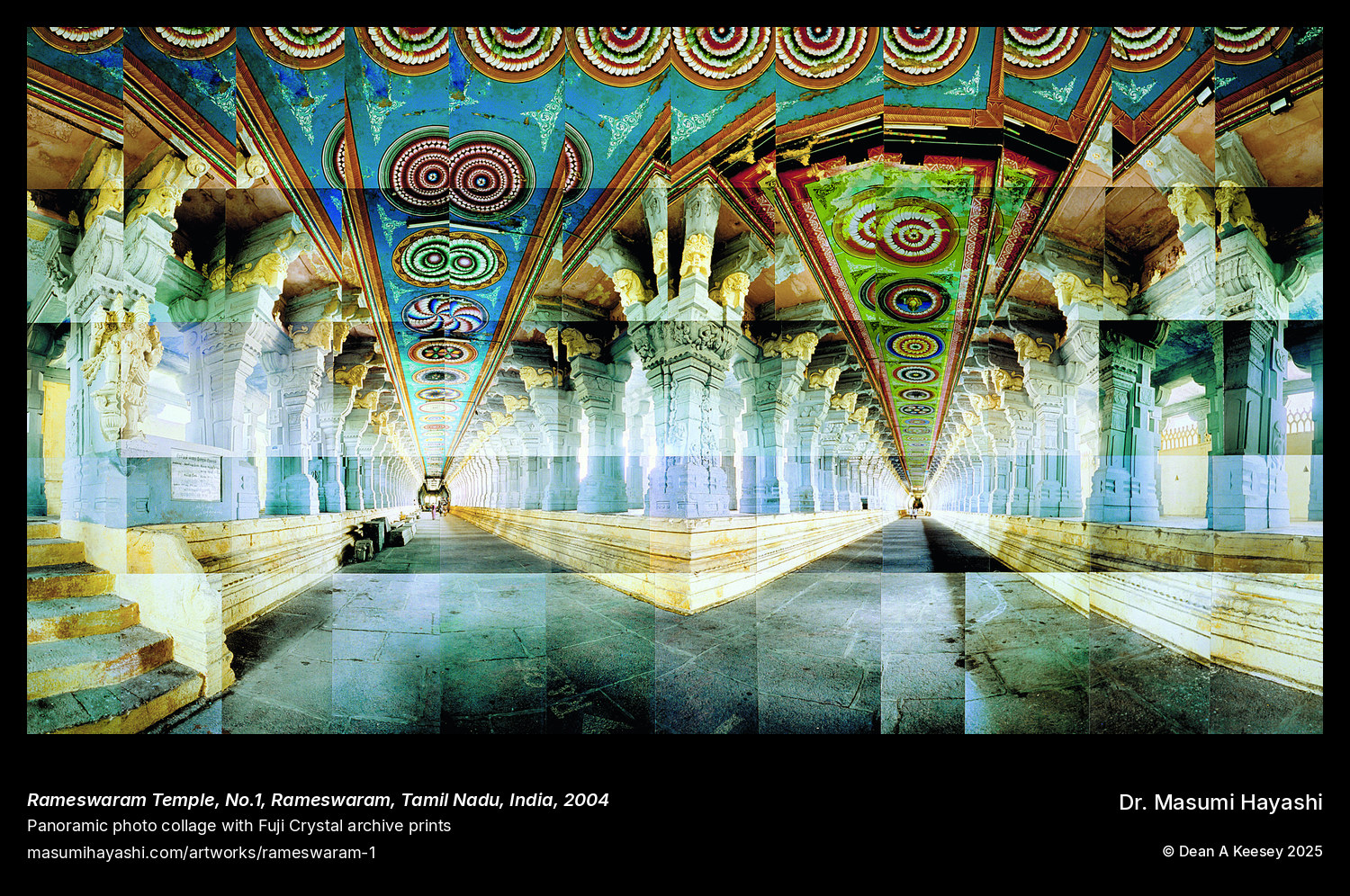
Rameswaram Temple
Rameswaram, Tamil Nadu, India
Panoramic Photo Collage
2004
41" x 23"
Rameswaram Temple #1, Rameswaram, Tamil Nadu, India
Overview
This panoramic photo collage documents Ramanathaswamy Temple in Rameswaram, Tamil Nadu - one of Hinduism’s holiest pilgrimage sites and one of the twelve Jyotirlingas (sacred Shiva shrines containing luminous linga manifestations) spread across India. Created in 2004 as part of Hayashi’s comprehensive Tamil Nadu temple documentation, this work captures the temple’s world-famous corridors - the longest temple corridors on Earth stretching 197 meters (east), 133 meters (west), with 1,212 massive pillars creating repetitive perspective effects unique to Dravidian architecture. The catalog notation “270 degrees” suggests this work documents the temple’s extraordinary architectural panorama: perhaps the endless pillar perspective converging toward vanishing points, or the ritual circuit pilgrims walk through these corridors performing ablutions at 22 sacred wells (tirthas) corresponding to Ramayana epic locations. Rameswaram holds unique status in Hindu tradition - sacred to both Shiva worshippers (Jyotirlinga) and Rama devotees (Ramayana), positioned on an island at India’s southeastern tip where Rama worshipped Shiva before crossing to Lanka to rescue Sita from demon king Ravana, making this simultaneously pilgrimage destination and mythological landscape embedded in India’s collective religious imagination for 2,000+ years.
Historical and Religious Context
Rameswaram: The Bridge to Lanka
Temple’s significance rooted in Ramayana epic connections:
Ramayana epic narrative (c. 500 BCE text describing events c. 5000 BCE per tradition):
- Prince Rama (avatar of Vishnu) exiled to forest with wife Sita and brother Lakshmana
- Sita kidnapped by Ravana (demon king of Lanka = modern Sri Lanka)
- Rama builds army of monkeys and bears led by Hanuman
- Rama’s Setu (bridge to Lanka) built by monkey army at Rameswaram
- Geological formations (Adam’s Bridge / Rama’s Bridge) between India-Sri Lanka interpreted as bridge remnants
- Before crossing to battle Ravana, Rama needed to worship Shiva to absolve sin of killing Ravana (learned Brahmin despite being demon)
- Hanuman sent to Mount Kailash to bring Shiva linga, delayed
- Sita made sand linga, Rama installed and worshipped (Ramanathaswamy = “Lord of Rama”)
- Hanuman arrived late with Kailash linga, installed nearby (Kasilingam)
- Both lingas worshipped at temple today
Rameswaram’s dual sacred status:
- Jyotirlinga (one of 12 most sacred Shiva shrines in India)
- Ramayana pilgrimage site (where Rama worshipped Shiva)
- Char Dham pilgrimage (one of four cardinal pilgrimage sites, southeastern)
- Hindu saying: “Pilgrimage to Varanasi incomplete without Rameswaram, pilgrimage to Rameswaram incomplete without Varanasi”
Island location significance:
- Pamban Island, southeastern tip of India
- Connected to mainland by Pamban Bridge (rail and road)
- 40 km from Sri Lanka (across Palk Strait)
- Adam’s Bridge / Rama Setu: Chain of limestone shoals between India-Sri Lanka
- NASA satellite images show geological formation interpreted as “bridge”
- Religious tradition: Rama’s bridge built by monkey army
- Controversial 2007 Sethusamudram Shipping Canal Project opposed by Hindu groups
Ramanathaswamy Temple: Architectural History
Temple evolved over 1,000+ years:
Ancient origins:
- Tradition claims temple site 2,000+ years old (Ramayana period)
- Archaeological evidence: Major construction 12th century CE onwards
- Continuous renovation and expansion through centuries
- Current form: Primarily 12th-17th century
Major construction periods:
12th century: Early temple foundations
- Pandya dynasty patronage
- Chola empire influence (Dravidian architecture)
15th-16th century: Major expansions
- Setupati rulers (local Maravar chieftains appointed by Madurai Nayaks)
- Construction of massive corridors
- Gopurams (gateway towers) erected
17th century: Completion of corridor system
- Longest temple corridors in world completed
- 1,212 pillars installed (some sources say 1,200+)
- Elaborate sculptural decoration
- Four concentric corridors creating nested rectangles
Architectural statistics (extraordinary scale):
- East corridor: 197 meters (646 feet) long
- West corridor: 133 meters (436 feet) long
- North and South corridors: 67 meters each
- Total pillars: 1,212 massive sculptured columns
- Pillar height: 30 feet each
- Corridor width: Wide enough for processions, crowds
- Total temple complex: Covers 15 acres
22 sacred wells (tirthas):
- Distributed throughout temple complex
- Each associated with specific deity or Ramayana location
- Pilgrims perform ritual ablutions in sequence
- Water believed to wash away sins
- Names correspond to sacred rivers, gods, Ramayana sites
- Agni Theertham (sea bathing before temple entry, on nearby beach)
Dravidian Temple Architecture Excellence
Rameswaram represents pinnacle of Tamil temple design:
Dravidian architectural elements:
- Gopurams: Multi-tiered gateway towers at cardinal directions
- Prakaras: Concentric enclosures (corridors surrounding sanctum)
- Corridors: Pillar halls for circumambulation (pradaksina)
- Mandapas: Pillared halls for ceremonies
- Garbhagriha: Inner sanctum housing Shiva linga
- Repetitive pillar perspective: Unique visual effect
Pillar corridor phenomenon:
- 1,212 pillars create extraordinary perspective effects
- Parallel rows of massive columns
- Each pillar sculpted with deities, mythological scenes
- Repetition creates infinite-seeming vista
- Vanishing point perspectives in multiple directions
- Architectural rhythm: Pillar, space, pillar, space…
- Light and shadow patterns throughout day
- Pilgrim movement through architectural forest
- “270 degrees” notation suggests panoramic capture of this perspective
Comparison to other Tamil temples:
- Meenakshi Temple, Madurai (Hayashi documented 09022, 09038): Urban pilgrimage center, 14 gopurams
- Airavatesvara Temple, Darasuram (Hayashi documented 09001, 09002): UNESCO World Heritage Chola temple
- Rameswaram distinguished by: Island isolation, corridor length, Ramayana connection, Jyotirlinga status
Pilgrimage Practices and Rituals
Rameswaram pilgrimage involves specific ritual sequence:
Full pilgrimage protocol:
- Agni Theertham (sea bathing) - Ritual purification in Bay of Bengal before entering temple
- 22 wells ritual - Bathing in sequence of tirthas throughout temple
- Main shrine darshan - Viewing Ramanathaswamy linga (main deity)
- Kasilingam worship - Hanuman’s linga from Kailash
- Circumambulation - Walking through corridors (pradaksina)
- Dhanushkodi visit - Tip of island (believed end of Rama’s bridge)
Annual festivals:
- Maha Shivaratri (February-March) - Great Night of Shiva, major pilgrimage time
- Thirukalyanam (July-August) - Celestial wedding of Shiva-Parvati, 10-day festival
- Arudra Darshanam (December-January) - Shiva’s cosmic dance
Pilgrimage demographics:
- Year-round steady flow (no specific season required)
- Peak: Festival times and school holidays
- Pilgrims from across India (especially South India, but pan-Indian)
- Many combine with Kanyakumari (India’s southern tip, 300 km away)
- International Hindu diaspora pilgrims
Artistic Significance
2004 Tamil Nadu Temple Documentation
Part of comprehensive Tamil Nadu sacred architecture series:
Tamil Nadu temples documented by Hayashi:
- Meenakshi Temple, Madurai (2 works: 09022, 09038) - Urban goddess temple
- Airavatesvara Temple, Darasuram (2 works: 09001, 09002) - UNESCO Chola masterpiece
- Rameswaram Temple (this work, 09030, 2004) - Island pilgrimage, Jyotirlinga, corridors
- Muthiah Ayyanar Temple, Kochadai Village (09026, date unknown) - Rural folk deity shrine
Geographic pattern: Tamil Nadu concentration
- 4 different temple sites documented (7+ individual works)
- Demonstrates Tamil Nadu’s extraordinary temple architecture density
- Dravidian tradition comprehensively documented
- Urban (Madurai), UNESCO (Darasuram), pilgrimage (Rameswaram), rural (Kochadai) range
Why multiple Tamil Nadu temples?
- Dravidian architecture represents distinct tradition from North Indian Nagara style
- Tamil Nadu preserves living temple culture (continuous worship, festivals, pilgrimages)
- Architectural innovation: Massive gopurams, elaborate corridors, sculptural programs
- UNESCO recognition (Great Living Chola Temples designation)
41 × 23” Horizontal Panorama
Format ideally suited to corridor documentation:
Horizontal emphasis suggests:
- Endless perspective of 1,212-pillar corridors
- 197-meter east corridor length
- Vanishing point convergence effects
- Repetitive pillar rhythm (pillar-space-pillar-space…)
- Procession of pilgrims through architectural framework
- Multiple concentric enclosures in single frame
“270 degrees” notation interpretation:
- Could refer to panoramic sweep (not quite 360° full circle, but 3/4 rotation)
- Three walls of rectangular corridor (not all four)
- Multiple directions of corridor perspectives combined
- Suggests comprehensive architectural documentation, not single viewpoint
- Hayashi’s photo collage technique: Multiple images assembled into panoramic view
Contrast with vertical works:
- Tamil Nadu gopurams often demand vertical format (tower emphasis)
- Corridors demand horizontal (length emphasis)
- This work: Horizontal 41×23 (1.78:1 ratio, moderate panorama)
- Format responsive to specific architectural feature documented
Edition Status and Placement
Inventory distribution:
- Edition 1: Framed in inventory (Artist’s estate retained, exhibition-ready)
- Editions 3, 4, 5: Packets (prepared for sale/distribution)
- Edition 2: Not listed (placement unknown, or never completed?)
Framed retention suggests:
- Work valued by artist (kept framed for exhibitions)
- Quality result (not “needs work” notation like some pieces)
- Exhibition potential recognized
Missing Edition 2:
- Possibly placed before 2007 catalog (not documented)
- Could be damaged or incomplete
- Or simple catalog omission
- Pattern seen in other works where not all editions tracked
Photographing Infinite Perspective
Rameswaram corridors present unique photographic opportunities and challenges:
Architectural photography opportunities:
- Repetitive pillar patterns (visual rhythm)
- Perspective convergence (vanishing points)
- Light and shadow through corridor length
- Sculptural detail on 1,212 pillars
- Human scale (pilgrims dwarfed by 30-foot pillars)
- Architectural infinity effect
Technical challenges:
- Extreme length (197 meters = 646 feet east corridor)
- How to capture scale in single image?
- Photo collage technique: Multiple images combined into panoramic vista
- Lighting variations along corridor length
- Crowds of pilgrims (constant movement)
- Repetition risks: How to show pattern without monotony?
Compositional questions:
- Emphasize single vanishing point perspective (classical architectural photography)?
- Show multiple corridors (270° panorama suggestion)?
- Include pilgrims for scale and living worship context?
- Detail (pillar sculpture) vs. overall (infinite perspective)?
- Inner corridors (darker, intimate) vs. outer corridors (lighter, grander)?
Photo collage advantages for Rameswaram:
- Can combine multiple viewpoints
- Can show corridor length beyond single photograph’s field of view
- Can create comprehensive architectural portrait
- Can show “270 degrees” of surrounding corridor perspectives
- Hayashi’s technique: Assembling architectural totality
Contemporary Relevance and Enduring Questions
Rameswaram Temple documentation invites consideration of:
Architectural and spatial:
- How do 1,212-pillar corridors create unique spatial experience?
- What is psychological effect of walking through 197-meter pillar perspective?
- How does repetition of identical architectural elements create sacred space?
- Why did Dravidian tradition develop world’s longest temple corridors?
Mythological and historical:
- How does Ramayana epic geography (Rama’s bridge to Lanka) shape pilgrimage?
- What is relationship between mythological event (Rama worship) and historical temple (12th century+)?
- How do Adam’s Bridge geological formations relate to religious tradition?
- Why does Rameswaram require both Jyotirlinga (Shiva) and Ramayana (Vishnu) devotion?
Pilgrimage and ritual:
- What is significance of 22 wells ablution sequence?
- How does island isolation enhance pilgrimage experience?
- Why does Hindu tradition link Varanasi (north) and Rameswaram (south) as complementary?
- What is role of Agni Theertham (sea bathing) before temple entry?
Photographic documentation:
- How to photograph architectural infinity (endless corridor perspective)?
- What does “270 degrees” notation reveal about documentation strategy?
- How does horizontal panoramic format serve corridor architecture?
- Can photo collage technique convey experience of walking through pillar forest?
Comparative Context: Rameswaram and Other Pilgrimage Sites
Hayashi’s pilgrimage site typology:
1. River bathing sites:
- River Ganges, Varanasi (09033, 2000) - Ghat architecture, cremation, moksha
- Hanuman Ghat, Bhaktapur (09015, 2004) - Nepal, smaller scale
2. Island/coastal sites:
- Rameswaram Temple (09030, 2004, this work) - Island, sea bathing, corridors
- Golden Temple, Kathmandu (09013, 2004) - Urban tank (not sea)
3. Mountain/hilltop sites:
- Swayambhunath Stupa, Nepal (09037, 2002) - 365 steps, valley views
- Hemakuta Hill, Hampi (09016, date unknown) - Boulder landscape
4. Plains monuments:
- Most Angkor temples, Khajuraho temples - Flat sites, architectural focus
Rameswaram’s uniqueness in Hayashi’s corpus:
- ONLY island temple site documented
- ONLY work with explicit “270 degrees” notation (panoramic documentation strategy)
- Longest architectural element documented (197m corridor vs. tallest work 73” = 1.85m)
- Dual mythological systems (Shiva Jyotirlinga + Ramayana Vishnu avatar)
- Sea bathing + 22 wells = most elaborate ablution ritual documented
Educational Significance
This work teaches about:
- Rameswaram Temple: Ramanathaswamy, one of 12 Jyotirlingas, island pilgrimage site
- World’s longest temple corridors: 197m east corridor, 1,212 massive pillars, architectural infinity
- Ramayana geography: Rama’s bridge to Lanka, Shiva worship before battle, mythological landscape
- 22 sacred wells: Ritual ablution sequence, tirtha bathing, sin purification
- Dravidian architecture: Repetitive pillar perspectives, concentric prakaras, Tamil temple tradition
- Dual sacred status: Shiva Jyotirlinga + Ramayana site + Char Dham pilgrimage
- Adam’s Bridge: Geological formation between India-Sri Lanka, religious interpretation as Rama’s bridge
- Tamil Nadu temple architecture: Hayashi’s comprehensive documentation (Meenakshi, Airavatesvara, Rameswaram)
- Horizontal panoramic format: 41×23” ideal for corridor perspective, “270 degrees” documentation
- Photo collage technique: Assembling architectural totality beyond single photograph’s limits
Note: This canonical content was extracted from the Masumi Hayashi Foundation Master Catalogue (2007 inventory). Edition 1 (framed) in artist’s estate; Editions 3-5 in Packets (Edition 2 placement unknown). Created in 2004, this work documents Ramanathaswamy Temple in Rameswaram, Tamil Nadu - one of 12 Jyotirlingas (holiest Shiva shrines) and major Ramayana pilgrimage site where Rama worshipped Shiva before crossing to Lanka. World-famous for longest temple corridors on Earth: 197m east corridor with 1,212 massive pillars creating extraordinary repetitive perspective effects. 41×23” horizontal panorama ideally suited to corridor documentation. Catalog notation “270 degrees” suggests comprehensive panoramic capture of nested rectangular corridors from multiple viewpoints, assembled via Hayashi’s photo collage technique. Island location at southeastern tip of India, Adam’s Bridge geological formations to Sri Lanka interpreted as Rama’s mythological bridge. Part of comprehensive Tamil Nadu temple series (Meenakshi, Airavatesvara, Rameswaram - urban, UNESCO, island pilgrimage typology). Demonstrates Dravidian architectural tradition’s spatial innovations: architectural infinity through repetition, sacred space created by corridor length and pillar rhythm, pilgrimage as movement through sacred geography.