Patan Durbar Square, Patan, Nepal | Masumi Hayashi Foundation
Back to Gallery
Picture of Patan Durbar Square, Patan, Nepal by Dr. Masumi Hayashi

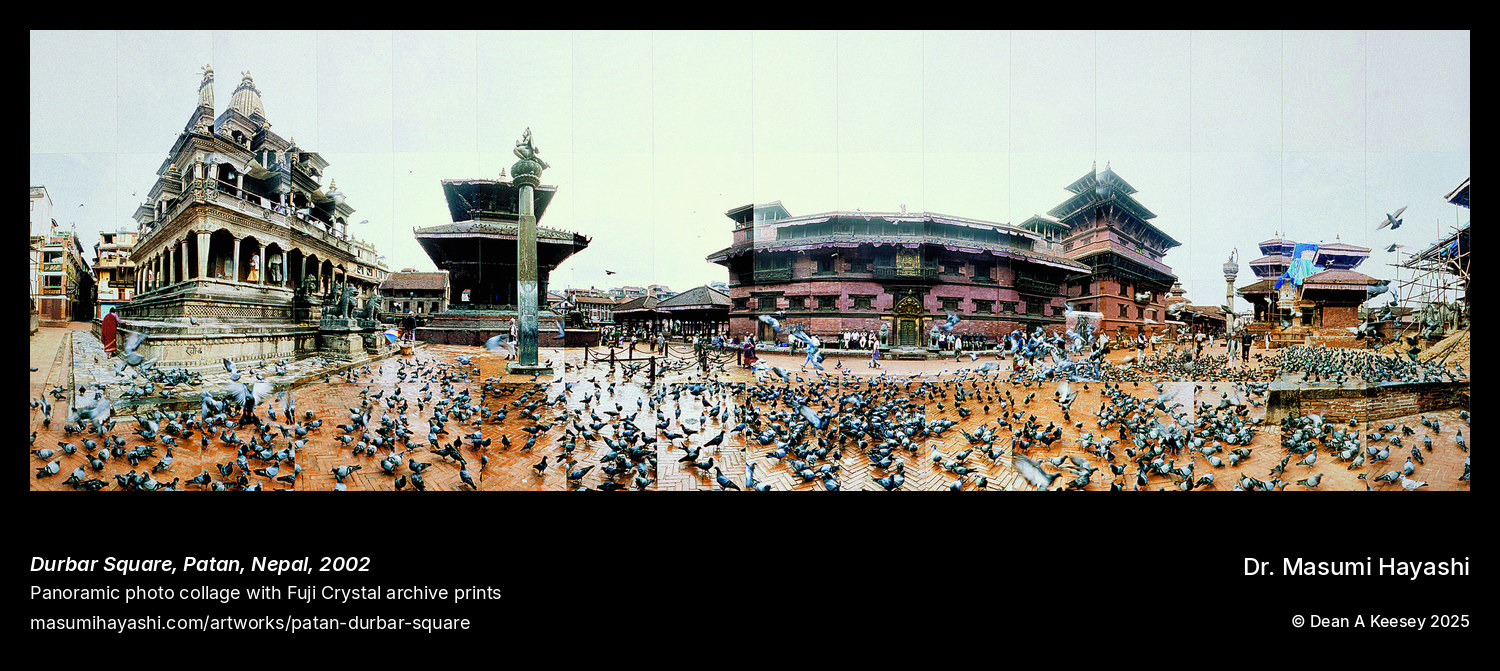
Patan Durbar Square, Patan, Nepal

Patan, Nepal

Panoramic photo collage

unknown

unknown

Patan Durbar Square, Patan, Nepal

Overview

This work documents Patan Durbar Square—one of three royal palace squares in Nepal’s Kathmandu Valley and UNESCO World Heritage Site representing pinnacle of Newari architecture spanning 12th-18th centuries. Patan (also called Lalitpur, “City of Beauty”) served as capital of independent Malla Kingdom until 1769 unification, developing distinctive architectural identity expressed through royal palace complex, Hindu temples, Buddhist monasteries (bahal), and courtyard houses (chowk) surrounding central square functioning as ceremonial, religious, commercial, and social center. The square exemplifies Kathmandu Valley’s unique synthesis of Hindu-Buddhist sacred architecture where temples dedicated to different deities coexist within single architectural ensemble—Krishna Temple (17th century shikhara-style stone temple), Bhimsen Temple, Vishwanath Temple, and Royal Palace with its intricate wooden windows (tun), carved doorways, and gilded roofs creating architectural complexity unmatched in South Asian urbanism. Hayashi’s documentation captured Patan Durbar Square as living sacred landscape rather than preserved monument—pilgrims circumambulating temples, vendors selling religious offerings, residents conducting daily activities within World Heritage context where centuries-old architecture continues serving original sacred and civic functions despite earthquake damage (particularly devastating 2015 Gorkha earthquake which destroyed or severely damaged multiple temples documented by Hayashi). Within Sacred Architectures series, Patan represents Hayashi’s sustained engagement with Kathmandu Valley’s architectural heritage—one of three Durbar Squares documented (alongside Kathmandu and Bhaktapur), suggesting systematic approach to royal palace architecture as genre within broader Asian sacred architecture survey. Three editions tracked (one Foundation inventory unframed, two in “Packets”) indicates moderate commercial success, with “Packets” designation suggesting editions organized for exhibition circulation, research access, or potential sales rather than permanently placed in collections.

Historical Context: Patan and the Malla Kingdoms

Patan Durbar Square’s architectural splendor emerged from unique political and cultural conditions:

Ancient Origins (3rd Century BCE - 12th Century CE): Patan’s history extends to Licchavi period (5th-9th centuries) when Buddhist culture flourished in Kathmandu Valley:

  • Royal patronage of Buddhist monasteries and Hindu temples
  • Development of distinctive Newari artistic traditions
  • Trade route connections linking Tibet, India, and beyond
  • Artistic workshops producing metalwork, woodcarving, and religious sculpture

Malla Dynasty and Architectural Flowering (12th-18th Centuries): Under Malla rulers, Patan developed independent architectural identity:

Political Independence (until 1769): Kathmandu Valley divided into three kingdoms—Kathmandu, Patan, and Bhaktapur—competing through architectural magnificence:

  • Rival kings commissioned increasingly elaborate temples and palace complexes
  • Competition drove architectural innovation and artistic refinement
  • Each Durbar Square developed distinctive character while sharing Newari architectural vocabulary
  • Royal patronage supported workshops maintaining traditional building crafts

Krishna Temple (1637, King Siddhi Narasimha Malla): Patan Durbar Square’s most distinctive monument:

  • Shikhara-style stone temple (North Indian architectural tradition transplanted to Kathmandu Valley)
  • Three-story structure with 21 pinnacles (shikhara) topped by golden finials
  • Carved stone reliefs depicting scenes from Mahabharata and Ramayana epics
  • Architectural departure from pagoda-style wooden temples dominating valley architecture
  • Survived 2015 earthquake with minimal damage due to stone construction

Royal Palace Complex: Multi-courtyard palace demonstrating Newari architectural mastery:

  • Mul Chowk: Central courtyard with Bidya Temple dedicated to Taleju Bhawani
  • Sundari Chowk: Courtyard featuring Tusha Hiti (royal bath) with elaborate carved stone reliefs
  • Keshav Narayan Chowk: Additional palace courtyard
  • Carved wooden windows, doors, and struts featuring intricate geometric and figurative designs
  • Gilded copper roofs reflecting light across square
  • Multi-story construction creating vertical architectural drama

Temple Concentration: Patan Durbar Square contains extraordinary density of Hindu-Buddhist sacred architecture:

  • Bhimsen Temple: Three-story pagoda dedicated to god of trade and business
  • Vishwanath Temple: Two-story pagoda with elephant and lion guardians
  • Jagannarayan Temple: Hindu temple adjacent to palace
  • Buddhist bahals (monastic courtyards) integrated into urban fabric
  • Stone and metal sculptures positioned throughout square

Hindu-Buddhist Synthesis: Patan exemplifies Kathmandu Valley’s unique religious integration:

  • Hindu temples and Buddhist monasteries sharing architectural space
  • Newari Buddhism maintaining distinctive practices separate from Tibetan or Theravada traditions
  • Tantric practices influencing both Hindu and Buddhist architecture
  • Royal families supporting both religious traditions simultaneously

2015 Gorkha Earthquake Impact: April 25, 2015 earthquake devastated Kathmandu Valley heritage:

  • Krishna Temple survived relatively intact (stone construction)
  • Hari Shankar Temple collapsed completely
  • Yognarendra Malla column (king’s statue) toppled
  • Portions of Royal Palace damaged
  • International reconstruction efforts ongoing when exact date of Hayashi’s documentation unknown
  • Her photographs may document pre-earthquake architecture now significantly altered or destroyed

Patan Within Kathmandu Valley Heritage

Patan Durbar Square belongs to interconnected architectural landscape:

Three Royal Palace Squares (all UNESCO World Heritage Sites):

  1. Kathmandu Durbar Square: Largest and most politically significant, former capital of unified Nepal
  2. Patan Durbar Square: Finest Newari craftsmanship, known for metalwork and stone carving
  3. Bhaktapur Durbar Square: Most preserved medieval character, extensive wooden architecture

Hayashi’s documentation of multiple Durbar Squares (confirmed: Patan, likely Kathmandu and Bhaktapur) suggests systematic comparative approach—understanding royal palace architecture as genre requiring multiple examples rather than single representative site.

Architectural Characteristics Distinguishing Patan:

  • Stone architecture prominence: Krishna Temple’s shikhara style contrasts with pagoda dominance elsewhere
  • Metalwork tradition: Patan’s reputation as metalworking center reflected in bronze and copper architectural elements
  • Courtyard architecture: Exceptional stone carving in palace courtyards (particularly Sundari Chowk’s Tusha Hiti)
  • Urban density: More compact square with greater temple concentration than Kathmandu or Bhaktapur

Within Sacred Architectures Series

Patan Durbar Square exemplifies Hayashi’s approach to documenting living sacred architecture:

Geographic Scope: Sacred Architectures series encompasses South and Southeast Asian sacred sites:

  • India: Majority of works documenting Hindu temples (Khajuraho, Hampi, Tamil Nadu sites), Buddhist caves (Ellora, Ajanta), Jain temples
  • Nepal: Kathmandu Valley heritage (Durbar Squares, Buddhist temples, Hindu sacred sites)
  • Cambodia: Angkor Wat and Angkor temple complexes
  • Thailand: Buddhist temples and sacred architecture

Newari Architecture Concentration: Multiple Kathmandu Valley works indicate sustained engagement:

  • Multiple Durbar Squares (royal palace complexes)
  • Buddhist temple architecture
  • Traditional urban sacred landscapes
  • Comprehensive documentation of Newari architectural traditions

Thematic Focus: Sacred Architectures series explores:

Living Sacred Landscapes: Unlike archaeological sites, Patan remains active religious and civic center—temples functioning for worship, festivals conducted in square, daily life integrated with ancient architecture

Architectural Synthesis: Hindu-Buddhist integration creating unique architectural expressions impossible in contexts where religions maintain separate spaces

Endangered Heritage: Documentation gains urgency post-2015 earthquake—Hayashi’s photographs preserve architecture subsequently damaged or altered, creating historical record of pre-earthquake state

Panoramic Documentation: Hayashi’s signature panoramic photo collage technique suited complex architectural ensembles where single viewpoint inadequately captures spatial relationships, multiple temples, and architectural density

Photography Challenges: Active Sacred Spaces

Documenting Patan Durbar Square presented distinctive challenges:

Living Site Constraints: Unlike abandoned industrial facilities or archaeological ruins, Patan remains active:

  • Religious ceremonies interrupting photography
  • Crowds of pilgrims, tourists, residents circulating through square
  • Restricted access to temple interiors and sacred palace areas
  • Need to respect religious protocols while documenting architecture
  • Changing light conditions as square faces different directions throughout day

Architectural Complexity: Square’s density created compositional challenges:

  • Multiple temples in proximity making isolated documentation difficult
  • Three-dimensional maze of courtyards, temples, and palace buildings
  • Ornate architectural details deserving attention while maintaining overall spatial understanding
  • Balance between architectural documentation and human activity animating spaces

Post-Earthquake Documentation Questions: Without knowing exact date of Hayashi’s photography:

  • If pre-2015: Documentation preserves architecture subsequently destroyed or damaged
  • If post-2015: Photography captures reconstruction efforts and altered architectural ensemble
  • Timing significantly affects work’s historical and documentary value

Collection Information

Year: Unknown Location: Patan, Nepal Medium: (Not specified) Edition: 1 of 5

  1. Masumi Hayashi Foundation (unframed, inventory)
  2. Packets (exhibition/research circulation)
  3. Packets (exhibition/research circulation)

Note: Patan Durbar Square—UNESCO World Heritage Site and finest example of Newari architecture in Kathmandu Valley—served as independent Malla Kingdom capital until 1769, developing distinctive architectural identity expressed through Krishna Temple (1637 shikhara-style stone temple), Royal Palace complex with intricate wooden windows and gilded roofs, and exceptional concentration of Hindu-Buddhist temples coexisting within single architectural ensemble. Work documents living sacred landscape where centuries-old architecture continues serving original religious and civic functions despite 2015 Gorkha earthquake damage affecting multiple structures. Within Sacred Architectures series, Patan represents one of three Kathmandu Valley royal palace squares documented (alongside Kathmandu and Bhaktapur), suggesting systematic comparative approach to Newari royal architecture. Three editions tracked with two designated “Packets” for exhibition circulation or research access. Appropriate for collections focusing on South Asian architecture, Hindu-Buddhist sacred spaces, Newari architectural traditions, UNESCO World Heritage documentation, or endangered cultural heritage preservation. Photography’s exact date unknown—potentially documenting pre-earthquake architecture now destroyed or altered, or post-earthquake reconstruction efforts transforming square’s appearance.

Donate