Muthiah Ayyanar Temple, Kochadai Village, Tamil Nadu, India | Masumi Hayashi Foundation
Back to Gallery
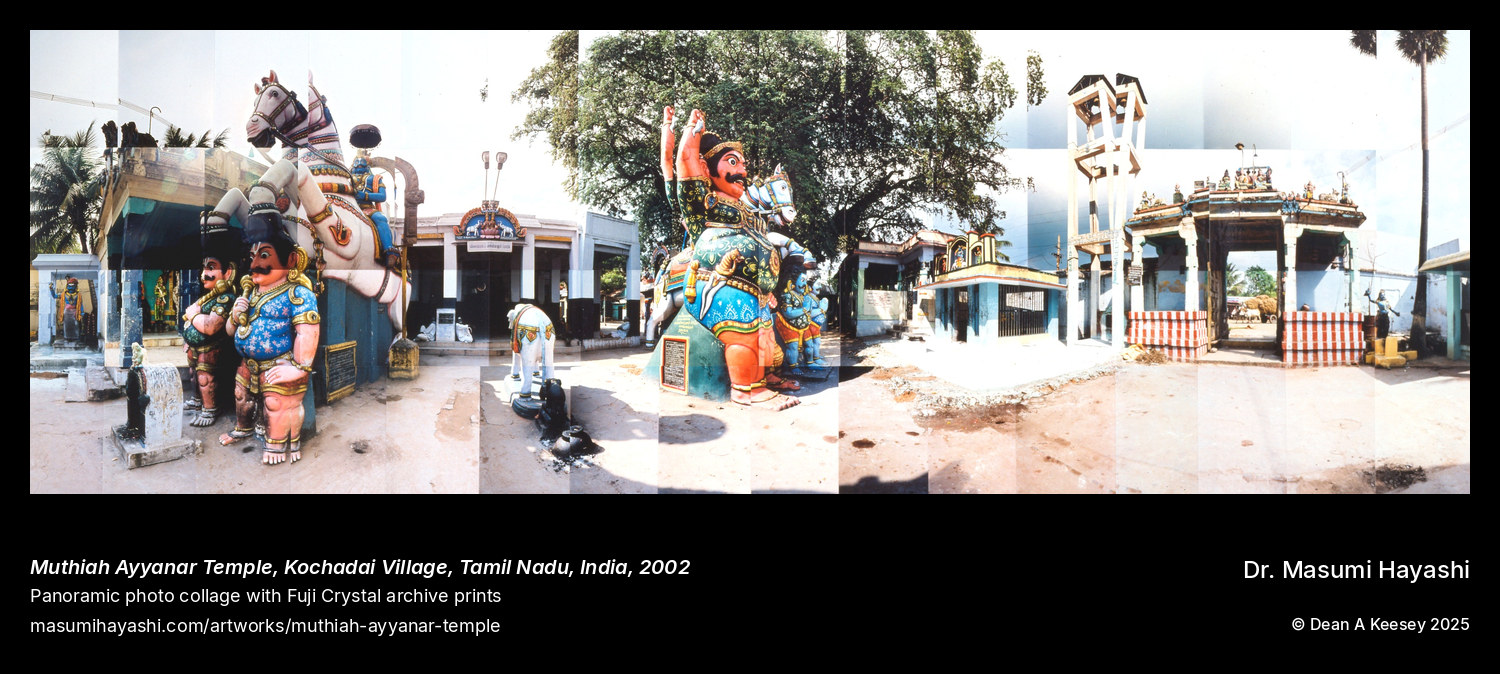
Picture of Muthiah Ayyanar Temple, Kochadai Village, Tamil Nadu, India by Dr. Masumi Hayashi

Muthiah Ayyanar Temple, Kochadai Village, Tamil Nadu, India

Kochadai Village, Madurai, Tamil Nadu, India

Panoramic Photo Collage

2002

53 x 19

Muthiah Ayyanar Temple, Kochadai Village, Tamil Nadu, India

Overview

This panoramic photo collage documents Muthiah Ayyanar Temple in Kochadai village near Madurai, Tamil Nadu - a rural folk deity shrine dramatically distinct from Sacred Architectures series’ predominant focus on grand brahmanical temples (Meenakshi, Rameswaram, Khajuraho), UNESCO World Heritage monuments (Airavatesvara, Ellora), and elite architectural traditions, instead capturing Tamil folk Hinduism’s village guardian worship where monumental terracotta horses (sometimes 20+ feet tall), carved wooden or clay warrior figures, and humble brick shrines surrounded by open-air compounds mark village boundaries protecting agricultural communities from demons, disease, wild animals, and malevolent spirits through Ayyanar deity’s fierce guardianship. Created in 2002 just one year after beginning comprehensive Meenakshi Temple documentation (2001-2003 trilogy), this work reveals Hayashi’s sophisticated understanding that Tamil religious landscape cannot be comprehended solely through brahmanical temples’ stone gopurams and thousand-pillar halls but requires documenting folk traditions practiced by majority rural Tamils who worship village deities (grama devata) alongside—or sometimes instead of—Sanskritic Hindu pantheon (Shiva, Vishnu, Devi). Ayyanar (or Aiyanar) functions as village guardian deity throughout Tamil Nadu and parts of Kerala: typically enshrined in simple open-air compounds at village edges, agricultural field boundaries, or forest fringes where his terracotta horse vahanas (divine vehicles) numbering from few to hundreds stand arrayed before modest shrines, many life-sized or larger-than-life representing horses Ayyanar rides during nightly patrols protecting village from supernatural and natural threats. Unlike brahmanical temples requiring Brahmin priests, Sanskrit rituals, and hierarchical access restrictions, Ayyanar worship is non-Brahmin tradition: village non-Brahmin castes (potters making terracotta horses, agricultural communities offering votive horses when prayers answered, village councils maintaining shrines) manage worship through oral traditions, Tamil-language prayers, animal sacrifice offerings (chickens, goats), and annual festivals where Ayyanar possesses mediums who speak prophecies and blessings to assembled villagers—folk religious practices predating Aryan-Brahmanical Hinduism’s arrival in South India potentially by millennia. The 53 x 19” horizontal panoramic format (2.79:1 width-to-height ratio, substantial width emphasizing horizontal spread) suggests documentation of multiple terracotta horses arranged in procession before shrine, or village compound’s lateral extent, or agricultural landscape context with shrine at field boundary—format serving outdoor folk shrine’s spatial organization (not enclosed temple architecture) where sacred and agricultural space interpenetrate creating permeable boundary between cultivated village civilization and wild forest/demon-inhabited beyond.

Historical and Religious Context

Ayyanar: Tamil Village Guardian Deity

Ayyanar worship represents pre-Sanskritic folk religious layer:

Origins and identity:

  • Etymology: Ayyanar (also Aiyanar, Sāsta, Hariharasuta) = “Respected Lord” in Tamil
  • Pre-Brahmanical origins: Likely indigenous Dravidian deity predating Aryan-Hindu synthesis
  • Brahmanical absorption attempted: Later texts identify Ayyanar as son of Shiva-Mohini (Vishnu’s female form), creating Sanskritic genealogy
  • But folk tradition persists: Village worship largely ignores Brahmanical myths, maintaining distinct oral traditions, non-Brahmin ritual specialists, Tamil-language practices
  • Function: Grama devata (village deity), kshetra palaka (guardian of territory), protector against:
    • Demons and malevolent spirits
    • Disease epidemics
    • Wild animals (tigers, elephants, boars threatening crops/livestock)
    • Thieves and bandits
    • Crop failure, drought, agricultural disasters
    • Boundary disputes with neighboring villages

Iconography and representation:

  • Human form: Warrior deity, often mustachioed, fierce expression, carrying weapons (sword, bow and arrows, club)
  • Crowned or turbaned: Royal/martial authority symbols
  • Accompanied by dwarf attendants (ganas): Helper spirits assisting patrols
  • Mount: Horse (vahana), crucial element—Ayyanar rides nightly patrolling village boundaries
  • Colors: Often painted bright colors (orange, red, white), renewed annually during festivals
  • Materials: Wood carving, clay modeling, terracotta, occasionally stone (but typically less permanent materials than Brahmin temple deities)

Terracotta horses (distinctive feature):

  • Votive offerings: Villagers pledge terracotta horses when seeking Ayyanar’s help
  • Fulfillment: When prayers answered (recovery from illness, good harvest, protection from danger), devotee commissions terracotta horse from village potter
  • Installation: Horse carried in procession, installed before Ayyanar shrine
  • Accumulation: Shrines can accumulate dozens to hundreds of horses over decades/centuries
  • Sizes: Range from small (2-3 feet) to monumental (20+ feet tall requiring scaffolding to construct)
  • Deterioration: Terracotta gradually weathers, crumbles (monsoon rains, sun, time), creating landscape of fragmenting horses in various decay stages
  • Renewal: Continuous offerings mean new horses replace old, creating dynamic sacred landscape

Folk Hinduism vs. Brahmanical Hinduism

Tamil religious landscape encompasses multiple layers:

Brahmanical (Sanskritic) Hinduism:

  • Deities: Shiva, Vishnu, Devi (Parvati, Lakshmi, Saraswati), standardized pan-Indian pantheon
  • Texts: Vedas, Upanishads, Puranas, epics (Ramayana, Mahabharata) in Sanskrit
  • Priests: Brahmins exclusively, hereditary priestly caste
  • Rituals: Elaborate Sanskrit mantras, fire offerings (homa), strict purity rules
  • Temples: Grand stone architecture (gopurams, mandapas, thousand pillars), hierarchical access (inner sanctums restricted)
  • Examples in Sacred Architectures: Meenakshi Temple (09023), Rameswaram Temple (09030), Kandariya Mahadeva Khajuraho (09017)
  • Social context: Elite patronage (kings, merchants, Brahmin communities), urban or major pilgrimage centers

Folk (Village) Hinduism:

  • Deities: Village guardians (Ayyanar, Muniappan, Karuppan), fierce goddesses (Mariamman, Draupadi, local ammans = mothers), ancestor spirits
  • Texts: Oral traditions, Tamil folklore, locally specific myths
  • Priests: Non-Brahmin ritual specialists (pujaris from agricultural/artisan castes, spirit mediums possessed by deities)
  • Rituals: Tamil prayers, animal sacrifice (chickens, goats), alcohol offerings (toddy palm wine), possession trance, folk music/dance
  • Temples: Simple brick/thatch shrines, open-air compounds, roadside niches, sometimes just sacred tree or stone under open sky
  • Examples: Muthiah Ayyanar Temple (09025, this work), thousands of village shrines across Tamil Nadu
  • Social context: Rural agricultural communities, non-Brahmin majority, village-level religious autonomy

Relationship between layers:

  • Parallel worship: Same Tamil villagers visit both Meenakshi Temple (urban Brahmin temple) AND village Ayyanar shrine
  • Different functions: Meenakshi for lifecycle rituals (marriage, sacred thread), pilgrimage, devotional bhakti; Ayyanar for immediate practical protection (harvest success, disease prevention, boundary security)
  • Hierarchical absorption attempts: Brahmanical Hinduism tries incorporating folk deities as subordinate (Ayyanar as Shiva’s son), but folk traditions resist full assimilation
  • Regional specificity: Folk deities highly localized (each village has unique variant of Ayyanar, specific origin myth, particular powers), whereas Brahmanical deities standardized pan-India

Village Guardian Cult Distribution

Ayyanar worship geography and social organization:

Geographic extent:

  • Primary: Tamil Nadu (all districts, thousands of shrines)
  • Secondary: Parts of Kerala (border regions), southern Karnataka
  • Urban vs. rural: Predominantly rural (village/agricultural contexts), less common in cities
  • Madurai region: Particularly strong Ayyanar devotion (Kochadai village near Madurai fits pattern)

Shrine locations (strategic placement):

  • Village boundaries: Marking edge between civilized (village/agriculture) and wild (forest/demons)
  • Field boundaries: Protecting crops from pests, wild animals, supernatural threats
  • Roadsides: Guarding travelers, marking territory transitions
  • Tank (reservoir) embankments: Water management critical to agriculture, Ayyanar protects irrigation infrastructure
  • Forest edges: Where village cultivation meets jungle, dangerous liminal zone requiring divine protection

Social organization of worship:

  • Village collective responsibility: Entire village community (not individual families) maintains Ayyanar shrine
  • Non-Brahmin management: Potter caste makes terracotta horses, agricultural castes perform rituals, village councils organize festivals
  • Annual festivals: Usually coinciding with agricultural calendar (post-harvest thanksgiving, pre-sowing protection requests)
  • Possession mediums: Ayyanar possesses human mediums (usually from non-Brahmin castes) who dance, speak prophecies, resolve village disputes, bless community
  • Animal sacrifice: Chickens, goats sacrificed to Ayyanar (forbidden in Brahmanical Vaishnava vegetarian traditions but central to folk worship)
  • Alcohol offerings: Toddy (palm wine) poured as offering (similarly forbidden in Brahmanical temples but normative in folk shrines)

Ayyanar in Tamil Cultural Landscape

Relationship to broader Tamil religious ecology:

Tamil goddess worship (overlap and distinction):

  • Mariamman (smallpox goddess): Similar village boundary location, non-Brahmin worship, animal sacrifice, but female and disease-specific
  • Draupadi (from Mahabharata but transformed in Tamil folk tradition): Festival cult involving fire-walking, possession, distinct from Sanskritic Draupadi
  • Local ammans (mother goddesses): Each village has own protective female deity, often fiercely independent of Brahmanical control
  • Gender division: Ayyanar male guardian, goddesses often female power (shakti), together protect village from multiple threats

Relationship to Madurai’s Meenakshi:

  • Contrast: Meenakshi Temple (which Hayashi also documented 2001-2003) represents brahmanical grandeur, urban pilgrimage, Sanskritic sophistication
  • Kochadai village Ayyanar shrine: Rural simplicity, folk autonomy, Tamil vernacular religious practice
  • Same Tamil religious landscape: Both coexist, serve different functions, appeal to different social contexts
  • Hayashi documents both: Demonstrating comprehensive understanding requiring attention to brahmanical AND folk traditions

Terracotta art tradition:

  • Potter caste: Hereditary caste (Kusavar in Tamil) specializes in terracotta horse production
  • Economic dimension: Votive horse commissions provide potter families’ income
  • Artistic creativity: Each potter develops signature style while maintaining iconographic conventions
  • Monumental scale: Some horses 15-20 feet tall (requiring weeks to build, dry, fire in massive kilns)
  • Landscape sculpture: Terracotta horse groves create striking rural sculptural landscapes unique to Tamil folk religion

Artistic Significance

2002 Folk Religion Documentation: Complementing Brahmanical Grandeur

Sophisticated breadth in Tamil religious documentation:

2001-2002 Tamil Nadu works revealing range:

  • Man & God, Meenakshi Temple (09023, 2001): Brahmanical goddess temple, 985-pillar hall, urban Madurai, elite architecture
  • Muthiah Ayyanar Temple (09025, 2002, this work): Folk village shrine, rural Kochadai, terracotta horses, non-Brahmin tradition
  • ONE YEAR APART: Hayashi documented Meenakshi (2001) then Ayyanar (2002), suggesting deliberate comprehensive strategy
  • Same region: Both near Madurai, Tamil Nadu—documenting same cultural region’s religious diversity

Why document BOTH brahmanical and folk?

  • Comprehensive Tamil religious landscape: Cannot understand Tamil Hinduism solely through grand temples—majority rural practice occurs at village shrines
  • Social class documentation: Meenakshi = elite/Brahmin/merchant patronage; Ayyanar = non-Brahmin agricultural communities
  • Architectural range: Stone gopurams + thousand pillars (Meenakshi) vs. brick shrines + terracotta horses (Ayyanar)
  • Ritual diversity: Sanskrit mantras + vegetarianism (Meenakshi) vs. Tamil prayers + animal sacrifice (Ayyanar)
  • Correcting elite bias: Art history/photography typically focuses on monumental architecture ignoring folk traditions—Hayashi includes both

2002 broader Indian documentation:

  • Swayambhunath Stupa, Nepal (09037, 2002) - Ancient Buddhist stupa
  • Muthiah Ayyanar Temple (09025, 2002, this work) - Tamil folk shrine
  • Demonstrates range: Buddhism + folk Hinduism, not just brahmanical Hindu temples

53 × 19” Horizontal Panoramic Format

Format serves outdoor folk shrine documentation:

Dimensions:

  • 53 inches width (over 4 feet) - substantial horizontal extent
  • 19 inches height (1 foot 7 inches) - relatively narrow
  • 2.79:1 width-to-height ratio - strong horizontal panorama

Comparison to Meenakshi work:

  • Meenakshi (09023): 53 × 19.5” (nearly identical dimensions!)
  • Ayyanar (09025, this work): 53 × 19” (virtually same format)
  • Why same format for different subjects?
    • Meenakshi: Horizontal endless pillar perspective (985 pillars in rows)
    • Ayyanar: Horizontal terracotta horse procession (multiple horses arrayed before shrine)
    • Format serving horizontal repetitive elements in both cases

What horizontal format captures for Ayyanar shrine:

  • Terracotta horse procession: Multiple horses (small to large) arranged laterally before shrine
    • Horses at varying distances creating depth
    • Different sizes (small votive offerings to monumental 15-20 foot horses)
    • Various decay stages (recent intact horses to fragmenting old offerings)
  • Village compound layout: Open-air shrine compound’s lateral extent
    • Brick shrine structure
    • Surrounding space with horses, attendant figures, offerings
    • No vertical gopuram towers (unlike Brahmanical temples)
  • Agricultural landscape context: Field boundary location
    • Shrine at edge between cultivated land and forest/wild
    • Landscape integration (not isolated monument)
    • Rural Tamil agricultural setting visible
  • Horizontal emphasis appropriate: Folk shrines horizontal/ground-level (not vertical tower architecture)

Single Framed Edition Retained

Inventory suggests strategic preservation:

Edition status:

  • Edition 1: Inventory - framed (Foundation retained)
  • Editions 2-5: Not listed (either placed before 2007, or incomplete documentation)

Why retain framed edition?

  • Recognition of folk tradition significance: Despite simple architecture, cultural documentation value recognized
  • Pairing with Meenakshi: Framed editions of both Meenakshi (09023) and Ayyanar (09025) retained—comprehensive Tamil Nadu set
  • Exhibition potential: Framed indicates display readiness, suggesting intent to exhibit brahmanical + folk pair
  • Unique subject: Few art photographers document folk shrines (preference for monumental architecture)—Hayashi’s Ayyanar documentation unusual, worth preserving

Photographing Folk Sacred Landscape

Challenges distinct from brahmanical temple photography:

Subject matter unique to folk shrines:

  • Terracotta horses: Main visual element
    • Sculptural forms in various scales, orientations
    • Weathering/decay aesthetic (crumbling terracotta, fragmenting horses)
    • Colors (painted bright orange, red, white, fading over time)
    • Accumulation over decades creating dense horse grove
  • Humble architecture: Brick shrine, simple construction, no elaborate stone carving
    • How to photograph visually when architecture modest?
    • Terracotta horses become primary photographic subject
  • Outdoor setting: Open-air compound, no interior sanctum
    • Harsh Tamil Nadu sun
    • Shadows from horses, trees, structures
    • Agricultural landscape visible beyond shrine
  • Decay and renewal: Dynamic landscape (old horses crumbling, new horses added)
    • Photograph captures moment in ongoing process
    • Not static monument but living tradition

Compositional strategies:

  • Horse procession: Using horizontal format to show multiple horses in sequence
  • Scale relationships: Small horses to monumental horses to human scale (if figures present)
  • Decay aesthetics: Fragmentation, weathering, patina as beauty (echoing Japanese wabi-sabi in Okunoin works?)
  • Sacred and agricultural: Village/field context showing shrine’s boundary-guardian function
  • Humble yet significant: Conveying religious importance despite architectural simplicity

Cultural sensitivity:

  • Active village worship: Not archaeological ruin but continuing practice
  • Non-Brahmin sacred space: Respectful photography of traditions outsiders (urban elite, foreigners) often dismiss
  • Animal sacrifice possible: If photographing during festival, may encounter practices some viewers find disturbing
  • Village privacy: Rural communities may be wary of outsider photographers

Aesthetic vs. ethnographic:

  • Ethnographic value: Document folk religious practice often ignored in art history
  • Aesthetic value: Terracotta horse groves create striking sculptural landscapes
  • Balance: Can Hayashi’s work serve both documentary (preserving knowledge) and aesthetic (formal beauty) functions?

Contemporary Relevance and Enduring Questions

Muthiah Ayyanar Temple documentation raises questions:

Folk religion preservation:

  • Is village guardian worship declining with urbanization, modern agriculture, rationalization?
  • Do younger Tamil villagers maintain Ayyanar devotion or abandon as “superstition”?
  • Will terracotta horse tradition continue as potter caste families leave traditional occupations?
  • How does documenting folk shrines (Ayyanar) complement documenting brahmanical temples (Meenakshi)?

Social class and religious documentation:

  • Why do art historians/photographers privilege elite architecture (grand temples) over folk traditions (village shrines)?
  • What is gained by including non-Brahmin religious practices in “Sacred Architectures” series?
  • How does Ayyanar documentation challenge typical Orientalist focus on exotic elite monuments?
  • Can photograph convey social context (agricultural communities, caste dynamics, ritual specialists)?

Terracotta art and ephemerality:

  • How to photograph deteriorating terracotta horses (decay as aesthetic or documentation problem)?
  • What does continuous renewal (new horses replacing old) say about folk religious vitality?
  • Is terracotta’s impermanence (vs. stone temple permanence) philosophically significant?
  • Do fragmenting horses create poignant meditation on time and devotion?

Brahmanical vs. folk Hinduism:

  • What is relationship between pan-Indian Hinduism (Meenakshi) and localized folk religion (Ayyanar)?
  • How do same communities worship both without contradiction?
  • Does documenting both reveal Hinduism’s actual complexity vs. simplified textbook versions?
  • Can photography convey theological/social distinctions between traditions?

Rural Tamil culture:

  • What is role of village guardian cults in agricultural communities’ worldview?
  • How does boundary location (village edge, field boundary) shape Ayyanar’s protective function?
  • Is animal sacrifice continuation of pre-Aryan Dravidian religious practices?
  • What happens to folk shrines when villages urbanize, agriculture mechanizes, traditions modernize?

Comparative Context: Meenakshi and Ayyanar as Tamil Religious Range

Hayashi’s Tamil Nadu documentation demonstrates breadth:

Brahmanical Temple (Meenakshi 2001-2003):

  • Man & God, Hall of a Thousand Pillars (09023, 2001): Interior 985-pillar hall
  • The Saint in the Market Place (09035, 2002): Exterior gopurams, urban context
  • Madonna and Child (09038, 2003): Sculptural detail
  • Architecture: Monumental stone, elaborate gopurams, thousand pillars
  • Priests: Brahmins exclusively
  • Rituals: Sanskrit mantras, vegetarian offerings
  • Social context: Urban Madurai, elite patronage, international pilgrimage
  • Functions: Lifecycle rituals, devotional bhakti, temple festivals
  • 53×19.5” format: Horizontal pillar perspective

Folk Village Shrine (Ayyanar 2002):

  • Muthiah Ayyanar Temple (09025, 2002, this work)
  • Architecture: Simple brick shrine, open-air compound, terracotta horses
  • Priests: Non-Brahmin village ritual specialists
  • Rituals: Tamil prayers, animal sacrifice, alcohol offerings, possession trance
  • Social context: Rural Kochadai village, agricultural communities
  • Functions: Boundary protection, harvest success, disease prevention, practical supernatural security
  • 53×19” format: Horizontal horse procession (nearly identical dimensions to Meenakshi!)

Why document both?

  • Comprehensive understanding: Tamil Hinduism cannot be understood solely through either brahmanical OR folk—requires both
  • Social range: Elite/Brahmin + non-Brahmin/agricultural communities
  • Architectural range: Stone monuments + terracotta/brick folk art
  • Functional range: Devotional bhakti + practical protection
  • Geographic range: Urban pilgrimage centers + rural village shrines
  • Corrects biases: Art photography typically ignores folk traditions—Hayashi includes them

Educational Significance

This work teaches about:

  • Ayyanar village guardian deity: Tamil folk Hinduism, rural agricultural communities, boundary protection against demons/disease/wild animals
  • Terracotta horse votive offerings: Potter caste artisans, monumental horses (up to 20 feet), accumulation over decades, weathering/decay aesthetic
  • Folk vs. Brahmanical Hinduism: Non-Brahmin priests, Tamil prayers, animal sacrifice, open-air shrines vs. Sanskrit rituals, Brahmin priests, stone temples
  • Village guardian cult geography: Boundary locations (village edges, field boundaries, forest fringes), strategic protection placement
  • Tamil religious landscape complexity: Same region includes Meenakshi brahmanical grandeur AND Ayyanar folk simplicity—both essential to understanding Tamil Hinduism
  • 2002 documentation paired with Meenakshi: Hayashi documents both elite temple (2001-2003 trilogy) and village shrine (2002), comprehensive Tamil religious range
  • 53×19” horizontal panorama: Nearly identical to Meenakshi format (53×19.5”), serving horizontal terracotta horse procession, outdoor compound layout
  • Social class documentation: Correcting art history’s elite bias by including non-Brahmin agricultural communities’ religious practices
  • Ephemeral art: Terracotta deterioration, continuous renewal, decay aesthetics vs. stone temple permanence
  • Possession ritual and oracle function: Ayyanar possesses mediums who speak prophecies, resolve disputes—living folk tradition continuing

Note: This canonical content was extracted from the Masumi Hayashi Foundation Master Catalogue (2007 inventory). Edition 1 (framed) in artist’s estate; Editions 2-5 not listed (possibly placed before 2007 or incomplete documentation). Created in 2002, this work documents Muthiah Ayyanar Temple in Kochadai village near Madurai - rural folk deity shrine dramatically contrasting with Sacred Architectures’ predominant brahmanical temple focus (Meenakshi, Rameswaram, Khajuraho). Ayyanar village guardian deity worshipped throughout Tamil Nadu: simple brick shrines at village boundaries surrounded by monumental terracotta horses (votive offerings, sometimes 20+ feet tall) representing vahanas Ayyanar rides during nightly patrols protecting agricultural communities from demons, disease, wild animals. Non-Brahmin tradition: potter caste makes horses, agricultural castes manage worship through Tamil prayers, animal sacrifice, alcohol offerings, possession mediums—folk practices predating Aryan-Brahmanical Hinduism. Created one year after beginning Meenakshi Temple trilogy (2001), demonstrating Hayashi’s sophisticated understanding that Tamil religious landscape requires documenting both elite brahmanical grandeur (Meenakshi’s 985 pillars, gopurams, Sanskrit rituals) AND rural folk traditions (Ayyanar’s terracotta horses, Tamil vernacular worship). 53×19” horizontal panorama (2.79:1 ratio, virtually identical to Meenakshi’s 53×19.5” format) captures terracotta horse procession arrayed before shrine, outdoor compound layout, agricultural landscape context—format serving folk shrine’s horizontal ground-level organization vs. brahmanical temple’s vertical tower architecture. Photographing weathering terracotta horses (bright paint fading, fragments crumbling, new horses replacing old) creates meditation on ephemeral art, continuous renewal, and living folk religious tradition’s vitality. Pairing Meenakshi (framed edition retained) + Ayyanar (framed edition retained) demonstrates deliberate comprehensive Tamil Nadu documentation strategy encompassing social class range, architectural typology diversity, brahmanical/folk theological spectrum essential to understanding South Indian Hinduism’s actual practiced complexity beyond simplified elite-focused representations.

Donate