Mantapa with Devotees, Hampi, Karnataka, India | Masumi Hayashi Foundation
Back to Gallery
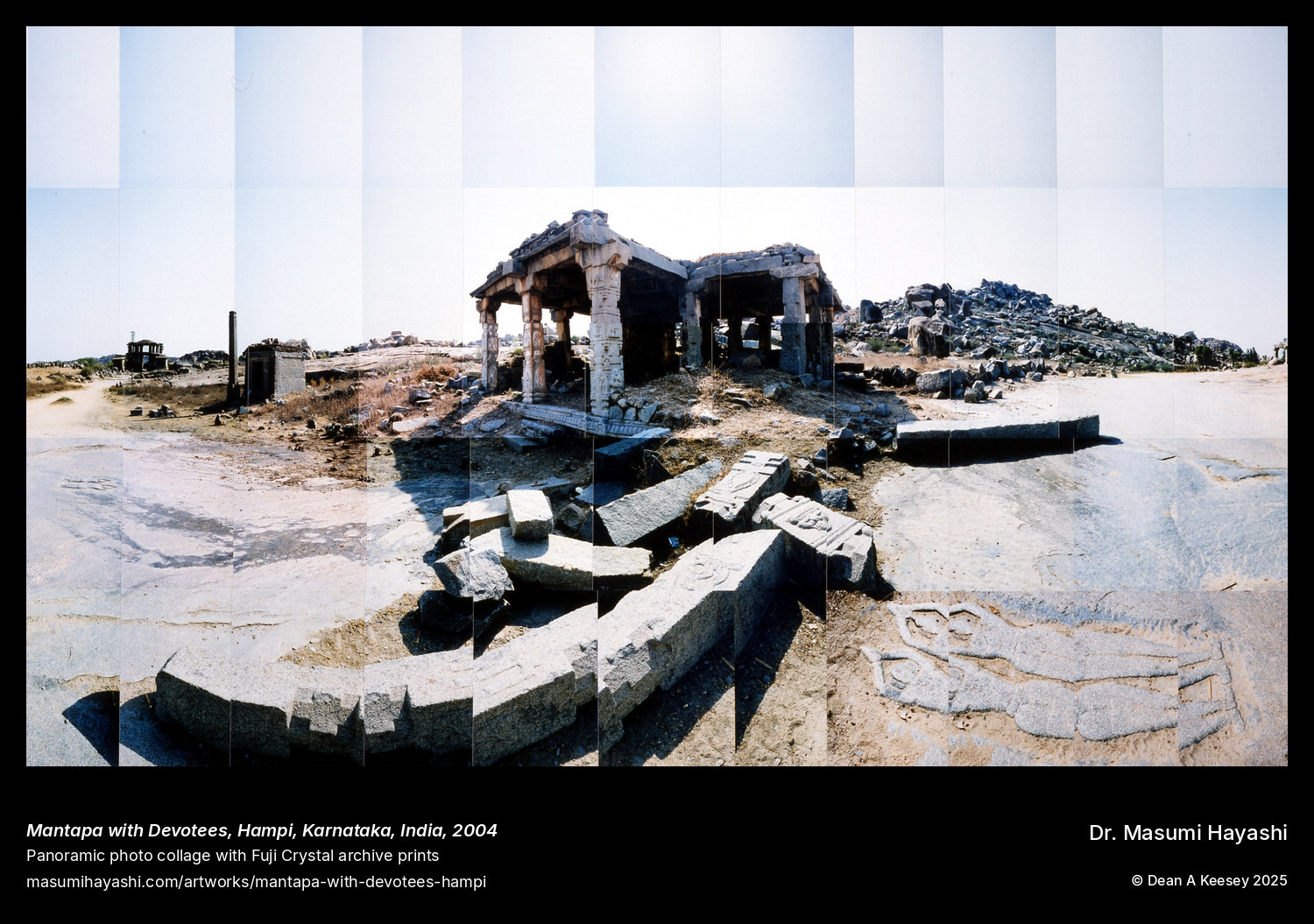
Picture of Mantapa with Devotees, Hampi, Karnataka, India by Dr. Masumi Hayashi

Mantapa with Devotees, Hampi, Karnataka, India

Hampi, Karnataka, India

Panoramic Photo Collage

2004

22" x 37"

Mantapa with Devotees, Hampi, Karnataka, India

Overview

Created in 2004, this 22 x 37-inch panoramic photo collage documents mantapa (pillared pavilion) at Hampi—UNESCO World Heritage Site preserving ruins of Vijayanagara Empire’s capital (14th-16th centuries), one of South Asia’s most architecturally significant archaeological landscapes where Hindu temple complexes, royal structures, and urban infrastructure scatter across dramatic boulder-strewn terrain creating unique fusion of monumental architecture and natural geological formations. The title’s “with Devotees” indicates living sacred landscape rather than archaeological ruin—pilgrims, worshippers, or local residents activating ancient architectural space through continued religious practice despite centuries of abandonment, demonstrating Hindu sacred sites’ resilience where ritual continuity survives political collapse, capital abandonment, and architectural decay. Mantapa represents essential Hindu temple architectural element—open or semi-enclosed pillared hall preceding main shrine, serving as gathering space for devotees, venue for religious ceremonies, and transitional zone between exterior worldly realm and interior sanctum housing deity image. The 22 x 37-inch format represents third confirmed vertical panorama within Sacred Architectures series (alongside Hanuman Ghat 24 x 45”, Madonna and Child 17 x 27”), employing 1.68:1 vertical aspect ratio suited to documenting mantapa’s characteristic tall carved pillars supporting elevated roof structure—vertical architectural elements demanding vertical compositional emphasis capturing pillars’ full height, capital sculptures, roof corbelling, and spatial relationship between ground plane and elevated covering. The 2004 date positions this within likely same Indian photographic journey as Meenakshi Temple work (created 2003), suggesting systematic Karnataka documentation alongside Tamil Nadu sites during concentrated South Indian sacred architecture survey.

Historical Context: Hampi and Vijayanagara Empire

Hampi preserves architectural legacy of medieval Hindu empire:

Vijayanagara Empire (1336-1646): Founded 1336 following Delhi Sultanate’s invasions of South India, Vijayanagara (“City of Victory”) emerged as major Hindu kingdom resisting Islamic expansion:

Political Power: At zenith (15th-16th centuries), empire controlled most of South India—Karnataka, Andhra Pradesh, Tamil Nadu, parts of Kerala and Odisha

Economic Prosperity: Capital city Vijayanagara housed estimated 500,000 inhabitants, rivaling contemporary Rome or Beijing—international trade, cotton and spice commerce, diamond markets creating extraordinary wealth

Architectural Patronage: Royal sponsorship produced monumental Hindu temple complexes, palace structures, fortifications, hydraulic infrastructure (reservoirs, aqueducts, tanks) demonstrating sophisticated urban planning and engineering

Cultural Florescence: Sanskrit literature, Telugu poetry, Carnatic music traditions, temple dance (bharatanatyam antecedents), religious scholarship flourished under royal patronage

1565 Battle of Talikota Catastrophe: Coalition of Deccan Sultanates defeated Vijayanagara armies:

  • Capital city sacked, temples desecrated, population massacred or fled
  • Monumental architecture systematically destroyed—sculpted figures defaced, gopurams toppled, palaces burned
  • Capital permanently abandoned—survivors scattered, empire fragmented into successor kingdoms
  • Hampi remained largely uninhabited except for continuing worship at some temple sites

Architectural Remains: Despite destruction, Hampi preserves extraordinary architectural heritage:

Major Temple Complexes:

  • Virupaksha Temple: Continuously functioning temple maintaining worship since 7th century through Vijayanagara period to present
  • Vittala Temple: Abandoned complex with exceptional stone carving—famous stone chariot, musical pillars (columns producing distinct tones when struck)
  • Hemakuta Hill Temples: Cluster of smaller shrines with panoramic views
  • Numerous other temples, shrines, pavilions scattered across 25+ square kilometer site

Mantapa Architecture: Pillared halls represent distinctive Vijayanagara architectural achievement:

  • Massive monolithic granite pillars carved with extraordinary detail
  • Pillars often depicting deities, mythological narratives, floral motifs, geometric patterns
  • Capitals (pillar tops) featuring elaborate corbelling and sculptural programs
  • Roof structures (where surviving) with corbelled domes or flat stone slabs
  • Open sides allowing air circulation in intense Karnataka heat
  • Platforms (jagati) elevating mantapas above ground level

UNESCO World Heritage Site (1986): International recognition of Hampi’s architectural and historical significance—ongoing conservation efforts addressing structural deterioration, tourist impact, encroachment, and weathering of exposed granite sculptures.

”With Devotees”: Living Sacred Landscape

Title emphasizing human presence distinguishes this work:

Active Worship at Archaeological Site: Despite Hampi’s status as ruined capital, several temples maintain active worship:

  • Virupaksha Temple: Continuous ritual function—daily pujas, festivals, pilgrimage destination
  • Local priests (pujaris) conducting ceremonies
  • Pilgrims traveling for religious merit, festival participation
  • Local community maintaining devotional relationships with temple deities

Mantapa Functions in Living Temples: When actively used, mantapas serve multiple purposes:

  • Congregation Space: Devotees gather for group worship, religious discourses, music performances
  • Festival Venue: During major festivals, mantapas host ceremonies, processions, ritual activities
  • Rest Area: Pilgrims sheltering from sun, resting between temple visits, meditating
  • Social Space: Community gathering beyond strictly religious functions—conversations, waiting, observing ceremonies

Documentary Approach: “With Devotees” indicates Hayashi captured:

  • Human figures activating architectural space
  • Contemporary religious practice within historical architecture
  • Continuity between medieval construction and modern worship
  • Scale relationships—human bodies demonstrating mantapa’s monumental proportions
  • Living heritage vs. archaeological preservation—architecture maintaining original function

Photography Challenges: Documenting devotees required:

  • Permission and respect for religious activities—avoiding interruption of ceremonies
  • Timing photography around worship schedules
  • Balancing architectural documentation with human presence
  • Capturing spontaneous religious activities vs. staged compositions
  • Navigating tourist vs. devotee presence—Hampi attracts both pilgrims and secular tourists

Vertical Panoramic Format: 22 x 37 Inches

At 22 x 37 inches, work employs vertical panorama emphasizing mantapa’s vertical architectural elements:

Format Analysis:

  • Width: 22 inches (under 2 feet) provides moderate horizontal field
  • Height: 37 inches (over 3 feet) creates vertical emphasis
  • Aspect Ratio: 1.68:1 (height to width)—moderate vertical panorama

Third Vertical Panorama Pattern:

  • Hanuman Ghat: 24 x 45” (1.88:1 vertical)—ghat descent
  • Madonna and Child: 17 x 27” (1.59:1 vertical)—gopuram tower
  • Mantapa with Devotees: 22 x 37” (1.68:1 vertical)—pillared hall

Consistent pattern: vertical formats chosen for architectures with strong vertical structural elements.

Mantapa Architecture’s Vertical Emphasis: Pillared halls create inherent vertical composition:

  • Tall Pillars: Monolithic columns rising 15-20+ feet from platform to roof
  • Carved Details: Sculptures covering full pillar height requiring vertical frame
  • Capital Architecture: Elaborate corbelled capitals and roof supports at pillar tops
  • Human Scale: Devotees’ figures at ground level contrasting with soaring pillars
  • Roof Structure: Elevated covering creating vertical spatial volume

Vertical Format Advantages:

  • Captures full pillar height from platform base through capital to roof
  • Documents vertical progression of sculptural programs
  • Emphasizes monumental scale through height emphasis
  • Shows devotees in proper scale relationship to architecture
  • Conveys spatial experience of standing within pillared hall

Hampi Within Sacred Architectures Series

Mantapa with Devotees contributes to systematic Hampi documentation:

Multiple Hampi Works Likely: Sacred Architectures series likely includes several Hampi works documenting site’s architectural diversity:

  • Different temple complexes (Virupaksha, Vittala, Hemakuta Hill)
  • Varied architectural elements (mantapas, gopurams, shrines, palace structures)
  • Diverse scales from intimate shrines to monumental temple complexes

Karnataka Sacred Architecture: Hampi works document Karnataka’s distinctive Vijayanagara architectural traditions:

  • Granite construction and monolithic pillars
  • Elaborate sculptural programs
  • Hindu temple architecture under royal patronage
  • Integration of architecture with dramatic natural boulder landscapes

2004 South Indian Journey: Created same year as Nepal concentration but likely separate journey:

  • South Indian sacred sites (Karnataka, Tamil Nadu)
  • Major temple complexes and archaeological sites
  • Concentrated documentation maximizing international travel
  • Recognition of endangered heritage requiring urgent documentation

Collection Information

Year: 2004 Location: Hampi, Karnataka, India Medium: Panoramic Photo Collage Dimensions: 22 x 37 inches (vertical panorama) Edition: 1 of 5

  1. Masumi Hayashi Foundation (unframed, inventory)

Note: Four additional edition locations unaccounted for. Vertical panoramic format (22” wide x 37” tall, over 3 feet height) emphasizes mantapa’s characteristic tall carved pillars supporting elevated roof structure—vertical architectural elements demanding vertical compositional emphasis. Title “with Devotees” indicates living sacred landscape where pilgrims and worshippers activate ancient Vijayanagara architecture through continued religious practice despite capital’s 1565 abandonment following Battle of Talikota catastrophe. Work documents UNESCO World Heritage Site Hampi—ruins of medieval Hindu empire’s capital preserving extraordinary temple architecture, mantapas (pillared pavilions), and sculptural programs scattered across dramatic boulder landscape. Mantapa represents essential Hindu temple architectural element serving as congregation space, festival venue, and transitional zone between worldly exterior and sacred interior. Third confirmed vertical panorama within Sacred Architectures series (alongside Hanuman Ghat, Madonna and Child), demonstrating format strategy emphasizing vertical structural elements. Created 2004 during likely South Indian photographic journey documenting Karnataka and Tamil Nadu sacred sites. Appropriate for museum collections prioritizing South Asian architectural documentation, Vijayanagara heritage, living sacred landscapes within archaeological contexts, or UNESCO World Heritage Site preservation. Vertical format creates distinctive display presence suited to documenting pillared architecture’s monumental vertical scale and devotees’ relationship to soaring columns.

Donate