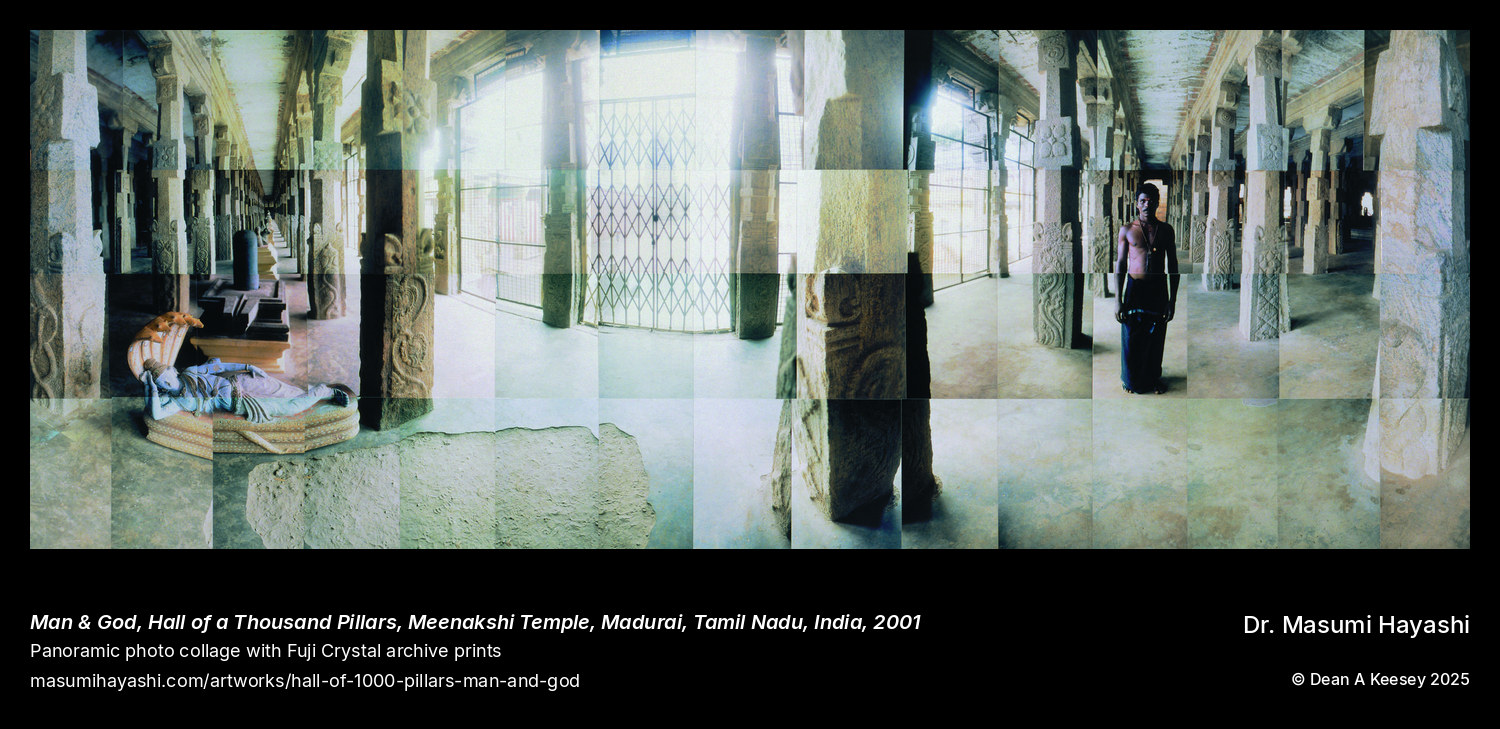
Man & God, Hall of a Thousand Pillars, Meenakshi Temple, Madurai, Tamil Nadu, India
Madurai, Tamil Nadu, India
Panoramic Photo Collage
2001
53 X 19.5
Man & God, Hall of a Thousand Pillars, Meenakshi Temple, Madurai, Tamil Nadu, India
Overview
This panoramic photo collage documents the Aayiram Kaal Mandapam (Hall of a Thousand Pillars) at Meenakshi Temple in Madurai, Tamil Nadu - one of the most spectacular architectural achievements of Dravidian temple construction, where 985 intricately carved granite pillars (not quite 1,000, but “thousand” signifies countless) create an infinite perspective effect as parallel rows converge toward vanishing points. Created in 2001 as the first of Hayashi’s three Meenakshi Temple works spanning 2001-2003, this piece captures the hall’s defining characteristic: repetitive pillar rhythms where each column features unique sculptural programs (deities, mythological scenes, yalis - mythical lion creatures, dancers, musicians) yet together create unified architectural experience through multiplication and perspective. The title “Man & God” suggests the hall’s function as threshold space where devotees encounter divine presence through architectural immersion - pilgrims dwarfed by forest of pillars, moving through space designed to evoke cosmic order and divine infinitude. Meenakshi Temple, dedicated to goddess Meenakshi (fish-eyed goddess, Parvati form) and her consort Sundareshwar (Shiva), represents Nayak dynasty’s (1623-1655) architectural ambition transforming Madurai into pilgrimage destination rivaling Varanasi, with 14 gopurams (gateway towers), 45-acre complex, and estimated 15,000 daily visitors continuing 2,000+ year temple tradition.
Historical and Religious Context
Meenakshi Temple: Living Goddess Center
Temple’s significance in Tamil religious landscape:
Meenakshi goddess tradition:
- Meenakshi = “fish-eyed one” (Tamil: Mīnākṣī, Sanskrit: Minakshi)
- Fish eyes symbolize: Never closing (constant watchfulness), beauty, prosperity
- Local Tamil goddess absorbed into Hindu pantheon as Parvati form
- Unique among major Hindu temples: Goddess (not male deity) is PRIMARY deity
- Sundareshwar (Shiva) subordinate spouse (reversal of typical Shiva-Parvati hierarchy)
- Reflects Dravidian goddess-centered traditions predating Aryan Hinduism
Founding mythology:
- King Malayadwaja Pandya performed yagna (fire sacrifice) seeking heir
- Three-year-old girl emerged from flames with three breasts
- Oracle: “Third breast will disappear when she meets her destined husband”
- Raised as warrior princess, conquered territories
- Met Shiva on Mount Kailash, third breast vanished
- Married Shiva, both returned to Madurai to rule
- Divine wedding (Thirukalyanam) celebrated annually with 10-day festival
- Temple marks their eternal residence in Madurai
Historical development:
- Archaeological evidence: Temple site 2,000+ years old
- Early Pandya dynasty patronage (6th-9th centuries CE)
- Destroyed by Muslim invasions (14th century, Malik Kafur’s raids 1310)
- Rebuilt by Viswanatha Nayak (1623-1659) - current form
- Nayak period (16th-17th centuries): Major Dravidian architectural flowering
- Continuous worship and pilgrimage 2,000+ years (despite destructions)
Temple complex scale:
- 45-acre walled complex
- 14 gopurams (gateway towers), tallest 52 meters (south tower)
- Multiple mandapas (pillared halls): Thousand Pillars, Ashta Shakti, Kambatadi, Kilikoondu
- Two main shrines: Meenakshi (goddess) and Sundareshwar (Shiva)
- Sacred tank: Potramarai Kulam (Golden Lotus Tank)
- Estimated 15,000 visitors daily (major pilgrimage destination)
- Annual Chithirai Festival (April-May): 1 million+ pilgrims for divine wedding celebration
Hall of a Thousand Pillars: Architectural Marvel
Aayiram Kaal Mandapam construction and significance:
Construction history:
- Built 1569 CE by Ariyanatha Mudaliar (Viswanatha Nayak’s prime minister)
- Part of Nayak period reconstruction and expansion
- 56 meters (183 feet) long × 52 meters (170 feet) wide
- Positioned on northern side of temple complex
- Near Sundareshwar shrine entrance
“Thousand Pillars” count:
- Actually 985 pillars (not quite 1,000)
- “Thousand” = countless, infinity (Sanskrit: sahasra, Tamil: aayiram)
- Each pillar: 3-4 meters (10-13 feet) tall
- Arranged in parallel rows creating grid pattern
- Granite carved from single blocks
- Each pillar unique sculptural program
- Monolithic construction (carved from bedrock in some accounts)
Sculptural programs on pillars:
- Yalis (vyalas): Mythical lion-like creatures with elephant trunks, open mouths
- Deities: Vishnu, Brahma, Devi forms, local deities
- Mythological narratives: Ramayana, Mahabharata scenes
- Musicians and dancers: 64 kalas (arts) represented
- Bracket figures: Madanikas (celestial beauties) supporting capitals
- Decorative motifs: Lotus, kalasha (pots), makaras (crocodiles)
- Nayak period style: Exuberant detail, narrative density, dynamic poses
Musical pillars:
- Some pillars produce musical notes when struck
- Different pitches from single pillar cluster
- Called “Musical Pillars” or “Sargam pillars” (seven notes)
- Scientific mystery: How hollow chambers create tones without cracking granite
- British colonial engineers studied but couldn’t replicate technique
- Now protected (touching prohibited to prevent damage)
Architectural infinity effect:
- Parallel rows of pillars creating vanishing point perspectives
- Multiple directional views (north-south, east-west axes)
- Repetition generates sense of endlessness
- Light and shadow patterns throughout day
- Pilgrims moving through “forest” of stone pillars
- Cosmic order represented through geometric multiplication
- Mathematical precision: 985 pillars in exact grid alignment
”Man & God” Title: Threshold Experience
Title suggests specific interpretation:
Man and God encounter:
- Human pilgrims (man) encountering divine presence (god) through architecture
- Scale relationship: Humans dwarfed by pillars, humbled by sacred space
- Threshold space: Between outer world and inner sanctum
- Liminal zone: Transition from secular to sacred
- Darshan (viewing deity) preparation: Pilgrims pause, pray, circumambulate before approaching shrines
Hall functions:
- Prayer and meditation: Devotees sit among pillars
- Circumambulation: Walking around perimeter as devotional practice
- Festival gatherings: Major ceremonies held in hall
- Teaching and discourse: Spiritual discussions, music, dance performances
- Museum function: Now houses Meenakshi Temple Art Museum
- Tourist attraction: Visitors marvel at architectural achievement
- Photographic subject: Endless pillar perspectives attract photographers worldwide
Spatial experience:
- Overwhelming scale (985 pillars)
- Disorientation (which direction? where am I in grid?)
- Pattern recognition (repetition with variation)
- Acoustic properties (echo, reverberation)
- Temperature regulation (pillars create shade, ventilation)
- Light filtering (sunlight through hall creating patterns)
- Movement choreography (pathways between pillars)
Artistic Significance
2001-2003 Meenakshi Temple Trilogy
Hayashi created three Meenakshi works over three years:
1. Man & God, Hall of a Thousand Pillars (09023, 2001, this work):
- First Meenakshi documentation
- Interior architectural focus: Pillar hall
- 53 × 19.5 inches (horizontal panorama)
- Fuji film stock
- Framed in artist’s estate (2007)
2. The Saint in the Market Place (09035, 2002):
- Exterior architectural focus: Temple complex, gopurams, urban context
- Created 2002 (one year after #1)
- Donated to Cleveland Museum of Art 2014
3. Madonna and Child (09038, 2003):
- Specific sculptural detail focus
- Created 2003 (completing trilogy)
- Different perspective/scale
Why trilogy?
- Meenakshi Temple’s complexity demands multiple perspectives
- Interior (pillar hall) vs. exterior (gopurams) vs. detail (sculpture)
- Comprehensive documentary approach
- Recognition of site’s significance meriting sustained engagement
- Three years suggests annual pilgrimage/documentation visits
- Parallel to Airavatesvara two-work strategy (vertical + horizontal perspectives)
53 × 19.5” Horizontal Panorama
Format ideally suited to pillar perspective:
Horizontal emphasis captures:
- Endless parallel rows of pillars
- Vanishing point convergence (pillars appearing to meet at horizon)
- Multiple pillars in single frame (not isolated columns)
- Width of hall (52 meters = 170 feet)
- Procession of sculptural diversity (many pillars, many carvings)
- Pilgrims moving through space (human scale comparison)
Aspect ratio analysis:
- 53 ÷ 19.5 = 2.72:1 (nearly 3:1 width-to-height)
- Strong horizontal panorama (not extreme like 3.26:1 Ganges, but significant)
- Format emphasizes breadth over height
- Pillar heights less important than pillar multiplication horizontally
- Perspective lines pulling eye across frame
“Man & God” title integration with format:
- Humans positioned at pillar bases (lower portion of frame)?
- Deities carved on pillar capitals and shafts (throughout vertical space)?
- Horizontal format showing human journey through sacred architecture?
- Width suggests community (many pilgrims) vs. individual devotion
Framed Edition in Inventory
Single framed edition (2007 catalog) suggests:
Exhibition preparation:
- Framed indicates display readiness
- First of trilogy (2001) retained for historical significance
- Other Meenakshi works dispersed (Cleveland Museum donated 2014)
- Comprehensive set preservation strategy?
Market considerations:
- Meenakshi Temple internationally recognized
- Tamil Nadu tourism icon
- Architectural photography subject with broad appeal
- Potential institutional acquisition target
- Getty Museum placement goal: Meenakshi trilogy would demonstrate range
Photographing Architectural Infinity
Hall of a Thousand Pillars photography challenges:
Technical considerations:
- Perspective management: Parallel rows must remain parallel (avoid keystoning)
- Depth of field: Multiple pillar rows from foreground to distant background in focus
- Lighting extremes: South Indian sun creating harsh shadows vs. hall’s relative darkness
- Repetition without monotony: How to show pattern while maintaining visual interest?
Compositional strategies:
- Vanishing point emphasis: Classic architectural photography (perspective lines converging)
- Sculptural detail vs. overall pattern: Close detail of individual pillars vs. infinity effect
- Human scale reference: Including pilgrims for size comparison and “Man & God” theme
- Light shafts: Sunlight filtering through hall creating volumetric light beams
- Multiple vanishing points: Hall allows views in multiple directions
Photo collage advantages:
- Can combine multiple images capturing hall’s breadth beyond single photograph
- Can show different pillar rows with varying sculptural programs
- Can create comprehensive architectural portrait
- Hayashi’s technique: Assembling spatial totality
Pilgrimage context:
- Active worship site (not museum or archaeological ruin)
- Pilgrims present (movement, prayer, offerings)
- Lived religious space documentation challenges
- Respectful photography amid devotional activities
- How to capture sacred function not just architectural form?
Contemporary Relevance and Enduring Questions
Hall of a Thousand Pillars documentation invites consideration of:
Architectural and mathematical:
- How do 985 pillars create sense of infinity?
- What is relationship between repetition and variation in sacred architecture?
- How does grid geometry convey cosmic order?
- Why “thousand” when actually 985? (Symbolic vs. literal counting)
Experiential and phenomenological:
- How does moving through pillar forest change spatial perception?
- What is role of disorientation in sacred space?
- How do architectural scale relationships (human vs. pillar) create humility?
- What does “Man & God” encounter mean in threshold space?
Cultural and religious:
- Why does goddess Meenakshi (not Shiva) dominate temple hierarchy?
- How does Dravidian tradition differ from North Indian Hindu architecture?
- What is significance of continuous 2,000-year worship despite destructions?
- How do 15,000 daily visitors experience sacred space amid crowds and tourism?
Photographic and documentary:
- How to photograph “infinity” created by repetition?
- Can single image (or photo collage) convey experience of walking through 985 pillars?
- What does trilogy approach (2001-2003) achieve that single work cannot?
- How does horizontal panoramic format serve or limit pillar hall documentation?
Comparative Context: Dravidian Pillar Halls
Hayashi’s pillar hall typology:
Tamil Nadu pillar halls documented:
- Meenakshi Temple, Madurai: 985-pillar hall (09023, 2001, this work)
- Rameswaram Temple: 1,212-pillar corridor, world’s longest (09030, 2004)
- Demonstrates Tamil Nadu’s pillar architecture excellence
Pillar perspective variations:
- Meenakshi: Grid pattern, multiple vanishing points, hall format
- Rameswaram: Linear corridor, single vanishing point, 197-meter length
- Different spatial experiences: Grid vs. corridor, square vs. linear
Thousand Pillars tradition:
- Multiple South Indian temples claim “thousand pillars”
- Actual counts vary: 985 (Meenakshi), 1,212 (Rameswaram), others
- “Thousand” = countless (symbolic, not literal arithmetic)
- Pillar multiplication as devotional expression
- Dravidian architectural signature
Comparative scale:
- Meenakshi hall: 985 pillars, 56×52 meters
- Rameswaram corridors: 1,212 pillars, 197 meters length
- Angkor temples: Different architectural tradition (Khmer, not Dravidian)
- Khajuraho temples: North Indian Nagara style, fewer pillars but elaborate exterior sculpture
Educational Significance
This work teaches about:
- Hall of a Thousand Pillars: Aayiram Kaal Mandapam, actually 985 pillars, built 1569 CE
- Meenakshi Temple: Goddess-centered temple, Madurai pilgrimage destination, 45-acre complex, 14 gopurams
- Dravidian architecture: Pillar multiplication, infinite perspective effects, Nayak period (16th-17th century)
- Sculptural programs: Yalis, deities, musicians, dancers, mythological narratives on each pillar
- Musical pillars: Granite columns producing tones when struck, scientific mystery
- “Man & God” threshold: Human-divine encounter through architectural immersion
- 2001-2003 trilogy: Sustained Meenakshi engagement, interior + exterior + detail perspectives
- 53×19.5” horizontal panorama: Format serving endless pillar perspective, vanishing point emphasis
- Tamil religious landscape: Hayashi documented both Meenakshi’s brahmanical grandeur and Ayyanar’s folk simplicity
- Photo collage technique: Assembling architectural totality beyond single photograph’s field of view
Note: This canonical content was extracted from the Masumi Hayashi Foundation Master Catalogue (2007 inventory). Edition 1 (framed) in artist’s estate. Created in 2001, this work is the first of Hayashi’s three Meenakshi Temple works spanning 2001-2003 (trilogy documenting Tamil Nadu’s greatest goddess temple). “Man & God” title suggests threshold experience: human pilgrims encountering divine presence through Hall of a Thousand Pillars’ overwhelming architecture. Aayiram Kaal Mandapam contains actually 985 intricately carved granite pillars (not quite 1,000, but “thousand” = countless/infinite) arranged in grid creating multiple vanishing point perspectives. Built 1569 CE by Ariyanatha Mudaliar during Nayak dynasty’s Dravidian architectural flowering. Each pillar unique (yalis, deities, musicians, mythological scenes) yet unified through repetition and mathematical precision. Some pillars musical (produce tones when struck). 53×19.5” horizontal panorama captures endless parallel pillar rows, vanishing point convergence, spatial infinity effect. Meenakshi Temple: Goddess Meenakshi (fish-eyed Parvati form) primary deity (reversal of typical Shiva dominance), 2,000-year temple tradition, 45-acre complex, 15,000 daily visitors. Companion works: “The Saint in the Market Place” (09035, 2002, donated Cleveland Museum 2014) and “Madonna and Child” (09038, 2003) - trilogy demonstrating architectural complexity requiring multiple perspectives.