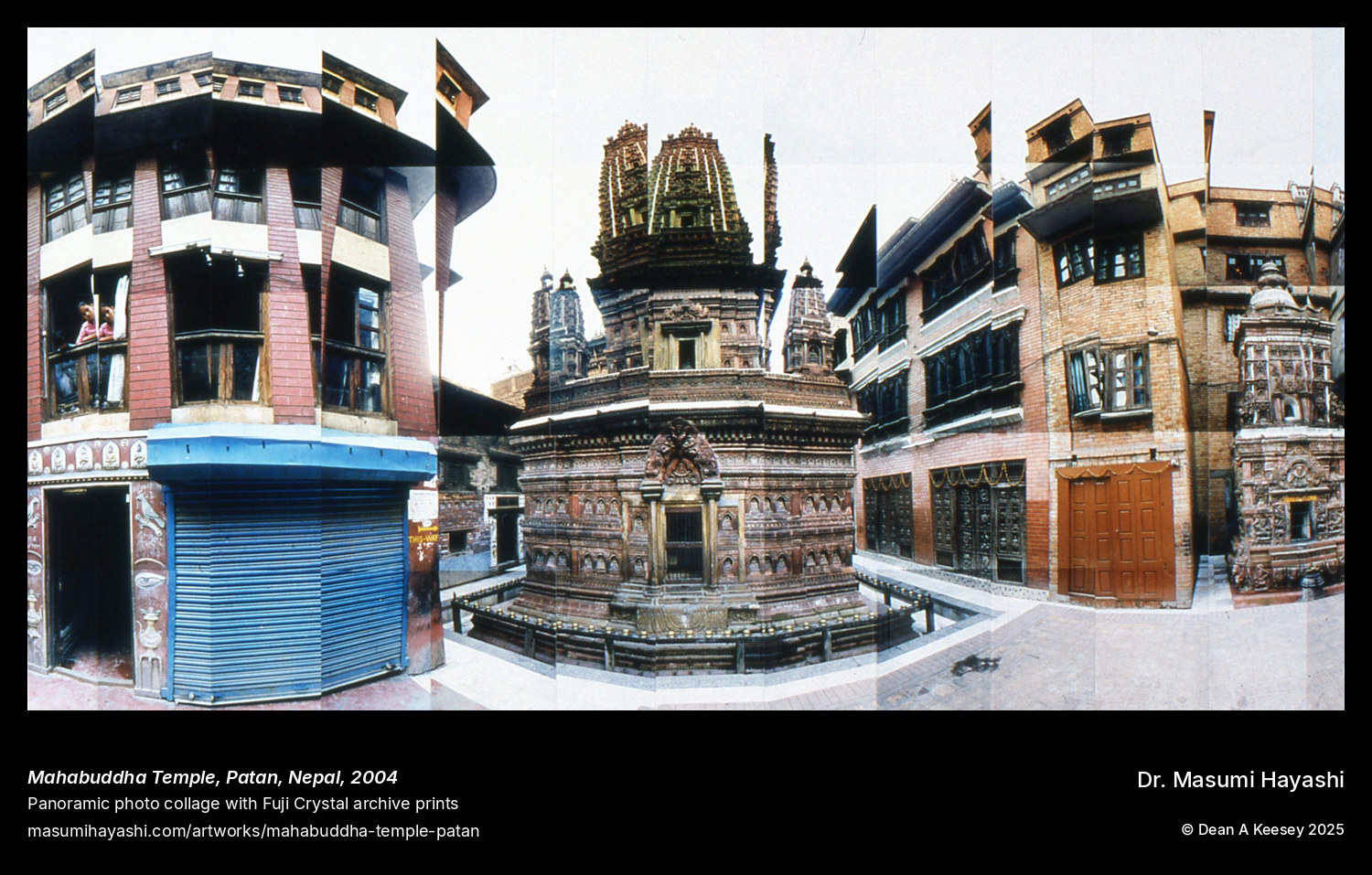
Maha buddha Temple, Patan, Nepal
Patan, Nepal
Panoramic Photo Collage
2004
45" x 22"
Maha buddha Temple, Patan, Nepal
Overview
Created in 2004, this 45 x 22-inch panoramic photo collage documents Maha Buddha Temple in Patan—likely referring to significant Buddhist monastery or temple within city historically known as center of Newari Buddhism before Hindu influence increased over centuries. The work represents fourth confirmed 2004 Nepal documentation (alongside Golden Temple, Hanuman Ghat, Patan Durbar Square), suggesting concentrated photographic journey systematically documenting Kathmandu Valley sacred architecture during single trip two years before Hayashi’s 2006 death. Unlike vertical panoramas employed for Hanuman Ghat’s ghat descent or Madonna and Child’s gopuram documentation, Maha Buddha Temple’s 45 x 22-inch format (2.05:1 aspect ratio, nearly 4 feet wide by under 2 feet tall) employs moderate horizontal panorama suited to documenting Buddhist monastery courtyard, temple facade, or architectural ensemble where lateral extent rather than vertical emphasis dictates compositional approach. Patan’s Buddhist heritage includes numerous significant monasteries and temples, though specific “Maha Buddha” identification remains uncertain without additional documentation—possibilities include Rato Machhendranath Temple (though technically Hindu-Buddhist synthesis), various Buddhist bahals (monastic courtyards), or other significant Buddhist architectural sites within city’s traditional Buddhist quarters. The 2004 date positions this alongside other late-career Sacred Architectures documentation demonstrating sustained commitment to Asian sacred architecture through final years, recognizing Kathmandu Valley’s architectural richness requiring multiple works capturing diverse building types, religious traditions, and architectural scales rather than single representative work. Only one edition remaining in Foundation inventory (unframed) while four editions unaccounted for indicates moderate commercial performance typical for specialized Sacred Architectures subjects requiring collectors with specific interest in Newari Buddhist architecture or Kathmandu Valley heritage documentation.
Historical Context: Patan’s Buddhist Heritage
Patan (Lalitpur, “City of Beauty”) maintained strong Buddhist traditions despite Hindu political dominance:
Buddhist History in Patan:
Ancient Buddhist Center: Patan served as major Buddhist center during Licchavi period (5th-9th centuries CE):
- Royal patronage of Buddhist monasteries (viharas)
- Extensive Buddhist scholarship and monastic education
- Artistic workshops producing Buddhist sculpture, metalwork, ritual objects
- Trade connections bringing Buddhist texts, teachers, artistic influences from India, Tibet, and beyond
Newari Buddhism Preservation: Unlike other Himalayan regions where Buddhism declined following Muslim invasions or Hindu revival movements, Patan maintained distinctive Newari Buddhist tradition:
- Hereditary Shakya and Vajracharya families preserving Buddhist practices through caste system
- Mahayana-Vajrayana synthesis creating unique doctrinal and ritual traditions
- Integration of Hindu deities and practices within Buddhist framework
- Architectural preservation of medieval Buddhist monasteries (bahals) within urban fabric
Bahál Architecture: Traditional Newari Buddhist monastery form:
- Rectangular enclosed courtyard entered through single ornate doorway
- Central shrine (often two-story structure) housing Buddha images
- Surrounding residential quarters for Shakya families maintaining temple
- Stone paving, prayer wheels, secondary shrines positioned around courtyard
- Woodcarving, metalwork, stone sculpture creating concentrated artistic environment
Buddhist-Hindu Synthesis: Patan exemplifies religious integration:
- Buddhist monasteries and Hindu temples coexisting within single urban blocks
- Shared festivals, architectural vocabularies, artistic traditions
- Royal patronage supporting both traditions simultaneously
- Doctrinal boundaries more fluid than rigid sectarian divisions found elsewhere
Major Buddhist Sites in Patan (Possible “Maha Buddha” Candidates): Without definitive identification, several significant Patan Buddhist sites could be referenced:
- Mahabauddha Temple: “Great Buddha” temple built in Indian shikhara style (though this typically called Mahabauddha not “Maha Buddha”)
- Various bahals: Chyasin Dega, Kwa Bahal, other traditional Buddhist monasteries
- Monastery courtyards housing significant Buddha images or relics
- Buddhist shrines within broader Hindu-Buddhist temple complexes
2015 Gorkha Earthquake Impact: Many Patan Buddhist sites damaged:
- Bahál structures with traditional brick and wooden construction vulnerable to seismic activity
- Central shrines, wooden struts, tiered roofs suffering damage
- Hayashi’s 2004 documentation preserves pre-earthquake architectural state
- Ongoing reconstruction efforts using traditional techniques and international expertise
Horizontal Panoramic Format: 45 x 22 Inches
At 45 x 22 inches, work employs moderate horizontal panorama contrasting with vertical formats in other Sacred Architectures works:
Format Analysis:
- Width: 45 inches (3.75 feet, nearly 4 feet) creates substantial lateral sweep
- Height: 22 inches (under 2 feet) provides sufficient vertical information without vertical emphasis
- Aspect Ratio: 2.05:1 (width to height)—moderate horizontal panorama, not extreme
Format Flexibility Within 2004 Nepal Documentation: Comparison with other 2004 Nepal works demonstrates format responsiveness to specific architectural requirements:
- Golden Temple: 46 x 29” (1.59:1)—moderate horizontal emphasizing courtyard
- Hanuman Ghat: 24 x 45” (1.88:1 vertical)—vertical panorama for ghat descent
- Maha Buddha Temple: 45 x 22” (2.05:1)—wider horizontal for lateral architectural extent
- Patan Durbar Square: Dimensions unknown but likely horizontal for square ensemble
Each format chosen specifically for architectural subject rather than applying formulaic approach.
Horizontal Format Suited For:
Monastic Courtyard Documentation: Bahál architecture emphasizes enclosed rectangular courtyard with surrounding structures—horizontal format captures courtyard’s lateral extent, flanking residential buildings, and relationship between central shrine and surrounding architectural elements
Temple Facade: Single temple building’s horizontal elevation documenting facade details, entrance architecture, and architectural proportions
Architectural Ensemble: Multiple structures within single composition requiring horizontal sweep to capture spatial relationships
Urban Sacred Landscape: Temple positioned within urban fabric, documenting relationship between sacred architecture and surrounding residential/commercial buildings
Within 2004 Nepal Photographic Journey
Maha Buddha Temple completes fourth confirmed 2004 Nepal work:
2004 Nepal Documentation:
- Patan Durbar Square: Royal palace complex and temple ensemble
- Golden Temple (Hiranya Varna Mahavihar): Newari Buddhist monastery, Patan
- Hanuman Ghat: Riverine sacred architecture, Bhaktapur
- Maha Buddha Temple: Buddhist temple/monastery, Patan (this work)
Geographic Concentration:
- Patan (2-3 works): Most documented city—Durbar Square, Golden Temple, Maha Buddha Temple
- Bhaktapur (1 work): Hanuman Ghat
- Kathmandu: Likely additional works not yet reviewed
Patan concentration suggests either:
- Extended stay in Patan providing convenient access to multiple sites
- Recognition of Patan’s exceptional architectural density deserving comprehensive documentation
- Logistical convenience—documenting nearby sites during same trip
- Architectural diversity within single city enabling varied documentation
Architectural Type Diversity (2004 Nepal):
- Royal palace architecture (Patan Durbar Square)
- Buddhist monastery architecture (Golden Temple, Maha Buddha Temple)
- Hindu riverine architecture (Hanuman Ghat)
- Mixed Hindu-Buddhist urban sacred landscapes
Systematic coverage across architectural types demonstrates comprehensive documentary approach.
Format Diversity (2004 Nepal):
- Vertical panoramas: Hanuman Ghat (24 x 45”)
- Moderate horizontal panoramas: Golden Temple (46 x 29”), Maha Buddha Temple (45 x 22”)
- Unknown formats: Patan Durbar Square
Format variations responding to specific architectural requirements rather than rigid technical formula.
Late-Career Work: Final Major International Journey
2004 Nepal documentation likely represents Hayashi’s final major international photographic journey:
Age and Physical Demands: At approximately 57 years old (born 1945, traveled 2004):
- International travel to Nepal requiring significant physical stamina
- Kathmandu Valley’s altitude (4,600 feet) creating mild acclimatization challenges
- Temple access involving stairs, uneven surfaces, crowded pilgrimage sites
- Equipment transport—cameras, film, tripods, accessories
- Multiple day shoots across valley documenting 4+ sites
2003-2004 Asian Documentation Concentration:
- 2003: Indian sites (Meenakshi Temple, likely others)
- 2004: Nepal concentration (4+ confirmed works)
- Suggests final concentrated effort documenting Asian sacred architecture
- Recognition of heritage threats (prescient given 2015 earthquake)
- Urgency completing Sacred Architectures documentation before physical limitations or death
Two Years Before Death (2006):
- Continued artistic productivity and international travel through final period
- No apparent decline in technical mastery or documentary ambition
- Sacred Architectures series as culminating focus
- Legacy awareness—preserving endangered heritage through comprehensive documentation
Collection Information
Year: 2004 Location: Patan, Nepal Medium: Panoramic Photo Collage Dimensions: 45 x 22 inches Edition: 1 of 5
- Masumi Hayashi Foundation (unframed, inventory)
Note: Four additional edition locations unaccounted for. Fourth confirmed 2004 Nepal work documenting Patan’s Buddhist architectural heritage—likely monastery or temple within city’s extensive Buddhist sacred landscape. Moderate horizontal panoramic format (45 x 22”, nearly 4 feet wide) contrasts with Hanuman Ghat’s vertical format (24 x 45”), demonstrating format flexibility responding to specific architectural requirements rather than formulaic technical approach. Work created during concentrated 2004 Kathmandu Valley photographic journey documenting multiple sites across Patan and Bhaktapur, representing likely final major international travel before 2006 death. Patan concentration (Durbar Square, Golden Temple, Maha Buddha Temple) recognizes city’s exceptional architectural density deserving comprehensive documentation across royal palace complexes, Buddhist monasteries, and Hindu-Buddhist synthesis sites. Photography created 11 years before 2015 Gorkha earthquake damaging Kathmandu Valley heritage, potentially documenting pre-earthquake architecture subsequently altered through damage or reconstruction. Appropriate for museum collections prioritizing Newari Buddhist architectural documentation, Kathmandu Valley sacred heritage, endangered cultural preservation, or comprehensive photographic documentation of living sacred landscapes. Work demonstrates sustained documentary commitment and international travel capacity through artist’s final active years, contributing to Sacred Architectures series as culminating late-career focus addressing Asian sacred architectural traditions with urgency recognizing heritage vulnerability.