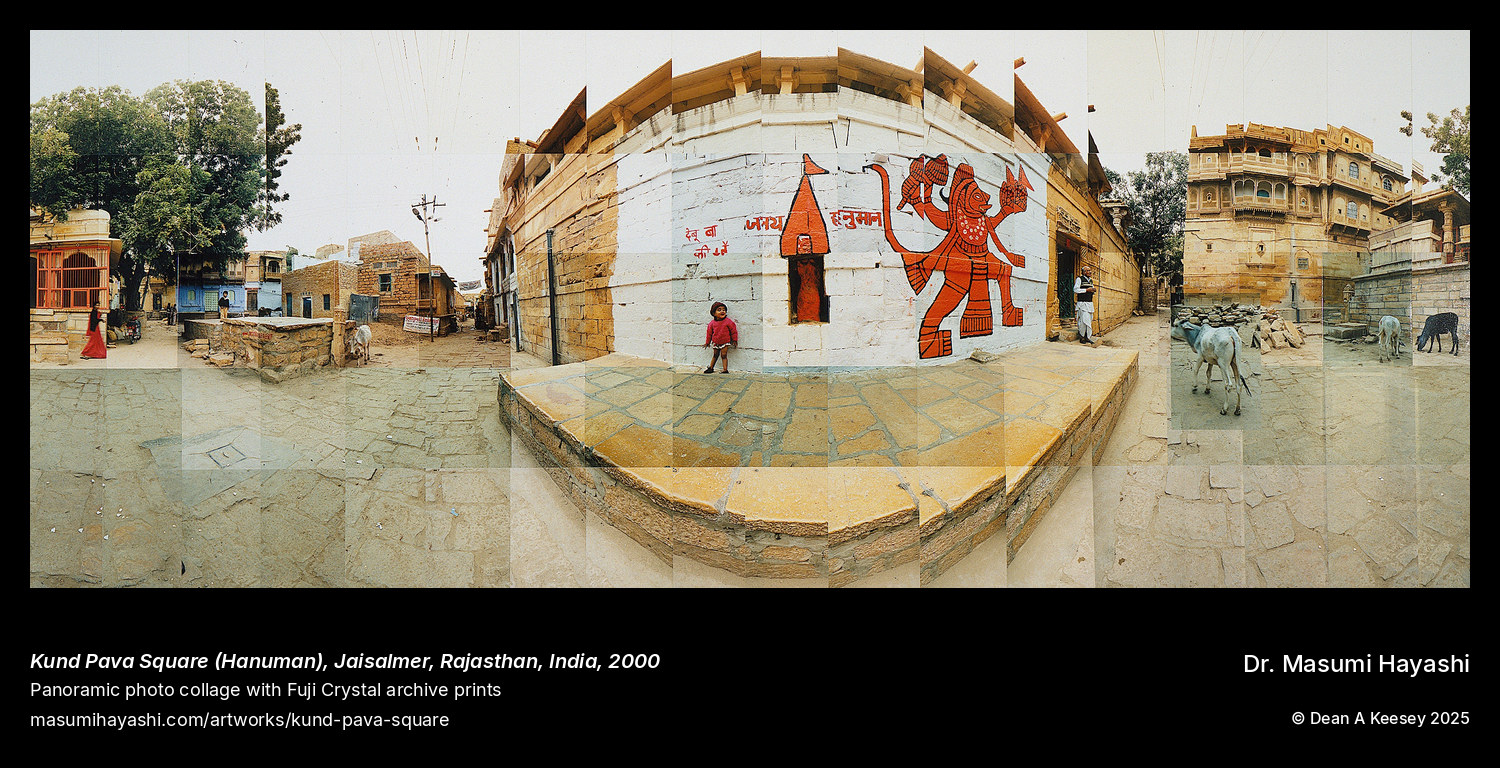
Kund Pava Square (Hanuman), Jaisalmer, Rajasthan, India
Jaisalmer, Rajasthan, India
Panoramic Photo Collage
2000
35 x 73
Kund Pava Square (Hanuman), Jaisalmer, Rajasthan, India
Overview
This panoramic photo collage documents a Hanuman temple or shrine in Kund Pava Square, Jaisalmer, Rajasthan - the legendary “Golden City” rising from Thar Desert where honey-colored sandstone architecture creates surreal mirage-like appearance amid endless sand dunes. Created in 2000 as part of Hayashi’s turn-of-millennium South Asian photographic journey (ELEVENTH confirmed 2000 work, third Rajasthan documentation alongside Jain Temple Jaisalmer 09018), this work captures Hanuman worship in desert fortress city context where Rajput warrior culture merged devotional Hinduism with architectural necessity, building temples, havelis (mansions), and public squares from local sandstone that glows golden in desert sun. The 35 x 73” extreme vertical format (2.09:1 height-to-width ratio, second-tallest in entire series after Jain Temple’s 25x73) suggests documentation of vertical architectural elements: perhaps Hanuman temple’s tower (shikhara), or multi-story havelimansions surrounding square, or merchants’ houses with elaborately carved facades characteristic of Jaisalmer’s 12th-19th century architecture. Hanuman - monkey god, Rama’s devoted companion in Ramayana epic, symbol of strength, devotion, and protection - enjoys particularly fervent worship in Rajasthan where warrior Rajput kings identified with Ramayana’s martial virtues and Hanuman’s unwavering loyalty to righteous king.
Historical and Religious Context
Jaisalmer: The Golden City
Desert fortress city’s unique position:
Geographic and climatic context:
- Located in Thar Desert, western Rajasthan
- 120 km from Pakistan border (strategic border location)
- Extreme climate: 50°C summer, cold winters, minimal rainfall
- Desert isolation preserved medieval character
- “Sonar Quila” (Golden Fort) - living fort with 3,000 residents still inhabiting
- Founded 1156 CE by Rawal Jaisal (Rajput king, Bhati dynasty)
- Name: Jaisal + mer (hill/fort) = Jaisal’s hill
Yellow sandstone architecture:
- Entire city built from local yellow Jaisalmer sandstone
- Glows golden in desert sun (hence “Golden City” epithet)
- Fine-grained sandstone allows intricate carving
- Facades elaborately decorated (jharokhas - overhanging balconies, lattice screens, brackets)
- Architectural preservation: UNESCO World Heritage candidate
- Visual effect: City appears to emerge from desert sand organically
Jaisalmer Fort (Sonar Quila):
- One of very few “living forts” (residents still inhabit)
- 250-foot yellow sandstone walls dominate city
- Founded 1156 CE, expanded through centuries
- Contains: Palaces, temples, havelis, shops, homes
- Jain temples within fort (built 12th-15th centuries)
- Hayashi documented Jain Temple (09018, 2000) - likely within fort complex
Economic history:
- Medieval caravan trade: India-Central Asia-China silk route
- Merchants (Oswals, Maheshwaris) built elaborate havelis
- 16th-18th centuries: Golden age of prosperity
- British colonial period: Maritime trade replaced caravan routes, Jaisalmer declined
- 20th century: Economic stagnation, then tourism boom (1970s onwards)
- 1965, 1971 India-Pakistan wars: Border location strategic importance
Hanuman: Monkey God and Warrior Deity
Hanuman’s significance in Hindu tradition and Rajput culture:
Ramayana epic role:
- Monkey god (vanara), son of wind god Vayu
- Rama’s devoted companion during exile and war against Ravana
- Crossed ocean to Lanka (jumped across sea)
- Found Sita (Rama’s kidnapped wife) imprisoned in Ashoka Grove
- Burned Lanka by setting his tail on fire
- Carried Sanjeevani mountain (healing herbs) to revive Lakshmana
- Ultimate bhakta (devotee): Lived only to serve Rama
- Immortal: Cursed/blessed to live until end of Kali Yuga
Theological and devotional significance:
- Strength: Physical power (carried mountain, leaped ocean)
- Devotion: Perfect bhakti to Rama, selfless service
- Celibacy: Brahmacharya (lifelong celibacy) empowering spiritual strength
- Protection: Guardian against evil, illness, obstacles
- Scholarship: Learned in scriptures (despite monkey form)
- Humility: Despite powers, remained humble servant
Rajasthan warrior culture and Hanuman:
- Rajput kings identified with Ramayana martial values
- Hanuman as warrior deity (not just devotional figure)
- Military expeditions invoked Hanuman for victory
- Forts contained Hanuman shrines for protection
- “Jai Hanuman” battle cry
- Warrior ethos: Loyalty to king like Hanuman to Rama
- Martial strength + devotional surrender ideal
Hanuman worship practices:
- Tuesdays and Saturdays: Special Hanuman worship days
- Hanuman Chalisa: 40-verse hymn (recited daily by millions)
- Sindoor (vermillion): Applied to Hanuman images (red color offerings)
- Wrestling: Akhara (wrestling schools) often have Hanuman shrines
- Bodybuilding: Hanuman patron of physical strength, gyms display images
- Students: Invoke Hanuman for concentration and learning
- Travelers: Seek protection for journeys
Kund Pava Square: Urban Sacred Space
Square’s function in Jaisalmer urban fabric:
Kund and Pava terminology:
- Kund: Water reservoir, tank, well (critical in desert environment)
- Pava: Square, courtyard, public space (possibly local/regional term)
- Name suggests: Public square centered on water source or near water body
- Desert cities: Water sources = gathering places, sacred spaces, social centers
Jaisalmer’s public squares and kunds:
- Multiple wells, tanks, baolis (step wells) throughout city
- Water scarcity makes every source sacred and communal
- Public squares host: Markets, festivals, religious ceremonies, social gatherings
- Temples often adjacent to water sources (ritual bathing before worship)
Hanuman temple in square context:
- Community worship center (not isolated rural shrine)
- Urban devotional practice (daily worship amid market activity)
- Public square temple: Accessible to all classes and castes
- Festival processions originate from or pass through square
- Merchant patronage: Wealthy traders funded temples, havelis
Haveli architecture surrounding squares:
- Elaborate merchant mansions (3-5 stories)
- Carved sandstone facades: Jharokhas (balconies), lattice screens (jali), brackets
- Ground floor: Commercial (shops, warehouses)
- Upper floors: Residential
- Inward-facing courtyards + street-facing elaborate facades
- Hayashi’s vertical format may capture: Haveli facades rising above square
Artistic Significance
2000 Turn-of-Millennium Journey: ELEVENTH Work Discovered
Part of extraordinary Fuji 4x6 2000 pilgrimage documentation:
2000 works confirmed (11 total):
India (6 works across 5 states):
- Bodhi Tree, Bodh Gaya, Bihar (09006)
- Kandariya Mahadeva, Khajuraho, Madhya Pradesh (09017)
- Lakshmana Temple, Khajuraho, Madhya Pradesh (09020)
- Jain Temple, Jaisalmer, Rajasthan (09018, 25x73” tallest)
- Kund Pava Square, Jaisalmer, Rajasthan (09019, this work, 35x73”) ← SECOND Jaisalmer work!
- River Ganges, Varanasi, Uttar Pradesh (09033, 19x62” most extreme aspect ratio)
Cambodia (5 works, all Angkor): 7. Banteay Srei, Angkor (09004) 8. Angkor Wat No. 1 (09003) 9. Bayon, Angkor Thom (09005) 10. Ta Prohm (09039) 11. Preah Khan (09029)
New pattern discovered:
- TWO Jaisalmer works: Jain Temple (09018) + Kund Pava Square (09019)
- TWO Khajuraho works: Kandariya + Lakshmana
- Five Angkor works
- 6 India + 5 Cambodia = 11 works total (6+5 balance shifted)
Geographic distribution:
- Bihar (1), Madhya Pradesh (2), Rajasthan (2), Uttar Pradesh (1), Cambodia (5)
- Rajasthan concentration: Both in Jaisalmer (desert city focus)
- Suggests multi-day Jaisalmer stay documenting multiple sacred sites
35 × 73” Extreme Vertical Format
Second-tallest work in entire series:
Vertical format analysis:
- 73” height (6 feet 1 inch - taller than most humans!)
- 35” width (less than 3 feet)
- 2.09:1 height-to-width ratio (very extreme vertical)
- Only Jain Temple Jaisalmer taller (25x73” = 2.92:1 - most extreme)
What extreme vertical format captures:
- Haveli facades: 3-5 story merchant mansions surrounding square
- Temple shikhara: Hanuman temple tower rising above square
- Architectural verticality: Jaisalmer’s upward-building desert architecture
- Carved facades: Floor-by-floor jharokhas, balconies, lattice screens
- Golden sandstone: Full-height facade glowing in desert light
- Vertical urban density: Desert cities build upward (water table constraints)
Comparison to Jain Temple Jaisalmer:
- Jain Temple: 25x73” (narrower, taller ratio)
- Kund Pava Square: 35x73” (wider, same height)
- Both documenting Jaisalmer vertical architecture
- Different subjects: Religious (Jain Temple) vs. urban secular/sacred mix (square + Hanuman shrine)
Horizontal formats in corpus:
- Most Sacred Architectures: Horizontal panoramas
- Vertical formats rare (signal special architectural requirement)
- Extreme verticals (70+ inches height): Jain Temple, this work, Bodhi Tree (24x69), Jain Temple (25x73)
- All vertical extremes: Towers (gopurams, shikharas, trees, facades)
Framed Edition in Inventory
Single framed edition (2007 catalog) suggests:
Exhibition preparation:
- 73” height requires special hanging considerations
- Framed indicates display readiness
- Part of 2000 journey documentation (historical significance)
- Second Jaisalmer work (paired with Jain Temple for comprehensive city portrait)
Rajasthan documentation:
- Two 2000 works from Jaisalmer
- Both extreme verticals (25x73, 35x73)
- Desert architecture’s vertical emphasis documented
- Golden sandstone aesthetic captured
- Merchant city sacred spaces (Jain Temple + Hanuman square)
Photographing Desert Urban Sacred Space
Kund Pava Square photography challenges:
Desert light:
- Harsh Rajasthan sun
- Golden sandstone glowing
- Extreme shadows and highlights
- Morning/evening light (golden hour amplified by golden stone)
- Desert haze and dust
- Blue sky contrast with yellow architecture
Vertical composition:
- Ground-to-roofline sweep
- Multiple floors of haveli facades
- Carved detail visible at each level
- How to maintain detail in 73” height print?
- Photo collage: Assembling vertical panorama from multiple images
Urban density:
- Crowded square (merchants, pilgrims, residents, tourists)
- Market activity
- Temple worship amid secular commerce
- Hanuman shrine accessibility
- Public space documentation ethics (photographing people in sacred + commercial space)
Architectural detail:
- Intricate sandstone carving (jharokhas, jali screens, brackets)
- How much detail legible in panoramic view?
- Individual elements vs. overall facade pattern
- Desert weathering of sandstone
Sacred-secular boundary:
- Hanuman shrine in commercial square
- Devotional practice amid market
- How to convey religious significance amid urban bustle?
- Title emphasizes Hanuman (sacred focus) despite urban context
Contemporary Relevance and Enduring Questions
Kund Pava Square documentation raises questions:
Urban sacred space:
- How do temples function in commercial squares vs. isolated pilgrimage sites?
- What is relationship between Hanuman devotion and merchant prosperity?
- How does desert environment shape sacred architecture and urban planning?
- What role do public squares play in desert city social fabric?
Architectural documentation:
- Why does Jaisalmer vertical architecture demand extreme vertical format?
- How do TWO Jaisalmer works (Jain Temple + Kund Pava Square) create comprehensive city portrait?
- What is significance of photographing both Jain (09018) and Hindu (09019, Hanuman) sacred spaces?
- Can 73” height print convey experience of standing in Jaisalmer square looking upward?
2000 journey:
- What is significance of ELEVEN 2000 works (exceeding initial 10-work count)?
- Why concentrate TWO works in Jaisalmer vs. single works elsewhere?
- How did multi-week 2000 journey organize (sequential route? return visits?)?
- What determines which sites merited documentation vs. which were passed over?
Rajput culture and religion:
- How does Rajput warrior ethos shape Hanuman worship?
- What is connection between desert fortress architecture and devotional practice?
- How do merchant patronage and martial culture coexist in Jaisalmer?
- What happened to caravan trade wealth when silk routes declined?
Comparative Context: Jaisalmer Two-Work Documentation
Hayashi’s Jaisalmer pair (both 2000, both extreme verticals):
Jain Temple, Jaisalmer (09018, 2000):
- 25 x 73 inches (2.92:1 - most extreme vertical in series)
- Jain temple (Dilwara-style architecture)
- Religious architecture focus
- Within Sonar Quila (Golden Fort)
- Two Foundation editions retained
Kund Pava Square (Hanuman) (09019, 2000, this work):
- 35 x 73 inches (2.09:1 - second-most extreme vertical)
- Hanuman shrine in urban square
- Urban secular/sacred mix
- Public square + merchant havelis
- Framed edition in inventory
Why two Jaisalmer works?
- Religious diversity: Jain + Hindu documentation
- Architectural typology: Isolated temple (Jain) + urban square (Hanuman)
- Scale variation: Both extreme verticals but different width (25” vs. 35”)
- Comprehensive city portrait: Sacred + secular, elite (Jain merchant) + popular (Hanuman warrior)
- Multi-day Jaisalmer visit suggested (not quick pass-through)
Jaisalmer’s uniqueness in 2000 journey:
- ONLY city with two works (all other sites: single work)
- Both works extreme verticals (architectural requirement)
- Both golden sandstone architecture (desert aesthetic)
- Suggests special significance or sustained engagement
Educational Significance
This work teaches about:
- Kund Pava Square: Public square in Jaisalmer with Hanuman temple/shrine, water source significance
- Hanuman worship: Monkey god, Rama’s devotee, strength/protection/devotion, Rajput warrior identification
- Jaisalmer “Golden City”: Desert fortress city, yellow sandstone architecture, silk route trade center
- Haveli architecture: Merchant mansions, elaborately carved facades, jharokhas and jali screens
- Extreme vertical format: 35x73” (second-tallest work), captures multi-story facades, temple towers
- 2000 journey ELEVENTH work: Fuji 4x6 film, turn-of-millennium pilgrimage, 6 India + 5 Cambodia
- TWO Jaisalmer works: Jain Temple (09018, 25x73”) + Kund Pava Square (09019, 35x73”) - comprehensive city portrait
- Desert urban sacred space: Temples in commercial squares, water source gathering places, merchant patronage
- Rajput warrior culture: Hanuman as martial deity, Ramayana identification, fortress city devotion
- Photo collage vertical panorama: Assembling extreme vertical perspective beyond single photograph
Note: This canonical content was extracted from the Masumi Hayashi Foundation Master Catalogue (2007 inventory). Edition 1 (framed) in artist’s estate. Created in 2000 as ELEVENTH work in turn-of-millennium photographic journey (Fuji 4x6 film specification). Documents Hanuman temple/shrine in Kund Pava Square, Jaisalmer - “Golden City” in Thar Desert built entirely from yellow sandstone. Extreme vertical format 35x73” (second-tallest in entire series, only Jain Temple Jaisalmer taller at 25x73”) captures vertical desert architecture: multi-story haveli facades, temple shikhara, carved sandstone glowing golden. Hanuman (monkey god, Rama’s devotee) particularly worshipped in Rajasthan where Rajput warriors identified with Ramayana martial values. Second of TWO Jaisalmer works (first: Jain Temple 09018), suggesting multi-day desert city stay and comprehensive documentation strategy. Public square + Hanuman shrine represents urban sacred space where devotional practice merges with commercial activity amid merchant havelis. 2000 journey now totals: 6 India works (Bihar, Madhya Pradesh x2, Rajasthan x2, Uttar Pradesh) + 5 Cambodia works (all Angkor complex). Jaisalmer concentration (TWO works, both extreme verticals) unique in 2000 journey - all other sites single works.