Jain Temple, Jaisalmer, Rajasthan, India
Jaisalmer, Rajasthan, India
Panoramic Photo Collage
2000
25 x 73
Jain Temple, Jaisalmer, Rajasthan, India
Overview
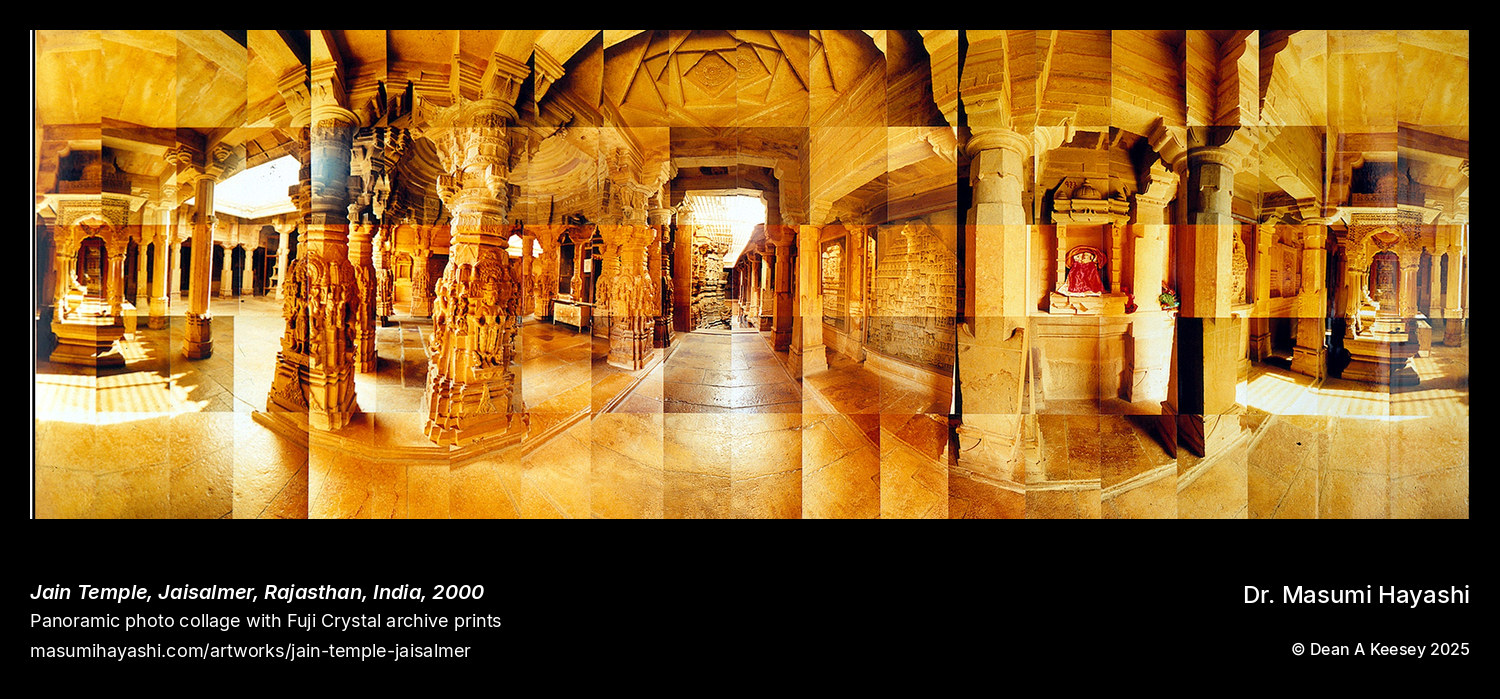
Created in 2000, this 25 x 73-inch panoramic photo collage documents Jain temple within Jaisalmer Fort—“Golden City” of Rajasthan’s Thar Desert where seven interconnected Jain temples constructed 12th-16th centuries by wealthy Jain merchant community create extraordinary complex of yellow sandstone architecture with white marble interiors bearing intricate carvings depicting Tirthankaras (Jain spiritual teachers), elaborate floral patterns, and manuscript libraries preserving ancient Jain texts representing Jain architectural and artistic traditions flourishing under royal patronage despite Jain community’s minority religious status within predominantly Hindu Rajput kingdoms. Jaisalmer’s Jain temples, positioned within 12th century fort complex atop Trikuta Hill, demonstrate distinctive Jain aesthetic preferences—non-violent imagery avoiding Hindu gods’ martial aspects, extreme sculptural detail reflecting Jain philosophical emphasis on precision and completeness, and architectural spaces designed for meditation, scripture study, and veneration of Tirthankaras rather than Hindu deity worship’s elaborate ritual choreography. The 25 x 73-inch format represents Sacred Architectures series’ second most extreme vertical panorama (2.92:1 aspect ratio approaching 3:1, 73-inch height exceeding 6 feet by one inch) creating nearly identical dimensions to Bodhi Tree’s 24 x 69 inches, suggesting deliberate format choice for documenting soaring vertical temple architecture where tower elements, sculptural programs distributed across height, and vertical spatial progression from ground level to elevated sanctums demand extreme vertical documentation impossible through moderate formats or conventional horizontal panoramas. The 2000 date positions Jain Temple as fourth confirmed turn-of-millennium work alongside Bodhi Tree (Bihar, Buddhist), Banteay Srei (Cambodia, Hindu-Buddhist), and Kandariya Mahadeva (Madhya Pradesh, Hindu), establishing systematic 2000 photographic journey documenting three major Indian religious architectural traditions—Buddhism (enlightenment site), Hinduism (tantric temple), and Jainism (merchant-patronage temple complex)—plus Hindu-Buddhist synthesis at Angkor, all employing identical Fuji 4 x 6 film specifications indicating deliberate technical consistency across comprehensive religious documentation campaign. Remarkably, two framed editions maintained in Foundation inventory (unusual duplication) while three editions remain unaccounted for, potentially indicating strategic retention recognizing Jain Temple’s rarity within artist’s oeuvre (only confirmed Jain architectural documentation), Jaisalmer’s “Golden City” visual distinctiveness, extreme vertical format’s exhibition value, and Jain community’s potential institutional collection interest requiring multiple framed editions for simultaneous exhibition or loan opportunities.
Historical Context: Jaisalmer and Jain Architectural Tradition
Jaisalmer represents distinctive Rajasthani architectural achievement where Jain merchant wealth funded extraordinary temple construction:
Jaisalmer Fort and City: Founded 1156 CE by Rajput ruler Rawal Jaisal:
- Strategic Location: Thar Desert trade route connecting India with Central Asia, Middle East—camel caravans transporting silk, spices, precious stones
- Living Fort: Unlike most Indian forts functioning as military/administrative centers, Jaisalmer Fort maintained residential quarter housing approximately 4,000 inhabitants within fortification walls—shops, homes, temples creating functioning urban community
- Yellow Sandstone Architecture: Local golden-yellow sandstone creating distinctive visual identity—entire city appears golden especially during sunset earning “Golden City” (Sonar Qila) epithet
- UNESCO World Heritage Site (2013): Hill Forts of Rajasthan series recognizing architectural and historical significance
Jain Community in Rajasthan: Jainism, ancient Indian religion emphasizing non-violence (ahimsa) and asceticism:
Origins: Founded 6th century BCE by Mahavira (contemporary with Buddha), Jainism developed parallel to Buddhism and Hinduism while maintaining distinct philosophical and ritual traditions
Core Principles:
- Ahimsa (Non-Violence): Extreme commitment avoiding harm to all living beings—vegetarianism, certain occupations forbidden (agriculture harming soil organisms), monks covering mouths preventing insect inhalation
- Anekantavada (Multiple Perspectives): Philosophical principle recognizing truth’s complexity—multiple valid viewpoints
- Asceticism: Monks and nuns practicing extreme renunciation including fasting, nudity (Digambara sect), minimal possessions
- Liberation: Spiritual goal achieving moksha through ethical living, ascetic practice, karma elimination
Jain Merchants in Medieval Rajasthan: Despite small population percentage, Jain community wielded disproportionate economic influence:
- Trade Networks: Jain merchants dominating long-distance trade—textiles, precious stones, spices, banking
- Royal Patronage: Rajput kingdoms protecting Jain communities recognizing economic value despite religious differences
- Temple Construction: Merchant wealth funding elaborate temple complexes—Ranakpur, Mount Abu (Dilwara Temples), Jaisalmer demonstrating architectural patronage parallel to Christian Renaissance merchants sponsoring churches
- Manuscript Preservation: Jain libraries (bhandars) preserving ancient texts including non-Jain works—significant contributions to Indian intellectual heritage
Jaisalmer Jain Temples: Seven interconnected temples within fort complex:
Construction Period: 12th-16th centuries spanning 400+ years continuous building and elaboration
Principal Temples:
- Parsvanatha Temple (1417): Largest, dedicated to 23rd Tirthankara
- Rishabhdev Temple (15th century): Dedicated to first Tirthankara
- Shantinath Temple (1536): Dedicated to 16th Tirthankara
- Kunthanath Temple: Dedicated to 17th Tirthankara
- Sambhavanath Temple: Dedicated to third Tirthankara
- Shitalnath Temple: Dedicated to 10th Tirthankara
- Adinath Temple: Dedicated to first Tirthankara
Architectural Features:
Exterior:
- Yellow Sandstone Construction: Fort’s local sandstone creating unified visual aesthetic
- Tower Elements (Shikharas): Vertical emphasis rising above complex
- Ornate Entrances: Carved torans (gateways), pillared porches
Interior:
- White Marble: Contrasting with yellow sandstone exterior—cool, reflective, symbolically pure
- Intricate Carving: Every surface carved—pillars, ceilings, walls, doorframes creating overwhelming visual density
- Pillared Halls (Mandapas): Congregation spaces with elaborately carved columns
- Sanctum Chambers: Housing Tirthankara images in meditation poses
- Manuscript Libraries (Gyan Bhandars): Preserving ancient Jain texts, palm-leaf manuscripts, illuminated copies
Sculptural Programs:
Tirthankaras: 24 spiritual teachers (jinas) achieving liberation and teaching path:
- Depicted in meditation pose (padmasana—lotus position)
- Peaceful facial expressions, closed or downcast eyes
- Naked or minimally clothed (Digambara tradition) or white-robed (Shvetambara tradition)
- Identifying symbols (animals, objects) distinguishing each Tirthankara
Yakshas and Yakshis: Guardian deities associated with Tirthankaras:
- Subsidiary figures flanking main images
- More dynamic poses compared to Tirthankaras’ stillness
- Decorative rather than central worship focus
Floral and Geometric Patterns: Non-figurative decoration reflecting Jain aesthetic:
- Scrolling vines, lotus flowers, mandalas
- Geometric interlocking patterns
- Extreme detail—fine lines, deep carving, layered relief
Absence of Hindu Martial Imagery: Unlike Hindu temples depicting gods fighting demons:
- Jain non-violence principle prohibiting violent imagery
- Focus on meditation, teaching, spiritual attainment rather than cosmic battles
- Peaceful aesthetic reflecting ahimsa philosophy
Contemporary Function:
- Active worship by local and visiting Jain community
- Daily rituals, annual festivals (Mahavir Jayanti celebrating founder’s birth)
- Tourist destination creating tensions between religious function and secular visitation
- Conservation challenges—sandstone weathering, tourist traffic, urban development pressures
Second Most Extreme Vertical Panorama: 25 x 73 Inches
At 25 x 73 inches, Jain Temple employs nearly identical extreme vertical format to Bodhi Tree:
Format Analysis:
- Width: 25 inches (2.08 feet, slightly over 2 feet) creates narrow horizontal field
- Height: 73 inches (6.08 feet, exceeding 6 feet) establishes dramatic vertical emphasis
- Aspect Ratio: 2.92:1 (height to width)—approaching 3:1 vertical panorama
Comparison with Other Extreme Verticals:
- Bodhi Tree: 24 x 69” (2.875:1 vertical)—MOST EXTREME
- Jain Temple: 25 x 73” (2.92:1 vertical)—SECOND MOST EXTREME (actually slightly more extreme ratio!)
- Kandariya Mahadeva: 30 x 59” (1.97:1 vertical)—approaching 2:1
- Hanuman Ghat: 24 x 45” (1.88:1 vertical)—ghat descent
Jain Temple Surpasses Bodhi Tree in Absolute Height:
- Bodhi Tree: 69 inches (5.75 feet)
- Jain Temple: 73 inches (6.08 feet)—TALLEST Sacred Architectures work by height
While Bodhi Tree has slightly more extreme aspect ratio (narrower width), Jain Temple’s 73-inch height makes it tallest individual work in series.
Format Rationale: Jain Temple Architecture:
Vertical Temple Towers: Jain temples emphasize vertical shikhara elements:
- Tower rising above complex creating skyline silhouette
- Vertical format capturing full elevation from base to finial
- 73-inch height enabling comprehensive tower documentation
Multi-Story Interior Spaces: Jain temples often feature:
- Ground floor main hall
- Upper level shrines, balconies, secondary chambers
- Vertical circulation—stairs connecting levels
- Extreme vertical format documenting multi-story spatial organization
Sculptural Distribution Across Height: Carving covering multiple vertical zones:
- Lower registers: Human viewing level with intimate detail examination
- Middle zones: Primary sculptural programs—Tirthankaras, yaksha-yakshi pairs, decorative patterns
- Upper zones: Ceiling carving, tower decoration, architectural ornament
- 73-inch format capturing complete vertical sculptural extent
Golden City Visual Context: Possible documentation strategies:
- Temple tower rising against desert sky
- Vertical elevation showing sandstone’s golden color gradations
- Architectural context within fort’s vertical topography (Trikuta Hill)
Display Considerations:
Exhibition Challenges: 73-inch height (over 6 feet) creates:
- Most demanding vertical space requirement in series
- Gallery walls requiring minimum 7-8 foot height with adequate clearance above/below frame
- Narrow width (25 inches) creating unusual proportions
- Framing complexity for 6+ foot height
Two Framed Editions Strategy: Foundation maintaining two framed editions unusual:
- Typically single framed edition sufficient
- Suggests anticipated high exhibition demand
- Enables simultaneous display in multiple locations
- Recognition of work’s rarity (only Jain architectural documentation)
- Format’s exhibition impact justifying multiple frame investment
Visual Impact: Extreme dimensions creating:
- Towering physical presence dominating gallery space
- Immersive vertical experience
- Format innovation distinguishing work within artist’s oeuvre
- Rarity increasing institutional collection value
Fourth 2000 Work: Comprehensive Religious Documentation
Jain Temple completes quartet of 2000 works documenting three major Indian religions:
2000 Works Confirmed (Complete List):
- Bodhi Tree (Bodh Gaya, Bihar)—Buddhism, 24 x 69” extreme vertical, Fuji 4 x 6
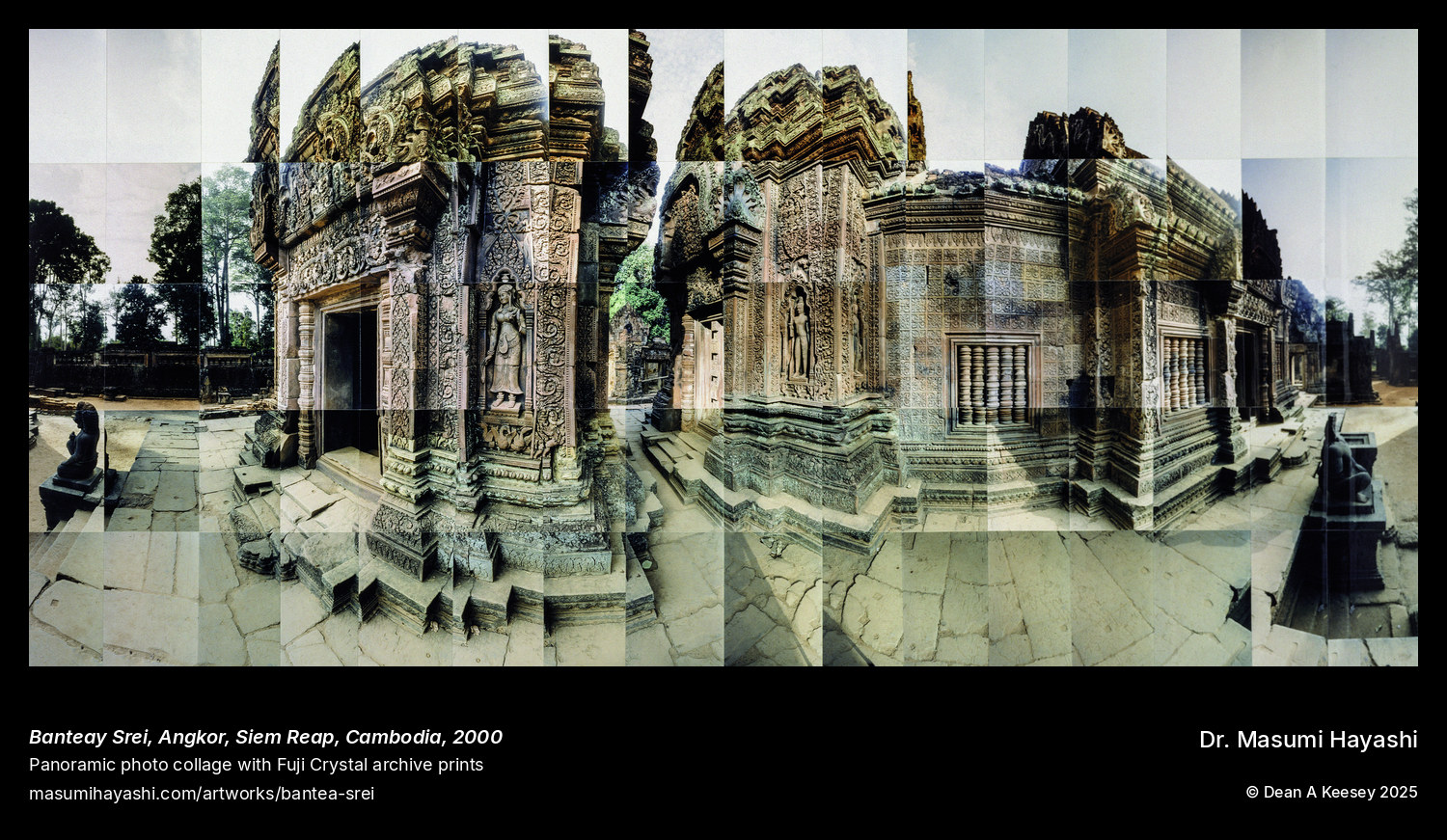
- Banteay Srei (Angkor, Cambodia)—Hindu-Buddhist, 27 x 56” moderate horizontal, Fuji 4 x 6
- Kandariya Mahadeva (Khajuraho, Madhya Pradesh)—Hinduism, 30 x 59” significant vertical, Fuji 4 x 6
- Jain Temple (Jaisalmer, Rajasthan)—Jainism, 25 x 73” extreme vertical, Fuji 4 x 6
Technical Consistency Absolute: All four 2000 works employ identical specifications:
- Fuji film stock (distinct from typical Kodak)
- 4 x 6-inch format (larger than typical 3.5 x 5)
- Systematic technical approach across entire journey
Religious Diversity Comprehensive: 2000 journey documenting Indian subcontinent’s three major indigenous religious traditions:
- Buddhism: Foundational enlightenment site (6th century BCE origins)
- Hinduism: Tantric temple architecture (medieval development)
- Jainism: Merchant-patronage temple complex (ancient tradition, medieval architecture)
- Hindu-Buddhist Synthesis: Angkor Wat (Southeast Asian religious evolution)
No other documented photographic journey achieved comparable religious comprehensiveness.
Geographic Distribution (India): Four Indian states plus Cambodia:
- Bihar (northeastern India)—Buddhism
- Madhya Pradesh (central India)—Hinduism
- Rajasthan (northwestern India)—Jainism
- Cambodia (Southeast Asia)—Hindu-Buddhist
Systematic coverage maximizing geographic and religious diversity.
Format Diversity:
- Two extreme verticals: Bodhi Tree (24 x 69”), Jain Temple (25 x 73”)
- One significant vertical: Kandariya Mahadeva (30 x 59”)
- One moderate horizontal: Banteay Srei (27 x 56”)
Format responsive to specific architectural requirements rather than formulaic approach.
Turn of Millennium Symbolism: Year 2000 timing documenting:
- Ancient religious traditions (Buddhism 6th century BCE, Jainism 6th century BCE, Hinduism millennia-old)
- Medieval architectural achievements (Angkor 10th century, Khajuraho 11th century, Jaisalmer 12th-16th centuries, Bodh Gaya’s Mahabodhi Temple 5th-6th centuries)
- Contemporary pilgrimage/tourism contexts
- Preservation urgency at century’s turn
Rajasthan Sacred Architecture: Northwestern India
Jain Temple expands Sacred Architectures’ Indian geographic scope to northwestern desert region:
India Documentation Confirmed (Geographic Distribution Expanded):
- Bihar: Bodh Gaya (2000)—Buddhist
- Madhya Pradesh: Khajuraho (2000), Ellora vicinity
- Maharashtra: Ellora Caves (2002)—Hindu-Buddhist-Jain rock-cut
- Karnataka: Hampi (2003-2004)—Hindu Vijayanagara
- Tamil Nadu: Meenakshi Temple (2003)—Hindu Dravidian
- Rajasthan: Jaisalmer (2000)—Jain
Six Indian states documented representing northern, central, southern, eastern, and western regions.
Rajasthan’s Jain Architectural Heritage: State preserves extraordinary Jain temple complexes:
- Ranakpur: 15th century marble temple with 1,444 carved pillars
- Mount Abu (Dilwara Temples): 11th-13th century marble temples, finest Jain architecture
- Jaisalmer: Seven interconnected temples within Golden City fort
- Bikaner, Osiyan, Ghanerao: Additional significant Jain sites
Jaisalmer documentation recognizes Rajasthan’s central role in Jain architectural patronage.
Only Confirmed Jain Architecture Documentation: Among known Sacred Architectures works:
- Multiple Hindu temples: Khajuraho, Meenakshi, Hampi, Ellora Hindu caves
- Buddhist sites: Bodh Gaya, likely Nepal monasteries
- Jain-Hindu-Buddhist coexistence: Ellora complex
- Single pure Jain temple: Jaisalmer
Rarity potentially explaining two framed Foundation editions—recognizing documentation’s uniqueness within artist’s oeuvre.
Two Framed Foundation Editions: Unusual Retention Strategy
Maintaining two framed editions represents atypical Foundation approach:
Typical Pattern: Most works: Single framed edition maximum, often unframed only
Jain Temple Exception: Two framed editions suggesting:
Anticipated Exhibition Demand:
- Rarity within oeuvre (only Jain architectural documentation)
- Extreme vertical format’s exhibition impact
- Multiple simultaneous display opportunities
- Loan requests from institutions focusing on Jain heritage
Format Considerations:
- 73-inch height requiring professional framing investment
- Two frames enabling simultaneous exhibitions
- One frame for permanent Foundation display, second for traveling exhibitions
Religious Community Interest:
- Jain community institutions potentially requesting loans
- Educational contexts requiring Jain architectural representation
- Interfaith exhibitions requiring Buddhist-Hindu-Jain comparisons
Getty-Level Placement Strategy: Retaining two editions ensuring:
- Availability despite institutional loans
- Flexibility responding to placement opportunities
- Recognition of work’s significance deserving multiple presentation contexts
Collection Information
Year: 2000 Location: Jaisalmer, Rajasthan, India Medium: Panoramic Photo Collage Dimensions: 25 x 73 inches (second most extreme vertical panorama, TALLEST by absolute height) Edition: 1 of 5 Film: 4 x 6 inches, Fuji
- Masumi Hayashi Foundation (framed, inventory)
Note: Three additional edition locations unaccounted for. Fourth confirmed 2000 work completing quartet documenting three major Indian religious traditions—Buddhism (Bodh Gaya), Hinduism (Khajuraho), Jainism (Jaisalmer)—plus Hindu-Buddhist synthesis (Angkor Banteay Srei), all employing identical Fuji 4 x 6 film establishing systematic turn-of-millennium photographic journey achieving unparalleled religious architectural diversity within single campaign. Work represents second most extreme vertical panorama (25 x 73”, 2.92:1 aspect ratio approaching 3:1) and tallest work by absolute height (73 inches exceeding 6 feet), documenting Jain temple within Jaisalmer Fort—“Golden City” where seven interconnected Jain temples constructed 12th-16th centuries by wealthy merchant community create extraordinary yellow sandstone complex with white marble interiors bearing intricate carving depicting Tirthankaras, floral patterns, and manuscript libraries preserving Jain textual heritage. Extreme vertical format captures soaring temple architecture’s full elevation from ground level to tower summit, comprehensive sculptural documentation across height, and multi-story spatial organization characteristic of Jain temple design. Only confirmed Jain architectural documentation within Sacred Architectures series establishes work’s rarity potentially explaining unusual retention of two framed Foundation editions anticipating multiple simultaneous exhibition opportunities, Jain community institutional interest, and recognition of work’s uniqueness deserving flexible presentation strategy. Jaisalmer documentation expands series’ Indian geographic scope to northwestern Rajasthan (sixth Indian state documented), contributing to systematic coverage understanding Indian sacred architecture requires documenting diverse religious traditions (Hindu-Buddhist-Jain), varied construction methods (freestanding temples vs. rock-cut caves), multiple regional architectural styles (Nagara vs. Dravidian vs. Rajasthani), and different patronage contexts (royal vs. merchant funding). Appropriate for major art museums with comprehensive Asian collections, university museums prioritizing comparative religious architecture studies, Jain community institutions, or museums documenting Indian merchant class’s cultural patronage demonstrating economic elite’s role shaping religious architectural heritage. Two Foundation editions ensure work’s availability for exhibitions, institutional loans, and educational contexts while three unaccounted editions potentially placed with institutions prioritizing Jain heritage preservation or collectors specializing in Indian religious architectural documentation. Extreme vertical format’s towering physical presence (over 6 feet tall) creates distinctive gallery display requiring specialized exhibition spaces while demonstrating photographic format innovation addressing specific architectural documentation requirements beyond conventional horizontal panorama conventions.