Golden Temple, Kathmandu, Nepal | Masumi Hayashi Foundation
Back to Gallery
Picture of Golden Temple, Kathmandu, Nepal by Dr. Masumi Hayashi

Golden Temple, Kathmandu, Nepal

Kathmandu, Nepal

Panoramic Photo Collage

2004

46" x 29"

Golden Temple, Kathmandu, Nepal

Overview

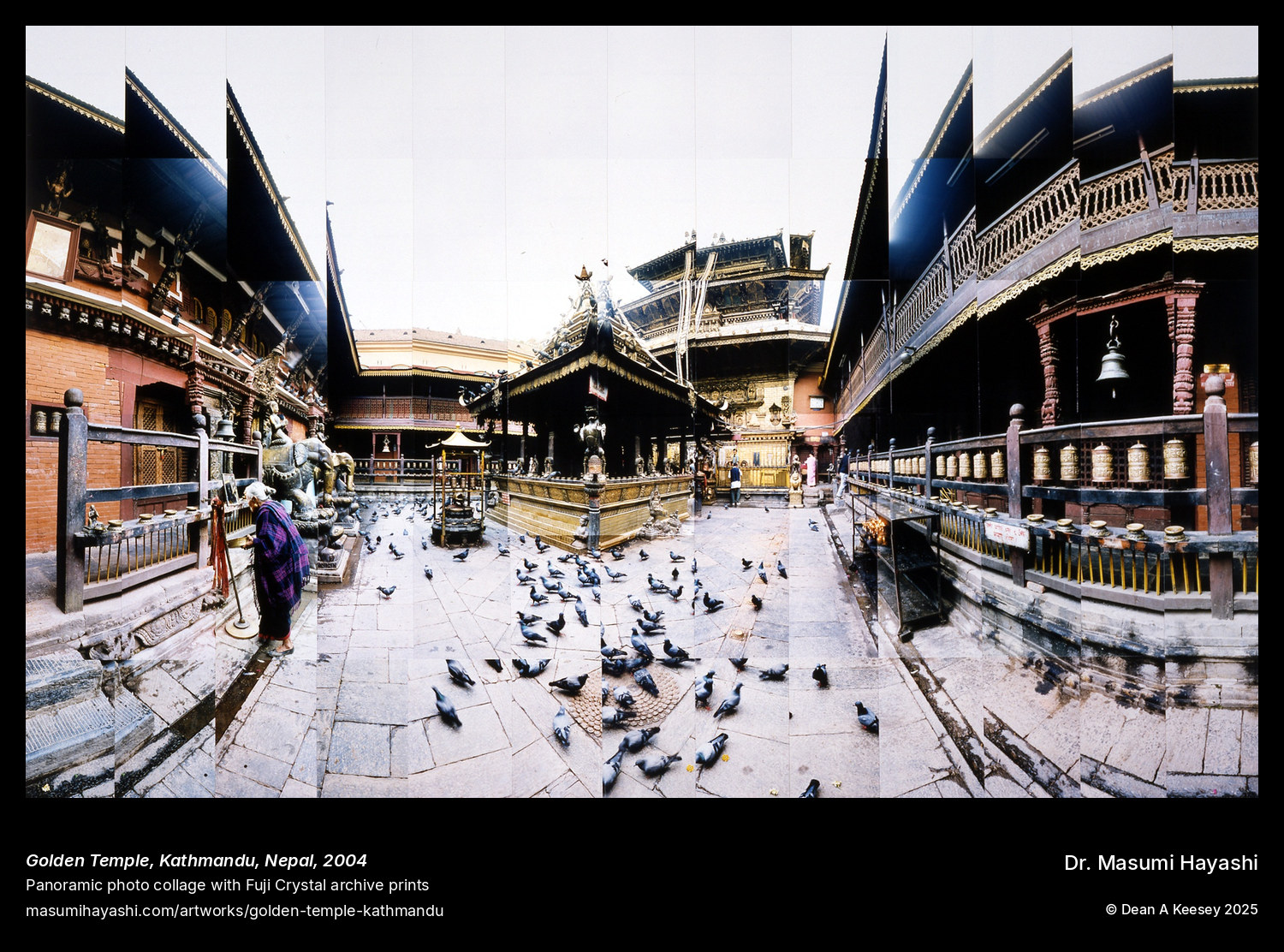
Created in 2004, this 46 x 29-inch panoramic photo collage documents the Golden Temple (Hiranya Varna Mahavihar)—12th century Newari Buddhist monastery in Patan renowned for its gilded copper facade creating luminous architectural presence giving the temple its popular name. The monastery represents pinnacle of Newari Buddhist architecture where traditional bahál (monastic courtyard) design incorporates exceptional metalwork craftsmanship—gilt copper repoussé work covering temple facades, carved wooden struts supporting tiered roofs, and stone sculptures positioned throughout enclosed courtyard creating concentrated sacred landscape withdrawn from surrounding urban fabric. Unlike grand royal palace squares or expansive Hindu temple complexes, the Golden Temple exemplifies intimate scaled sacred architecture where high surrounding walls create bounded sacred precinct entered through single doorway, revealing inner courtyard dominated by central shrine with its distinctive gilded exterior reflecting Kathmandu Valley sunlight and creating otherworldly luminosity that has attracted pilgrims, artists, and visitors for centuries. The 2004 date positions this as late-career work—created just two years before Hayashi’s death in 2006, suggesting sustained commitment to Sacred Architectures documentation through final active years despite health challenges and other demands. The 46 x 29-inch format (1.6:1 aspect ratio) employs moderate horizontal panorama suited to documenting rectangular courtyard architecture where spatial enclosure and architectural facades facing inward create compositional emphasis on central shrine and surrounding monastic buildings rather than extensive lateral sweep. Only one edition accounted for (Foundation inventory, unframed) while four editions remain unplaced indicates commercial challenges possibly reflecting late-career work’s limited market exposure, specialized subject matter (Newari Buddhist architecture), or Foundation’s retention strategy preserving editions for future placement in collections prioritizing Asian sacred architecture or Newari cultural heritage.

Historical Context: Hiranya Varna Mahavihar

The Golden Temple’s architectural and religious significance emerges from unique position within Newari Buddhism:

Founding and Name (12th Century): Hiranya Varna Mahavihar translates as “Golden Monastery”—referring to gilded copper facade rather than solid gold construction:

  • Traditional attribution to King Bhaskar Varman (12th century)
  • Alternative founding stories link temple to earlier Buddhist establishment
  • Name derives from distinctive gilt copper repoussé work covering main shrine
  • Popular designation “Golden Temple” used internationally while Hiranya Varna Mahavihar remains formal Nepali name

Newari Buddhism Context: The temple represents distinctive Newari Buddhist tradition:

Mahayana-Vajrayana Synthesis: Newari Buddhism combines Mahayana philosophical traditions with Tantric Vajrayana practices, creating unique expression distinct from Tibetan, Chinese, or Southeast Asian Buddhist traditions

Caste-Based Monasticism: Unlike celibate monk-based Buddhism elsewhere, Newari Buddhism operates through hereditary caste system where Shakya and Vajracharya families maintain temples, perform rituals, and transmit knowledge generationally through family lines rather than monastic ordination

Architectural Expression: Bahál courtyard form creates enclosed sacred landscape integrating temple architecture, residential quarters, and communal spaces within single compound walls

Hindu-Buddhist Synthesis: Newari Buddhism incorporates Hindu deities, practices, and architectural elements creating syncretic tradition where rigid religious boundaries dissolve in daily practice

Architectural Features:

Central Shrine: Three-tiered pagoda-style temple with gilded copper facade:

  • Repoussé metalwork depicting Buddhist deities, mythological scenes, decorative patterns
  • Gilt surface reflects changing light throughout day, creating luminous presence
  • Wooden struts carved with protective deities supporting tiered roofs
  • Interior housing main Buddha image and ritual objects

Courtyard Layout (Bahál Design):

  • Rectangular enclosed courtyard entered through single ornate doorway
  • Central shrine dominating courtyard space
  • Surrounding two-story structures housing residential and ritual spaces
  • Stone paving with ritual circumambulation path around central shrine
  • Secondary shrines and prayer wheels positioned around courtyard perimeter
  • Metalwork, woodcarving, and stone sculpture concentrated throughout enclosed space

Metalwork Tradition: Golden Temple showcases Patan’s renowned metalworking craftsmanship:

  • Gilt copper repoussé requiring specialized hammering techniques creating raised relief designs
  • Traditional lost-wax bronze casting for sculptures
  • Maintenance requiring periodic re-gilding preserving luminous appearance
  • Craft knowledge transmitted through family lineages maintaining techniques across centuries

Active Religious Function: Unlike many heritage monuments becoming primarily tourist attractions, Golden Temple maintains active worship:

  • Daily rituals performed by hereditary temple guardians (Shakya families)
  • Buddhist festivals celebrated in courtyard
  • Pilgrims circumambulating central shrine
  • Ritual offerings presented at various shrines
  • Living religious tradition continuing within historic architectural fabric

Late-Career Work: 2004 Creation Date

The 2004 date carries significance within Hayashi’s biography and artistic production:

Final Active Years (2003-2006): Creating Golden Temple documentation just two years before 2006 death demonstrates:

Sustained Documentary Commitment: Continuing international travel and demanding photography despite health challenges, professional obligations (Cleveland State University teaching), and administrative responsibilities (managing artwork production, edition creation)

Asian Sacred Architecture Focus: Late-career concentration on Sacred Architectures series rather than other thematic directions suggests this subject maintained particular significance—possibly spiritual dimensions, aesthetic fascination, or archival urgency documenting endangered heritage

Technical Demands: Panoramic photo collage technique requiring extensive post-production work (darkroom processes, precise alignment, mounting) continued through final years despite physical demands

Subject Selection: Choosing intimate scaled monastery architecture (Golden Temple’s enclosed courtyard) rather than grand temple complexes might reflect late-career preferences for concentrated, contained subjects over sprawling architectural documentation

Photographic Context: 2004 Asian photography occurred during transitional period:

  • Digital photography increasingly common but professional film photography maintaining quality advantages
  • Earthquake damage not yet affecting Kathmandu Valley (2015 Gorkha earthquake would come 11 years later)
  • Growing tourism pressures on sacred sites but pre-smartphone era allowing more contemplative documentation
  • Hayashi’s continued use of film and analog collage techniques increasingly distinctive as digital manipulation became standard

Format Analysis: 46 x 29 Inches

At 46 x 29 inches (1.6:1 aspect ratio), this work employs moderate horizontal panorama:

Dimensions Context:

  • Width: 46 inches (nearly 4 feet) creates substantial horizontal sweep without approaching extreme panoramic formats (Post-Industrial works sometimes exceeded 80 inches width)
  • Height: 29 inches (over 2 feet) provides generous vertical information for capturing multi-story temple architecture, tiered roofs, and surrounding courtyard structures

Format-Subject Relationship:

Courtyard Architecture: Rectangular bahál courtyard with central shrine surrounded by structures creates natural horizontal composition:

  • Moderate aspect ratio (1.6:1) suited to courtyard’s proportions—less extreme than linear infrastructure documentation but more extended than square temple complexes
  • Width accommodates central shrine plus flanking architectural elements
  • Height captures vertical emphasis of tiered pagoda roofs and multi-story surrounding buildings

Enclosed Space Documentation: Unlike open architectural sites, Golden Temple’s walled courtyard creates bounded compositional field:

  • Natural framing through architectural enclosure
  • Concentrated visual information within limited spatial extent
  • Less need for extreme panoramic formats capturing distant elements or extensive lateral spread

Comparison Within Sacred Architectures: Without complete series data, 46 x 29 inches represents moderate format:

  • Smaller than some Angkor Wat works possibly requiring extreme width for temple complex documentation
  • Larger than more compact temple interior or detail documentation
  • Balanced approach providing both comprehensive courtyard view and sufficient detail resolution

Within Hayashi’s Kathmandu Valley Documentation

Golden Temple contributes to systematic Kathmandu Valley sacred architecture documentation:

Newari Architecture Focus: Multiple confirmed works documenting Nepal include:

  • Patan Durbar Square: Royal palace complex and temple ensemble
  • Golden Temple (Hiranya Varna Mahavihar): This work, Newari Buddhist monastery architecture
  • Likely additional Kathmandu Valley sites (Bhaktapur, Kathmandu Durbar Square, other temples)

Architectural Type Diversity: Documenting both palace squares and monastic architecture demonstrates comprehensive approach:

  • Royal architectural complexes (Durbar Squares) representing political and civic sacred spaces
  • Buddhist monasteries (Golden Temple) representing religious communal architecture
  • Understanding Newari architectural tradition requiring multiple building types and functions

Comparative Documentation Value: Multiple Kathmandu Valley works enable viewers to understand:

  • Shared Newari architectural vocabulary across building types
  • Distinctive characteristics of different architectural categories
  • Architectural traditions’ range from grand public squares to intimate enclosed courtyards
  • Hindu-Buddhist synthesis expressed through diverse architectural forms

Endangered Heritage Documentation

Post-2015 Gorkha earthquake, Golden Temple documentation gains added significance:

Earthquake Context: April 25, 2015 earthquake severely damaged Kathmandu Valley heritage:

  • Many Buddhist monasteries suffered structural damage
  • Gilded facades damaged or collapsed
  • Wooden elements deteriorated or destroyed
  • International reconstruction efforts ongoing

Golden Temple’s Fate: While specific earthquake damage details for Hiranya Varna Mahavihar require verification, Hayashi’s 2004 documentation created historical record:

  • Pre-earthquake architectural state preserved in photographs
  • Metalwork details potentially altered or restored post-earthquake
  • Comparison tool for reconstruction ensuring historical accuracy
  • Visual evidence of temple’s appearance before trauma

Documentary Preservation Value: For Buddhist monasteries, temples, and sacred sites threatened by:

  • Seismic vulnerability (Kathmandu Valley’s ongoing earthquake risk)
  • Urban development pressures
  • Tourism impact on architectural fabric
  • Climate change affecting traditional materials
  • Photographs serve preservation function beyond aesthetic documentation

Collection Information

Year: 2004 Location: Kathmandu (Patan), Nepal Medium: Panoramic Photo Collage Dimensions: 46 x 29 inches Edition: 1 of 5

  1. Masumi Hayashi Foundation (unframed, inventory)

Note: Four additional edition locations unaccounted for. Late-career work (2004, two years before artist’s 2006 death) documents Golden Temple (Hiranya Varna Mahavihar)—12th century Newari Buddhist monastery renowned for gilded copper facade creating luminous architectural presence. Monastery exemplifies intimate-scaled bahál courtyard architecture where enclosed sacred precinct contains central shrine surrounded by residential and ritual structures within walled compound. Work demonstrates sustained commitment to Sacred Architectures documentation through final active years, continued use of panoramic photo collage technique requiring extensive post-production work. Moderate horizontal format (46 x 29”, 1.6:1 aspect ratio) suited to rectangular courtyard architecture emphasizing central shrine and surrounding buildings. Photography created 11 years before devastating 2015 Gorkha earthquake damaging Kathmandu Valley heritage, potentially documenting pre-earthquake architectural state now altered through damage or reconstruction. Appropriate for museum collections prioritizing Asian sacred architecture, Newari cultural heritage documentation, endangered heritage preservation, Buddhist architectural traditions, or photographic documentary projects addressing religious architectural landscapes. Work represents intersection of documentary photography, sacred architecture documentation, and preservation of threatened cultural heritage through visual record-making.

Donate