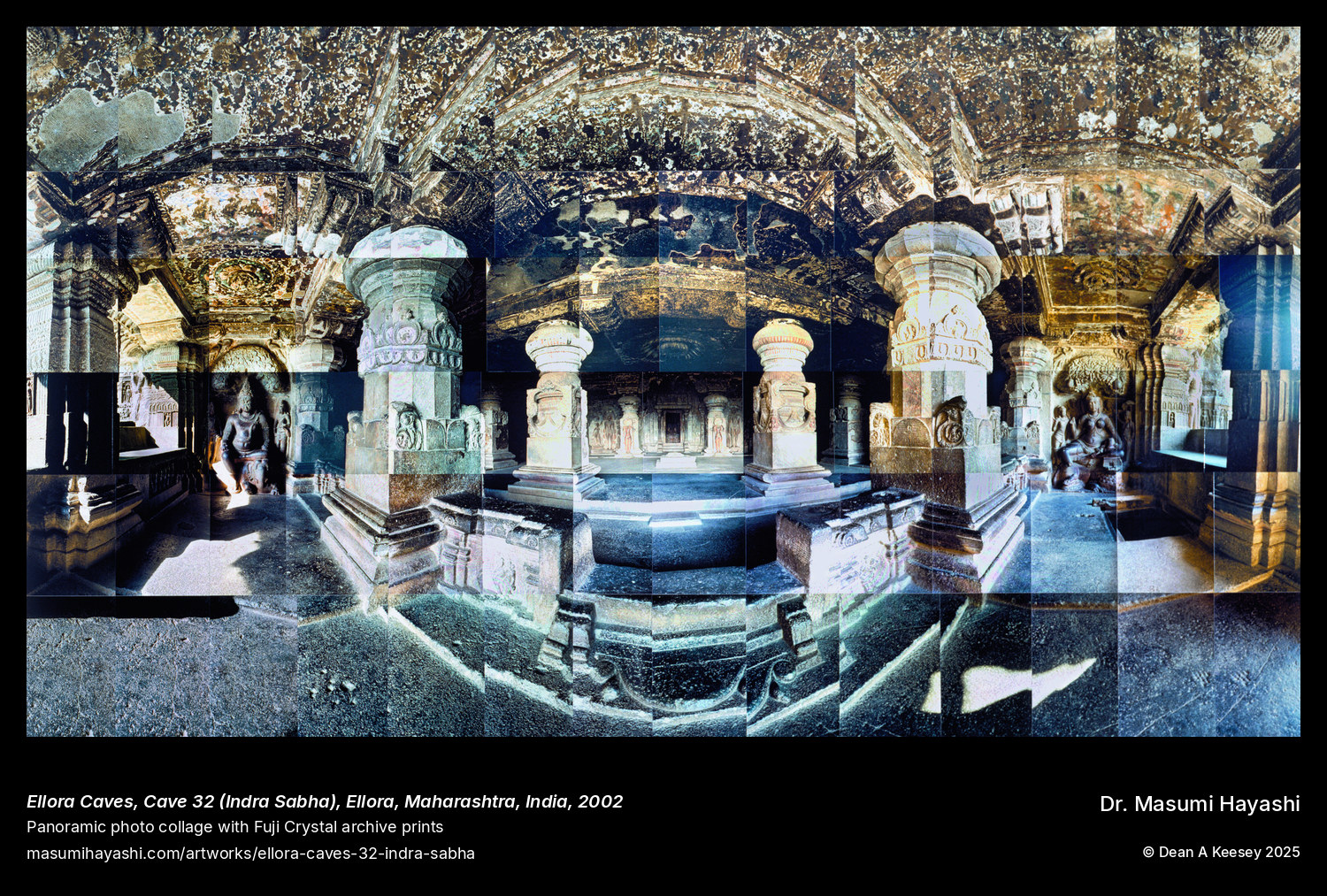
Ellora Caves, Cave 32 (Indra Sabha)
Ellora, Maharashtra, India
Panoramic photo collage with Fuji Crystal archive prints
2002
48 x 28
This vertical 48-by-28-inch panorama documents Cave 32 at Ellora—the Indra Sabha or “Hall of Indra”—representing the pinnacle of Jain cave architecture within the UNESCO World Heritage Site containing thirty-four rock-cut temples carved from basalt cliffs over five centuries. The four-foot height captures the two-story cave’s vertical organization: upper level featuring elaborate sculptural programs, lower level providing columned assembly hall, the entire structure excavated from living rock through subtractive carving that removed stone to reveal architectural forms.
Created in 2002, the work represents Hayashi’s documentation of India’s third major religious tradition after Hindu and Buddhist sites visited in 2000. Ellora’s thirty-four caves divide among three religions—twelve Buddhist (caves 1-12, dating 600-800 CE), seventeen Hindu (caves 13-29, dating 600-870 CE), and five Jain (caves 30-34, dating 800-1000 CE)—demonstrating remarkable religious tolerance across medieval Maharashtra where royal patronage supported multiple faiths simultaneously.
Cave 32’s Jain iconography features the twenty-four Tirthankaras—spiritual teachers who achieved liberation and showed others the path—depicted in meditation poses with serene expressions. The cave’s dedication to Indra (a Vedic deity adopted into Jain cosmology as guardian of the eastern direction) reflects Jainism’s syncretic absorption of Hindu deities into supporting roles while maintaining distinct doctrine. Unlike Hindu caves depicting divine battles, Jain imagery emphasizes peaceful transcendence, ahimsa (non-violence) as core principle visible in sculptural programs.
The two-story format required extraordinary engineering: workers excavated from top downward, carving upper story first before removing stone to create lower spaces. Every architectural element—columns, beams, sculptures, decorative moldings—was carved from original rock rather than assembled from separate pieces. The vertical panorama captures this spatial organization, the viewer’s eye ascending through carved stone celebrating monastic architecture’s achievement.
Ellora’s physical proximity of Buddhist, Hindu, and Jain caves—sometimes sharing common cliffs—documents medieval India’s religious pluralism, the practical coexistence enabling concentrated patronage from successive dynasties.
More from Sacred Architectures
Airavatesvara Temple #1, Darasuram, Tamil Nadu, India
Angkor Wat, no. 1, Angkor, Siem Reap, Cambodia
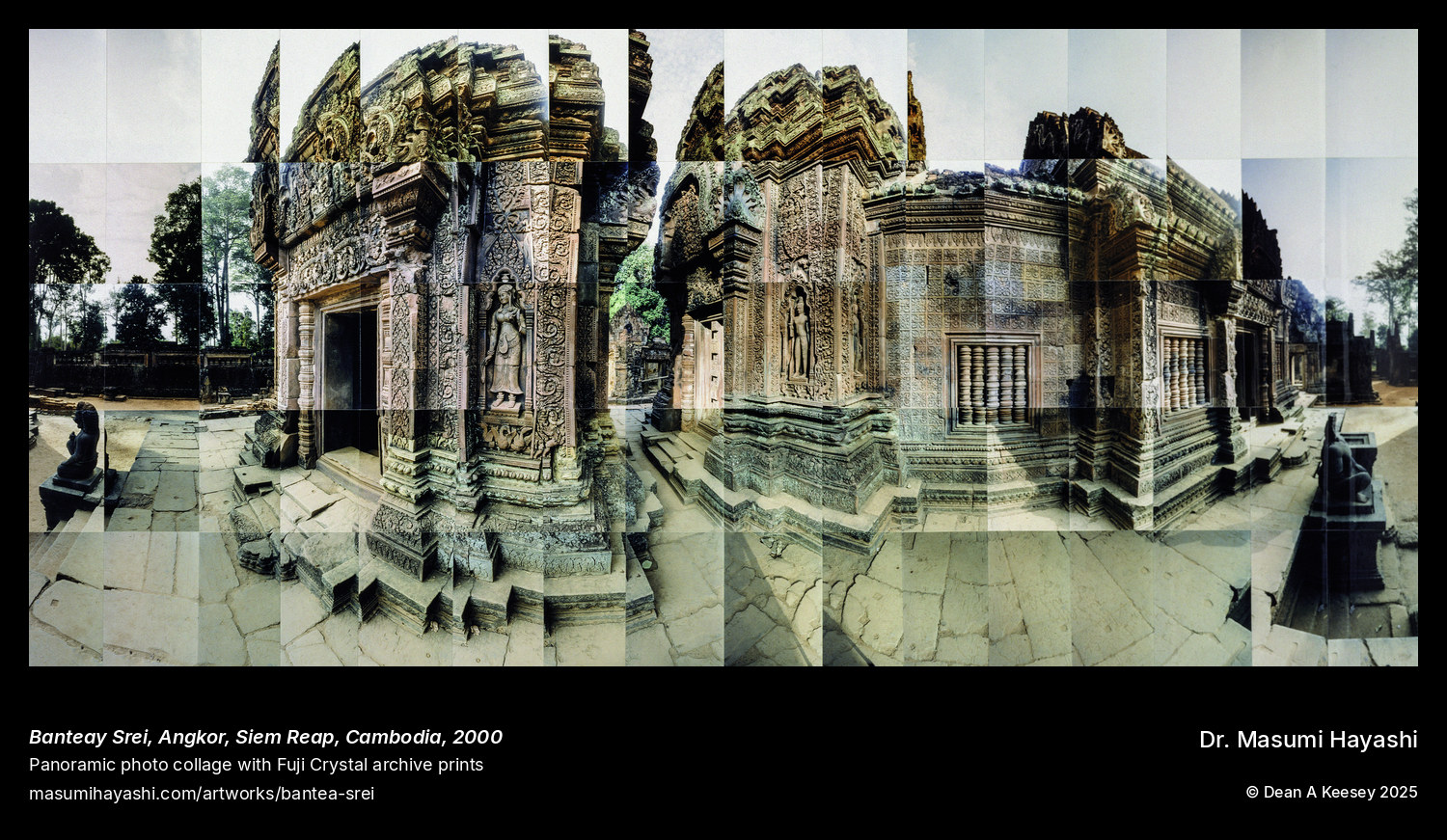
Banteay Srei, Angkor, Siem Reap, Cambodia
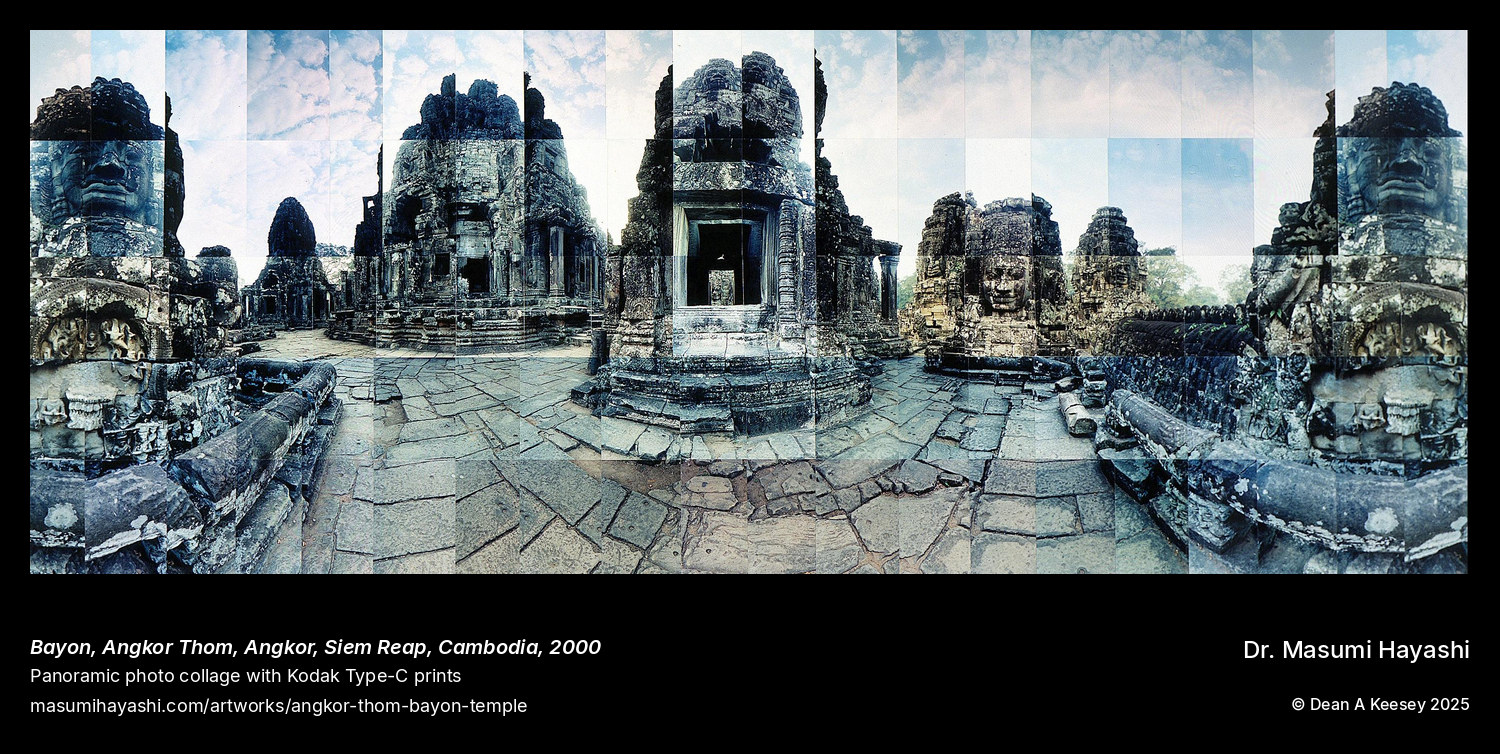
Bayon, Angkor Thom, Angkor, Siem Reap, Cambodia
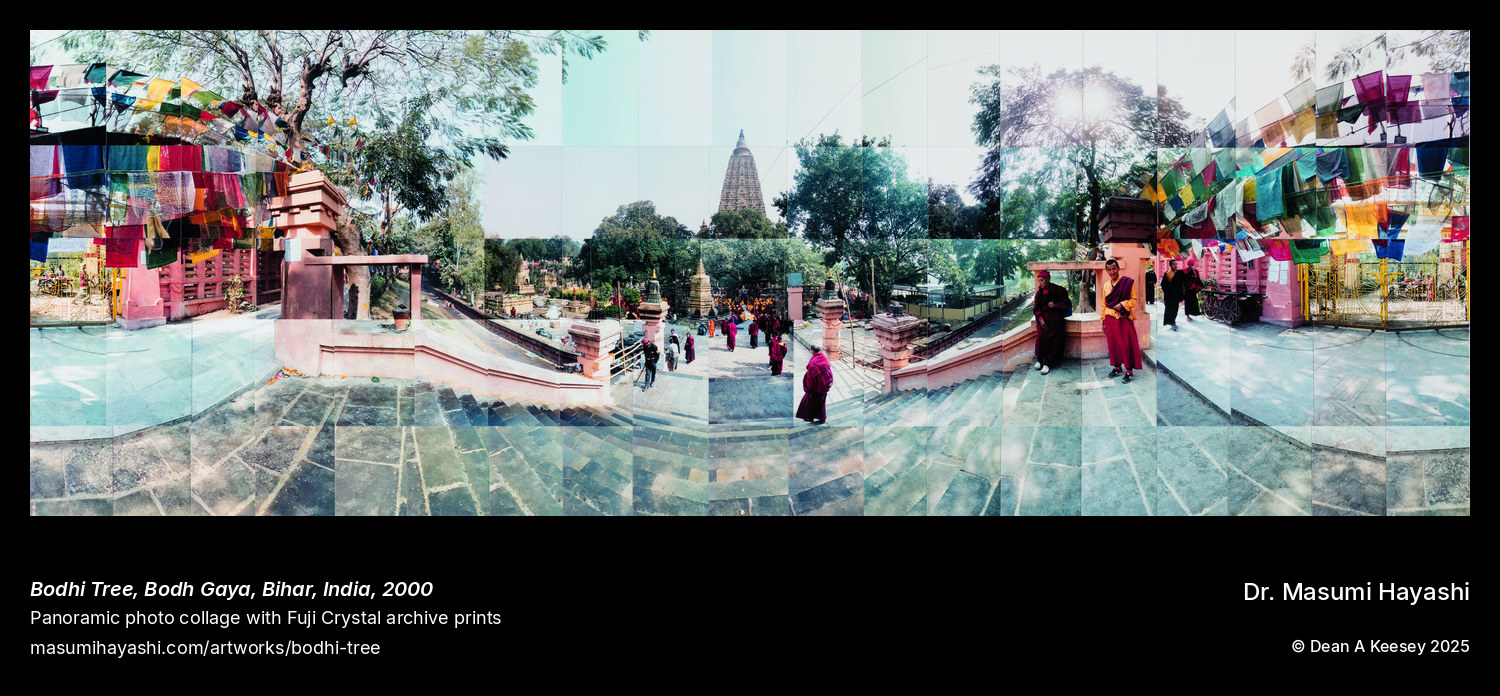
Bodhi Tree, Bodh Gaya, Bihar, India