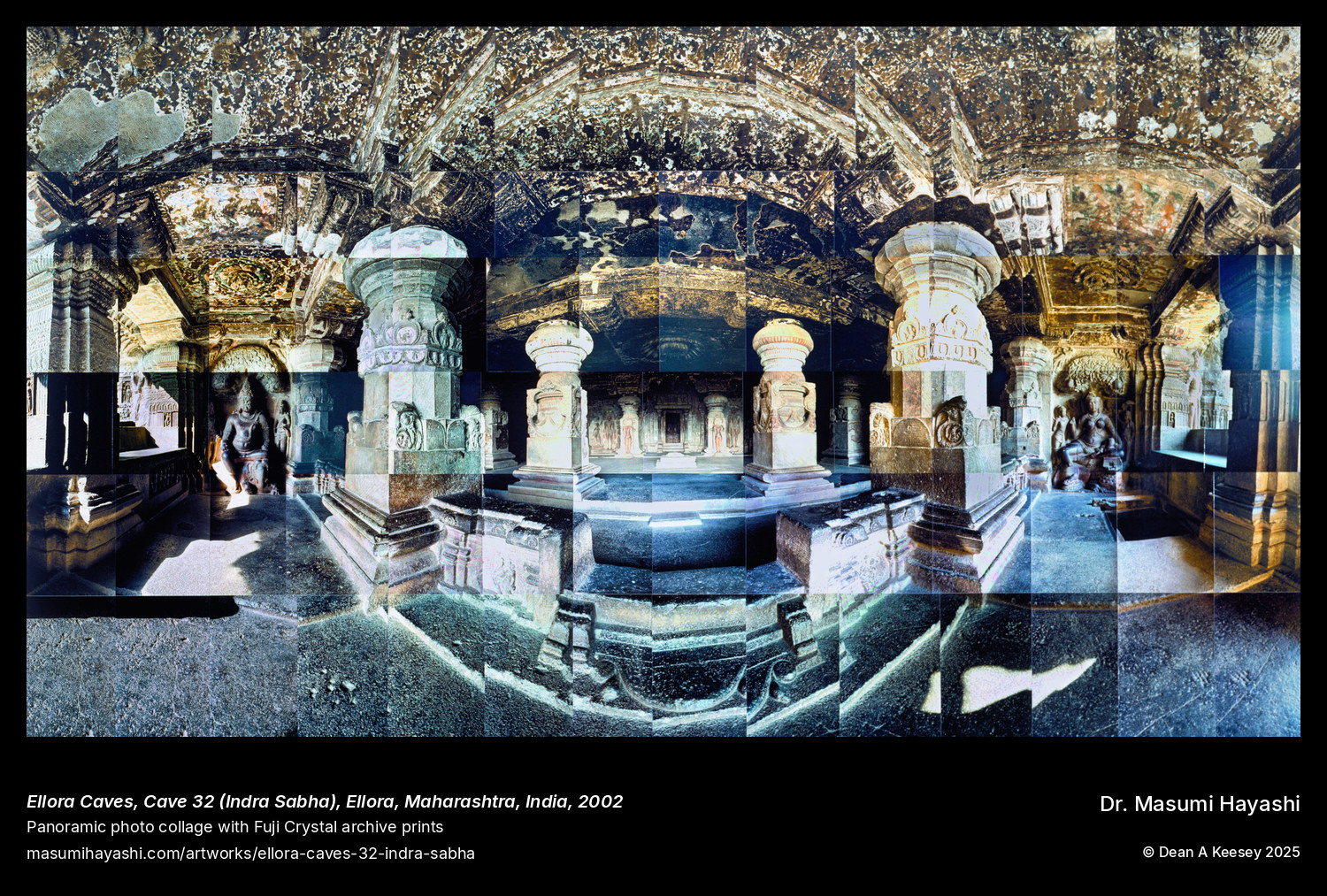
Ellora Caves, Cave 32 (Indra Sabha), Ellora, Maharashtra, India
Ellora, Maharashtra, India
Panoramic Photo Collage
2002
48 X 28
Ellora Caves, Cave 32 (Indra Sabha), Ellora, Maharashtra, India
Overview
“Ellora Caves, Cave 32 (Indra Sabha)” documents one of India’s most exquisite Jain rock-cut temples, carved from living basalt during the 9th century CE at the UNESCO World Heritage site of Ellora, Maharashtra. Created in 2002 during Masumi Hayashi’s documentation of Indian sacred architecture, this 48-by-28-inch horizontal panorama captures the refined sculptural artistry and architectural sophistication of late Jain cave temple construction. The work represents Hayashi’s engagement with rock-cut architecture—temples not built but excavated from solid stone—a distinctive Indian architectural tradition requiring fundamentally different spatial and technical approaches than free-standing structures.
The Indra Sabha (literally “Assembly Hall of Indra”) stands as the largest and most ornate Jain cave at Ellora, representing the culmination of centuries of rock-cut temple development. Where earlier caves demonstrated technical mastery, Indra Sabha achieves artistic refinement, its walls adorned with elaborate carvings of Tirthankaras (Jain spiritual teachers), celestial beings, and intricate vegetal ornament. The cave’s two-story structure, monolithic shrine, and finely carved elephant sculptures exemplify the ambitious scale and sophisticated execution characteristic of 9th-century Jain patronage at Ellora.
The 2002 creation date positions this work within Hayashi’s intensive documentation of Indian religious architecture spanning multiple traditions and regions. The same year produced “Muthiah Ayyanar Temple” (Tamil folk religion) and preceded the 2004 Tamil Nadu temple documentation campaign (Chola and Nayak traditions). The inclusion of Jain architecture alongside Hindu and Buddhist sites demonstrates Hayashi’s comprehensive approach to documenting India’s religious pluralism—the coexistence of diverse spiritual traditions within shared cultural and artistic frameworks.
The Fuji film specification maintains consistency with other Indian temple documentation from this period, ensuring comparable color rendition across works documenting widely varied architectural sites and regional conditions. The 48-by-28-inch horizontal format suggests documentation emphasizing lateral architectural relationships within the cave—the progression from exterior courtyard through carved mandapa to inner shrine, or the lateral extension of sculptural programs across cave walls.
Historical and Cultural Context
Ellora’s Unique Religious Pluralism
The Ellora cave complex, carved into Maharashtra’s Charanandri Hills between the 6th and 10th centuries CE, represents a rare architectural manifestation of India’s religious pluralism. The site contains 34 cave temples: 12 Buddhist (earliest, 6th-7th centuries), 17 Hindu (7th-8th centuries), and 5 Jain (9th-10th centuries, latest). This chronological and religious diversity demonstrates successive patronage by different dynasties and religious communities, all choosing the same dramatic basalt escarpment for monumental rock-cut architecture.
UNESCO’s 1983 World Heritage inscription recognizes Ellora as “epitome of Indian rock-cut architecture,” acknowledging both technical achievement and cultural significance. The site documents 400 years of architectural evolution while demonstrating peaceful coexistence of Buddhist, Hindu, and Jain communities—each tradition creating distinctive temple forms within adjacent cave complexes. This religious diversity at a single location offers unparalleled opportunities for comparative architectural analysis.
The Jain caves, though smallest in number, represent the final and in some ways most refined phase of Ellora’s development. By the 9th-10th centuries, when Jain patrons commissioned Caves 30-34, rock-cut architecture had evolved from experimental excavation to confident artistic expression. The Jain caves benefit from accumulated technical knowledge while demonstrating distinctive Jain aesthetic preferences: restrained architectural forms, emphasis on sculptural detail over monumental scale, and iconographic programs focused on the 24 Tirthankaras central to Jain spiritual cosmology.
Cave 32: Indra Sabha Architecture
Cave 32, known as Indra Sabha (“Assembly Hall of Indra”), stands as the largest and most elaborate Jain cave at Ellora. The cave’s name references Indra, the Vedic king of gods, though the temple’s function remained purely Jain, dedicated to Mahavira (the 24th Tirthankara). This naming demonstrates the complex syncretism characteristic of Indian religious culture, where Jain architecture could adopt Hindu mythological references while maintaining distinct Jain ritual function and iconography.
The cave’s architectural organization follows typical Jain temple patterns: an open courtyard surrounded by cells and shrines, a central shrine housing a monolithic sculpture, and elaborate carved ornamentation throughout. What distinguishes Indra Sabha is its two-story construction—the upper level carved as a complete second temple—and the exceptional quality of sculptural execution. The cave’s walls display intricate carvings of Tirthankaras in meditation, celestial musicians and dancers (gandharvas and apsaras), elaborate floral patterns, and narrative scenes from Jain mythology.
The cave’s most celebrated feature is a monolithic elephant sculpture in the courtyard, carved from the same living rock as the cave itself. This technical achievement—creating a free-standing sculptural element without separating it from its parent stone—demonstrates the virtuosic control Ellora’s sculptors exercised over intractable basalt. The elephant, though appearing as independent sculpture, remains molecularly continuous with the cliff face from which the entire cave was excavated.
Rock-Cut Architecture: Technical and Conceptual Distinctions
Rock-cut temples represent fundamentally different architectural approaches than free-standing structures. Rather than assembling materials into buildings, rock-cut architecture removes stone to reveal temples hidden within living rock. This subtractive rather than additive process creates distinctive spatial qualities: interior volumes that feel simultaneously enclosed (by surrounding rock) and monumental (through excavated height and breadth), architectural elements that merge seamlessly without joints or seams, and spatial experiences defined by removal and revelation rather than construction and enclosure.
The technical challenges differ dramatically from conventional architecture. Errors in free-standing construction can be corrected; errors in rock excavation are permanent, the removed stone irretrievable. Planning must be comprehensive and precise before excavation begins, with architects visualizing complete three-dimensional structures within solid cliff faces. The excavation process proceeds from top to bottom (preventing excavated debris from damaging completed work below) and from exterior to interior (establishing overall cave dimensions before carving internal detail).
These technical constraints shape aesthetic results. Rock-cut architecture tends toward sculptural rather than structural thinking—caves carved like enormous sculptures rather than built like conventional buildings. Architectural elements that in free-standing temples would require structural justification (columns supporting roofs, walls bearing loads) become purely decorative in rock-cut contexts, their “structural” appearance referencing architectural conventions while serving no actual load-bearing function. This liberation from structural necessity allows extraordinary sculptural elaboration.
Format and Technical Analysis
Horizontal Panoramic Strategy
The 48-by-28-inch horizontal format creates a 1.71:1 aspect ratio, a relatively wide panoramic proportion well-suited to documenting cave interiors’ lateral extension. Unlike the extreme horizontal panoramas of certain City Works pieces (some exceeding 3:1 or 4:1 ratios), this moderate width suggests documentation emphasizing spatial progression through cave architecture—from exterior courtyard through intermediate spaces to inner shrine—while maintaining sufficient height to capture architectural elevations and ceiling details.
The format’s 48-inch width provides substantial lateral coverage, potentially encompassing the full breadth of the cave’s courtyard, the relationship between monolithic shrine and surrounding carved walls, or the progression of sculptural programs across extended architectural surfaces. The 28-inch height maintains sufficient vertical dimension to capture the cave’s two-story construction and ceiling details without compressing these elements excessively.
Horizontal formats particularly suit rock-cut architecture documentation for several reasons. Cave interiors typically extend horizontally into cliff faces rather than vertically (unlike free-standing temple towers), creating architectural volumes wider than they are tall. Sculptural programs often develop laterally across walls, inviting horizontal visual scanning. The progression from exterior light (cave entrance) to interior darkness (inner shrine) follows horizontal rather than vertical logic, a spatial sequence the panoramic format can encompass comprehensively.
Photographic Challenges of Cave Documentation
Documenting rock-cut cave interiors presents distinctive photographic challenges absent in free-standing architecture. Extreme contrasts between exterior brightness and interior darkness create exposure problems, with cave entrances potentially overexposing while inner spaces fall into shadow. The basalt stone’s dark coloration absorbs light, requiring longer exposures or supplemental lighting to capture sculptural detail. Confined interior spaces limit photographic positions and viewing distances, complicating comprehensive spatial documentation.
The panoramic photo collage technique offers particular advantages for these challenges. By assembling multiple photographs taken at different exposures, the technique can manage extreme light contrasts, capturing detail in both bright exterior areas and shadowed interior spaces within a single comprehensive image. Multiple frames allow progressive documentation of spatial sequences impossible to photograph from single viewpoints. The collage process also permits subtle adjustments to individual frames’ exposure and color balance, creating visually unified panoramas despite varying light conditions across the cave interior.
The Fuji film specification suggests color film documentation, capturing the warm tonalities of weathered basalt and the subtle color variations in carved surfaces. While rock-cut architecture might seem monochromatic—all carved from uniform dark stone—subtle color variations emerge from different weathering patterns, mineral deposits, and light quality at different depths within the cave. Color film captures these nuances invisible to black-and-white photography.
Interior Space and Depth Compression
Cave interior documentation necessarily involves depth compression—representing three-dimensional architectural volumes as two-dimensional photographic surfaces. The horizontal panoramic format manages this compression by spreading laterally, using width to suggest depth through sequential spatial progression. Where single-point-perspective photographs create strong depth illusions through converging lines, panoramic assemblages might maintain more parallel architectural relationships, the sequential frames suggesting spatial progression through lateral rather than perspectival depth cues.
This alternative approach to representing depth resonates with traditional Indian architectural representation, which often employed multiple simultaneous viewpoints rather than single-point perspective. Indian architectural drawings and paintings frequently show buildings from slightly elevated viewpoints with minimal perspectival convergence, emphasizing plan organization and architectural relationships over illusionistic depth. Hayashi’s panoramic collage technique, with its multiple viewpoints and moderated perspectival distortion, might echo these traditional representational strategies.
Series Context and Comparative Analysis
Rock-Cut versus Free-Standing Architecture
Within the Sacred Architectures series, “Ellora Caves, Cave 32” represents the primary documentation of rock-cut architecture, distinguishing it from the numerous free-standing temple works documenting Tamil Nadu (Meenakshi, Rameswaram, Airavatesvara), Rajasthan (Jain temples at Jaisalmer), Cambodia (Angkor monuments), and Japan (various Buddhist temples and shrines). This inclusion ensures the series acknowledges India’s distinctive rock-cut architectural tradition alongside more widespread free-standing temple construction.
The comparison between rock-cut Ellora and free-standing temples like Airavatesvara reveals fundamental architectural differences despite both serving similar religious functions. Where Airavatesvara’s vimana tower soars upward as architectural statement, Indra Sabha’s two-story construction burrows horizontally into living rock. Where free-standing temples employ structural systems (columns, beams, vaults), rock-cut temples simulate these elements purely sculpturally, their “columns” bearing no loads, their “roofs” continuous with surrounding stone. Where conventional temples experience weathering from all sides, cave temples erode primarily at entrances, their interiors protected by surrounding rock mass.
These distinctions create different photographic documentation challenges and opportunities. Free-standing temples photograph well from exterior vantage points emphasizing architectural profiles and spatial relationships to surrounding landscapes. Rock-cut temples require interior documentation emphasizing carved surfaces, spatial progressions, and the relationship between excavated void and encompassing solid. Hayashi’s horizontal panoramic format responds to these distinctive requirements.
Jain Architectural Documentation
The Indra Sabha work represents Hayashi’s engagement with Jain religious architecture, a tradition less extensively documented in the Sacred Architectures series than Hindu or Buddhist sites. Other Jain works include “Jain Temple, Jaisalmer” (2000), a vertical panorama documenting ornate Rajasthani Jain temple towers. The comparison between Ellora’s rock-cut 9th-century cave and Jaisalmer’s free-standing medieval temple reveals Jain architecture’s regional and temporal diversity.
Jain architectural aesthetics tend toward restrained forms and elaborate surface ornamentation—monumental temples with compact plans, modest exterior profiles, and extraordinary interior sculptural detail. This aesthetic reflects Jain theological emphasis on asceticism and non-violence combined with celebration of spiritual knowledge. The architecture balances restraint (avoiding excessive monumentality) with artistic elaboration (honoring the Tirthankaras through exquisite craftsmanship).
Both Ellora and Jaisalmer Jain works demonstrate this balance, though expressed through different regional traditions. Ellora’s rock-cut approach achieves restraint through horizontal extension rather than vertical soaring, while expending extraordinary labor on sculptural detail. Jaisalmer’s free-standing towers achieve vertical grace through delicate proportions while covering every surface with intricate carving. The Sacred Architectures series’ inclusion of both works acknowledges Jain architecture’s diverse regional expressions.
UNESCO World Heritage Documentation
The 2002 creation date situates this work nearly 20 years after UNESCO’s 1983 World Heritage inscription of Ellora. This timing distinguishes it from the Airavatesvara documentation (2004), which coincided exactly with UNESCO recognition. By 2002, Ellora had been internationally recognized for two decades, its status as world heritage well-established.
This temporal distance from UNESCO inscription creates different documentary contexts. Where the Airavatesvara works capture monuments at the moment of international recognition, the Ellora documentation represents mature world heritage site management—established conservation practices, developed tourism infrastructure, and accumulated preservation experience. The photographic record thus documents not only historical architecture but also contemporary heritage management’s effects on access, presentation, and conservation.
The Sacred Architectures series includes multiple UNESCO World Heritage sites: Ellora (inscribed 1983), Khajuraho (1986), Angkor (1992), Great Living Chola Temples (2004), among others. This concentration of World Heritage documentation positions the series as artistic interpretation of internationally recognized cultural monuments, creating visual records that balance aesthetic vision with documentary responsibility toward sites deemed universally significant.
Edition Status and Institutional Context
Current Edition Locations
The edition tracking indicates retention of two framed editions in inventory, with additional notation of “#5, Artists proof”:
Artist’s Proof #5: Status unclear from current records
This retention of two regular editions plus possibly an artist’s proof suggests limited distribution from the five-edition run. The two framed editions provide institutional acquisition opportunities while the artist’s proof notation indicates edition complexity beyond the standard numbered five.
Artist’s proofs typically exist outside the regular numbered edition, created during the printing process to verify quality before authorizing the full edition run. Their existence and retention suggests careful quality control in the printing process and potential additional impressions beyond the five numbered editions. Clarifying the artist’s proof’s current location and status would complete edition tracking.
The retention of two framed editions from a single work is unusual in the current inventory patterns, where most works show zero or one edition retained. This double retention might reflect strong Foundation preference for the work (retaining multiple impressions for flexibility in future exhibitions or acquisitions) or might indicate recent printing with editions not yet distributed.
Institutional Placement Potential
The work’s UNESCO World Heritage subject matter, combined with documentation of rock-cut architecture and Jain religious tradition, positions it favorably for institutional collections focused on:
- Indian art and architecture: Museums with South Asian collections valuing documentation of distinctive Indian architectural traditions
- Rock-cut architecture studies: Academic institutions teaching architectural history or ancient building technologies
- Jain studies: Collections supporting scholarship on Jain religion, art, and culture
- UNESCO World Heritage: Institutions collecting photographic documentation of internationally significant cultural sites
The horizontal format’s moderate dimensions (48×28 inches) offer practical advantages for institutional display—substantial enough for gallery impact but manageable in terms of conservation, framing, and wall space requirements. The format works effectively as standalone focal piece or within thematic groupings of Indian sacred architecture documentation.
Museums with existing Ellora-related collections (sculptural fragments, architectural documentation, archaeological materials) might particularly value this photographic work as contemporary artistic interpretation complementing historical artifacts. The 2002 creation date provides recent documentation of the site’s current condition under UNESCO management.
Conservation and Display Considerations
The 48-by-28-inch horizontal format presents moderate conservation challenges, requiring standard museum-quality framing and handling protocols. The Fuji chromogenic print process demands protection from light exposure, humidity fluctuation, and atmospheric pollutants, with display rotation recommended to limit cumulative light exposure over time.
The two framed editions currently in inventory presumably demonstrate appropriate conservation framing standards, providing models for future framing of distributed editions. Consistency in framing approach across the Sacred Architectures series facilitates cohesive exhibition presentation when multiple works display together.
The horizontal orientation and moderate width (48 inches) make the work suitable for various gallery contexts—neither so large as to require exceptional wall space nor so small as to lack visual impact. The format functions effectively in intimate gallery spaces while maintaining presence in larger exhibition halls.
Cultural Significance and Artistic Achievement
“Ellora Caves, Cave 32 (Indra Sabha)” represents Masumi Hayashi’s photographic engagement with one of India’s most distinctive architectural traditions—rock-cut temples excavated from living stone rather than constructed from assembled materials. The work documents not merely religious architecture but a fundamentally different approach to creating sacred space: removing rather than adding, revealing rather than building, carving rather than constructing. This alternative architectural logic—temples hidden within solid cliff faces, waiting for excavation to reveal them—represents a conceptual achievement as significant as any technical or aesthetic accomplishment.
The horizontal panoramic format—spreading across 48 inches to encompass the cave’s lateral spatial progression—demonstrates sophisticated adaptation of photographic technique to architectural subject. Where conventional photography fragments cave interiors into isolated views unable to convey spatial sequence or architectural relationships, the panoramic approach maintains spatial integrity, revealing how 9th-century Jain architects orchestrated progressive revelation from bright exterior courtyard to shadowed inner shrine.
As documentation of Jain sacred architecture, the work contributes to the Sacred Architectures series’ religious and cultural breadth. The inclusion of Jain sites alongside Hindu, Buddhist, and Shinto monuments establishes the series as genuinely comparative, documenting diverse approaches to creating sacred space across different religious traditions, regional cultures, and historical periods. This comparative framework elevates the series beyond documentation of individual monuments toward investigation of how different spiritual traditions and cultural contexts generate distinctive architectural expressions.
The work’s creation in 2002—nearly 20 years after UNESCO World Heritage recognition—captures Ellora as a mature heritage site with established conservation practices and international visibility. The photographic record thus documents not only 9th-century architecture but also early 21st-century heritage management, preserving visual evidence of how UNESCO designation affects monument preservation, public access, and cultural interpretation. This temporal layering—ancient architecture experienced through contemporary heritage frameworks—adds complexity to what might otherwise seem straightforward architectural documentation.
Collection Information
Year: 2002 Location: Ellora, Maharashtra, India Medium: Panoramic Photo Collage Dimensions: 48 × 28 inches Film Stock: Fuji Edition: 1 of 5
- Inventory - framed
- Inventory - framed
- Unknown
- Unknown
- Unknown Artist’s Proof #5: Status unclear
Note: Two framed editions currently retained in inventory. Artist’s proof notation requires verification to clarify total number of impressions and current locations of all editions including proof(s).