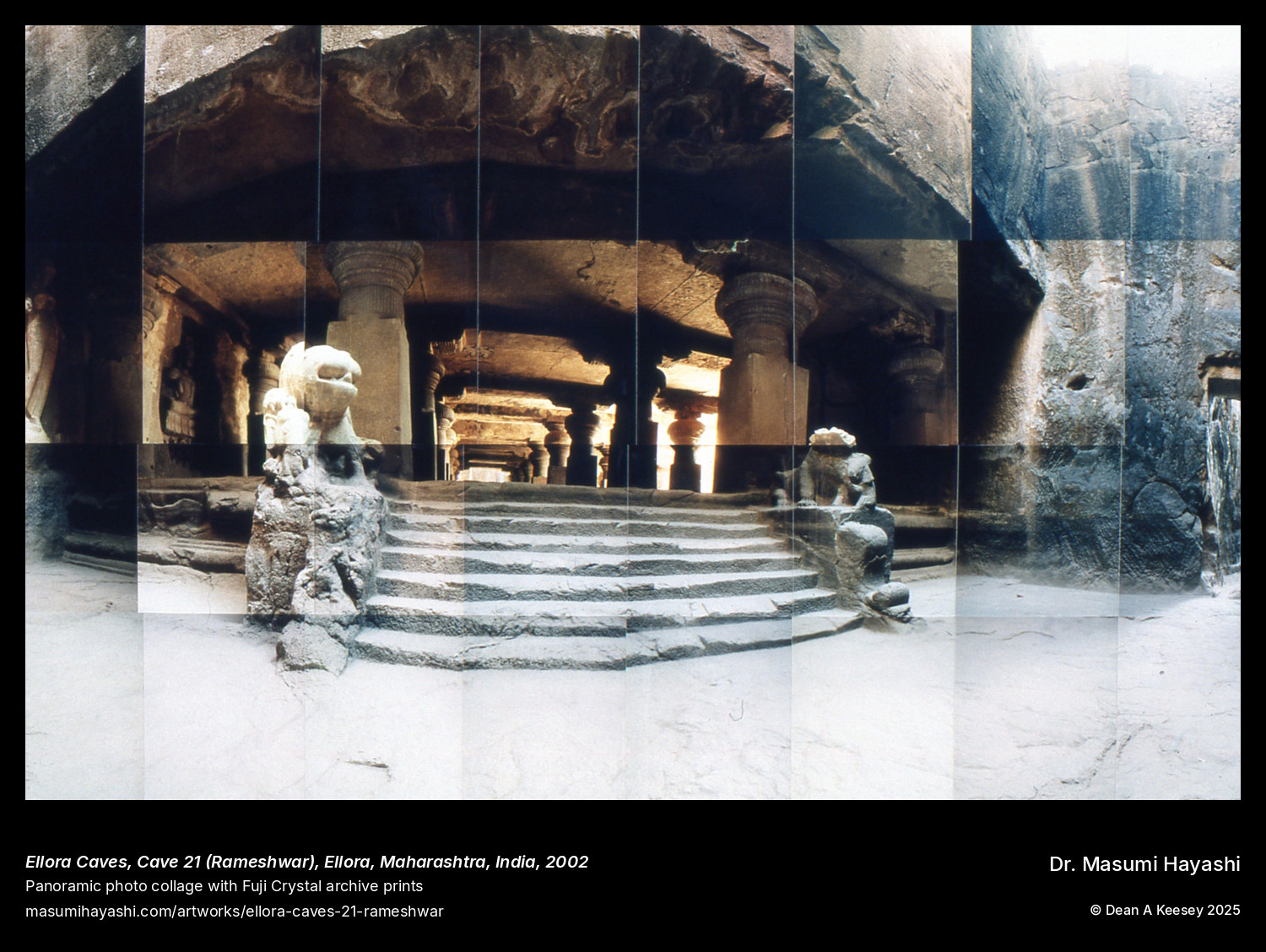
Ellora Caves, Cave 21 (Rameshwar), Ellora, Maharashtra, India
Ellora, Maharashtra, India
Panoramic Photo Collage
2002
45" x 29"
Ellora Caves, Cave 21 (Rameshwar), Ellora, Maharashtra, India
Overview
Created in 2002, this 45 x 29.5-inch panoramic photo collage documents Cave 21 (Rameshwar) at Ellora Caves—UNESCO World Heritage Site preserving 34 rock-cut monastery and temple caves excavated between 5th-10th centuries CE representing extraordinary achievement in Indian rock-cut architecture where Buddhist, Hindu, and Jain religious communities sequentially carved monumental structures directly from vertical basalt cliff face, creating immense halls, pillared corridors, elaborate sculptural programs, and functioning sacred spaces without constructing freestanding buildings. Cave 21, part of Hindu cave sequence (Caves 13-29), represents 6th-7th century excavation dedicated to Shiva, featuring monolithic carved pillars, elaborate door frames, guardian sculptures (dvarapalas), and interior shrine (garbhagriha) housing linga—demonstrating sophisticated architectural and sculptural techniques where every architectural element (walls, columns, ceilings, decorative details) emerged through removal of surrounding rock rather than additive construction. The 2002 date positions this as earliest confirmed Sacred Architectures work, predating Hemakuta Hill (2003), Madonna and Child (2003), and Nepal concentration (2004), suggesting Sacred Architectures series began earlier than previously documented—possibly late 1990s or early 2000s—with initial Indian rock-cut architecture documentation before expanding to freestanding temple complexes, Southeast Asian sites, and Kathmandu Valley monuments. The 45 x 29.5-inch format employs moderate horizontal panorama (1.53:1 aspect ratio, nearly 4 feet wide) suited to documenting cave temple’s lateral architectural extent—pillared hall width, sculptural distribution across walls, horizontal progression from entrance to inner sanctum—without extreme horizontal formats required for panoramic vistas or vertical formats needed for gopuram towers. Ellora’s significance extends beyond architectural achievement to inter-religious context where Buddhist, Hindu, and Jain communities coexisted creating adjacent sacred structures over five centuries, demonstrating complex religious landscape where patronage, artistic exchange, and sequential excavation produced unified architectural site encompassing diverse religious traditions—phenomenon rare in Indian sacred architecture where sectarian sites typically maintained single religious identity.
Historical Context: Ellora Caves and Rock-Cut Architecture Tradition
Ellora represents pinnacle of Indian rock-cut architecture spanning multiple religious traditions:
Rock-Cut Architecture Tradition: Ancient Indian architectural practice creating structures by excavating natural rock:
Technique: Rather than building structures with quarried stone (additive construction), artisans carved temples, monasteries, halls, and sculptures directly from living rock—subtractive process removing material to reveal architectural forms
Advantages:
- Structural integrity—walls, pillars, ceilings continuous with surrounding rock creating earthquake-resistant architecture
- Permanent materials—basalt cliff faces providing durable medium
- Sculptural integration—architectural and decorative elements carved as unified whole
- No external construction materials required—eliminating transportation and assembly challenges
Challenges:
- Irreversible errors—mistakes in carving permanent, demanding precise planning
- Sequential top-down excavation—work proceeding from ceiling downward, preventing conventional scaffolding
- Limited light—interior spaces requiring careful planning for illumination during carving and ritual use
- Rock quality variations—dealing with natural fissures, color changes, hardness variations
Major Rock-Cut Sites in India:
- Ajanta Caves (Buddhist, 2nd century BCE-5th century CE)—nearby Ellora, primarily painting-focused
- Ellora Caves (Buddhist-Hindu-Jain, 5th-10th centuries CE)—multiple religious traditions
- Elephanta Caves (Hindu, 5th-8th centuries CE)—Mumbai Harbor island
- Badami Cave Temples (Hindu, 6th century CE)—Karnataka
- Numerous smaller sites across Maharashtra, Karnataka, Madhya Pradesh
Ellora Complex Overview (UNESCO World Heritage Site, 1983): 34 caves arranged along 2-kilometer basalt cliff:
Cave Distribution by Religion:
- Buddhist Caves (Caves 1-12): 5th-7th centuries, earliest excavations—monasteries (viharas), prayer halls (chaityas), stupas, Buddha sculptures
- Hindu Caves (Caves 13-29): 6th-8th centuries, mid-period excavations—temples dedicated to Shiva, Vishnu, and other deities including extraordinary Cave 16 (Kailasa Temple, world’s largest monolithic structure)
- Jain Caves (Caves 30-34): 8th-10th centuries, latest excavations—monasteries, shrines, elaborate sculptural detailing reflecting Jain aesthetic preferences
Patronage Context: Various dynasties sponsored excavations:
- Rashtrakuta Dynasty (6th-10th centuries): Major patrons of Hindu caves including Kailasa Temple
- Chalukya Dynasty: Earlier Buddhist cave patronage
- Local wealthy merchants and nobles: Smaller cave sponsorship
- Inter-religious tolerance enabling sequential excavation by different communities
Religious Coexistence: Ellora exemplifies rare phenomenon:
- Buddhist, Hindu, and Jain caves coexisting within 2-kilometer stretch
- No evidence of sectarian conflict despite religious differences
- Shared artistic vocabularies and technical knowledge across communities
- Sequential excavation suggesting changing regional religious demographics over five centuries
Cave 21 (Rameshwar): Hindu Cave Temple
Cave 21 represents mid-period Hindu excavation demonstrating mature rock-cut technique:
Name and Dedication:
- Rameshwar: “Lord of Rama”—epithet for Shiva, referencing Ramayana narrative where Rama worships Shiva
- Primarily Shiva temple featuring linga shrine
Architectural Features:
Pillared Hall (Mandapa): Main hall with monolithic carved pillars:
- Square or octagonal pillar cross-sections
- Elaborate capital designs (pillar tops) featuring carved brackets, lotus motifs
- Pillars supporting carved ceiling creating interior spatial volume
- Pillars originally freestanding rocks now serving structural function through selective removal of surrounding basalt
Entrance Architecture: Cave entrance featuring:
- Elaborate door frame carving with decorative bands, floral patterns
- Guardian Figures (Dvarapalas): Fierce protective deities flanking doorway holding weapons, shown in dynamic poses deterring malevolent forces
- Threshold demarcating exterior worldly realm from interior sacred space
Interior Shrine (Garbhagriha): Inner sanctum at cave rear:
- Small dark chamber housing Shiva linga (cylindrical stone symbol)
- Limited access—typically only priests entering for ritual worship
- Architectural progression from open entrance hall to restrictive inner shrine creating spatial hierarchy
Sculptural Programs: Wall carvings depicting:
- Shiva Mythology: Dancing Shiva (Nataraja), Shiva and Parvati, Shiva destroying demons, mythological narratives
- River Goddesses: Ganga and Yamuna figures near entrance
- Attendant Deities: Minor gods, celestial beings, protective figures
- Decorative Motifs: Floral patterns, geometric designs, architectural ornament
Ceiling Carving: Carved ceiling featuring:
- Coffered patterns creating visual interest
- Lotus medallions—Buddhist influence persisting in Hindu contexts
- Structural appearance despite being solid rock—carved to resemble wooden beam construction
Natural Lighting: Strategic positioning enabling:
- Morning or afternoon sun penetrating entrance illuminating pillared hall
- Gradual light diminishment toward inner shrine creating sacred darkness
- Exterior courtyard (where present) providing transitional lighting zone
6th-7th Century Dating: Artistic style and epigraphic evidence indicating:
- Mature rock-cut technique following earlier Buddhist cave experiments
- Predating Kailasa Temple’s extreme ambition (mid-8th century)
- Stylistic similarities with other mid-period Hindu caves (Caves 14-20)
Moderate Horizontal Panoramic Format: 45 x 29.5 Inches
At 45 x 29.5 inches, work employs moderate horizontal panorama suited to cave temple documentation:
Format Analysis:
- Width: 45 inches (3.75 feet, nearly 4 feet) creates substantial lateral field
- Height: 29.5 inches (2.46 feet, nearly 2.5 feet) provides adequate vertical information
- Aspect Ratio: 1.53:1 (width to height)—moderate horizontal panorama, not extreme
Comparison with Other Sacred Architectures Formats:
- Golden Temple (Kathmandu): 46 x 29” (1.59:1)—similar moderate horizontal
- Ellora Cave 21: 45 x 29.5” (1.53:1)—comparable moderate horizontal
- Hemakuta Hill (Hampi): 73 x 28” (2.6:1)—extreme horizontal
- Hanuman Ghat (Bhaktapur): 24 x 45” (1.88:1 vertical)—vertical panorama
Format responsive to specific architectural requirements rather than standardized approach.
Format Rationale for Cave Temples:
Lateral Architectural Extent: Cave temples emphasize horizontal progression:
- Entrance to interior shrine movement along horizontal axis
- Pillared hall width determining spatial experience
- Sculptural programs distributed across lateral wall surfaces
- Moderate horizontal format captures this architectural logic
Interior Spatial Documentation: Unlike exterior temple vistas requiring extreme horizontals:
- Cave interiors have finite width determined by excavation extent
- 45-inch width adequate for comprehensive hall documentation
- Not requiring extreme formats needed for unbounded landscape panoramas
Pillar Documentation: Pillared halls create horizontal rhythm:
- Multiple pillars arranged in rows
- Horizontal format capturing pillar repetition and spatial intervals
- Ceiling-to-floor vertical extent manageable within 29.5-inch height
Entrance to Shrine Progression: Documenting spatial sequence:
- Entrance architecture → pillared hall → inner shrine
- Horizontal format following visitor’s spatial experience moving through cave
- Progressive sacred zones requiring lateral documentation
Technical Specifications: Standard Kodak 3.5 x 5: Unlike Banteay Srei’s Fuji 4 x 6 film:
- Standard Kodak film stock (most common in Hayashi’s work)
- 3.5 x 5-inch format (standard vs. Fuji’s 4 x 6)
- Suggests no special film requirements for basalt rock color reproduction
- Consistent with typical Sacred Architectures technical approach
Earliest Sacred Architectures Work: Series Origins
2002 date establishes earlier series origins than previously documented:
Confirmed Chronology:
- 2002: Ellora Caves, Cave 21 (this work)—Maharashtra, India
- 2003: Madonna and Child (Meenakshi Temple, Tamil Nadu), Hemakuta Hill (Hampi, Karnataka)
- 2004: Nepal concentration (Patan, Bhaktapur), Mantapa with Devotees (Hampi)
Suggests Sacred Architectures series began early 2000s or possibly late 1990s.
Geographic Progression: Documentation sequence suggests:
- Maharashtra (2002): Rock-cut architecture—Ellora Caves
- Tamil Nadu / Karnataka (2003): Freestanding temple architecture—Meenakshi Temple, Hampi
- Nepal (2004): Kathmandu Valley sacred architecture
- Cambodia (date uncertain): Angkor temple complexes
Multi-year sustained commitment to Asian sacred architecture documentation.
Architectural Typology Evolution: Series documenting diverse architectural traditions:
- Rock-cut architecture: Ellora Caves (excavated from living rock)
- Freestanding temples: Hampi, Meenakshi (constructed architecture)
- Urban sacred complexes: Patan Durbar Square, Golden Temple
- Riverine architecture: Hanuman Ghat (stepped river access)
- Hilltop vistas: Hemakuta Hill (distributed temple cluster)
Comprehensive coverage understanding “sacred architecture” encompassing multiple building types, construction methods, religious traditions, and geographic regions.
Pre-2002 Documentation Possibility: Ellora may not represent absolute series beginning:
- Other undocumented earlier works possible
- Banteay Srei listed as “2000” (if confirmed) predates Ellora
- Series potentially beginning late 1990s with systematic early 2000s documentation
Maharashtra Sacred Architecture: Western India
Ellora Caves expands series’ Indian geographic scope to western region:
India Documentation Confirmed:
- Maharashtra: Ellora Caves (2002)—western India, Deccan Plateau
- Karnataka: Hampi works (2003-2004)—southern India
- Tamil Nadu: Meenakshi Temple (2003)—far southern India
- Other states likely: Madhya Pradesh (Khajuraho), Rajasthan, Bihar, Uttar Pradesh
Maharashtra’s Rock-Cut Heritage: State preserves extraordinary concentration of rock-cut architecture:
- Ajanta Caves (Buddhist, primarily paintings)
- Ellora Caves (Buddhist-Hindu-Jain, primarily sculpture)
- Elephanta Caves (Hindu)
- Numerous lesser-known rock-cut sites
Hayashi’s Ellora documentation recognizes Maharashtra’s architectural significance.
UNESCO World Heritage Site Documentation Pattern: Multiple Sacred Architectures works document UNESCO sites:
- India: Ellora Caves, Hampi, Bodh Gaya (likely)
- Nepal: Patan Durbar Square, Kathmandu Valley sites
- Cambodia: Angkor (Banteay Srei, others)
Deliberate focus on internationally recognized heritage requiring documentation and institutional collection placement.
Mid-Career Work: Four Years Before Death
2002 creation positions this as mid-to-late career work:
Timeline Context:
- Born: 1945
- 2002 (this work): Age ~57, four years before death
- 2006: Death at age 61
Sustained Artistic Productivity: Creating major works four years before death:
- Continued international travel to Maharashtra
- Physical capacity for demanding site access (climbing to cave entrances, uneven terrain, extended photography sessions)
- Technical mastery maintained through final years
- Sacred Architectures emerging as late-career focus
Series Development: 2002-2004 concentrated documentation suggests:
- Recognition of endangered architectural heritage
- Urgency completing comprehensive Asian sacred architecture survey
- Artistic vitality and documentary commitment through final active period
- Systematic site selection prioritizing UNESCO sites, major religious centers, diverse architectural typologies
Collection Information
Year: 2002 Location: Ellora, Maharashtra, India Medium: Panoramic Photo Collage Dimensions: 45 x 29.5 inches (moderate horizontal panorama) Edition: 1 of 5 Film: 3.5 x 5 inches, Kodak
- Masumi Hayashi Foundation (unframed, inventory)
Note: Four additional edition locations unaccounted for. Work documents UNESCO World Heritage Site Ellora Caves—extraordinary 5th-10th century rock-cut architectural complex where 34 Buddhist, Hindu, and Jain cave temples carved from vertical basalt cliff demonstrate ancient India’s rock-cut architecture mastery and inter-religious coexistence rare in Indian sacred landscape. Cave 21 (Rameshwar) represents 6th-7th century Hindu temple dedicated to Shiva, featuring monolithic carved pillars, elaborate entrance sculpture including guardian figures (dvarapalas), interior shrine housing linga, and wall carvings depicting Shiva mythology—architectural and sculptural achievement where every element emerged through selective rock removal rather than additive construction. Moderate horizontal panoramic format (45 x 29.5”, nearly 4 feet wide, 1.53:1 aspect ratio) suits cave temple’s lateral architectural extent documenting pillared hall width, entrance to shrine progression, and sculptural distribution across wall surfaces. 2002 date establishes earliest confirmed Sacred Architectures work, predating South India concentration (2003) and Nepal documentation (2004), suggesting series began early 2000s or possibly late 1990s with Maharashtra rock-cut architecture documentation before expanding to freestanding temples, Southeast Asian sites, and Kathmandu Valley monuments. Standard technical specifications (Kodak 3.5 x 5 film) indicate typical photographic approach without special requirements. Created four years before artist’s 2006 death during sustained international travel and documentary productivity. Ellora documentation expands series’ Indian geographic scope to western Maharashtra’s Deccan Plateau, contributing to systematic coverage understanding Indian sacred architecture requires documenting diverse construction methods (rock-cut vs. freestanding), multiple religious traditions (Buddhist-Hindu-Jain coexistence), and varied architectural scales (individual caves to monumental complexes). Appropriate for museum collections prioritizing South Asian architectural documentation, UNESCO World Heritage Site preservation, rock-cut architecture traditions, inter-religious studies, or comprehensive photographic surveys documenting endangered cultural heritage before deterioration, tourism impact, or environmental damage compromises architectural integrity.