Dry Lake, Nehru Park, Udaipur, Rajasthan, India | Masumi Hayashi Foundation
Back to Gallery
Picture of Dry Lake, Nehru Park, Udaipur, Rajasthan, India by Dr. Masumi Hayashi

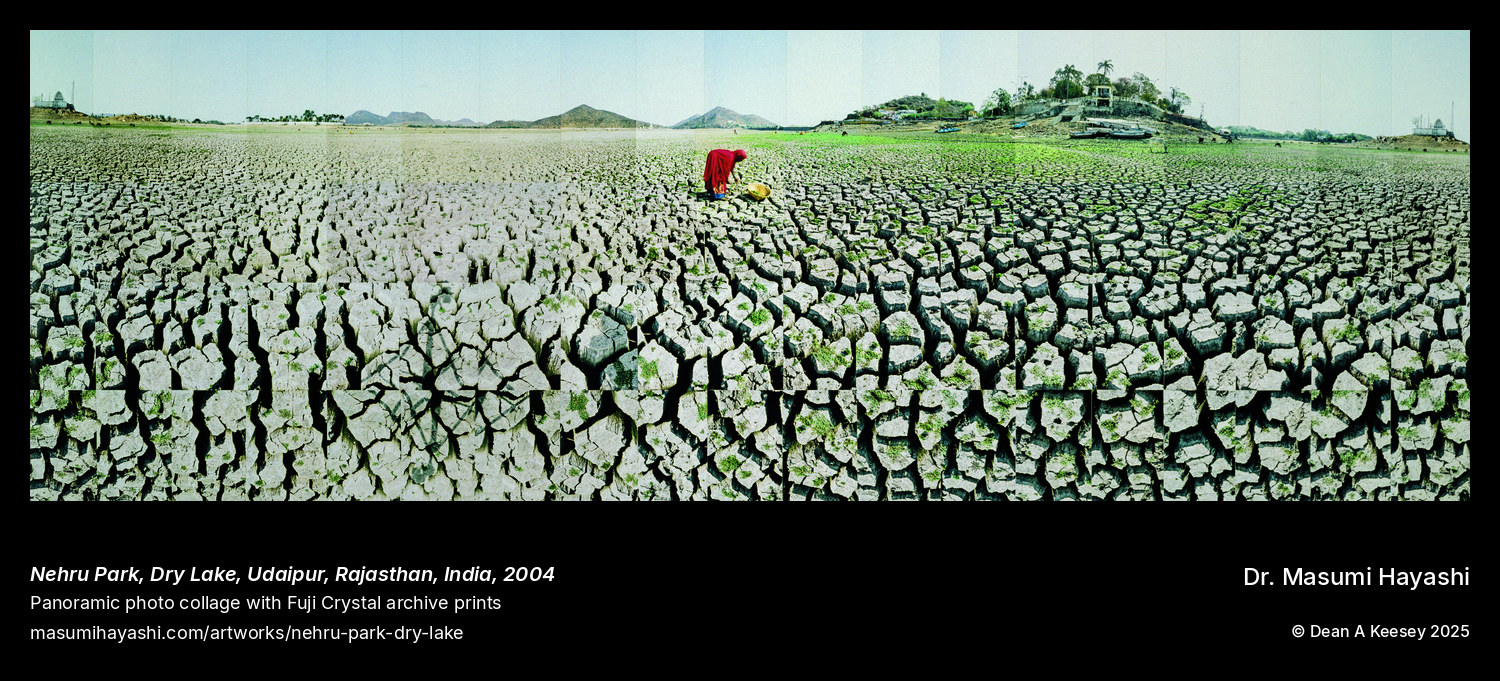
Dry Lake, Nehru Park, Udaipur, Rajasthan, India

Fateh Sagar Lake, Udaipur, Rajasthan, India

Panoramic Photo Collage

2004

18" x 57"

Dry Lake, Nehru Park, Udaipur, Rajasthan, India

Overview

This panoramic photo collage documents Fateh Sagar Lake and Nehru Park during drought period in Udaipur, Rajasthan - the legendary “City of Lakes” where water scarcity transforms sacred artificial lakes into cracked desert mud, exposing the environmental fragility underlying Rajasthan’s romantic palace-and-lake tourism imagery. Created in 2004, this work captures Fateh Sagar Lake’s drought-exposed lakebed, one of four major artificial lakes engineered by Udaipur’s Mewar rulers (1559 onwards) to create oasis city amid Thar Desert’s aridity. Nehru Park, normally an island reached by boat when lake is full, becomes landlocked peninsula or entirely accessible by foot during severe drought, revealing the lake’s engineered infrastructure usually submerged underwater. The title “Dry Lake” emphasizes environmental crisis over picturesque tourism: Udaipur’s lakes (Pichola, Fateh Sagar, Udai Sagar, Swaroop Sagar) regularly suffer drought, threatening city’s water supply, agricultural irrigation, and cultural identity as “Venice of the East.” The 18 x 57” extreme vertical format (3.17:1 height-to-width ratio, narrowest work in entire series at 18” width, narrower even than River Ganges’s 19” width) suggests documentation of vertical landscape features: perhaps exposed lake embankment walls (ghats, pavilions, temples descending toward absent water), or Nehru Park’s vertical architecture, or distant palace buildings on surrounding hills visible across dry lakebed. Major institutional recognition: Edition 2 donated to Smithsonian Institution 2018 via Katz-Huyck collection - placing environmental documentation of sacred landscape crisis in America’s premier museum.

Historical and Environmental Context

Udaipur: City of Lakes

Artificial lake system’s cultural and practical significance:

Udaipur founding and lake engineering:

  • Founded 1559 CE by Maharana Udai Singh II (Mewar dynasty)
  • Capital relocated from Chittorgarh after Mughal sieges
  • Selected valley surrounded by Aravalli Hills
  • Critical engineering: Natural valley dammed to create artificial lakes
  • Water security in desert region paramount
  • Lakes served: Drinking water, irrigation, defense moat, aesthetic beauty

Four major Udaipur lakes:

  1. Lake Pichola (1362 CE, expanded 16th century): Most famous, City Palace on eastern shore
  2. Fateh Sagar Lake (1678 CE, rebuilt 1889): Named after Maharana Fateh Singh
  3. Udai Sagar (1565 CE): Named after founder Udai Singh II
  4. Swaroop Sagar (1680): Smaller decorative lake near City Palace

Fateh Sagar Lake specifics:

  • Built 1678 CE by Maharana Jai Singh
  • Dam breach 1884, rebuilt 1889 by Maharana Fateh Singh (current name)
  • Three islands: Nehru Park (largest), solar observatory, public park
  • 2.4 km² surface area when full
  • Maximum depth: 13.4 meters (44 feet)
  • Primary water source: Rainfall catchment from surrounding Aravalli Hills
  • Secondary source: Interconnected canal system linking Udaipur’s lakes

Nehru Park island:

  • Largest island in Fateh Sagar Lake
  • Named after Jawaharlal Nehru (India’s first Prime Minister)
  • Features: Restaurant, gardens, fountains, lakeside walks
  • Access: Boat from shore when lake full
  • Tourism attraction: Sunset views, palace panoramas
  • During drought: Island becomes accessible by foot across dry lakebed

”City of Lakes” Identity

Cultural significance of water in desert:

Rajasthan water scarcity:

  • Thar Desert climate: Annual rainfall 15-40 cm (6-16 inches)
  • Groundwater depletion: Aquifers exhausted
  • Surface water: Entirely dependent on monsoon rains (July-September)
  • Failed monsoon = drought = empty lakes
  • Historical pattern: Cycles of plenty and scarcity

Udaipur’s exceptional status:

  • Anomaly in Rajasthan: City with abundant water (when lakes full)
  • Marketing: “Venice of the East,” “White City” (marble palaces), “City of Lakes”
  • Tourism economy: Lake views, palace hotels (Lake Palace Hotel floating on Pichola)
  • James Bond film Octopussy (1983) showcased Udaipur’s lakes/palaces
  • Romantic imagery: White marble palaces reflected in blue lakes
  • Environmental reality: Lakes frequently dry, water rationing, tourism threatened

Sacred and aesthetic dimensions:

  • Lakeside ghats (steps descending to water): Ritual bathing, ceremonies
  • Temples and shrines on lake shores and islands
  • Festivals celebrated on lakes: Boats, processions, rituals
  • Aesthetic: Jal Mahal (water palaces), gardens, pavilions designed for lake views
  • Monsoon-dependent beauty: When lakes dry, city’s entire character changes

Drought Cycles and Environmental Crisis

Chronic water insecurity:

Historical droughts:

  • Rajasthan droughts documented centuries (famines, migration, conflict)
  • Udaipur lakes regularly decline or empty: 2000, 2002, 2009, 2012, 2016, 2019
  • 2018-2019: Severe drought, Pichola and Fateh Sagar nearly empty
  • Lake Palace Hotel boat access cut off (guests stranded or ferried via shrinking channel)
  • Tourism industry devastated

Causes of lake depletion:

  • Rainfall variability: Monsoon failure or weak monsoon
  • Climate change: Shifting rainfall patterns, increased temperature, evaporation
  • Population growth: Udaipur population 450,000+ (2011), water demand exceeds supply
  • Groundwater extraction: Wells draining aquifers that feed lakes
  • Deforestation: Aravalli Hills deforestation reduces rainfall catchment
  • Development: Urbanization, encroachment on catchment areas
  • Siltation: Silt accumulation reduces lake capacity

Water management challenges:

  • Competing uses: Drinking water vs. irrigation vs. tourism aesthetics
  • Political tensions: Water allocation disputes
  • Technical solutions: Desiltation, rainwater harvesting, canal repairs
  • Climate adaptation: Can Udaipur maintain “City of Lakes” identity with climate change?

Dry lake exposures:

  • Cracked mud: Geometric patterns as clay dries and contracts
  • Exposed infrastructure: Ghats, foundations, pipelines, debris
  • Lost fish population: Thousands die as water evaporates
  • Landscape transformation: Blue lakes become brown-gray expanses
  • Nehru Park accessibility: Island becomes pedestrian-accessible (strange blessing)
  • Tourism paradox: Dry lakes photographed as climate documentation, not beauty

Sacred Landscapes in Crisis

Environmental documentation within “Sacred Architectures” series:

Why “Sacred Architectures” classification?

  • Traditional sacred architectures: Temples, stupas, palaces
  • Dry Lake: Environmental landscape, engineered water body
  • Connection: Lakes are sacred in Hinduism (tirthas), ritual bathing sites
  • Ghats and lakeside temples visible when lake drains
  • “Sacred” can mean: Religiously significant AND culturally essential
  • Udaipur’s identity as “City of Lakes” is sacred to Mewari heritage

Sacred water in Hinduism:

  • All water bodies potentially sacred (rivers, lakes, tanks, wells)
  • Ritual bathing (snana) purifies sins
  • Water offerings to deities
  • Cremation ashes immersed in sacred waters
  • Lakes and tanks built by kings as religious merit (dharma)
  • Fateh Sagar and Pichola: Not major pilgrimage sites but locally sacred

Climate and sacred space:

  • Does drought desecrate sacred lake?
  • How do communities adapt rituals when water disappears?
  • Environmental crisis as spiritual crisis (for water-dependent cultures)
  • Hayashi documenting: Sacred landscape under threat, not timeless temple

Artistic Significance

2004 Documentation: Environmental Turn

Shift toward environmental commentary:

Sacred Architectures series patterns:

  • Most works: Timeless temples, ongoing worship, architectural documentation
  • Dry Lake: Environmental crisis, drought, climate vulnerability
  • Expanding “sacred” definition: Not just buildings, but essential landscapes
  • Contemporary relevance: Climate change documented, not just historical architecture

2004 India works:

  • Meenakshi Temple (09023, 2001) - Continued trilogy
  • Airavatesvara Temples (09001-09002, 2004) - UNESCO Chola masterpieces
  • Rameswaram Temple (09030, 2004) - 1,212-pillar corridors
  • Dharamsala temples (09027, 09041, 2004) - Tibetan exile
  • Dry Lake, Udaipur (09026, 2004, this work) - Environmental crisis

Why document dry lake?

  • Captures climate vulnerability
  • Complicates “sacred architectures” narrative (not just preservation, but threat)
  • Environmental documentation alongside architectural
  • Water scarcity as critical issue for sacred landscapes
  • Tourism imagery vs. environmental reality

18 × 57” Extreme Vertical Format

Narrowest work in entire series:

Dimensional analysis:

  • 57” height (4 feet 9 inches)
  • 18” width (1 foot 6 inches - narrowest in series!)
  • 3.17:1 height-to-width ratio (extreme vertical)
  • Comparison: River Ganges 19x62” (previously narrowest width)
  • Comparison: Jain Temple Jaisalmer 25x73” (tallest, but wider)

What extreme narrow vertical captures:

  • Exposed ghat steps: Descending from high embankment to dry lakebed
  • Vertical distance: Height difference when lake drains (13.4 meter depth when full)
  • Nehru Park architecture: Vertical structures on island
  • Distant palaces: City Palace or Lake Palace visible across expanse?
  • Embankment walls: Vertical stone structures designed for water containment
  • Atmospheric perspective: Vertical compression emphasizing distance/height

Format serving environmental message:

  • Narrow width: Constricted, limited (like water scarcity)
  • Extreme height: Depth of crisis (vertically drained)
  • Opposite of expected lake documentation (usually horizontal panoramas for water vistas)
  • Vertical format subverts expectations (not picturesque beauty, but environmental crisis)

Major Institutional Placement: Smithsonian 2018

Edition 2: Katz-Huyck → Smithsonian Institution:

  • Donated 2018 via Katz-Huyck collection
  • Smithsonian significance: America’s premier museum complex
    • 21 museums, galleries, libraries, zoo
    • National collection of American history and culture
    • International collections (Asian art, world cultures)
  • Placement demonstrates:
    • Institutional recognition of Hayashi’s work
    • Environmental documentation valued (not just aesthetic architectural photography)
    • Sacred landscape crisis relevant to American museum audiences
    • Cross-cultural climate change themes
    • Hayashi’s corpus entering major permanent collections (alongside Cleveland Museum)

Collector Katz-Huyck:

  • Private collector who donated to Smithsonian
  • Provenance: Artist → Katz-Huyck → Smithsonian (2018)
  • Suggests active collecting and institutional donation strategy

Other major institutional placements:

  • Cleveland Museum of Art: “The Saint in the Market Place, Meenakshi Temple” (2014)
  • Smithsonian: “Dry Lake, Nehru Park, Udaipur” (2018)
  • Pattern: Major museums recognizing Hayashi’s Sacred Architectures series

Photographing Environmental Crisis

Dry lakebed photography challenges:

Visual subjects:

  • Cracked mud patterns (geometric, organic)
  • Exposed ghats (stone steps leading to nothing)
  • Nehru Park structures (isolated amid dry expanse)
  • Distant architecture (palaces visible across drained lake)
  • Vertical embankments (height usually obscured by water)
  • Desert-like landscape (contradicting “City of Lakes” imagery)

Compositional questions:

  • How to convey absence (missing water)?
  • Negative space emphasizing loss?
  • Human figures for scale (people walking on lakebed)?
  • Vertical format emphasizing depth of drainage?
  • Contrast between architectural beauty and environmental crisis?

Technical challenges:

  • Harsh Rajasthan light on exposed mud
  • Heat shimmer and atmospheric distortion
  • Texture documentation: Cracked mud, exposed silt
  • Color palette: Browns, grays, whites (not blue water)
  • Vertical panorama assembly via photo collage

Ethical and documentary considerations:

  • Documenting crisis, not exploiting
  • Environmental message vs. aesthetic beauty
  • Does photograph warn or attract (tourists photographing drought as spectacle)?
  • Historical record of climate vulnerability

Contemporary Relevance and Enduring Questions

Dry Lake documentation raises urgent questions:

Environmental and climate:

  • How does climate change threaten sacred cultural landscapes?
  • Can Udaipur maintain “City of Lakes” identity with chronic drought?
  • What happens when water-dependent tourism and heritage sites lose water?
  • How do communities adapt sacred rituals when water sources disappear?

Cultural identity:

  • Is “City of Lakes” viable in climate change era?
  • How does environmental crisis threaten intangible heritage (festivals, rituals, identity)?
  • What is relationship between tourism imagery (romantic lake palaces) and reality (dry mud)?
  • Can engineered landscapes (artificial lakes) survive in changing climate?

Sacred landscape definition:

  • Should environmental documentation be included in “Sacred Architectures” series?
  • How does drought transform sacred space (desecration or natural cycle)?
  • What makes landscape “sacred” (religious use, cultural identity, both)?
  • Does Hayashi’s work document timeless sacred spaces or climate-vulnerable heritage?

Institutional recognition:

  • Why did Smithsonian acquire drought documentation (not temple beauty)?
  • What does environmental crisis documentation say about Hayashi’s expanding vision?
  • How do museums frame climate change art (environmental activism, cultural documentation, aesthetic)?
  • Will Edition 2’s Smithsonian placement bring broader recognition to series?

Photographic documentation:

  • How to photograph absence and crisis (not just presence and beauty)?
  • Does extreme vertical format serve environmental message or architectural subject?
  • Can single photograph convey multi-year drought pattern?
  • What is responsibility of photographer documenting environmental crisis?

Comparative Context: Water and Sacred Space

Hayashi’s water-related sacred spaces:

River Ganges, Varanasi (09033, 2000):

  • Sacred river, flowing water, ghat architecture
  • 19x62” (3.26:1) extreme vertical
  • Water present, sacred rituals continuing
  • Hinduism’s holiest river

Dry Lake, Udaipur (09026, 2004, this work):

  • Artificial lake, water absent, drought crisis
  • 18x57” (3.17:1) extreme vertical (narrower than Ganges!)
  • Water missing, cultural identity threatened
  • Sacred landscape vulnerability

Contrasts:

  • Ganges: Natural river (though polluted), eternal flow (mythologically)
  • Fateh Sagar: Artificial reservoir, monsoon-dependent, engineered
  • Ganges: Living sacred rituals despite pollution
  • Dry Lake: Suspended rituals due to drought
  • Both extreme verticals documenting water’s vertical relationship to architecture (ghats descending)

Educational Significance

This work teaches about:

  • Dry Lake crisis: Fateh Sagar Lake drought exposing environmental fragility
  • Udaipur “City of Lakes”: Artificial lake system engineered by Mewar rulers, tourism identity, water scarcity
  • Nehru Park: Island in Fateh Sagar becoming accessible during drought
  • Extreme vertical format: 18x57” (narrowest work at 18” width), 3.17:1 ratio emphasizing vertical drainage
  • Smithsonian placement 2018: Major institutional recognition, environmental documentation valued
  • Sacred landscape vulnerability: Climate change threatening culturally essential water bodies
  • Rajasthan drought cycles: Chronic water insecurity, failed monsoons, tourism impact
  • Environmental documentation: Expanding “Sacred Architectures” beyond temples to threatened landscapes
  • Water and sacred space: Lakes as tirthas, ritual bathing sites, cultural identity foundations
  • Photo collage technique: Assembling extreme vertical perspective of environmental crisis

Note: This canonical content was extracted from the Masumi Hayashi Foundation Master Catalogue (2007 inventory). Edition 1 (framed) in artist’s estate; Edition 2 donated to Smithsonian Institution 2018 via Katz-Huyck collection - major institutional placement; Editions 3-5 in Packets. Created in 2004, this work documents Fateh Sagar Lake drought in Udaipur, Rajasthan - “City of Lakes” where engineered water bodies regularly empty during failed monsoons, threatening tourism, water supply, and cultural identity. Nehru Park island normally reached by boat becomes landlocked or accessible by foot during severe drought. 18x57” extreme vertical format (narrowest work in entire series at 18” width, 3.17:1 height-to-width ratio) emphasizes vertical landscape features: exposed ghat steps descending to dry lakebed, embankment walls designed for water containment now exposed, vertical distance when lake drains from maximum 13.4-meter depth. Expands “Sacred Architectures” series from timeless temple documentation to environmental crisis documentation - sacred landscape vulnerability to climate change. Udaipur’s four artificial lakes (Pichola, Fateh Sagar, Udai Sagar, Swaroop Sagar) suffer chronic drought (2000, 2002, 2009, 2012, 2016, 2019) threatening “Venice of the East” romantic tourism imagery with brown-gray cracked mud reality. Smithsonian placement recognizes Hayashi’s environmental documentation alongside Cleveland Museum’s Meenakshi acquisition (2014) - two major American institutions acquiring Sacred Architectures works.

Donate