City of the Dead, No. 2, Okunoin, Koya, Wakayama, Japan | Masumi Hayashi Foundation
Back to Gallery
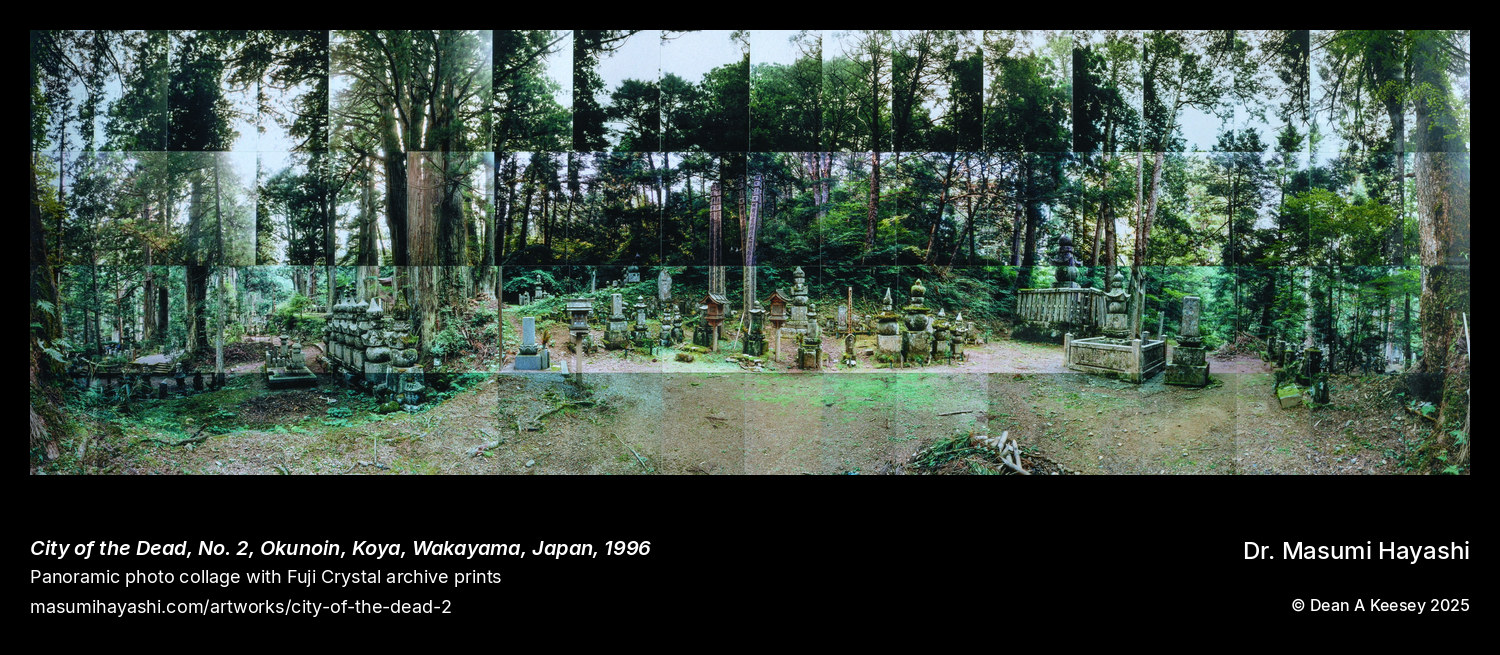
Picture of City of the Dead, No. 2, Okunoin, Koya, Wakayama, Japan by Dr. Masumi Hayashi

City of the Dead, No. 2, Okunoin, Koya, Wakayama, Japan

Okunoin, Koyasan, Japan

Panoramic Photo Collage

1996

17 x 53

City of the Dead, No. 2, Okunoin, Koya, Wakayama, Japan

Overview

This panoramic photo collage documents Okunoin cemetery on Mount Koya (Koyasan), Wakayama Prefecture - Japan’s largest and holiest cemetery where 200,000+ graves and memorial stupas crowd beneath towering cryptomeria cedars along two-kilometer path leading to mausoleum of Kobo Daishi (Kukai, 774-835 CE), founder of Shingon esoteric Buddhism who Japanese Buddhists believe remains in eternal meditation awaiting Maitreya Buddha’s arrival. Created in 1996 as second of two Okunoin works (companion: City of the Dead No. 1, 09009, also 1996), this piece captures the cemetery’s otherworldly atmosphere where centuries of moss-covered stone monuments, weathered wooden markers, and recent corporate memorial stupas create layered death landscape beneath forest canopy filtering dappled light onto pilgrimage path walked daily by monks delivering food offerings to Kobo Daishi’s mausoleum (Okunoin), maintaining 1,200-year tradition that saint still lives in meditative state requiring sustenance. The 17 x 53” extreme vertical format (3.12:1 height-to-width ratio, one of narrowest works in series at 17” width) suggests documentation of vertical forest architecture: towering cedar trunks, multi-tiered memorial stupas, lanterns hanging from branches, or vertical depth of pilgrimage path descending through cemetery toward inner sanctuary. Two Foundation editions retained (framed + unframed, 2007 catalog) indicates work’s significance in documenting Japanese Buddhist death culture dramatically distinct from previous Sacred Architectures focus on temple architecture and living worship.

Historical and Religious Context

Mount Koya (Koyasan): Sacred Mountain

Shingon Buddhism’s headquarters and pilgrimage destination:

Kobo Daishi (Kukai) founding (816 CE):

  • Kukai (posthumously: Kobo Daishi = “Great Teacher Who Spread Dharma”)
  • Born 774 CE, Shikoku Island
  • Studied esoteric Buddhism in China (Tang Dynasty, 804-806)
  • Returned to Japan, established Shingon school (esoteric Buddhism)
  • Emperor Saga granted Mount Koya for monastic complex (816 CE)
  • Remote mountain location: Suitable for meditation, away from worldly politics
  • Established Kongobuji Temple as Shingon headquarters

Kobo Daishi’s “death” and eternal meditation belief:

  • Entered eternal meditation (nyujo) 835 CE, age 62
  • Shingon tradition: Kobo Daishi did not die but entered meditative trance
  • Awaits Maitreya Buddha’s arrival (56.7 million years in future)
  • Still alive in mausoleum (Okunoin) requiring daily food offerings
  • Monks deliver two meals daily to mausoleum since 835 CE (1,200+ years!)
  • Mausoleum off-limits (photography forbidden, sacred inner sanctum)
  • Pilgrims approach mausoleum bridge but cannot enter building

Mount Koya monastic complex:

  • Elevation 800 meters (2,600 feet), Kii Mountains, Wakayama Prefecture
  • 117 temples (currently, historical peak: 2,000+ temples)
  • ~5,000 monks and residents (historical)
  • Shukubo (temple lodgings): Pilgrims stay in temples, eat shojin ryori (Buddhist vegetarian cuisine)
  • UNESCO World Heritage Site 2004: “Sacred Sites and Pilgrimage Routes in Kii Mountain Range”

Okunoin: Japan’s Largest Cemetery

Cemetery’s scale and significance:

Cemetery statistics:

  • 200,000+ graves and memorial stupas (estimates vary, uncounted)
  • 2-kilometer path from Ichinohashi Bridge to mausoleum
  • Oldest graves: 1,000+ years (medieval samurai, aristocrats, monks)
  • Newest graves: Contemporary memorials (corporations, individuals)
  • Continuous burials 1,200+ years

Why burial at Okunoin?

  • Proximity to Kobo Daishi’s mausoleum = spiritual benefit
  • Belief: Being near Kobo Daishi ensures rebirth in Pure Land
  • Posthumous ordination: Kobo Daishi will ordain dead as monks when Maitreya arrives
  • Merit transfer: Kobo Daishi’s infinite merit extends to those buried nearby
  • Japanese saying: “To be buried at Okunoin = guaranteed enlightenment”

Who is buried at Okunoin:

  • Feudal lords (daimyo): Tokugawa clan, Date Masamune, Oda Nobunaga relatives
  • Samurai: Warrior families seeking posthumous spiritual benefit
  • Monks: Shingon priests wish to be near teacher Kobo Daishi
  • Merchants and commoners: Those who could afford memorial
  • Modern corporations: Company memorial stupas (Panasonic, UCC Coffee, Nissan, etc.)
  • Famous individuals: Writers, artists, politicians
  • War memorial: Pacific War soldiers, kamikaze pilots

Corporate memorials (unusual phenomenon):

  • Companies erect memorial stupas for deceased employees
  • Rocket-shaped stupa (space program memorial)
  • Insect memorial (pest control company honoring killed insects!)
  • Demonstrates Buddhism’s expansive compassion (even insects merit memorials)
  • Controversial: Commodification of sacred space vs. expression of corporate paternalism

Cemetery Landscape and Atmosphere

Visual and spatial experience:

Forest setting:

  • Ancient cryptomeria cedars (sugi, Japanese cedar)
  • Trees hundreds of years old, towering 30+ meters
  • Filtered light creates dappled shadows
  • Moss covering everything (graves, lanterns, pathways, trees)
  • Atmospheric: Foggy mornings, misty afternoons
  • Sound: Rustling leaves, birdsong, silence

Monument density and variety:

  • Stone stupas (gorinto = five-element stupas)
  • Wooden grave markers (sotoba)
  • Stone lanterns (toro) lining pathways
  • Memorial tablets and carved inscriptions
  • Modern polished granite (recent burials)
  • Ancient weathered stones (medieval aristocrats)
  • Layered centuries: Impossible to distinguish eras at glance

Path structure:

  • Outer path (Ichinohashi Bridge to Nakanohashi Bridge): Older graves, samurai memorials
  • Inner path (Nakanohashi to Torodo Hall): Denser monuments, lantern hall
  • Torodo (Lantern Hall): 10,000+ lanterns donated by pilgrims
  • Gobyo Bridge: Final approach to mausoleum (photography forbidden beyond)
  • Okunoin Mausoleum: Inner sanctum where Kobo Daishi meditates

Pilgrimage practice:

  • Walk 2km path meditatively
  • Stop at significant graves (historical figures, relatives)
  • Offer water, incense, prayers at graves
  • Light candles at Torodo (Lantern Hall)
  • Cross Gobyo Bridge to mausoleum
  • Offer prayers to Kobo Daishi
  • Monks perform daily services

Artistic Significance

1996 Japanese Buddhist Death Culture Documentation

Earliest Sacred Architectures works:

Two Okunoin works (both 1996):

  • City of the Dead, No. 1 (09009, 1996): First perspective
  • City of the Dead, No. 2 (09010, 1996, this work): Second perspective

Why two works?

  • Cemetery’s complexity merits multiple perspectives
  • Different sections of 2km path (outer vs. inner?)
  • Different monument types or atmospheric conditions
  • Comprehensive documentation strategy (precedent for later multi-work sites)

1996 significance:

  • Among earliest Sacred Architectures works (series began mid-1990s)
  • Establishes pattern: Japanese Buddhist sites documented early
  • Precedes major India/Cambodia/Nepal documentation (2000-2004)
  • Death culture theme unusual in series focused on living worship

Japanese aesthetic:

  • Wabi-sabi (beauty in impermanence, aging, decay)
  • Moss, weathering, patina as beauty
  • Forest-cemetery integration (not cleared cemetery like Western traditions)
  • Subtle, muted colors (grays, greens, browns)
  • Atmospheric mystery (fog, filtered light)

17 × 53” Extreme Vertical Format

Among narrowest works:

Dimensional analysis:

  • 53” height (4 feet 5 inches)
  • 17” width (1 foot 5 inches) - VERY narrow
  • 3.12:1 height-to-width ratio
  • Second-narrowest width after Dry Lake Udaipur (18”)
  • Extreme vertical emphasizing height over breadth

What extreme narrow vertical captures:

  • Cedar trunks: Towering trees rising vertically
  • Stupa tiers: Five-element gorinto stupas stacked vertically
  • Path depth: Long perspective down forest path
  • Lantern columns: Stone lanterns stacked or aligned
  • Vertical forest layers: Canopy, mid-story, monument level, ground cover
  • Atmospheric depth: Mist or fog receding vertically

Format echoing cemetery experience:

  • Narrow path through forest (constricted horizontal space)
  • Vertical emphasis (looking up at cedars, looking down path)
  • Claustrophobic beauty (enclosed by monuments and trees)
  • Vertical format = upward spiritual aspiration?

Two Foundation Editions Retained

Unusual retention pattern:

Inventory status (2007 catalog):

  • Edition 1: Framed in inventory
  • Edition 2: Unframed in inventory
  • Editions 3-5: Packets
  • Artist’s Proof 1: Packets

Why retain two editions?

  • Recognition of work’s significance
  • Paired with City of the Dead No. 1 (likely also retained)
  • Exhibition flexibility (framed for gallery, unframed for travel)
  • Japanese Buddhist death culture documentation valued
  • Early career work meriting preservation

Photographing Sacred Death Landscape

Okunoin cemetery photography challenges:

Lighting challenges:

  • Forest canopy filters sunlight (dark environment)
  • Dappled light creates extreme contrast
  • Moss absorbs light (muted colors)
  • Overcast common (atmospheric moisture)
  • Long exposures required for low light

Compositional strategies:

  • Monument density (how to show 200,000 graves without chaos?)
  • Vertical cedars vs. horizontal monument spread
  • Path perspective (leading lines through cemetery)
  • Atmospheric depth (fog, mist enhancing mystery)
  • Selective focus (foreground monument vs. receding forest)

Cultural sensitivity:

  • Active cemetery (not historical relic)
  • Ongoing burials and memorials
  • Families visiting graves
  • Monks performing rituals
  • Photography restrictions (mausoleum area forbidden)
  • Respect for sacred death space

Aesthetic vs. document:

  • Wabi-sabi beauty (decay, moss, patina)
  • Tourism attraction (Okunoin popular for photographers)
  • Sacred pilgrimage site (not just aesthetic subject)
  • How to convey spiritual significance vs. picturesque scenery?

Contemporary Relevance and Enduring Questions

City of the Dead documentation raises questions:

Death culture and sacred space:

  • How does Japanese Buddhist death culture differ from Western cemetery traditions?
  • What is significance of believing Kobo Daishi still lives in meditation?
  • Why do 200,000+ people seek burial near saint’s mausoleum?
  • How does forest-cemetery integration create unique sacred landscape?

Continuity and change:

  • 1,200-year tradition of daily food offerings to Kobo Daishi (belief in living saint)
  • Corporate memorials (modern innovation or continuity with patronage traditions?)
  • UNESCO designation (preservation vs. tourism impact)
  • Can sacred cemetery maintain spiritual function amid photography tourism?

Artistic documentation:

  • Why document death landscape within “Sacred Architectures” series?
  • How do two works (No. 1 and No. 2) create comprehensive cemetery portrait?
  • Does extreme vertical format serve cemetery architecture or forest setting?
  • Can photograph convey experience of walking 2km through 200,000 graves?

Comparative death cultures:

  • Japanese forest cemetery vs. Western manicured lawn cemeteries
  • Buddhist death optimism (rebirth, enlightenment) vs. Western grief
  • Communal cemetery (proximity to saint) vs. family plots
  • Integration with living worship (pilgrimage path) vs. separated cemeteries

Comparative Context: Okunoin No. 1 and No. 2

Hayashi’s Okunoin pair (both 1996):

City of the Dead, No. 1 (09009, 1996):

  • First documentation (No. 1 designation)
  • Likely different section of 2km cemetery path
  • Similar atmospheric forest-cemetery setting
  • Dimensions and inventory status: (not specified in this file, would need to reference)

City of the Dead, No. 2 (09010, 1996, this work):

  • Second documentation (No. 2 designation)
  • 17 x 53” extreme vertical
  • Two Foundation editions retained (framed + unframed)
  • Emphasis on vertical forest/monument architecture

Two-work cemetery strategy:

  • 2km path offers multiple perspectives
  • Different monument sections (feudal vs. modern? outer vs. inner?)
  • Atmospheric variations (light, fog, season?)
  • Comprehensive documentation of Japan’s largest cemetery
  • Establishes multi-work pattern for complex sites (later seen: Meenakshi trilogy, Airavatesvara pair)

Educational Significance

This work teaches about:

  • Okunoin cemetery: Japan’s largest cemetery, 200,000+ graves, 2km pilgrimage path
  • Kobo Daishi (Kukai): Shingon Buddhism founder, eternal meditation belief, daily food offerings 1,200+ years
  • Mount Koya (Koyasan): Shingon headquarters, 117 temples, UNESCO World Heritage Site 2004
  • Forest cemetery: Cryptomeria cedars, moss-covered monuments, wabi-sabi aesthetic
  • Burial motivations: Proximity to Kobo Daishi ensures rebirth, posthumous ordination belief
  • Monument diversity: Feudal lords, samurai, monks, corporations, modern individuals across 1,200 years
  • Extreme vertical format: 17x53” (second-narrowest at 17” width), emphasizing forest height, monument tiers, path depth
  • Two-work documentation: No. 1 + No. 2 comprehensive cemetery portrait (both 1996)
  • Japanese Buddhist death culture: Living saint belief, corporate memorials, forest integration
  • 1996 early work: Among earliest Sacred Architectures, establishes Japanese Buddhist focus

Note: This canonical content was extracted from the Masumi Hayashi Foundation Master Catalogue (2007 inventory). Editions 1-2 in artist’s estate (1 framed, 1 unframed - unusual double retention); Editions 3-5 and Artist’s Proof in Packets. Created in 1996 as second of two Okunoin cemetery works (companion: City of the Dead No. 1, 09009), documenting Japan’s largest and holiest cemetery on Mount Koya where 200,000+ graves surround Kobo Daishi’s mausoleum. Shingon Buddhism founder Kukai (774-835 CE) believed to remain in eternal meditation requiring daily food offerings 1,200+ years. Cemetery’s 2km pilgrimage path through ancient cryptomeria cedar forest contains monuments spanning 1,200 years: feudal lords, samurai, monks, modern corporations. 17x53” extreme vertical (second-narrowest work at 17” width, 3.12:1 ratio) captures vertical forest architecture: towering cedars, multi-tiered stupas, path perspective. Two-work strategy (No. 1 + No. 2) provides comprehensive documentation of complex sacred death landscape. Among earliest Sacred Architectures works (1996), establishing Japanese Buddhist theme years before major India/Cambodia documentation (2000-2004). Wabi-sabi aesthetic: moss-covered stones, weathered monuments, forest integration create otherworldly atmosphere where centuries layer atop each other beneath filtered canopy light.

Donate