City of the Dead, No. 1, Okunoin, Koya, Wakayama, Japan
Okunoin, Koyasan, Japan
Panoramic Photo Collage
1996
17 x 53
City of the Dead, No. 1, Okunoin, Koya, Wakayama, Japan
Overview
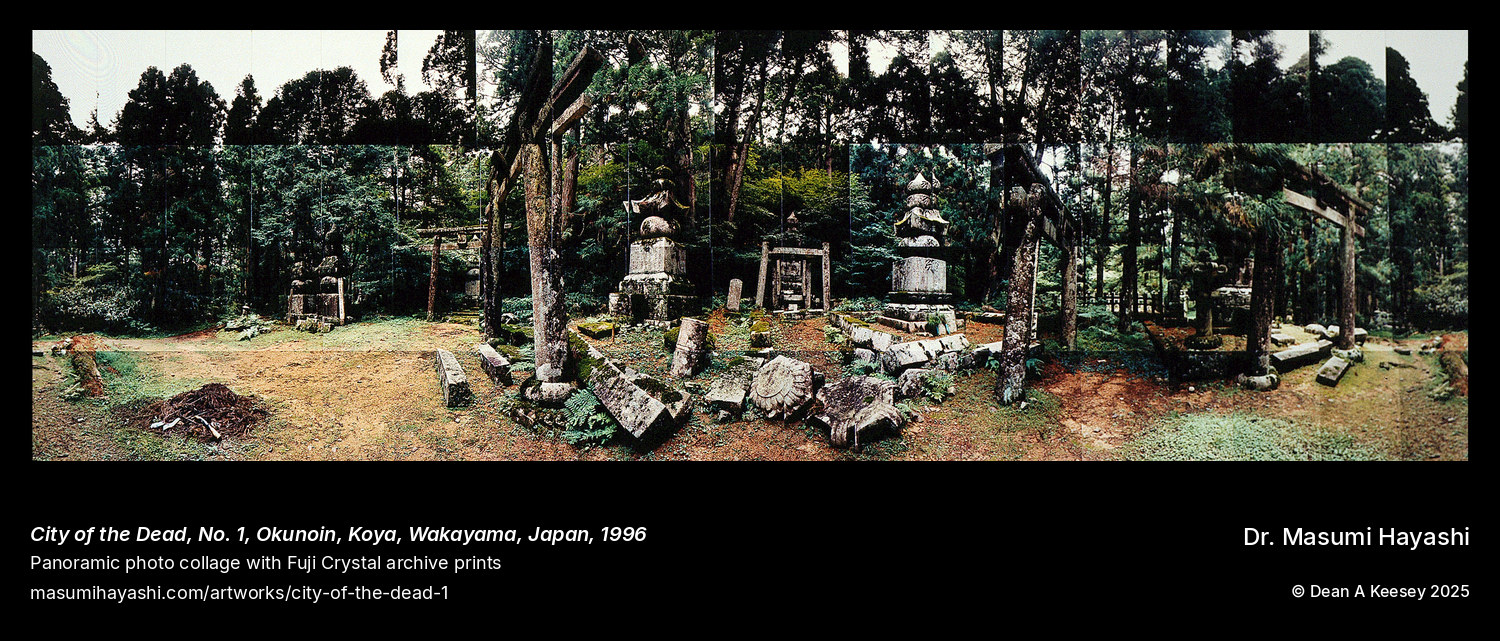
This panoramic photo collage documents Okunoin cemetery on Mount Koya (Koyasan), Wakayama Prefecture - the first of Hayashi’s two 1996 works capturing Japan’s largest and holiest cemetery where 200,000+ graves and memorial stupas crowd beneath towering cryptomeria cedars along two-kilometer pilgrimage path leading to mausoleum of Kobo Daishi (Kukai, 774-835 CE), founder of Shingon esoteric Buddhism who Japanese Buddhists believe remains in eternal meditation awaiting Maitreya Buddha’s arrival. Created in 1996 as the FIRST of two Okunoin works (companion: City of the Dead No. 2, 09010, also 1996), this piece establishes the two-work documentation strategy capturing cemetery’s complexity from multiple perspectives along 2km path that encompasses 1,200 years of continuous burials spanning feudal lords, samurai warriors, monks, commoners, modern corporations, and war memorials—each monument contributing to dense forest of stone stupas, wooden markers, and memorial tablets creating layered death landscape beneath forest canopy filtering dappled light onto paths walked daily by monks delivering food offerings to Kobo Daishi’s mausoleum (Okunoin), maintaining 1,200-year tradition that saint still lives in meditative state requiring sustenance. The 17 x 53” extreme vertical format (3.12:1 height-to-width ratio, second-narrowest width in entire series at 17” after only Dry Lake Udaipur’s 18”, matching No. 2’s identical dimensions) suggests documentation of similar vertical forest architecture as companion work: towering cedar trunks, multi-tiered memorial stupas, lanterns hanging from branches, or vertical depth of pilgrimage path descending through cemetery toward inner sanctuary—though as “No. 1” this work likely documents different section of 2km path or alternative perspective on same sacred death landscape, enabling comprehensive cemetery portrait through dual documentation. TWO Artist’s Proofs in Foundation inventory (unusual: Proof 1 “un#” + Proof 2 “Inventory - unframed”) alongside Edition 1 (unframed) indicates THREE total editions retained from this work compared to No. 2’s two-edition retention—suggesting both works valued sufficiently to preserve multiple examples despite being among earliest Sacred Architectures experiments from mid-1990s when series parameters still developing. The 1996 date establishes Japanese Buddhist death culture as foundational Sacred Architectures theme years before major India/Cambodia/Nepal documentation (2000-2004 turn-of-millennium journey), demonstrating Hayashi’s early interest in Asian sacred architecture predating series’ eventual expansion to encompass Hinduism, Jainism, Tibetan Buddhism, and Southeast Asian religious traditions documented across Sacred Architectures’ full ~31-work corpus.
Historical and Religious Context
Mount Koya (Koyasan): Sacred Mountain and Shingon Headquarters
Okunoin cemetery exists within broader context of Mount Koya’s religious significance:
Kobo Daishi (Kukai) founding (816 CE):
- Kukai (774-835 CE, posthumously: Kobo Daishi = “Great Teacher Who Spread Dharma”)
- Born Shikoku Island, studied esoteric Buddhism in China (Tang Dynasty, 804-806)
- Returned to Japan, established Shingon school (esoteric Buddhism combining Indian tantra, Chinese Chan, Japanese indigenous traditions)
- Emperor Saga granted Mount Koya for monastic complex (816 CE)
- Remote mountain location (elevation 800 meters/2,600 feet, Kii Mountains, Wakayama Prefecture) suitable for meditation, away from worldly politics of Heian capital (Kyoto)
- Established Kongobuji Temple as Shingon headquarters
- Mount Koya became—and remains—center of Shingon Buddhism globally
Kobo Daishi’s “death” and eternal meditation belief:
- Entered eternal meditation (nyujo) 835 CE, age 62, in mausoleum on Mount Koya
- Shingon tradition: Kobo Daishi did NOT die but entered meditative trance
- Awaits Maitreya Buddha’s arrival (56.7 million years in future according to Buddhist cosmology)
- Still alive in mausoleum (Okunoin) requiring daily food offerings
- Monks deliver two meals daily to mausoleum since 835 CE (1,200+ years continuous tradition!)
- Mausoleum off-limits to visitors (photography forbidden, sacred inner sanctum accessible only to designated monks)
- Pilgrims approach mausoleum bridge (Gobyo Bridge) but cannot enter building housing Kobo Daishi
- Belief in living saint creates unique death culture: proximity to Kobo Daishi ensures spiritual benefit
Mount Koya monastic complex scale:
- Currently 117 temples (historical peak: 2,000+ temples during medieval period)
- ~5,000 monks and residents (historical)
- Shukubo (temple lodgings): Pilgrims stay in temples, eat shojin ryori (Buddhist vegetarian cuisine prepared by monks)
- UNESCO World Heritage Site 2004: “Sacred Sites and Pilgrimage Routes in Kii Mountain Range” (includes Mount Koya, Kumano Kodo pilgrimage routes, and Yoshino/Omine sacred peaks)
- Year-round pilgrimage destination: domestic Japanese pilgrims, international Buddhist practitioners, cultural tourists
Okunoin: Japan’s Largest Cemetery and Pilgrimage Destination
Cemetery’s scale and spiritual significance:
Cemetery statistics:
- 200,000+ graves and memorial stupas (estimates vary, no complete count exists)
- 2-kilometer path from Ichinohashi Bridge (first bridge, main entrance) to Kobo Daishi’s mausoleum
- Oldest graves: 1,000+ years (medieval samurai, aristocrats, monks from Heian and Kamakura periods)
- Newest graves: Contemporary memorials (2000s corporate memorials, recent burials continuing tradition)
- Continuous burials 1,200+ years creating layered death landscape where centuries coexist
- Cemetery expanded organically over millennium as more families, clans, corporations sought proximity to Kobo Daishi
Why burial at Okunoin? Belief in posthumous salvation:
- Proximity to Kobo Daishi’s mausoleum = spiritual benefit: Being near living saint ensures rebirth in Pure Land
- Posthumous ordination: Belief that Kobo Daishi will ordain dead as monks when Maitreya Buddha arrives
- Merit transfer: Kobo Daishi’s infinite merit (from enlightenment and compassionate works) extends to those buried nearby
- Japanese saying: “To be buried at Okunoin = guaranteed enlightenment” (paraphrased popular belief)
- Family prestige: Having ancestral grave at Okunoin elevates family’s Buddhist piety and social status
- Continuity: Families maintain graves for generations, visiting regularly, performing memorial rites
Who is buried at Okunoin (social diversity across 1,200 years):
- Feudal lords (daimyo): Tokugawa clan (Edo shogunate rulers), Date Masamune (legendary one-eyed warlord), relatives of Oda Nobunaga (16th-century unifier)
- Samurai warriors: Warrior families seeking posthumous spiritual benefit after lives of violence
- Monks: Shingon priests wish to be near their spiritual teacher Kobo Daishi
- Merchants and commoners: Those wealthy enough to afford memorial (merchant class grew during Edo period, many built elaborate family memorials)
- Modern corporations: Company memorial stupas for deceased employees (Panasonic, UCC Coffee, Nissan, Sharp, Kikkoman soy sauce, Yakult, others)
- Famous individuals: Writers, artists, politicians, cultural figures
- War memorial: Pacific War soldiers, kamikaze pilots, those who died in service during WWII
- Sectarian diversity: Though Shingon cemetery, some buried belonged to other Buddhist schools (Pure Land, Zen) drawn by Kobo Daishi’s universal spiritual authority
Corporate memorials (unusual 20th-century phenomenon):
- Companies erect memorial stupas honoring deceased employees (paternalistic corporate culture)
- Rocket-shaped stupa: Space program memorial (commemorating those who worked in aerospace)
- Insect memorial (kuchu kuyoto): Pest control company (Fumakilla) honoring killed insects! Demonstrates Buddhism’s expansive compassion—even insects merit memorials recognizing their sacrifice
- Coffee cup stupa: UCC Coffee company memorial shaped like coffee cup
- Controversial among traditionalists: Commodification of sacred space vs. expression of corporate responsibility and Buddhist compassion extending to modern economic relationships
- Demonstrates Okunoin’s living tradition adapting to contemporary Japanese society while maintaining spiritual core
Cemetery Landscape and Atmospheric Experience
Visual and spatial characteristics:
Forest setting creating otherworldly atmosphere:
- Ancient cryptomeria cedars (sugi, Japanese cedar) towering 30+ meters (100+ feet)
- Trees hundreds of years old (some planted deliberately, others self-seeded)
- Filtered light creates dappled shadows: Sunlight barely penetrates dense canopy, creating perpetual twilight even midday
- Moss covering everything: graves, lanterns, pathways, tree trunks creating unified green carpet
- Atmospheric conditions: Foggy mornings, misty afternoons (high elevation humidity)
- Sound environment: Rustling leaves, birdsong, occasional monk chanting, footsteps on stone path, profound silence between visitors
- Seasons: Cherry blossoms spring (pale pink petals on dark stone), green moss summer, red autumn leaves, snow winter (quietest, most mystical)
Monument density and stylistic diversity spanning 1,200 years:
- Stone stupas (gorinto = five-element stupas): Five stacked geometric shapes representing earth, water, fire, wind, void (Buddhist cosmology)
- Wooden grave markers (sotoba): Vertical planks with Sanskrit inscriptions, names, death dates
- Stone lanterns (toro): Hundreds lining pathways, many donated by pilgrims, families, corporations
- Memorial tablets and carved inscriptions: Sanskrit mantras, posthumous Buddhist names, family crests
- Modern polished granite: Recent burials using contemporary materials (black polished stone with gold inscriptions)
- Ancient weathered stones: Medieval aristocrat memorials barely legible, moss obscuring inscriptions
- Layered centuries: Impossible to distinguish eras at glance—12th-century samurai memorial beside 21st-century corporate stupa, creating temporal disorientation
Path structure and pilgrimage progression:
- Ichinohashi Bridge (first bridge, main entrance): Marks boundary between secular and sacred space, pilgrims bow before crossing
- Outer path (Ichinohashi to Nakanohashi Bridge): Older graves, samurai memorials, feudal clan burial grounds, wider path accommodating tour groups
- Nakanohashi Bridge (middle bridge): Transition to inner cemetery, narrower path, denser monuments
- Inner path (Nakanohashi to Torodo Hall): Denser monuments, more ancient graves, increasingly sacred atmosphere
- Torodo (Lantern Hall): 10,000+ lanterns donated by pilgrims over centuries, continuously burning (oil lamps), darkened hall creating ethereal glow
- Gobyo Bridge: Final approach to mausoleum, photography forbidden beyond this point, pilgrims bow deeply before crossing
- Okunoin Mausoleum: Inner sanctum where Kobo Daishi meditates, off-limits except to designated monks, daily food offerings delivered
Pilgrimage practices and devotional behaviors:
- Walk 2km path meditatively: Slow contemplative pace, often chanting sutras
- Stop at significant graves: Historical figures, relatives, famous memorials
- Offer water (osenko): Ladling water over graves from stone basins, purifying deceased
- Incense offering: Burning incense sticks at family graves, memorial sites
- Light candles at Torodo: Lantern Hall pilgrimage component, contributing light to 10,000+ lamps
- Cross Gobyo Bridge: Final approach to mausoleum requiring reverent deportment
- Offer prayers to Kobo Daishi: Standing before mausoleum (cannot enter), reciting Shingon mantras
- Monks perform daily services: Morning and evening rituals maintaining 1,200-year tradition
Artistic Significance
1996 Early Sacred Architectures: Establishing Japanese Buddhist Focus
Among earliest documented Sacred Architectures works:
Two Okunoin works establishing paired documentation pattern (both 1996):
- City of the Dead, No. 1 (09009, 1996, this work): First perspective, first chronologically
- City of the Dead, No. 2 (09010, 1996): Second perspective, complementary documentation
Why TWO works for single cemetery?
- Cemetery’s 2km length: Single work cannot capture full pilgrimage path from Ichinohashi Bridge to mausoleum
- Different sections documented: No. 1 possibly outer path (older samurai memorials, wider spacing), No. 2 possibly inner path (denser monuments, approaching Torodo/mausoleum) [speculation based on numbering]
- Different monument types: Feudal vs. modern, stone vs. wood, ancient vs. contemporary corporate memorials
- Atmospheric variations: Light conditions, fog, season differences between visits
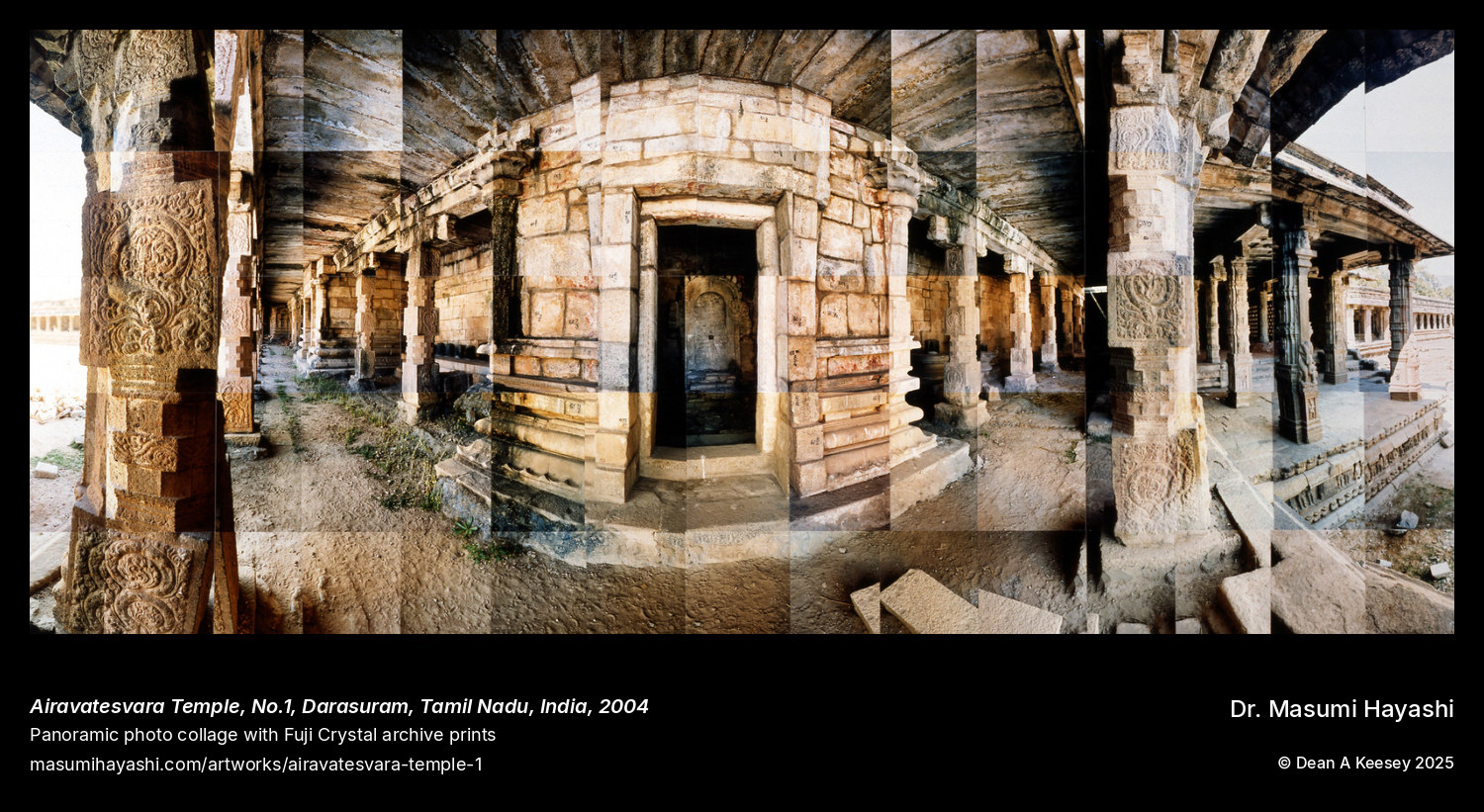
- Comprehensive documentation strategy: Establishes pattern seen later in series (Meenakshi trilogy 2001-2003, Airavatesvara pair 2004, Jaisalmer pair 2000) where complex sites merit multiple perspectives
- Precedent for multi-work sites: Two Okunoin works demonstrate that comprehensive documentation sometimes requires multiple works rather than single representative image
1996 significance in series development:
- Among earliest Sacred Architectures works (series began mid-1990s, exact start date unclear)
- Establishes Japanese Buddhist themes years before major India/Cambodia/Nepal documentation (2000-2004 turn-of-millennium journey)
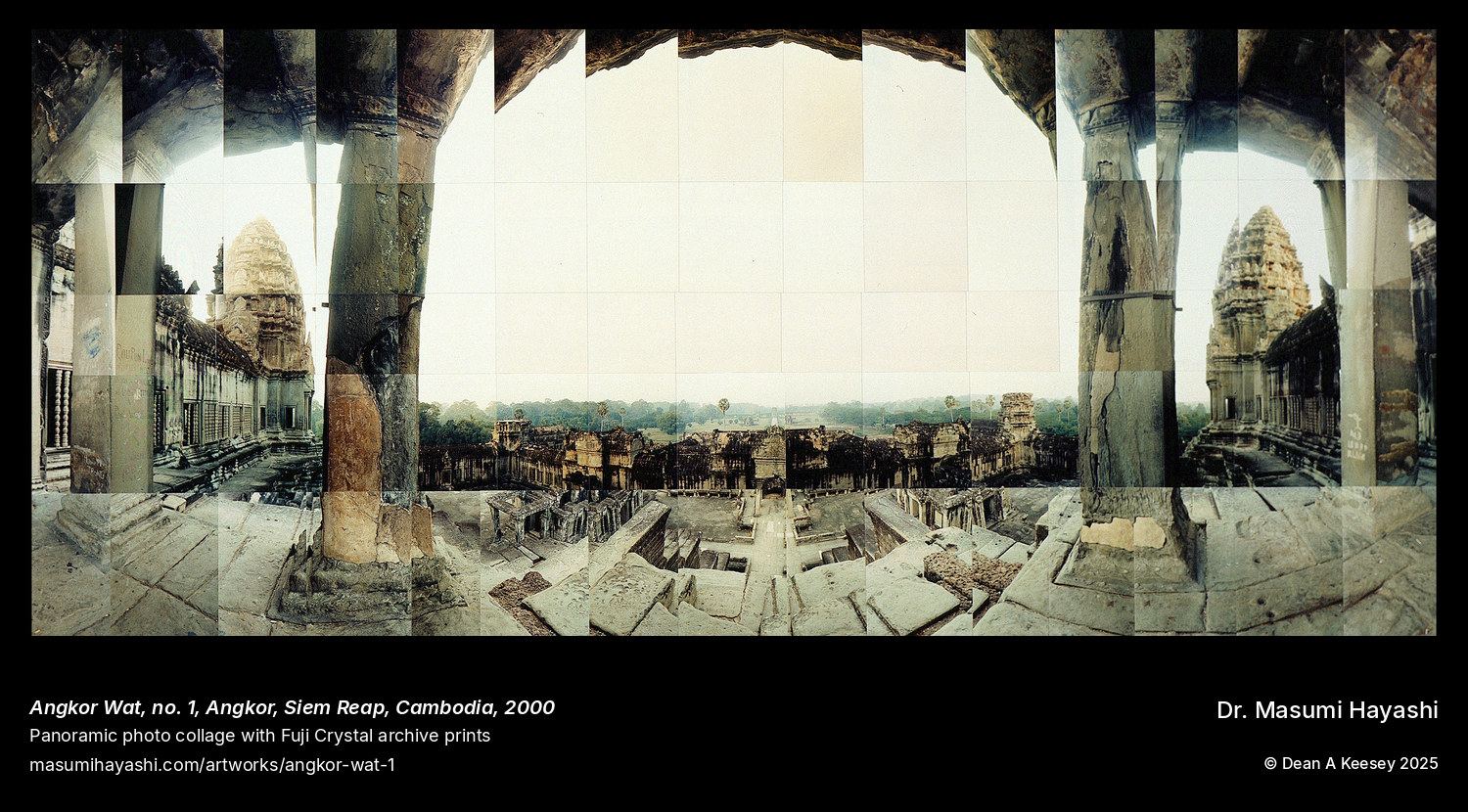
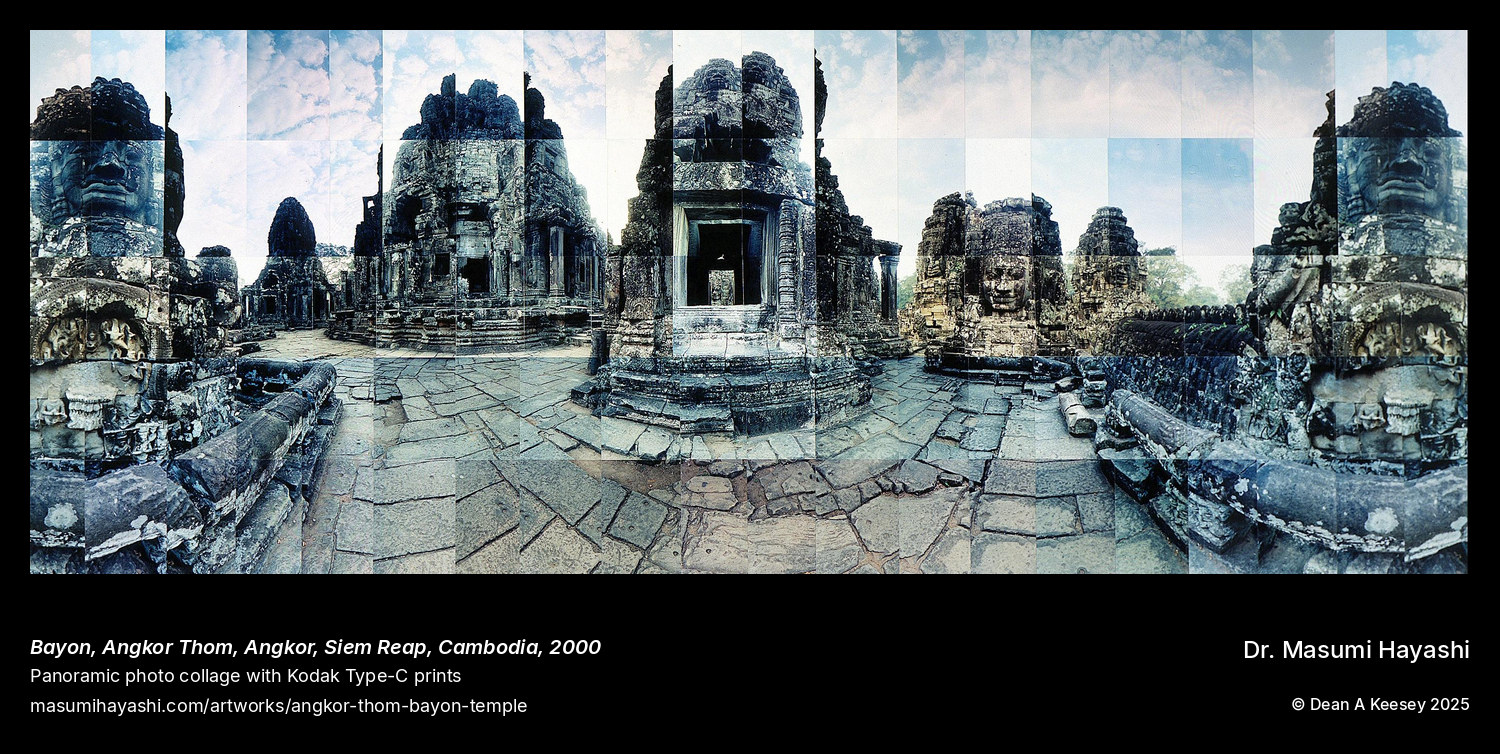
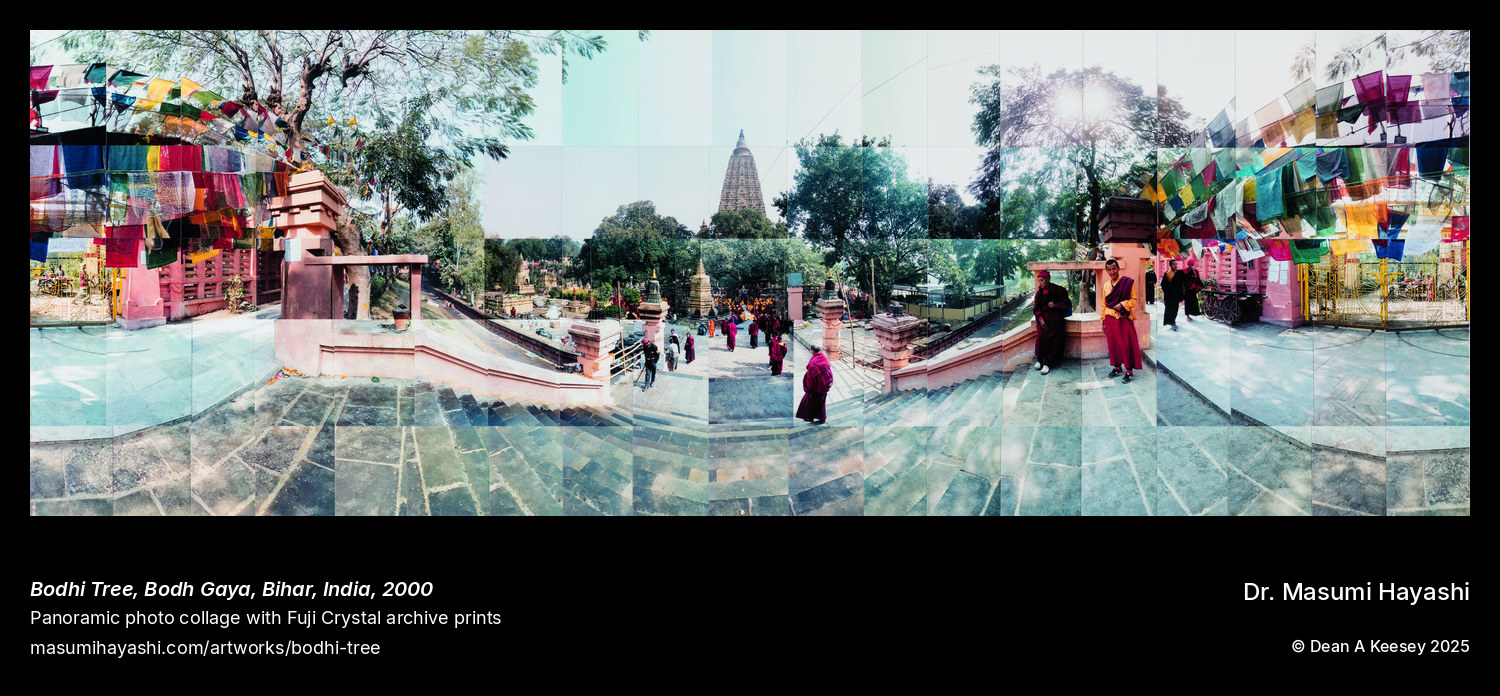
- Precedes Angkor temples (2000), Khajuraho (2000), Bodh Gaya (2000), Meenakshi (2001-2003)
- Death culture theme unusual in series predominantly focused on living worship (temples, stupas, active pilgrimage sites)
- Early experimentation: 1996 date suggests Hayashi developing Sacred Architectures parameters, testing what subjects and formats work
Japanese aesthetic sensibilities: Wabi-sabi and impermanence:
- Wabi-sabi (侘寂): Beauty in impermanence, aging, decay—core Japanese aesthetic philosophy
- Moss and weathering: Not defects but enhancements, adding patina of time
- Forest-cemetery integration: Nature not cleared but embraced, monuments emerging from/returning to forest
- Subtle muted colors: Grays (stone), greens (moss), browns (cedar bark, earth), occasional red (autumn leaves, lanterns)
- Atmospheric mystery: Fog, filtered light, shadows creating sense of otherworldliness
- Mono no aware (物の哀れ): Pathos of transience, poignant awareness that all things pass—cemeteries as meditation on mortality
17 × 53” Extreme Vertical Format
Matching companion work No. 2’s identical dimensions:
Format specifications:
- 53” height (4 feet 5 inches) - nearly human height
- 17” width (1 foot 5 inches) - VERY narrow, second-narrowest in entire series after Dry Lake Udaipur (18” width)
- 3.12:1 height-to-width ratio (extreme vertical)
- Identical to No. 2: Both Okunoin works share exact dimensions, suggesting deliberate pairing or systematic approach
What extreme narrow vertical format captures:
- Cedar trunks rising vertically: Towering cryptomeria trunks ascending toward canopy, emphasizing forest’s vertical architecture
- Stupa tiers stacked: Five-element gorinto stupas’ vertical stacking (earth → water → fire → wind → void), showing complete monument from base to pinnacle
- Path depth perspective: Long view down forest path showing vertical descent or ascent through cemetery toward distant goal (mausoleum)
- Lantern columns: Stone lanterns aligned vertically along path edges, procession receding into distance
- Vertical forest layers: Multiple levels from ground cover (moss, stones) → monument level (stupas at human height) → mid-story (lower branches) → canopy (filtered light source above)
- Atmospheric depth: Mist or fog receding vertically creating sense of infinite vertical space despite narrow horizontal frame
Format echoing cemetery spatial experience:
- Narrow path constriction: 2km pilgrimage path winds through forest, laterally constricted by dense monuments and trees—narrow format mimics walker’s limited horizontal field of view
- Vertical emphasis: Pilgrims look upward (cedar canopy, filtering light) and downward (path, graves), vertical gaze predominant
- Claustrophobic beauty: Enclosed by monuments and trees on all sides, horizontal space limited, vertical space expansive—format captures this spatial paradox
- Vertical format = upward spiritual aspiration?: Buddhist cosmology’s vertical structure (realms of existence ascending from hell to pure lands to buddhahood), cemetery’s vertical monuments pointing toward enlightenment
Edition Distribution: THREE Retained (Unusual Pattern)
Inventory status differs from No. 2:
Edition tracking:
- Edition 1: Inventory - unframed (Foundation retained)
- Editions 2-5: Packets (prepared for distribution/sale)
- Artist’s Proof 1: “un#” (notation unclear—unfinished? unnumbered?)
- Artist’s Proof 2: Inventory - unframed (Foundation retained)
Three editions retained (E1 + AP2, possibly AP1) vs. No. 2’s two editions:
- Higher retention suggests: Recognition of work’s importance as series foundational piece, or difficulty selling (early work before series reputation established), or deliberate archival strategy
- Both Artist’s Proofs in inventory unusual: Most works show AP in Packets or distributed; retaining both suggests either special circumstances or incomplete edition information
- Companion comparison: No. 2 retained 1 framed + 1 unframed (two total); No. 1 retained 1 unframed (E1) + 1 unframed (AP2) + possibly AP1 (three total if “un#” means retained)
- Why retain MORE of No. 1 than No. 2?: Possible explanations: No. 1 as “first” has historical priority, or technical/aesthetic superiority, or simpler inventory notation discrepancies rather than deliberate retention strategy difference
Photographing Sacred Death Landscape: Technical and Cultural Challenges
Okunoin cemetery photography presents unique challenges:
Lighting challenges in forest environment:
- Dense canopy filters sunlight: Forest creates perpetually dim environment, long exposures required
- Dappled light creates extreme contrast: Patches of sunlight breaking through canopy create bright spots amid shadows, challenging exposure latitude
- Moss absorbs light: Green moss covering surfaces has low reflectivity, further darkening environment
- Overcast conditions common: Mount Koya’s high elevation and humidity create frequent fog, mist, overcast skies reducing already limited light
- Long exposures consequences: Potential for motion blur (visitors walking, tree branches swaying, photographer movement), requiring tripod, slow methodical work
Compositional strategies for overwhelming density:
- Monument density problem: How to show 200,000 graves without creating visual chaos? Selective focus essential
- Vertical cedars vs. horizontal monument spread: Tension between vertical emphasis (trees, stupas) and horizontal extent (monuments spreading along path)
- Path perspective as organizing principle: Using path’s linear recession as compositional anchor, organizing monument density along either side
- Atmospheric depth: Fog, mist, filtered light creating layers of depth, farther monuments fading into atmospheric haze
- Selective focus depth of field: Sharp foreground monument, gradually softening background creating sense of infinite recession beyond what’s visible
Cultural sensitivity and respectful documentation:
- Active cemetery, not historical relic: Ongoing burials, families visiting ancestral graves, contemporary mourning practices
- Funeral processions: Occasionally encounter burial ceremonies, cremated remains being interred
- Families visiting graves: Pilgrims performing memorial rites (water offerings, incense, prayers), should not intrude on private grief
- Monks performing rituals: Daily services, food offerings to Kobo Daishi, chanting sutras—sacred activities requiring respectful distance
- Photography restrictions: Mausoleum area (beyond Gobyo Bridge) photography forbidden—must document from permitted areas only
- Respect for sacred death space: Cemetery is religious site, not tourist attraction—photographic approach must acknowledge spiritual significance
Aesthetic vs. documentary tension:
- Wabi-sabi beauty (decay, moss, patina): Could approach Okunoin purely aesthetically as sublime ruin, romantic forest scene
- Tourism attraction: Okunoin popular with photographers drawn to picturesque moss-covered monuments, atmospheric mist
- Sacred pilgrimage site: But primary function is religious—Shingon Buddhists’ holiest cemetery, living faith practice continuing 1,200 years
- Documentary challenge: How to convey spiritual significance vs. merely picturesque scenery? Presence of pilgrims/monks in frame? Compositional choices emphasizing depth, scale, reverence vs. prettiness?
Contemporary Relevance and Enduring Questions
City of the Dead No. 1 documentation raises questions:
Death culture and sacred space:
- How does Japanese Buddhist death culture differ from Western cemetery traditions (individualized graves vs. family plots, forest integration vs. lawn parks, belief in living saint proximity vs. secular memorial)?
- What is significance of believing Kobo Daishi still lives in meditation after 1,200 years? How does this belief shape burial practices and cemetery’s meaning?
- Why do 200,000+ people seek burial near saint’s mausoleum across 1,200 years? What does proximity offer (spiritual insurance, family prestige, communal belonging)?
- How does forest-cemetery integration create unique sacred landscape unavailable in cleared Western cemeteries?
Continuity and change across 1,200 years:
- 1,200-year continuous tradition: Daily food offerings to Kobo Daishi since 835 CE represents one of world’s longest continuous religious practices—what does this durability say about faith, institutional stability, cultural conservatism?
- Corporate memorials: Modern innovation (20th century companies erecting employee memorials) or continuity with historical patronage (feudal lords, merchants funding monuments)? Does commercialization threaten sacred space or demonstrate Buddhism’s adaptive capacity?
- UNESCO designation 2004: Preservation vs. tourism impact—can sacred cemetery maintain spiritual function amid international photography tourism and bus loads of visitors?
- Contemporary Japanese Buddhism: Okunoin’s thriving pilgrimage contrasts with decline of Buddhism in some urban Japanese contexts—why does Okunoin remain vital?
Artistic documentation and multi-work strategies:
- Why document death landscape within “Sacred Architectures” series focused on temples, stupas, active worship spaces?
- How do TWO works (No. 1 + No. 2) create comprehensive cemetery portrait that single work cannot achieve?
- Does extreme vertical format serve cemetery architecture (stupas, trees) or forest setting, or both?
- Can photograph (even panoramic photo collage) convey experiential reality of walking 2km through 200,000 graves?
- What is relationship between photographic documentation and pilgrimage—can photograph substitute for, supplement, or inspire actual pilgrimage?
Comparative death cultures (Japan vs. West):
- Forest cemetery vs. manicured lawn: Japanese aesthetic embracing nature’s integration vs. Western control imposing order
- Buddhist death optimism vs. Western grief: Rebirth, enlightenment, merit transfer offering hope vs. Western emphasis on loss, finality
- Communal cemetery proximity: Seeking nearness to Kobo Daishi (spiritual benefit from association) vs. Western family plots (genetic/bloodline organization)
- Integration with living worship: Pilgrimage path through cemetery to mausoleum integrates death into spiritual journey vs. Western separation of cemeteries from worship spaces
Comparative Context: Okunoin No. 1 and No. 2 Paired Documentation
Hayashi’s Okunoin pair (both 1996):
City of the Dead, No. 1 (09009, 1996, this work):
- First documentation chronologically (No. 1 designation)
- Likely different section of 2km cemetery path (outer vs. inner, or different lateral branch)
- 17 x 53” extreme vertical (identical to No. 2)
- Fuji 4x6 film (technical consistency)
- THREE editions retained in Foundation (E1 + AP2, possibly AP1)
- First work establishes documentation parameters, introduces Japanese Buddhist death culture to Sacred Architectures series
City of the Dead, No. 2 (09010, 1996):
- Second documentation (No. 2 designation, continuation/complement to No. 1)
- 17 x 53” extreme vertical (matching No. 1 exactly)
- Fuji/Kodak film (slight variation)
- TWO editions retained (1 framed + 1 unframed, strategic preservation for exhibitions)
- Emphasizes vertical forest architecture, monument tiers, path perspective according to previous expansion
Two-work cemetery documentation strategy:
- 2km path demands multiple perspectives: Cannot capture cemetery’s full extent, diversity, atmospheric range in single work
- Different monument sections: Feudal samurai memorials vs. modern corporate stupas? Outer path’s older graves vs. inner path approaching mausoleum? Lateral branches diverging from main path?
- Atmospheric variations: Different lighting conditions, seasonal differences, fog density, time of day creating varied moods
- Comprehensive cemetery portrait: Together, No. 1 + No. 2 offer fuller understanding of Okunoin’s complexity than either alone
- Establishes multi-work pattern: Precedent for later series developments (Meenakshi trilogy 2001-2003 = interior/exterior/detail; Airavatesvara pair 2004 = vertical/horizontal; Jaisalmer pair 2000 = Jain temple/Hindu square; Okunoin pair 1996 = cemetery multi-perspective)
Educational Significance
This work teaches about:
- Okunoin cemetery: Japan’s largest cemetery, 200,000+ graves, 2km pilgrimage path through cryptomeria cedar forest
- Kobo Daishi (Kukai): Shingon Buddhism founder (774-835 CE), eternal meditation belief, daily food offerings continuing 1,200+ years
- Mount Koya (Koyasan): Shingon headquarters (816 CE), 117 temples, UNESCO World Heritage Site 2004
- Forest cemetery aesthetics: Cryptomeria cedars, moss-covered monuments, wabi-sabi philosophy (beauty in impermanence)
- Burial motivations: Proximity to Kobo Daishi ensures rebirth in Pure Land, posthumous ordination belief when Maitreya Buddha arrives
- Monument social diversity: Feudal lords, samurai, monks, merchants, modern corporations, war memorials spanning 1,200 years
- Extreme vertical format: 17x53” (second-narrowest at 17” width), emphasizing forest height, stupa tiers, path depth
- Two-work documentation: No. 1 + No. 2 comprehensive cemetery portrait (both 1996), multi-perspective strategy
- Japanese Buddhist death culture: Living saint belief (Kobo Daishi meditating 1,200 years), corporate memorials demonstrating adaptive tradition, forest integration creating unique sacred landscape
- 1996 early work: Among earliest Sacred Architectures, establishes Japanese Buddhist focus years before India/Cambodia turn-of-millennium journey (2000-2004)
Note: This canonical content was extracted from the Masumi Hayashi Foundation Master Catalogue (2007 inventory). THREE editions in artist’s estate: Edition 1 (unframed) + Artist’s Proof 2 (unframed), possibly Artist’s Proof 1 (“un#”); Editions 2-5 in Packets. Created in 1996 as FIRST of two Okunoin cemetery works (companion: City of the Dead No. 2, 09010), documenting Japan’s largest and holiest cemetery on Mount Koya where 200,000+ graves surround Kobo Daishi’s mausoleum. Shingon Buddhism founder Kukai (774-835 CE) believed to remain in eternal meditation requiring daily food offerings 1,200+ years. Cemetery’s 2km pilgrimage path through ancient cryptomeria cedar forest contains monuments spanning 1,200 years: feudal lords (Tokugawa, Date Masamune), samurai warriors, monks, modern corporations (Panasonic, Nissan, UCC Coffee, insect memorial). 17x53” extreme vertical (identical to No. 2, second-narrowest work at 17” width, 3.12:1 ratio) captures vertical forest architecture: towering cedars, multi-tiered stupas, path perspective, lantern columns. Two-work strategy (No. 1 + No. 2) provides comprehensive documentation of complex sacred death landscape requiring multiple perspectives along 2km path from Ichinohashi Bridge to Torodo Lantern Hall to Kobo Daishi mausoleum. Among earliest Sacred Architectures works (1996), establishing Japanese Buddhist theme and multi-work documentation pattern years before major India/Cambodia journey (2000-2004). Wabi-sabi aesthetic: moss-covered stones, weathered monuments, forest integration create otherworldly atmosphere where centuries layer atop each other beneath filtered canopy light. UNESCO World Heritage Site 2004 recognition of Mount Koya’s sacred mountain significance in Japanese religious landscape.