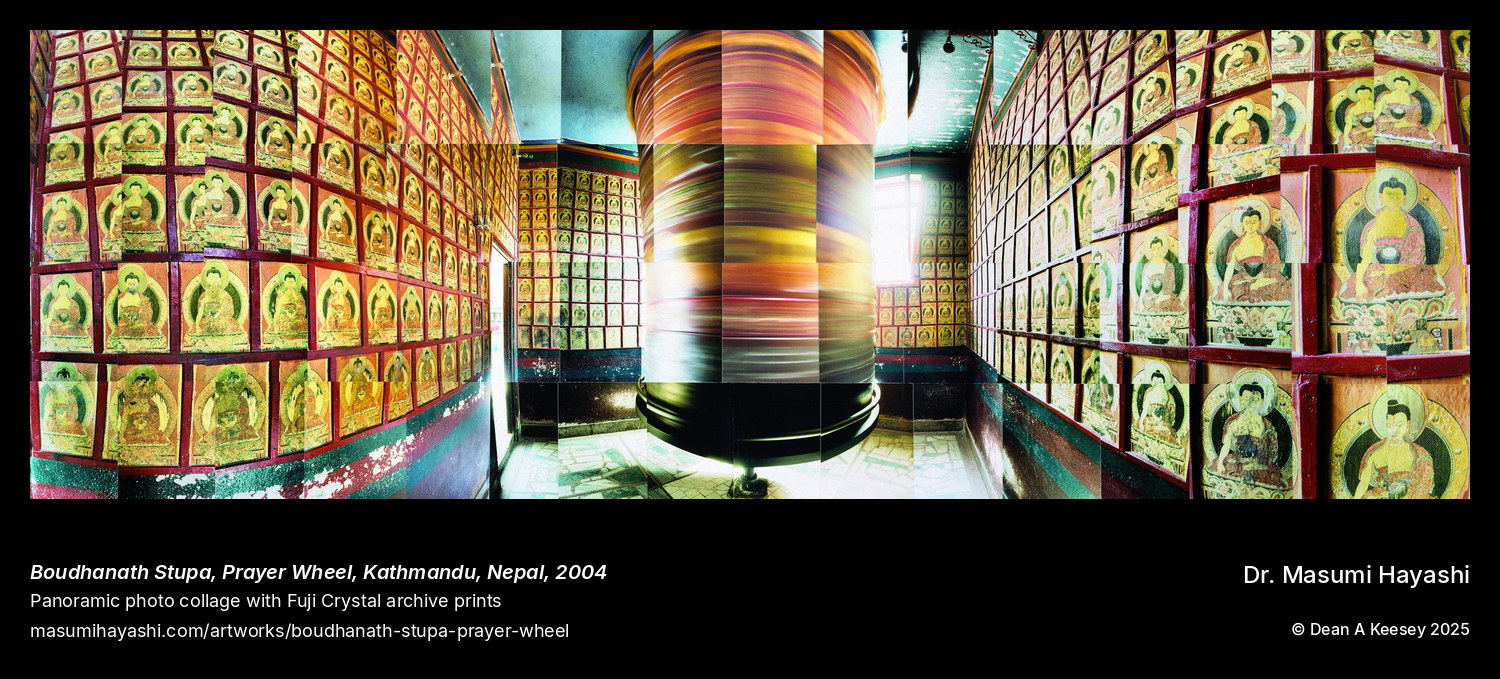
Boudhanath Stupa, Prayer Wheel, Kathmandu, Nepal
Kathmandu, Nepal
Panoramic Photo Collage
2004
56" x 19"
Boudhanath Stupa, Prayer Wheel, Kathmandu, Nepal
Overview
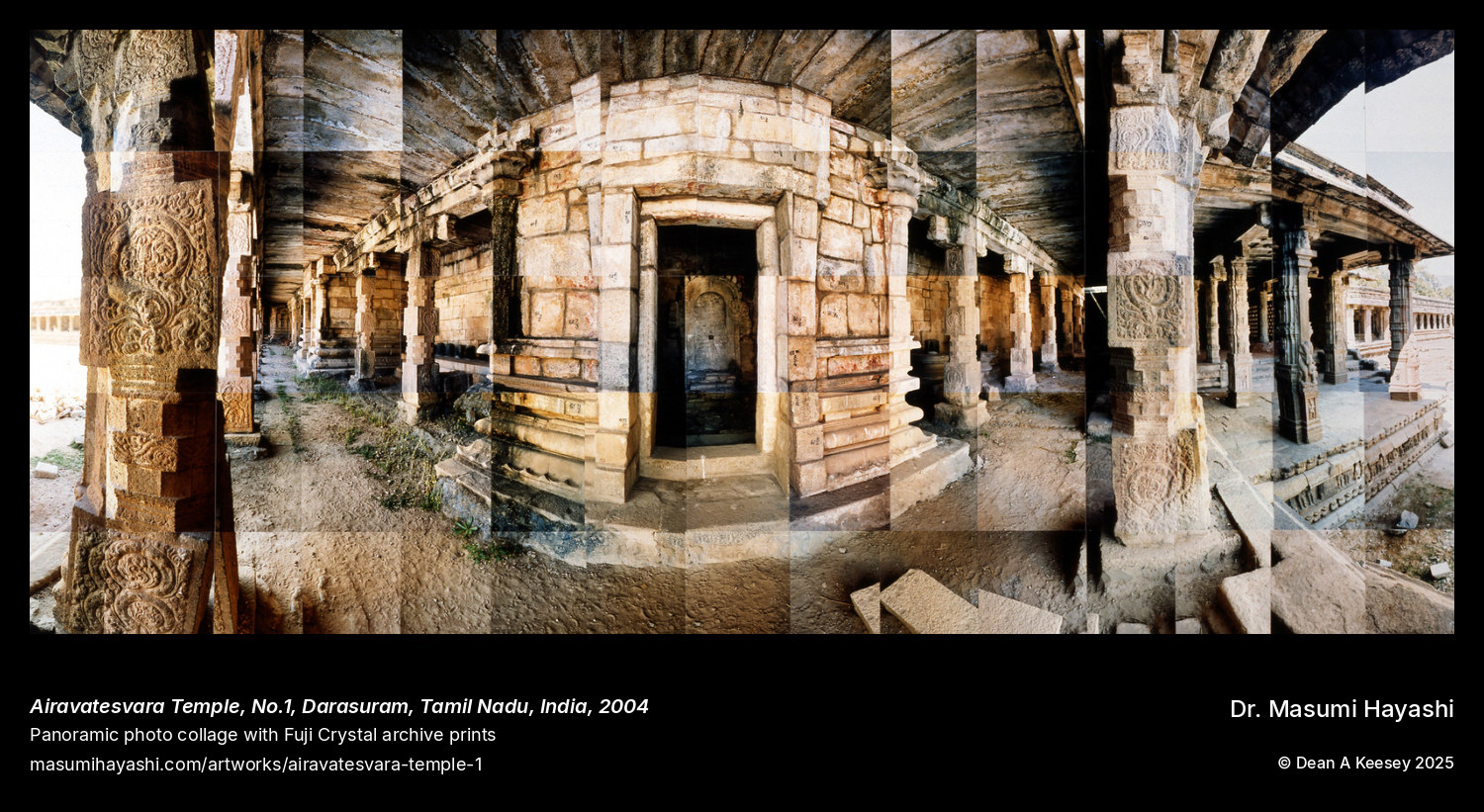
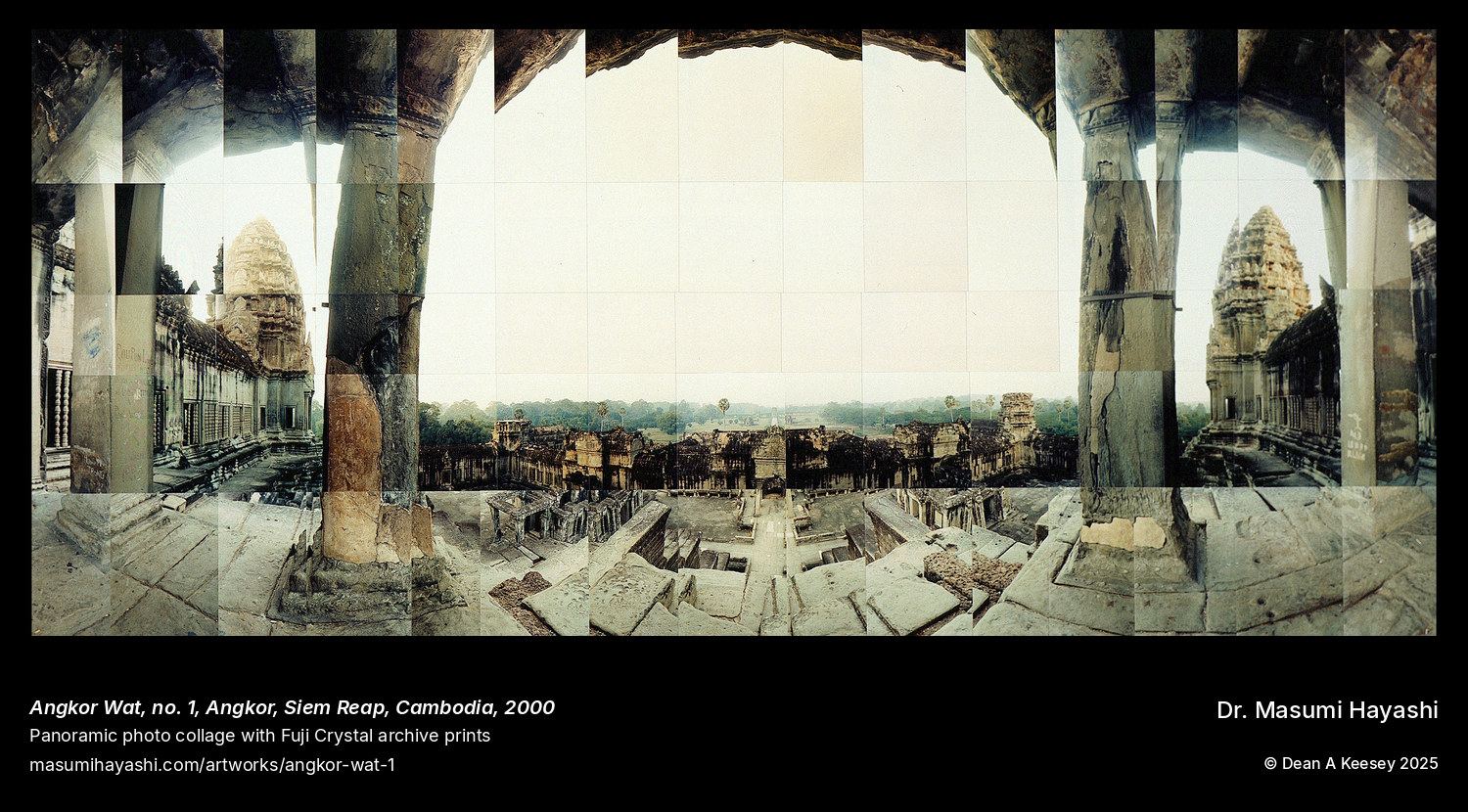
“Boudhanath Stupa, Prayer Wheel” documents one of the world’s largest Buddhist stupas and most significant Tibetan Buddhist pilgrimage sites outside Tibet. Created in 2004 during the same intensive photographic campaign producing Hayashi’s Tamil Nadu temple documentation (Airavatesvara, Rameswaram, Dry Lake Udaipur, Norbulingka Dharamsala), this 56-by-19-inch horizontal panorama captures the devotional practice surrounding Nepal’s UNESCO World Heritage stupa—specifically the prayer wheels circumscribing the monument’s base, which pilgrims spin clockwise while circumambulating the structure, each rotation believed to generate merit equivalent to reciting the mantras contained within the wheels.
The Boudhanath Stupa, located in Kathmandu Valley approximately 11 kilometers from the city center, stands as one of the largest spherical stupas in the world and the primary center of Tibetan Buddhism in Nepal. Following the 1959 Tibetan exodus after Chinese occupation, Boudhanath became focal point for Tibetan refugee communities establishing monasteries, businesses, and cultural institutions around the ancient stupa. This modern Tibetan presence transformed Boudhanath from primarily Newar Buddhist site into vibrant international Tibetan Buddhist center, the stupa’s massive mandala structure and all-seeing Buddha eyes now surrounded by dozens of Tibetan monasteries, shops selling religious artifacts, and continuous streams of pilgrims performing kora (circumambulation).
The work’s institutional trajectory proved exceptional: Edition 1 donated to the Cleveland Museum of Art in 2014, the same year as “The Saint in the Market Place, Meenakshi Temple”—two major South Asian sacred architecture works placed simultaneously in Hayashi’s home city museum. This dual donation created significant South Asian religious architecture presence in Cleveland Museum’s collection while honoring Hayashi’s regional legacy. The remaining four editions exist only as packets (unprinted), making the Cleveland Museum’s framed edition the sole printed impression—an unusual distribution pattern suggesting the work was created specifically for museum placement or printed only when the Cleveland donation materialized.
The horizontal format’s extreme width (56 inches, among the widest in the Sacred Architectures series) allows comprehensive documentation of the prayer wheel circumambulation path, potentially capturing the devotional practice’s spatial sequence and the relationship between individual pilgrims, spinning prayer wheels, and the stupa’s massive white dome rising above. This documentary emphasis on devotional practice rather than architectural monumentality alone distinguishes the work from purely architectural studies, acknowledging the stupa’s function as living pilgrimage center generating continuous ritual activity.
Historical and Cultural Context
Boudhanath Stupa: Architectural Mandala
The Boudhanath Stupa exemplifies Buddhist stupa architecture at monumental scale—a hemispherical structure approximately 36 meters in height containing Buddhist relics and functioning as three-dimensional mandala (sacred geometric diagram). Traditional accounts date the stupa’s origins to the 5th or 6th century CE, though archaeological evidence and architectural analysis suggest the current structure largely dates from the 14th century with subsequent renovations, particularly after the 2015 Nepal earthquake which damaged portions of the structure subsequently restored.
The stupa’s architectural organization follows classic Buddhist stupa form while achieving exceptional scale: a massive whitewashed dome (harmika) rests on a square base with four pairs of Buddha eyes painted on each side, gazing in cardinal directions; a gilded tower (spire) rises from the dome’s apex supporting a parasol pinnacle. The eyes—witnessing all actions and representing Buddha’s omniscience—have become the stupa’s most iconic feature, reproduced on countless images and establishing Boudhanath’s visual identity within global Buddhist iconography.
The architectural mandala’s symbolic meanings layer multiple levels: the base represents earth, the dome water, the spire fire, the parasol air, and the pinnacle ether—the five elements of Buddhist cosmology. The thirteen tiers on the spire represent the stages toward enlightenment. The stupa’s whitewashed surface symbolizes purity while periodic repainting (traditionally coinciding with important religious dates) involves community participation, the physical labor of renewal itself considered meritorious action.
UNESCO’s 1979 World Heritage inscription recognizes Boudhanath as “one of the most imposing symbols of Buddhism in Nepal and is one of the most sacred Buddhist pilgrimage sites in the world.” The designation acknowledges both architectural significance and ongoing religious function—the “living heritage” concept UNESCO increasingly emphasized in recognition that cultural monuments’ value derives partly from continuous use within living traditions rather than preservation as static historical artifacts.
Tibetan Buddhist Presence and the 1959 Exodus
The 1959 Tibetan exodus following Chinese military occupation of Tibet transformed Boudhanath from primarily Newar Buddhist pilgrimage site into the world’s most significant Tibetan Buddhist center outside Tibet itself. Thousands of Tibetan refugees settled in Boudhanath area, establishing monasteries representing major Tibetan Buddhist lineages (Nyingma, Kagyu, Sakya, Gelug), creating thriving exile community infrastructure, and making the stupa central to Tibetan Buddhist life in diaspora.
This Tibetan presence manifests architecturally in dozens of monasteries, gompas (meditation halls), and retreat centers surrounding the stupa—each institution representing specific lineages, teachers, or monastic traditions transplanted from Tibet to Nepal. The area also developed vibrant commercial infrastructure: shops selling Tibetan religious artifacts (prayer wheels, thankas, statues, ritual implements), restaurants serving Tibetan cuisine, guesthouses accommodating pilgrims, and cultural centers preserving Tibetan language, arts, and traditions.
By 2004, when Hayashi documented the site, Boudhanath functioned as international Tibetan Buddhist headquarters, attracting both traditional Tibetan pilgrims and Western Buddhist practitioners studying with Tibetan teachers in the numerous monasteries and retreat centers. This religious diversity—traditional Newar Buddhist communities, Tibetan refugee populations, international Buddhist practitioners—created complex social and religious landscape around the ancient stupa, all communities participating in circumambulation practices while bringing different cultural and devotional approaches to shared sacred geography.
Prayer Wheels: Devotional Technology
The work’s title—“Boudhanath Stupa, Prayer Wheel”—emphasizes the prayer wheels surrounding the stupa’s base, distinctive features of Tibetan Buddhist devotional practice. These cylindrical wheels, typically 2-3 feet tall and mounted on spindles allowing rotation, contain tightly wound scrolls inscribed with mantras (most commonly “Om Mani Padme Hum,” the mantra of Avalokiteshvara, bodhisattva of compassion). Buddhist tradition holds that spinning prayer wheels generates merit equivalent to vocally reciting all contained mantras—technological amplification of devotional practice allowing practitioners to “recite” thousands of mantra repetitions through physical rotation.
The prayer wheel circumambulation path at Boudhanath creates distinctive devotional choreography: pilgrims walk clockwise around the stupa’s base (traditional Buddhist circumambulation direction), spinning each successive prayer wheel with right hand while mentally reciting mantras, counting recitations on mala beads, and maintaining meditative focus. This coordination of physical movement, manual action (spinning wheels), verbal recitation, and mental concentration represents ideal Tibetan Buddhist practice integrating body, speech, and mind in unified devotional activity.
The prayer wheels also function as visual rhythm along the circumambulation path, their regular spacing creating architectural cadence and their spinning motion generating kinetic energy within otherwise static architectural environment. The wheels’ metallic surfaces catch sunlight, their constant rotation by successive pilgrims creating shimmer and movement, while the wheels’ mechanical sound—the distinctive clacking, whirring, creaking of metal on metal—provides sonic texture to devotional experience.
Format and Technical Analysis
Extreme Horizontal Panorama
The 56-by-19-inch dimensions create a 2.95:1 aspect ratio, an extremely wide horizontal panorama among the widest in the Sacred Architectures series. This extreme width suits documentation of circumambulation practice—the lateral movement of pilgrims around the stupa, the sequential spinning of prayer wheels extending along the circumambulation path, and the horizontal relationship between individual devotional actors and monumental stupa structure.
The format’s 56-inch width allows extensive lateral coverage, potentially encompassing substantial portions of the circumambulation path, multiple pilgrims engaged in devotional practice, and the sequential rhythm of prayer wheels spaced along the stupa’s base. The relatively compressed 19-inch height maintains focus on ground-level activity—pilgrims, prayer wheels, immediate architectural context—while de-emphasizing the stupa’s soaring vertical dome and spire that would require taller format to document comprehensively.
This horizontal emphasis on devotional practice and human activity contrasts with purely architectural documentation that might employ vertical formats to capture stupa height and proportions. The format choice suggests Hayashi prioritized documenting living Buddhist practice—the continuous circumambulation, prayer wheel spinning, and communal devotional activity—over static architectural monumentality. This documentary emphasis on practice rather than structure alone acknowledges the stupa’s function as generator of devotional activity rather than merely aesthetic object.
Documentary Photography of Devotional Practice
Documenting active religious practice presents challenges distinct from architectural photography of empty sacred spaces. Prayer wheel circumambulation at Boudhanath generates continuous human movement, changing light conditions as sun moves across sky, and unpredictable interactions between pilgrims, tourists, resident monks, and vendors. Capturing coherent panoramic documentation within this dynamic environment requires photographic strategies accommodating movement, managing varied lighting, and representing temporal activity through spatial form.
The panoramic photo collage technique’s assembly of multiple photographs into unified views potentially represents the circumambulation practice’s sequential nature through spatial distribution across the panoramic width. Where single-frame photography would freeze one moment of devotional activity, the assembled panorama might suggest temporal progression—successive moments of prayer wheel spinning, different pilgrims at different circumambulation stages, the cumulative effect of many individual devotional acts within shared sacred geography.
The Fuji 4×6 film specification (matching other 2004 works: Airavatesvara, Rameswaram, Dry Lake, Norbulingka) ensures technical consistency across that year’s prolific temple documentation campaign spanning Tamil Nadu, Himachal Pradesh, Rajasthan, and now Nepal. The film’s characteristic warm color palette would capture the stupa’s whitewashed dome, colorful prayer flags, metallic prayer wheels, and maroon robes of Tibetan monks and nuns, the warm saturation emphasizing visual richness of active pilgrimage site.
”Prayer Wheel” Singular: Focused Documentation?
The title’s use of “Prayer Wheel” (singular) rather than “Prayer Wheels” (plural) creates interpretive ambiguity. Does the work focus on one particular prayer wheel among the hundreds circumscribing the stupa? Does the singular reference the prayer wheel concept generally while documenting many individual wheels? Or does the title’s specificity suggest close documentation of prayer wheel mechanics, iconography, and devotional use?
This titular specificity might indicate the work emphasizes detailed documentation of prayer wheel construction, decoration, and spinning mechanism rather than comprehensive circumambulation path coverage. If so, the extreme horizontal format would allow lateral scanning across prayer wheel surface details, surrounding architectural context, and relationship between wheel and pilgrims spinning it, the width accommodating both detail and spatial context within unified panoramic view.
Series Context and Comparative Analysis
2004 Photographic Campaign: Expanded Geographic Range
“Boudhanath Stupa, Prayer Wheel” extends the 2004 photographic campaign’s geographic range from Tamil Nadu and Himachal Pradesh (both Indian states) to include Nepal—the first and only Nepalese work in the Sacred Architectures series. This geographic expansion demonstrates Hayashi’s systematic documentation of Himalayan and South Asian Buddhist traditions: Japanese Buddhism (multiple works), Tibetan exile institutions in India (Dharamsala works), and now Tibetan Buddhism in Nepal.
The 2004 works collectively establish remarkable productivity and geographic range:
- Tamil Nadu: Airavatesvara Temple #1 and #2 (Chola architecture), Rameswaram Temple #1 (pilgrimage complex)
- Rajasthan: Dry Lake, Nehru Park, Udaipur (environmental documentation)
- Himachal Pradesh: Norbulingka Temple, Dharamsala (Tibetan cultural preservation)
- Nepal: Boudhanath Stupa (this work, Tibetan Buddhist pilgrimage)
This single-year documentation spanning four regions and multiple religious traditions (Hindu Chola and Nayak temples, Jain architecture implied through Rajasthan sites, Tibetan Buddhist institutions) positions 2004 as perhaps Hayashi’s most ambitious and geographically diverse temple documentation year.
Tibetan Buddhist Documentation Across the Series
Boudhanath represents the third major Tibetan Buddhist site in the Sacred Architectures series, following the 2004 Dharamsala works (Norbulingka and Tsuglagkhang). Together, these three works document Tibetan Buddhism in diaspora—the religious and cultural traditions displaced from Tibet by Chinese occupation, reconstituted in Indian and Nepalese exile communities, and maintained through institutional structures preserving Tibetan language, arts, monastic education, and religious practice.
The comparative analysis reveals different aspects of Tibetan Buddhism in exile:
- Norbulingka, Dharamsala: Cultural preservation through traditional arts education
- Tsuglagkhang, Dharamsala: Political/religious authority (Dalai Lama’s seat)
- Boudhanath, Nepal: Pilgrimage center and largest Tibetan refugee community outside India
This trilogy of Tibetan exile documentation captures the multifaceted nature of displaced religious tradition—political leadership, cultural preservation, and mass pilgrimage all necessary components of maintaining Tibetan Buddhism outside Tibet. The works collectively acknowledge the complex relationship between religion, politics, culture, and exile shaping contemporary Tibetan Buddhist life.
Cleveland Museum of Art Donation Context
The 2014 Cleveland Museum donation paired “Boudhanath Stupa, Prayer Wheel” with “The Saint in the Market Place, Meenakshi Temple”—two works documenting radically different South Asian sacred traditions (Tibetan Buddhism and Tamil Hindu goddess worship) creating balanced representation of regional religious diversity. This dual donation’s curation demonstrates thoughtful institutional placement strategy: providing Cleveland audiences access to major Asian religious architecture traditions while honoring Hayashi’s home city legacy.
The timing—2014, eight years after Hayashi’s 2006 death—represents Foundation’s strategic museum placement efforts rather than artist-initiated donations. The selection of these particular works (Tibetan Buddhist Nepal and Tamil Hindu India) over other available Sacred Architectures pieces suggests intentional diversity in representing Asian sacred architecture and religious practice rather than concentrated focus on single tradition or region.
Edition Status and Institutional Context
Exceptional Edition Distribution
The edition tracking reveals extraordinary pattern: Edition 1 printed and donated to Cleveland Museum, while Editions 2-5 exist only as packets (unprinted):
Editions 2-5: All packets (unprinted)
This single-edition printing represents the most extreme distribution pattern in the entire Sacred Architectures series. Possible explanations include:
- Targeted museum printing: Work created specifically for Cleveland Museum donation, printed only when placement confirmed
- Limited edition strategy: Intentional scarcity enhancing the Cleveland Museum’s acquisition uniqueness
- Printing economics: Foundation choosing to print only as institutional interest materializes rather than speculative printing
- Strategic reserve: Maintaining unprinted editions for future high-value placements if institutional demand emerges
The packets notation for four editions provides future flexibility—if major museums, Buddhist studies programs, or Tibetan cultural institutions express acquisition interest, editions could be printed to museum specifications. This approach minimizes upfront printing costs while preserving placement options.
Institutional Appeal
The work’s distinctive subject and Cleveland Museum placement position it as model for potential additional institutional acquisitions:
- Buddhist studies programs: Academic institutions teaching Tibetan Buddhism, stupa architecture, pilgrimage practices
- Museums with Tibetan collections: Institutions holding Tibetan art, thankas, ritual objects complemented by architectural documentation
- Comparative religion collections: Academic libraries teaching prayer wheel technology, circumambulation practices, devotional choreography
- Nepal-focused institutions: Organizations documenting Nepalese cultural heritage, Kathmandu Valley architecture, religious pluralism
- Pilgrimage studies: Collections exploring global pilgrimage traditions, sacred geography, religious travel
The Cleveland Museum donation establishes precedent for comparable regional museum placements while the extreme horizontal format’s documentary emphasis on devotional practice rather than pure architectural form creates distinctive educational value—teaching about living Buddhist practice, not merely historical monuments.
Cultural Significance and Artistic Achievement
“Boudhanath Stupa, Prayer Wheel” represents Masumi Hayashi’s photographic engagement with Tibetan Buddhist devotional practice at one of the tradition’s most sacred sites outside Tibet. The work documents not merely monumental architecture but the continuous devotional activity such architecture generates—the prayer wheel circumambulation creating rhythmic choreography of movement, manual action, verbal recitation, and mental concentration that defines Tibetan Buddhist practice. This emphasis on practice rather than static form acknowledges sacred architecture’s function: not aesthetic object but generator of devotional experience.
The extreme horizontal format—spanning 56 inches to encompass extensive circumambulation path—demonstrates sophisticated documentary strategy for representing temporal practice through spatial form. Where vertical formats suit documenting architectural height, this horizontal panorama captures the lateral sequential nature of circumambulation, the relationship between individual pilgrims and monumental stupa structure, and the visual rhythm of prayer wheels punctuating the devotional path.
As documentation of Tibetan Buddhism in Nepalese diaspora, the work contributes to the Sacred Architectures series’ exploration of how displaced religious traditions reconstitute themselves in exile. Boudhanath’s transformation from Newar Buddhist pilgrimage site to international Tibetan Buddhist center following the 1959 exodus demonstrates religious architecture’s capacity to absorb new meanings and communities while maintaining essential sacred functions—the ancient stupa serving contemporary exile community’s spiritual needs while hosting international Buddhist practitioners from diverse cultural backgrounds.
The 2014 Cleveland Museum donation, paired with the Meenakshi Temple work, brought major South Asian sacred architecture documentation to Midwestern audiences while honoring Hayashi’s Cleveland legacy. The donation’s exceptional character—printing only one edition for museum placement rather than speculative full edition production—suggests targeted institutional strategy, the work created or printed specifically for meaningful museum placement rather than commercial distribution. This approach prioritizes institutional education and public access over market considerations, aligning with Hayashi Foundation’s mission of placing significant work in museums and educational contexts.
Collection Information
Year: 2004 Location: Kathmandu, Nepal Medium: Panoramic Photo Collage Dimensions: 56 × 19 inches Film Format: 4 × 6 Film Stock: Fuji Edition: 1 of 5
- Cleveland Museum of Art (donated 2014, framed)
- Packets (unprinted)
Note: Exceptional edition distribution—only Edition 1 printed and donated to Cleveland Museum of Art in 2014 (same year as Meenakshi Temple donation). Remaining four editions exist as packets, unprinted but available for future institutional placements if significant acquisition interest emerges. This single-edition printing represents unique pattern within Sacred Architectures series, possibly indicating work created specifically for targeted museum donation rather than general edition distribution.