Bodhi Tree, Bodh Gaya, Bihar, India
Bodh Gaya, Bihar, India
Panoramic Photo Collage
2000
24 x 69
Bodhi Tree, Bodh Gaya, Bihar, India
Overview
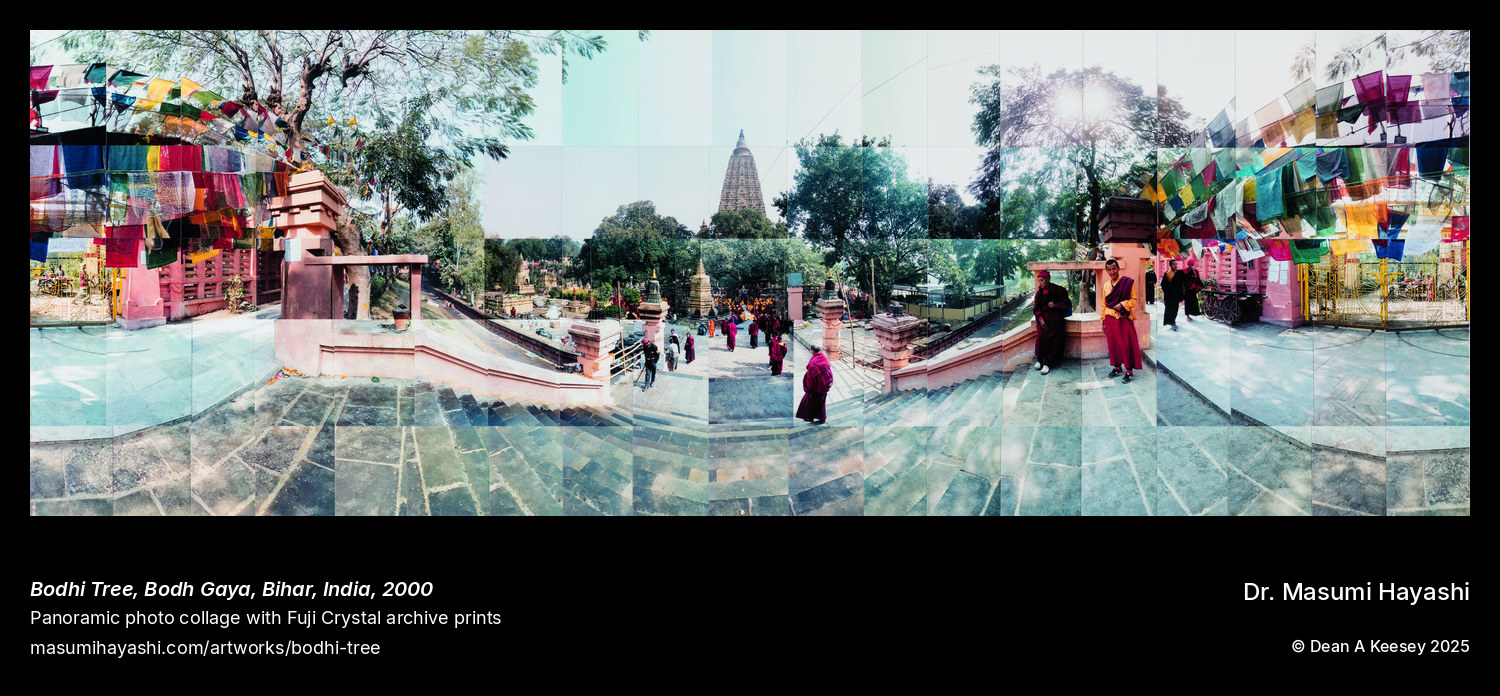
Created in 2000, this 24 x 69-inch panoramic photo collage documents the Bodhi Tree at Bodh Gaya—Buddhism’s most sacred pilgrimage site where Siddhartha Gautama achieved enlightenment under original Bodhi Tree’s descendant circa 528 BCE, establishing foundational moment in Buddhist tradition where prince’s realization of Four Noble Truths and Noble Eightfold Path transformed him into Buddha (“the awakened one”) creating religious movement eventually encompassing East, Southeast, and Central Asia across 2,500+ years. The current Bodhi Tree descends from original tree through multiple generations—Ashoka’s 3rd century BCE daughter transplanting sapling to Sri Lanka, returning cutting replanted at Bodh Gaya after original’s destruction, subsequent cultivations maintaining genetic lineage to enlightenment site despite centuries of Islamic invasions, neglect, and 19th century British archaeological recovery efforts restoring Mahabodhi Temple complex to functioning pilgrimage destination. The 24 x 69-inch format represents Sacred Architectures series’ most extreme vertical panorama—69-inch height approaches 6 feet (5.75 feet exactly), creating 2.875:1 aspect ratio (nearly 3:1 vertical) capturing Bodhi Tree’s towering vertical presence from ground-level roots through massive trunk to spreading canopy overhead, format emphasizing sacred tree’s monumentality and vertical growth symbolizing spiritual ascent from earthly ignorance toward enlightened transcendence. The 2000 date establishes earliest confirmed Sacred Architectures work, predating Ellora Cave 21 (2002), Madonna and Child (2003), and Nepal concentration (2004), indicating series origins at turn of millennium with Buddhist pilgrimage site documentation before expanding to Hindu temple architecture, rock-cut caves, and Kathmandu Valley monuments. Technical specifications matching Banteay Srei (also 2000, Fuji 4 x 6 film) suggest deliberate 2000 photographic journey documenting Asian sacred sites with larger-format Fuji film chosen for specific color rendering, enhanced resolution, or equipment availability during international travel. Remarkably, work achieved significant cultural recognition through placement in Apple TV+ film Swan Song (2021) directed by Academy Award-winning writer-director Benjamin Cleary and starring Mahershala Ali—production designer specifically requested Hayashi’s Bodhi Tree for set decoration, though only bottom six inches appeared in trailer poster frame, nonetheless representing prestigious posthumous placement demonstrating work’s continued cultural relevance and institutional recognition beyond traditional fine art collection contexts.
Historical and Religious Context: Bodh Gaya Pilgrimage Site
Bodh Gaya represents Buddhism’s foundational geographic and spiritual center:
Buddha’s Enlightenment Narrative (circa 528 BCE): Prince Siddhartha Gautama’s transformative moment:
- Prior Context: 35-year-old prince abandoned royal life seeking solution to human suffering, spending six years practicing extreme asceticism failing to achieve spiritual breakthrough
- Bodh Gaya Arrival: Traveling to Bodh Gaya village (modern Bihar state, northeastern India), sitting beneath large pipal tree (Ficus religiosa, now called Bodhi Tree meaning “enlightenment tree”)
- Enlightenment Achievement: After extended meditation, achieving profound realization of Four Noble Truths (existence of suffering, suffering’s origin in craving, suffering’s cessation through craving elimination, Noble Eightfold Path leading to cessation) and dependent origination
- Buddha Identity: Transformation from Prince Siddhartha to Buddha (“awakened one”), becoming founder of Buddhist religious and philosophical tradition
- Teaching Mission: Subsequently traveling India teaching dharma (Buddhist doctrine) for 45 years until death age 80
Bodhi Tree Through History:
Original Tree (6th century BCE): Large pipal tree under which Buddha sat achieving enlightenment—became immediate pilgrimage destination for early Buddhist community visiting site of Buddha’s transformation
Ashoka Period (3rd century BCE): Emperor Ashoka (268-232 BCE), Buddhist convert ruling Mauryan Empire:
- Visited Bodh Gaya establishing commemorative structures
- Daughter Sanghamitta took sapling to Sri Lanka establishing Jaya Sri Maha Bodhi tree (still living, world’s oldest documented tree with known planting date)
- Original tree at Bodh Gaya subsequently died or destroyed
Medieval Period Threats:
- 7th century: Tree damaged during King Shashanka’s persecution of Buddhists
- 12th-13th centuries: Islamic invasions destroying Buddhist monasteries, universities (Nalanda), pilgrimage sites—Bodh Gaya abandoned, tree neglected
- Centuries of Decline: Site falling into ruin as Buddhism declined in India while flourishing elsewhere in Asia
19th Century Recovery: British colonial archaeological efforts:
- 1862: Alexander Cunningham identifying ruined Mahabodhi Temple’s Buddhist significance through archaeological excavation
- Late 19th century: Temple restoration, site clearing, renewed pilgrimage activity
- Bodhi Tree descendant from Sri Lankan lineage replanted at enlightenment site
Current Tree: Present Bodhi Tree at Bodh Gaya:
- Direct descendant of original tree through Sri Lankan lineage
- Mature pipal tree (Ficus religiosa) with massive spreading canopy
- Central position immediately behind Mahabodhi Temple’s western wall
- Surrounded by stone platform (vajrasana—“diamond throne”) marking exact enlightenment spot
- Protected within temple complex attracting millions of pilgrims annually
Mahabodhi Temple Complex (UNESCO World Heritage Site, 2002): Major Buddhist pilgrimage destination:
- Central temple tower (170 feet height) marking enlightenment site
- Constructed 5th-6th centuries CE during Gupta period
- Four smaller corner towers, stone railings with Buddhist symbols
- Multiple meditation platforms, prayer areas, monks’ residential quarters
- International Buddhist monasteries from Tibet, Thailand, Japan, Bhutan representing diverse Buddhist traditions
Contemporary Pilgrimage: Bodh Gaya attracts Buddhist pilgrims worldwide:
- Tibetan Buddhists performing prostrations, circumambulations
- Southeast Asian Theravada practitioners sitting extended meditations
- East Asian Mahayana pilgrims conducting group ceremonies
- Western Buddhist converts studying dharma at international centers
- Annual Kalachakra teachings when Dalai Lama visits drawing 100,000+ attendees
Most Extreme Vertical Panorama: 24 x 69 Inches
At 24 x 69 inches, Bodhi Tree employs Sacred Architectures series’ most extreme vertical format:
Format Analysis:
- Width: 24 inches (2 feet) creates narrow horizontal field
- Height: 69 inches (5.75 feet, nearly 6 feet tall) establishes dramatic vertical emphasis
- Aspect Ratio: 2.875:1 (height to width)—approaching 3:1 vertical panorama, most extreme vertical in series
Comparison with Other Vertical Panoramas:
- Bodhi Tree: 24 x 69” (2.875:1 vertical)—MOST EXTREME
- Hanuman Ghat (Bhaktapur): 24 x 45” (1.88:1 vertical)—ghat descent
- Mantapa with Devotees (Hampi): 22 x 37” (1.68:1 vertical)—pillared hall
- Madonna and Child (Meenakshi): 17 x 27” (1.59:1 vertical)—gopuram/sculpture
Bodhi Tree significantly exceeds all other vertical formats—69-inch height 50% taller than Hanuman Ghat’s 45 inches, creating nearly 6-foot vertical presence demanding specialized exhibition spaces.
Format Rationale: Sacred Tree Documentation:
Vertical Growth Emphasis: Trees create inherent vertical compositions:
- Ground-level root system → massive trunk → spreading canopy overhead
- Vertical growth axis symbolizing spiritual ascent
- Towering presence above human scale
- Nearly 6-foot format capturing tree’s full vertical extent from roots to upper branches
Spiritual Verticality: Buddhist symbolic associations:
- Earth to sky progression representing samsara (earthly existence) to nirvana (enlightenment)
- Tree reaching toward heavens while rooted in earth—bridging material and spiritual realms
- Vertical meditation practice—seated figure beneath vertical tree creating sacred axis
- Ascent metaphor central to Buddhist philosophy
Human Scale Relationship: 24-inch width (2 feet) approaching human shoulder width:
- Intimate horizontal dimension contrasting with soaring height
- Vertical format replicating meditator’s view looking upward from seated position beneath tree
- Format creating immersive vertical experience
Architectural vs. Natural Sacred Space: Unlike temple architecture (horizontal courtyards, moderate vertical gopurams):
- Natural tree form demanding extreme vertical documentation
- Living organism versus constructed architecture
- Organic vertical growth versus planned architectural proportions
Display Presence and Challenges:
Exhibition Requirements: 69-inch height creates significant practical considerations:
- Nearly 6-foot height requiring specialized gallery walls with adequate vertical clearance
- Narrow width (2 feet) creating unusual display proportions
- Vertical orientation rare in panoramic photography typically emphasizing horizontal sweep
- Framing complexity for 69-inch height (Edition 2 maintained as framed inventory)
Visual Impact: Extreme vertical format creates:
- Dramatic presence through unexpected orientation
- Immersive vertical experience forcing viewer to scan from bottom to top
- Format innovation distinguishing work within artist’s oeuvre
- Rarity potentially increasing institutional collection value
Fuji 4 x 6 Film: Technical Specifications
Bodhi Tree employs same film specifications as Banteay Srei:
Film Format: 4 x 6 inches (instead of typical 3.5 x 5) Film Stock: Fuji (instead of usual Kodak)
Implications:
2000 Photographic Journey: Both Bodhi Tree and Banteay Srei created 2000 using identical film:
- Possible same trip documenting India and Cambodia (Bihar → Angkor Wat route through Southeast Asia)
- Equipment and film stock consistency across 2000 works
- Deliberate technical choice for specific color rendering or resolution requirements
Fuji Color Characteristics: Fuji films historically known for:
- Warmer color temperatures enhancing reds, yellows
- Different grain structure compared to Kodak
- Enhanced saturation appealing for architectural/landscape photography
- Possible preference for rendering natural foliage (Bodhi Tree green canopy, Banteay Srei’s jungle setting)
Larger Format Benefits: 4 x 6-inch negatives versus 3.5 x 5:
- Greater resolution enabling fine detail capture
- Increased tonal range supporting extreme vertical panorama assembly
- Larger working area for panoramic collage construction
Geographic/Equipment Context: Possible reasons for Fuji film:
- Local film availability during Asian travel
- Equipment compatibility with Fuji film stocks
- Artist preference evolved by 2000 for specific color reproduction needs
Earliest Sacred Architectures Work: Series Origins at Turn of Millennium
2000 date establishes earliest confirmed Sacred Architectures work:
Confirmed Chronology (Updated):
- 2000: Bodhi Tree (Bodh Gaya, Bihar, India), Banteay Srei (Angkor, Cambodia)
- 2002: Ellora Caves Cave 21 (Maharashtra, India)
- 2003: Madonna and Child (Meenakshi Temple, Tamil Nadu), Hemakuta Hill (Hampi, Karnataka)
- 2004: Nepal concentration (Patan, Bhaktapur), Mantapa with Devotees (Hampi)
Series Spanning Six Years (2000-2006 death): Sacred Architectures represents sustained late-career focus:
- Initiated turn of millennium (2000) age 55
- Continued through 2004 (final documented works) age 59
- Artist died 2006 age 61—series potentially continuing through final two years with undocumented works
2000 as Pivotal Year: Two confirmed 2000 works (Bodhi Tree, Banteay Srei):
- Buddhist pilgrimage site (India) + Hindu-Buddhist Angkor temple (Cambodia)
- Suggesting 2000 Asian photographic journey documenting multiple sacred sites
- Possible additional 2000 works not yet catalogued
- Turn of millennium timing potentially symbolic—documenting ancient sacred traditions at century’s turn
Geographic and Religious Scope: Series documenting:
- Buddhism: Bodh Gaya (enlightenment site), likely Nepal Buddhist monasteries, Southeast Asian temples
- Hinduism: Multiple Indian temple complexes, Angkor Wat Hindu-Buddhist synthesis
- Jainism: Ellora Caves Jain sections, Rajasthan Jain temples (likely)
- Multi-religious sites: Ellora (Buddhist-Hindu-Jain coexistence)
Comprehensive approach understanding Asian sacred architecture requires documenting diverse religious architectural traditions rather than single-tradition focus.
Film Placement: Swan Song (Apple TV+, 2021)
Bodhi Tree achieved significant posthumous cultural recognition through film placement:
Production Details:
- Film: Swan Song (Apple TV+, 2021)
- Director: Benjamin Cleary (Academy Award-winning writer-director for live-action short Stutterer, 2016)
- Star: Mahershala Ali (two-time Academy Award winner—Moonlight, Green Book)
- Genre: Science fiction drama exploring themes of identity, mortality, family
- Production Design: Requested Hayashi’s Bodhi Tree specifically for set decoration
Artwork Placement:
- Work appeared in character’s home as set decoration
- Production designer specifically requested Hayashi’s work recognizing artistic and thematic significance
- Bottom approximately six inches visible in scene producing YouTube trailer poster frame
- No full-frame shots of complete artwork made it into final film cut
- Trailer poster featured frame showing bottom portion of Bodhi Tree
Significance for Foundation: Mark of pride for Dean Keesey (artist’s son, Foundation director):
- Academy Award-winning director specifically seeking Hayashi’s work
- Posthumous recognition demonstrating continued cultural relevance
- High-profile Apple TV+ platform providing exposure to international streaming audience
- Thematic resonance—Buddhist enlightenment imagery in film exploring consciousness, identity, mortality
Cultural Impact: Film placement represents:
- Recognition beyond traditional fine art collection contexts
- Crossover into popular culture and entertainment industry
- Production design acknowledging artwork’s aesthetic and symbolic power
- Potential increased awareness driving museum and collector interest
Documentary vs. Decorative Function: Interesting tension:
- Hayashi’s documentary intention capturing sacred Buddhist pilgrimage site
- Film repurposing image as domestic decoration within fictional character’s home
- Buddhist enlightenment symbolism potentially resonating with film’s philosophical themes
- Artwork’s meaning transformed through context—pilgrimage documentation becoming set element
Willard Huyck and Gloria Katz Collection / Smithsonian Placement
Edition 1’s placement represents exceptional institutional and private collection success:
Collectors:
- Willard Huyck (1945-2024): Screenwriter, director (American Graffiti co-writer with George Lucas, Howard the Duck director)
- Gloria Katz (1942-2018): Screenwriter, producer (long-time collaboration with Huyck)
- Hollywood power couple with significant film industry connections
- Known art collectors with sophisticated aesthetic taste
Collection Context: Huyck/Katz collection eventually destined for Smithsonian:
- Smithsonian Institution representing premier American museum network
- Collection donation or bequest ensuring permanent institutional placement
- Museum-quality recognition for Hayashi’s work
- Getty-level institutional placement achieving Foundation’s highest aspiration
Why Bodhi Tree Appealed to Hollywood Collectors: Possible factors:
- Buddhist spiritual themes resonating with California counterculture heritage
- Photographic format innovation (extreme vertical panorama)
- Subject matter’s universal significance (Buddhism’s founding moment)
- Aesthetic sophistication appealing to art-literate film industry professionals
- Cleveland connection (Hayashi’s institutional base)—possible personal acquaintance
Edition Distribution:
- Edition 1: Willard Huyck/Gloria Katz → Smithsonian
- Editions 2 & 4: Foundation inventory (1 framed, 1 unframed)
- Editions 3 & 5: “Packets” (storage/preservation status unclear)
Three editions accounted for (1 institutional placement, 2 Foundation inventory), two “Packets” status requiring clarification.
Collection Information
Year: 2000 Location: Bodh Gaya, Bihar, India Medium: Panoramic Photo Collage Dimensions: 24 x 69 inches (extreme vertical panorama, nearly 6 feet tall) Edition: 1 of 5 Film: 4 x 6 inches, Fuji
- Willard Huyck/Gloria Katz Collection → Smithsonian Institution
- Masumi Hayashi Foundation (framed, inventory)
- Packets (status requires clarification)
- Masumi Hayashi Foundation (unframed, inventory)
- Packets (status requires clarification)
Note: Earliest confirmed Sacred Architectures work (2000) establishing series origins at turn of millennium, predating Ellora Cave 21 (2002), South India concentration (2003), and Nepal documentation (2004). Work represents Sacred Architectures series’ most extreme vertical panorama (24 x 69”, nearly 6 feet tall, 2.875:1 aspect ratio approaching 3:1 vertical), capturing Bodhi Tree’s towering vertical presence from ground-level roots through massive trunk to spreading canopy—format emphasizing sacred tree’s monumentality and symbolizing Buddhist spiritual ascent from earthly existence toward enlightened transcendence. Documents Buddhism’s most sacred pilgrimage site where Siddhartha Gautama achieved enlightenment beneath Bodhi Tree circa 528 BCE creating foundational moment in Buddhist tradition—current tree descends from original through Sri Lankan lineage maintained across 2,500 years despite destruction, invasions, and centuries of neglect before 19th century British archaeological recovery restoring Mahabodhi Temple complex (UNESCO World Heritage Site, 2002) to functioning pilgrimage destination attracting millions annually. Fuji 4 x 6 film specifications match Banteay Srei (also 2000), suggesting deliberate 2000 photographic journey documenting Asian sacred sites with larger-format film chosen for enhanced resolution and specific color rendering capturing natural foliage and architectural details. Edition 1 achieved exceptional institutional placement: Hollywood screenwriters Willard Huyck and Gloria Katz (American Graffiti co-writer with George Lucas) collection destined for Smithsonian Institution, representing Getty-level permanent museum placement fulfilling Foundation’s highest aspiration for fine art collection recognition. Posthumous cultural recognition through film: Work appeared in Apple TV+ film Swan Song (2021) directed by Academy Award-winning writer-director Benjamin Cleary starring Mahershala Ali, where production designer specifically requested Hayashi’s Bodhi Tree for set decoration—though only bottom six inches visible in trailer poster frame, placement demonstrates continued cultural relevance and recognition beyond traditional fine art contexts. Extreme vertical format (nearly 6 feet tall) creates distinctive display presence while requiring specialized exhibition spaces accommodating unusual proportions—framed edition maintained in Foundation inventory demonstrating institutional commitment to preserving diverse format examples. Two Foundation editions plus Smithsonian placement ensures work’s availability for exhibitions, research, and institutional loans. Appropriate for museum collections prioritizing Asian sacred architecture documentation, Buddhist pilgrimage site preservation, extreme format experimentation, UNESCO World Heritage Site representation, or comprehensive photographic surveys capturing religiously significant natural and architectural landscapes. Bodhi Tree’s spiritual centrality to world Buddhism combined with photographic format innovation and institutional placement success establishes this as major work within Sacred Architectures series deserving prominent exhibition and scholarly attention.