Banteay Srei, Angkor, Siem Reap, Cambodia | Masumi Hayashi Foundation
Back to Gallery
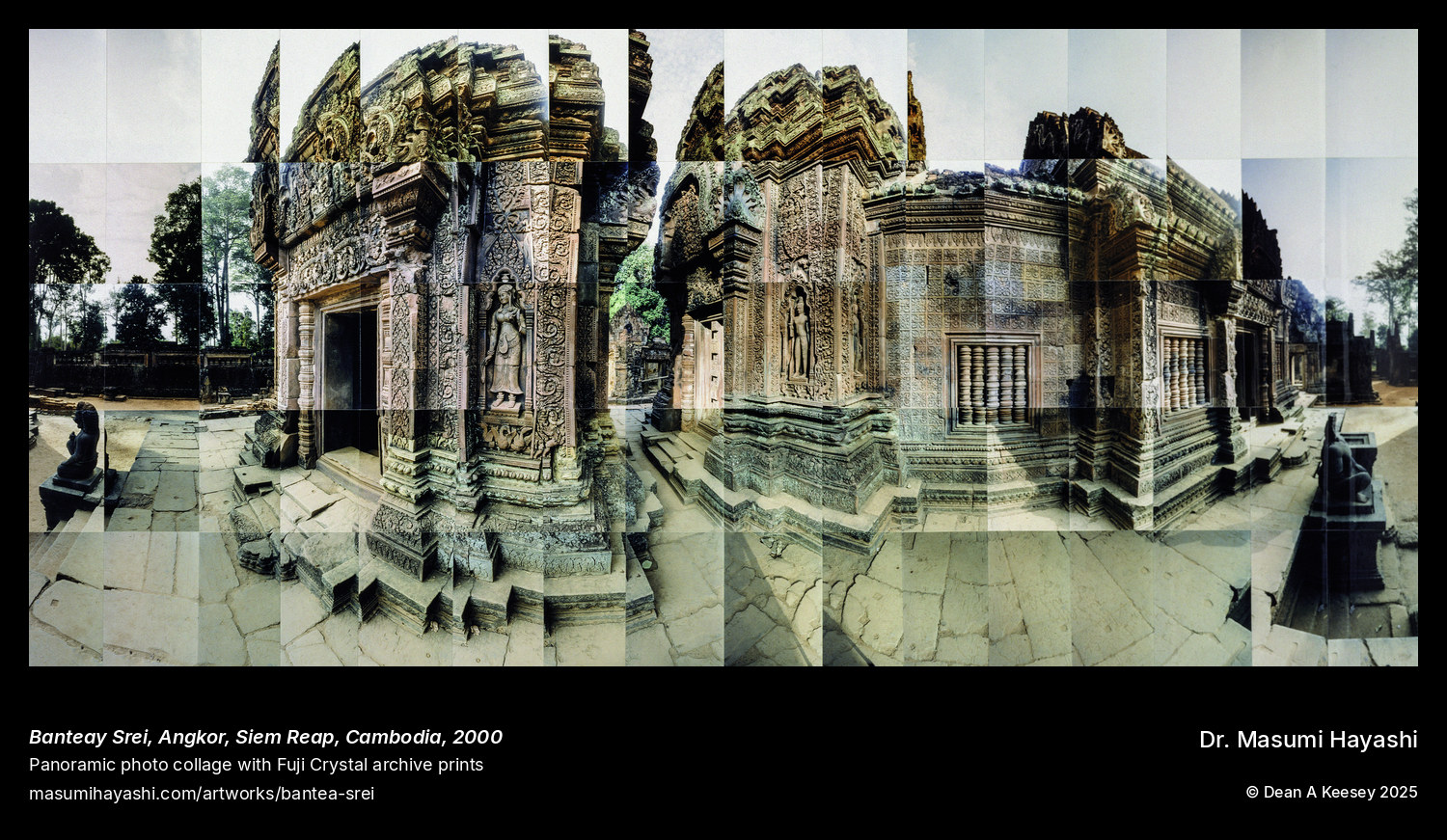
Picture of Banteay Srei, Angkor, Siem Reap, Cambodia by Dr. Masumi Hayashi

Banteay Srei, Angkor, Siem Reap, Cambodia

Angkor, Siem Reap, Cambodia

Panoramic Photo Collage

2000

27 x 56

Banteay Srei, Angkor, Siem Reap, Cambodia

Overview

Created in 2000, this 27 x 56-inch panoramic photo collage documents Banteay Srei—10th century Hindu temple located 25 kilometers northeast of main Angkor temple complex, renowned throughout Khmer art history as possessing finest stone carving in Angkor civilization, where pink sandstone’s relative softness enabled sculptors to achieve extraordinary detail impossible in harder gray sandstone used for Angkor Wat and most major temples. The temple’s name “Citadel of Women” (Banteay Srei) derives from either delicate sculptural refinement suggesting female artisanship or dedication to goddess Shiva Kama (unclear historical etymology), but temple functioned as Shaivite Hindu sanctuary built 967 CE during reign of Rajendravarman II by royal counselor Yajnavaraha—rare example of major Angkor temple commissioned by non-royal patron demonstrating religious and cultural vitality beyond strictly royal building programs. The exceptional stone carving covering virtually every surface—doorways, lintels, pediments, false doors, libraries—depicts intricate mythological narratives (Ramayana episodes, Mahabharata scenes), floral patterns achieving lace-like delicacy, protective deities (dvarapalas), and apsaras (celestial dancers) creating visual density and artistic refinement representing Khmer sculptural tradition’s zenith before 11th-12th century architectural expansion prioritized monumental scale over minute detail. The 2000 date positions this as earlier Sacred Architectures work predating Indian (2003) and Nepal (2004) concentration, suggesting Hayashi’s Asian sacred architecture documentation began with Southeast Asian (Cambodian, possibly Thai) sites before expanding to South Asian Hindu-Buddhist traditions. Remarkably, complete edition placement—all five editions sold or donated, Foundation inventory entirely absent with note “Not in inventory! (Bummer!)”—indicates exceptional commercial success and retrospective Foundation regret at retaining zero editions for exhibitions, loans, research access, or future placement opportunities, suggesting Banteay Srei’s international recognition, Angkor’s cultural prominence, and work’s artistic merit created strong collector demand.

Historical Context: Banteay Srei and Angkor Civilization

Banteay Srei represents distinctive achievement within broader Angkor architectural tradition:

Angkor Empire (9th-15th Centuries): Khmer empire centered at Angkor (modern Cambodia) represented major Southeast Asian power:

  • Controlled much of mainland Southeast Asia—Cambodia, Thailand, Laos, Vietnam
  • Extensive hydraulic infrastructure (barays/reservoirs, canals) supporting rice agriculture
  • Hindu-Buddhist religious synthesis with royal cult and temple construction
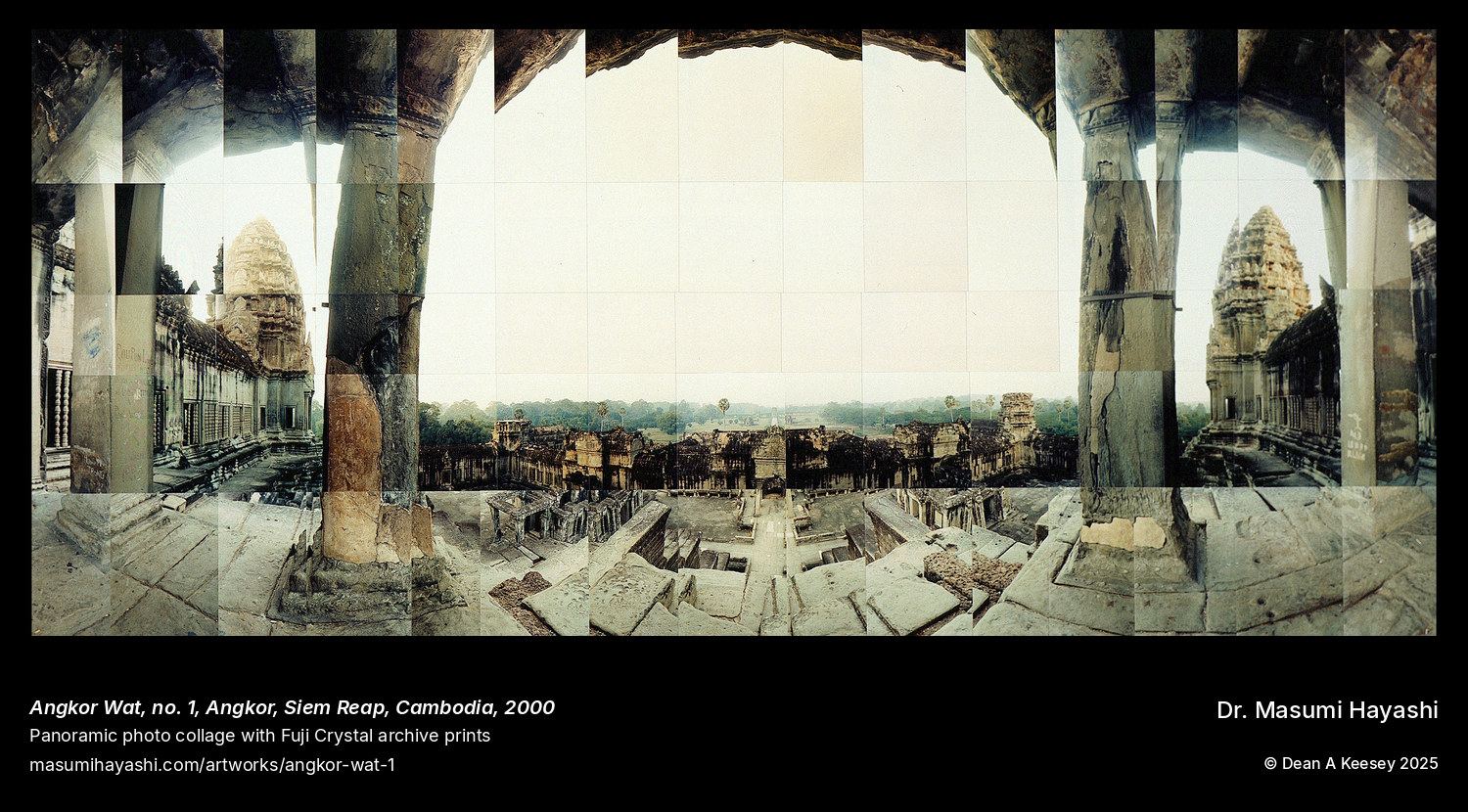
  • Architectural legacy—Angkor Wat, Angkor Thom, Bayon, hundreds of temple sites

Banteay Srei Construction (967 CE): Built during Rajendravarman II’s reign by Yajnavaraha (royal counselor/priest):

Non-Royal Patronage: Unlike most major Angkor temples commissioned by kings, Banteay Srei represents wealthy official’s devotional building—demonstrating religious culture extending beyond strictly royal sphere

Shaivite Dedication: Temple dedicated to Shiva (Hindu god), specifically Tribhuvanamahesvara form—typical for 10th century Angkor where Shaivism dominated before later Buddhist influences

Modest Scale: Compared to Angkor Wat’s massive extent, Banteay Srei remains relatively compact—three central towers (prasats), libraries, enclosure walls, causeway creating contained architectural ensemble

Pink Sandstone Material: Quarried from local sources, pink sandstone’s relative softness (compared to gray sandstone used for most Angkor temples) enabled unprecedented sculptural detail—fine lines, deep undercuts, layered relief creating three-dimensional effects impossible in harder stone

Architectural and Sculptural Features:

Central Sanctuary Towers (Prasats):

  • Three brick towers on common platform
  • Pink sandstone false doors, lintels, pediments with extraordinary carved detail
  • Interior cells originally housing linga (Shiva symbols) and religious images

Carved Pediments and Lintels: Narrative scenes depicting:

  • Ramayana: Ravana shaking Mount Kailash, Rama and Lakshmana fighting
  • Mahabharata: Dueling princes, Krishna scenes
  • Shiva Mythology: Dancing Shiva, Kama (god of love) destruction, family scenes
  • Mythological guardians, divine beings, decorative floral patterns

Libraries (Satellite Buildings): Small structures flanking approach causeway:

  • Heavily decorated with carved reliefs
  • Function uncertain—possibly scripture storage, ritual preparation spaces

Guardian Figures (Dvarapalas): Protective deities flanking doorways:

  • Elaborate costume details, jewelry, weapons
  • Each figure individualized despite repeated iconographic type
  • Pink sandstone enabling facial expression detail and costume refinement

Apsaras (Celestial Dancers): Female figures in dancing poses:

  • Elaborate headdresses, jewelry, graceful postures
  • Decorative rather than narrative function—beautifying sacred architecture

“Lace-Like” Carving Quality: Sculptors achieved:

  • Undercut carving creating shadows and depth
  • Fine line work resembling textile or jewelry rather than stone
  • Layered relief—multiple planes of sculptural depth
  • Preservation of minute details including finger gestures, fabric folds, ornament patterns

20th Century Rediscovery and Conservation:

  • French colonial archaeologists “rediscovered” and began conservation early 1900s
  • André Malraux’s 1923 attempted theft (stealing carved apsaras) creating international scandal
  • Extensive restoration including structural reinforcement, drainage improvements
  • UNESCO World Heritage Site designation (1992) as part of Angkor complex
  • Ongoing conservation addressing stone weathering, biological growth, tourist impact

Complete Edition Placement: Exceptional Success and Retrospective Regret

Zero Foundation inventory combined with “Not in inventory! (Bummer!)” note reveals unusual situation:

All Five Editions Placed: Complete edition absorption—every print sold to collectors or donated to institutions:

  • No Foundation retention for exhibitions requiring Banteay Srei representation
  • No loans available to museums or galleries
  • No research access for scholars studying Hayashi’s Angkor documentation
  • No future placement opportunities if appropriate institutions emerge

Foundation Regret: “Bummer!” notation indicates:

  • Retrospective recognition that retaining at least one edition would have been strategic
  • Current inability to include Banteay Srei in Hayashi retrospectives or traveling exhibitions
  • Lost opportunities for institutional placements prioritizing Angkor documentation
  • Evidence of evolving Foundation retention strategies—later works typically retained 1-3 editions

Success Factors: Why complete placement occurred:

Banteay Srei’s International Fame: Temple widely recognized as finest Khmer carving—collectors familiar with Angkor aware of Banteay Srei’s exceptional artistic significance

Angkor’s Cultural Prominence: Cambodia’s Angkor temples among world’s most celebrated archaeological sites—broader collector interest than more specialized Indian or Nepalese subjects

Year 2000 Dating: Early Sacred Architectures work potentially marketed before Foundation retention strategies matured

Artistic Merit: Hayashi’s documentation of world-renowned sculptural site creating strong visual impact

Southeast Asian Market: Collectors specializing in Khmer art, Angkor documentation, or Southeast Asian heritage

Institutional Interest: Museums prioritizing Southeast Asian art acquiring editions for permanent collections

2000 Dating: Early Sacred Architectures Work

As 2000 work, Banteay Srei predates confirmed Indian (2003) and Nepal (2004) concentration:

Sacred Architectures Chronology (Documented Dates):

  • 2000: Banteay Srei (Cambodia) - this work
  • 2003: Meenakshi Temple (Tamil Nadu, India)
  • 2004: Nepal concentration (Golden Temple, Hanuman Ghat, Patan works, Maha Buddha Temple)
  • 2004: Additional Indian sites (Hampi works)

Geographic Evolution: Documentation progression suggests:

  1. Southeast Asia (Cambodia, possibly Thailand) - 2000
  2. South India (Tamil Nadu, Karnataka) - 2003-2004
  3. Nepal (Kathmandu Valley) - 2004

Six Years Before Death: Created when Hayashi was approximately 55 years old (born 1945):

  • Mid-career rather than late-career positioning
  • International travel and demanding photography at peak physical capacity
  • Six years before 2006 death—substantial remaining active period
  • Sacred Architectures series as sustained decade-long project (2000-2004+)

Technical Specifications: Fuji Film Stock

Banteay Srei employs different film than typical Kodak stock:

Film Format: 4 x 6 inches (instead of usual 3.5 x 5) Film Stock: Fuji (instead of typical Kodak)

Implications:

  • Different color rendition—Fuji films historically known for warmer tones, enhanced reds
  • Larger negative format (4 x 6 vs. 3.5 x 5) providing greater resolution and detail capture
  • Possible response to pink sandstone’s distinctive color requiring specific film characteristics
  • Technical experimentation or equipment availability during Cambodia travel
  • Different grain structure and tonal range compared to Kodak stocks

Pink Sandstone Color: Banteay Srei’s distinctive pink sandstone potentially influenced film choice:

  • Fuji’s warm color bias complementing pink stone tones
  • Enhanced red sensitivity capturing sandstone’s distinctive hue
  • Color accuracy crucial for documenting material’s unique aesthetic qualities

Collection Information

Year: 2000 Location: Angkor (Banteay Srei), Siem Reap, Cambodia Medium: Panoramic Photo Collage Dimensions: 27 x 56 inches Edition: 1 of 5 Film Format: 4 x 6 inches Film Stock: Fuji

No editions currently in Foundation inventory—all five editions placed/sold.

Foundation Note: “Not in inventory! (Bummer!)”—retrospective regret at complete edition placement precluding current exhibitions, loans, or research access.

Note: Complete edition placement represents exceptional commercial success within Hayashi’s oeuvre, reflecting Banteay Srei’s international recognition as finest example of Khmer stone carving and Angkor’s cultural prominence attracting strong collector interest. Created 2000, work predates documented Indian (2003) and Nepal (2004) Sacred Architectures concentration, suggesting Asian sacred architecture documentation began with Southeast Asian sites. Banteay Srei (967 CE, “Citadel of Women”) represents 10th century Hindu temple renowned for extraordinary pink sandstone carving achieving detail impossible in harder gray sandstone used for most Angkor temples—mythological narratives (Ramayana, Mahabharata scenes), protective deities, celestial dancers, floral patterns creating “lace-like” sculptural refinement representing Khmer artistic zenith. Temple commissioned by royal counselor rather than king, demonstrating religious culture extending beyond strictly royal patronage. UNESCO World Heritage Site within broader Angkor complex. Different technical specifications (4 x 6 Fuji film vs. typical 3.5 x 5 Kodak) possibly responding to pink sandstone’s distinctive color requiring specific film characteristics. Appropriate for museum collections prioritizing Southeast Asian art, Khmer architectural documentation, Angkor heritage, UNESCO World Heritage Site preservation, or finest examples of stone carving traditions. Complete edition absence from Foundation inventory (“Bummer!”) precludes current availability but indicates strong historical market reception and retrospective recognition that retention strategy should have preserved at least one edition for institutional access and future placement opportunities.

Donate