Angkor Wat, no. 1, Angkor, Siem Reap, Cambodia
Angkor, Siem Reap, Cambodia
Panoramic Photo Collage
2000
23 x 52
Angkor Wat, no. 1, Angkor, Siem Reap, Cambodia
Overview
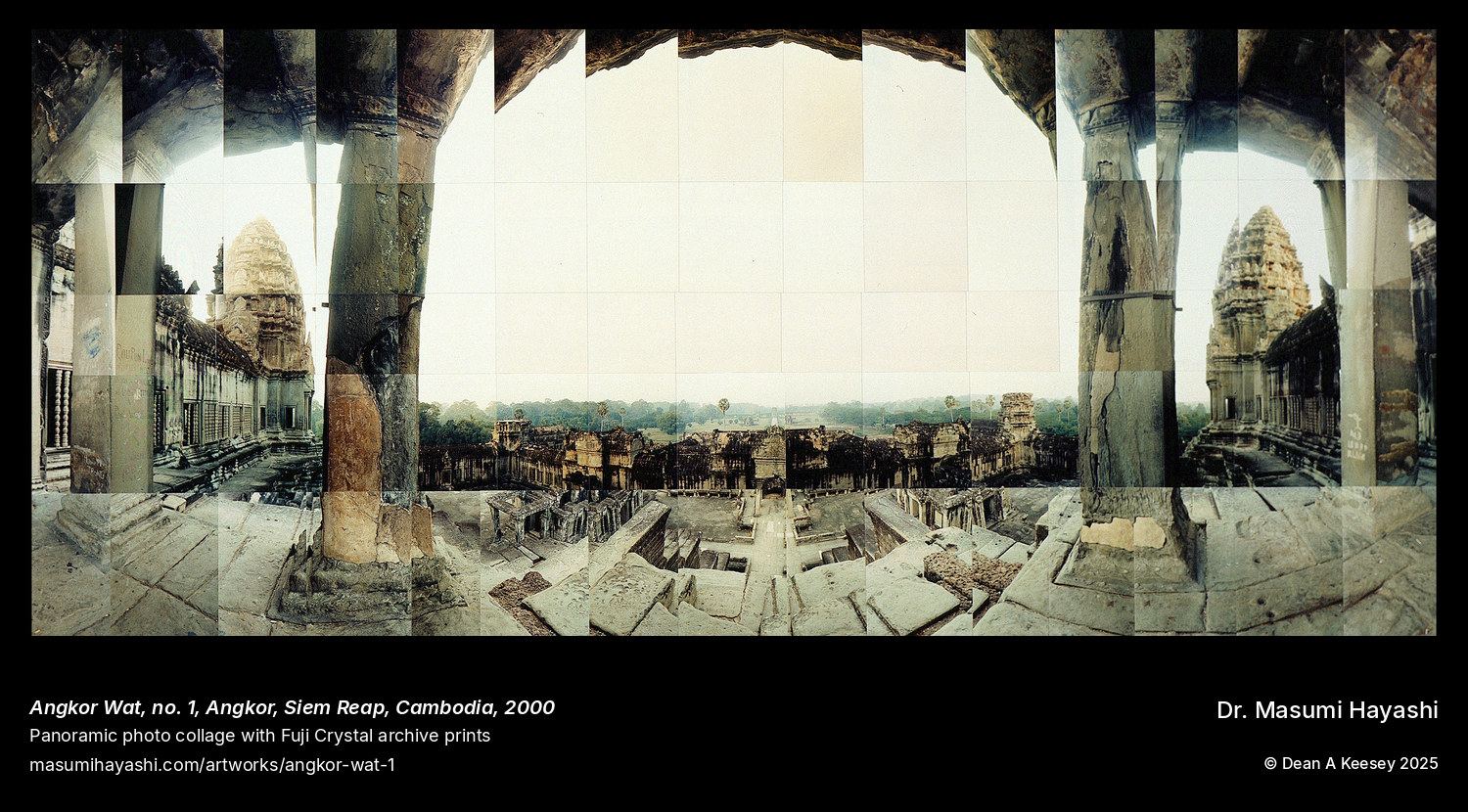
Created in 2000, this 23 x 52-inch panoramic photo collage documents Angkor Wat—world’s largest religious monument and architectural masterpiece of Khmer Empire (9th-15th centuries) where massive temple complex originally constructed as Hindu shrine dedicated to Vishnu gradually transformed into Buddhist temple reflecting Cambodia’s religious evolution while maintaining extraordinary architectural and sculptural integrity despite centuries of abandonment, jungle encroachment, and 20th century conflicts. The temple, built early 12th century during King Suryavarman II’s reign, rises through three rectangular galleries surrounding central quincunx of towers (five towers arranged in diamond pattern) representing Mount Meru cosmic mountain in Hindu-Buddhist cosmology—tallest central tower reaching 213 feet symbolizing divine peak where gods reside, surrounded by four subsidiary towers creating architectural representation of universe’s sacred geography. The complex’s western orientation (unusual among Angkor temples typically facing east) potentially indicating funerary function or Vishnu association (western direction connected to Vishnu in Hindu cosmology), combined with extensive bas-relief galleries depicting Hindu epics (Ramayana, Mahabharata) and celestial beings (apsaras numbering nearly 2,000), establishes Angkor Wat as pinnacle of classical Khmer architectural achievement synthesizing religious devotion, royal power, and artistic mastery. The 23 x 52-inch format employs significant vertical panorama (2.26:1 aspect ratio, 52-inch height exceeding 4 feet) capturing temple’s soaring tower architecture from ground-level galleries through graduated levels to central spire’s summit—vertical format emphasizing Mount Meru symbolism where architectural ascent mirrors spiritual progression from earthly realm toward divine transcendence. The 2000 date positions Angkor Wat No. 1 as fifth confirmed turn-of-millennium work alongside Bodhi Tree (Bihar), Banteay Srei (Angkor), Kandariya Mahadeva (Madhya Pradesh), and Jain Temple (Rajasthan), establishing systematic photographic journey documenting Buddhism, Hinduism, Jainism, and Hindu-Buddhist architectural synthesis across India and Cambodia, all employing identical Fuji 4 x 6 film specifications. The “no. 1” designation indicates multiple Angkor Wat works within Sacred Architectures series, suggesting comprehensive documentation of complex’s varied architectural elements, perspectives, and spatial sequences rather than single representative work, pattern consistent with Hayashi’s systematic approach documenting major sites (Hampi, Meenakshi Temple) through multiple works capturing diverse architectural typologies and compositional opportunities.
Historical Context: Angkor Wat and Khmer Empire
Angkor Wat represents extraordinary achievement of medieval Southeast Asian civilization:
Khmer Empire (9th-15th centuries): Powerful kingdom controlling much of mainland Southeast Asia (modern Cambodia, Thailand, Laos, southern Vietnam):
- Capital: Angkor region, extensive urban complex supporting population estimated 750,000-1,000,000 at peak
- Hydraulic Civilization: Sophisticated water management—massive reservoirs (barays), canals, rice paddies enabling agricultural surplus supporting non-farming population (priests, artists, bureaucrats, military)
- Religious Synthesis: Hindu-Buddhist traditions coexisting, evolving from predominantly Hindu (9th-12th centuries) toward Mahayana then Theravada Buddhism (13th-15th centuries)
- Architectural Legacy: 72+ major stone temple complexes plus hundreds of smaller structures across Angkor archaeological zone
Angkor Wat Construction (Early 12th Century): Built during King Suryavarman II’s reign (1113-1150 CE):
Royal Patronage: Temple functioning as state temple and eventual mausoleum for Suryavarman II—combining religious devotion with royal legitimation and posthumous commemoration
Construction Scale:
- Site Area: 162.6 hectares (402 acres) including moat and outer wall
- Building Materials: Estimated 5-10 million sandstone blocks quarried from Phnom Kulen mountains 25+ miles away, transported via canals
- Labor: Tens of thousands of workers over 30+ year construction period
- Moat: 650 feet wide, 13+ feet deep surrounding entire complex—both defensive and symbolic (cosmic ocean)
Original Hindu Dedication: Temple dedicated to Vishnu (unusual—most Angkor temples honored Shiva):
- Western orientation potentially connecting to Vishnu association (Vishnu linked with western direction in Hindu cosmology)
- Vishnu imagery throughout bas-reliefs and architectural symbolism
- Possible funerary function suggested by western orientation (west associated with death in Hindu tradition)
Transformation to Buddhism (13th-14th centuries): Cambodia’s religious shift reflected in temple evolution:
- Hindu imagery maintained but Buddhist statues added
- Buddha images placed in galleries, sanctuaries
- Temple continuing as major religious site rather than abandoned
- Contemporary function as Theravada Buddhist monastery and pilgrimage destination
Architectural Design:
Symbolic Cosmology: Temple represents universe in Hindu-Buddhist cosmology:
- Mount Meru: Central towers symbolizing cosmic mountain, gods’ abode
- Cosmic Ocean: Surrounding moat representing primordial waters
- Galleries: Representing mountain ranges encircling Meru
- Spatial Progression: Ascending through three gallery levels toward summit symbolizing spiritual ascent
Three Gallery Levels:
- First Gallery (Ground Level): 611 feet × 768 feet enclosure with extensive bas-relief galleries
- Second Gallery: Intermediate level with pillared halls, libraries
- Third Gallery (Upper Terrace): Elevated platform supporting five towers, restricted sacred space
Each level accessed via steep staircases emphasizing vertical ascent and progressive sacred zones.
Five Towers (Quincunx): Diamond pattern arrangement:
- Central Tower: 213 feet height (from ground), tallest structure
- Four Corner Towers: Subsidiary peaks surrounding central tower
- Mount Meru Symbolism: Five peaks of cosmic mountain
- Lotus Bud Form: Tower shapes resembling lotus flowers (sacred in Hindu-Buddhist traditions)
Bas-Relief Galleries: First gallery walls bearing extraordinary relief carvings:
- Total Length: 2,600+ feet of continuous narrative relief
- Carving Quality: Fine detail despite massive scale—individual faces, weapons, costumes distinguishable
Major Relief Narratives:
- Battle of Kurukshetra (Mahabharata): Epic war between Pandava and Kaurava cousins
- Churning of the Ocean of Milk: Hindu creation myth—gods and demons churning cosmic ocean to obtain amrita (immortality elixir)
- Ramayana Scenes: Rama’s battle against demon king Ravana
- Suryavarman II Procession: Historical king depicted with retinue, military forces
- Heaven and Hell: Judgment scenes showing righteous ascending to paradise, wicked descending to torments
Apsara Devatas (Celestial Dancers): Nearly 2,000 carved female figures:
- Graceful poses, elaborate headdresses, jewelry, clothing
- Individual variations despite repetitive iconographic type
- Decorative function beautifying sacred architecture
20th Century Preservation and UNESCO Status:
Rediscovery: French colonial archaeologists (late 19th century) “discovering” complex partially reclaimed by jungle:
- Archaeological clearing, documentation, initial restoration
- École française d’Extrême-Orient conducting systematic study
20th Century Threats:
- Khmer Rouge period (1975-1979): Minimal damage—Angkor Wat spared worst destruction
- Looting and art theft: Statues, lintels removed, sold to international markets
- Landmines: Surrounding areas mined during conflicts
- Tourism pressure: Millions of annual visitors creating conservation challenges
UNESCO World Heritage Site (1992): International recognition and conservation support:
- Ongoing restoration addressing sandstone deterioration, structural stability, drainage issues
- Archaeological park management balancing preservation with tourism
- Community involvement in conservation and economic development
Contemporary Function:
- Active Buddhist monastery with resident monks
- Major tourist destination (2+ million annual visitors pre-COVID)
- Symbol of Cambodian national identity (appearing on national flag)
- Pilgrimage site for Buddhist devotees
- Archaeological research ongoing revealing construction techniques, urban context
Significant Vertical Panorama: 23 x 52 Inches
At 23 x 52 inches, Angkor Wat No. 1 employs significant vertical panorama emphasizing tower architecture:
Format Analysis:
- Width: 23 inches (1.92 feet, under 2 feet) creates narrow horizontal field
- Height: 52 inches (4.33 feet, over 4 feet tall) establishes strong vertical emphasis
- Aspect Ratio: 2.26:1 (height to width)—significant vertical panorama approaching 2.5:1
Comparison with Other Vertical Panoramas:
- Jain Temple: 25 x 73” (2.92:1)—TALLEST, second most extreme
- Bodhi Tree: 24 x 69” (2.875:1)—MOST EXTREME
- Kandariya Mahadeva: 30 x 59” (1.97:1)—approaching 2:1
- Angkor Wat No. 1: 23 x 52” (2.26:1)—significant vertical, over 4 feet tall
- Hanuman Ghat: 24 x 45” (1.88:1)—ghat descent
- Mantapa with Devotees: 22 x 37” (1.68:1)—pillared hall
Angkor Wat’s 52-inch height creates substantial vertical presence while narrowest width (23 inches) among significant verticals emphasizes extreme aspect ratio.
Format Rationale: Tower Documentation:
Quincunx Tower Arrangement: Five towers in diamond pattern create vertical composition:
- Ground platform → gallery levels → tower bases → graduated peaks → central spire finial
- Vertical format capturing full elevation from terrace to summit
- 52-inch height enabling comprehensive tower cluster documentation
Mount Meru Symbolism: Vertical format reinforcing cosmological meaning:
- Cosmic mountain requiring vertical documentation
- Architectural ascent from earthly base toward divine summit
- Towers’ upward thrust symbolizing spiritual progression
Three Gallery Levels: Progressive vertical zones:
- First gallery (ground): Human activity level with bas-reliefs
- Second gallery (intermediate): Transitional sacred space
- Third gallery (upper terrace): Restricted platform supporting towers
- Vertical format documenting complete spatial hierarchy
Possible Compositional Strategies:
Central Tower Focus: Documenting tallest tower’s full elevation:
- Lotus bud form requiring vertical framing
- 213-foot height demanding format emphasizing upward extent
- Summit finial as compositional apex
Quincunx from Distance: Five-tower arrangement viewed from approach:
- Diamond pattern visible against sky
- Towers rising above gallery rooflines
- Vertical format capturing towers’ dominance over horizontal galleries
Interior to Exterior Progression: Vertical sequence through galleries toward towers:
- Lower gallery darkness → upper terrace light → open sky above towers
- Vertical movement replicating pilgrim experience ascending toward summit
Display Considerations: 52-inch height (over 4 feet) requiring:
- Gallery walls with adequate vertical space
- Professional framing for narrow vertical format
- Exhibition contexts appreciating vertical panorama innovation
- Framed edition (Edition 1) maintained in Foundation inventory
Fifth 2000 Work: Comprehensive 2000 Photographic Journey
Angkor Wat No. 1 completes quintet documenting three major religious traditions:
2000 Works Confirmed (Complete List):
- Bodhi Tree (Bodh Gaya, Bihar, India)—Buddhism, 24 x 69” extreme vertical
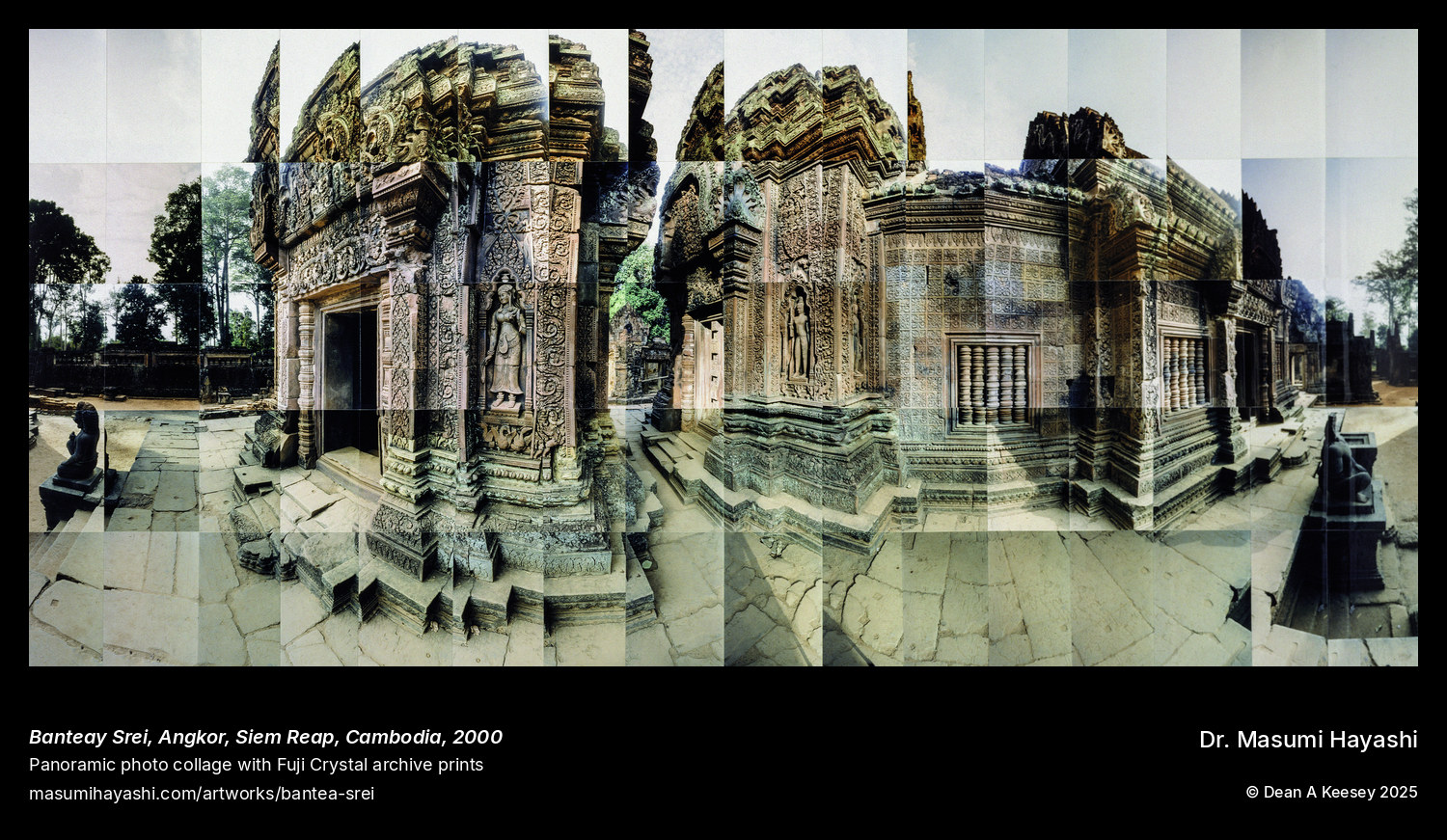
- Banteay Srei (Angkor, Cambodia)—Hindu-Buddhist, 27 x 56” moderate horizontal
- Kandariya Mahadeva (Khajuraho, Madhya Pradesh, India)—Hinduism, 30 x 59” vertical
- Jain Temple (Jaisalmer, Rajasthan, India)—Jainism, 25 x 73” extreme vertical
- Angkor Wat No. 1 (Angkor, Cambodia)—Hindu-Buddhist, 23 x 52” vertical
Technical Consistency Absolute: All five 2000 works employ identical specifications:
- Fuji film stock (distinct from typical Kodak)
- 4 x 6-inch format (larger than typical 3.5 x 5)
- Systematic technical approach throughout journey
Geographic Pattern:
- India (4 sites): Bihar, Madhya Pradesh, Rajasthan—three regions spanning northeastern, central, northwestern India
- Cambodia (2 sites): Both at Angkor—Banteay Srei (25km from main complex), Angkor Wat (central monument)
Pattern suggesting India → Cambodia or Cambodia → India → Cambodia route.
Religious Diversity (Three Major Traditions):
- Buddhism: Bodh Gaya (enlightenment site, foundational location)
- Hinduism: Khajuraho (tantric temple), Angkor Wat originally (Vishnu dedication)
- Jainism: Jaisalmer (merchant-patronage temple complex)
- Hindu-Buddhist Synthesis: Banteay Srei, Angkor Wat’s Buddhist phase
Comprehensive approach documenting Indian subcontinent’s indigenous religious architectural traditions plus Southeast Asian religious evolution.
Format Diversity:
- Four vertical panoramas: Bodhi Tree (24x69”), Jain Temple (25x73”), Kandariya Mahadeva (30x59”), Angkor Wat No. 1 (23x52”)
- One horizontal: Banteay Srei (27x56”)
Vertical emphasis in 2000 works suggesting deliberate documentation strategy favoring tower/temple elevation over horizontal spread.
Two Cambodia Works: Banteay Srei + Angkor Wat establishing Angkor complex documentation:
- Different scales—intimate temple (Banteay Srei) vs. massive monument (Angkor Wat)
- Different architectural approaches—pink sandstone detailed carving vs. gray sandstone monumental design
- Possible additional Angkor works not yet documented
”No. 1” Designation: Multiple Angkor Wat Works
Title’s “no. 1” indicates sequential documentation:
Implications:
- At least Angkor Wat No. 2 exists (likely No. 3, possibly more)
- Multiple perspectives, architectural elements, compositional approaches
- Systematic coverage similar to Hampi (Hemakuta Hill, Mantapa with Devotees—two confirmed works)
Possible Additional Angkor Wat Works: Different compositional focuses:
- No. 1: Tower elevation (this work, vertical format)
- No. 2: Bas-relief galleries (possibly horizontal format documenting narrative sequences)
- No. 3: Approaching causeway (possibly extreme horizontal documenting axial approach)
- Additional numbers: Interior spaces, reflective moat views, sunrise/sunset lighting
Systematic Site Documentation Pattern: Major sites receiving multiple works:
- Angkor Wat: No. 1 confirmed, additional numbers likely
- Hampi: Two confirmed (Hemakuta Hill 2003, Mantapa with Devotees 2004)
- Meenakshi Temple: Possibly multiple (Madonna and Child confirmed, others possible)
Pattern demonstrates comprehensive approach understanding major monuments require multiple works capturing architectural diversity, varied perspectives, different scales rather than single representative image.
Collection Information
Year: 2000 Location: Angkor, Siem Reap, Cambodia Medium: Panoramic Photo Collage Dimensions: 23 x 52 inches (significant vertical panorama, over 4 feet tall) Edition: 1 of 5 Film: 4 x 6 inches, Fuji
- Masumi Hayashi Foundation (framed, inventory)
Note: Four additional edition locations unaccounted for. Fifth confirmed 2000 work completing quintet documenting Buddhism (Bodh Gaya), Hinduism (Khajuraho), Jainism (Jaisalmer), and Hindu-Buddhist synthesis (Banteay Srei, Angkor Wat)—all employing identical Fuji 4 x 6 film establishing systematic turn-of-millennium photographic journey achieving unparalleled religious architectural diversity spanning India and Cambodia. Work documents Angkor Wat—world’s largest religious monument and masterpiece of Khmer Empire’s 12th century architectural achievement where massive temple complex originally constructed as Hindu shrine dedicated to Vishnu gradually transformed into Buddhist temple reflecting Cambodia’s religious evolution. Temple’s quincunx tower arrangement (five towers in diamond pattern symbolizing Mount Meru cosmic mountain) rises 213 feet at central peak, surrounded by three gallery levels bearing 2,600+ feet of bas-relief carvings depicting Hindu epics (Ramayana, Mahabharata, Churning of Ocean of Milk) and nearly 2,000 apsara celestial dancers—extraordinary synthesis of religious devotion, royal power, and artistic mastery representing classical Khmer civilization’s zenith. Significant vertical panoramic format (23 x 52”, over 4 feet tall, 2.26:1 aspect ratio) emphasizes temple’s soaring tower architecture from ground galleries through graduated levels to central spire summit—vertical format capturing Mount Meru symbolism where architectural ascent mirrors spiritual progression toward divine transcendence. “No. 1” designation indicates multiple Angkor Wat works within Sacred Architectures series suggesting comprehensive documentation capturing complex’s varied architectural elements, diverse perspectives, and spatial sequences rather than single representative work—pattern consistent with systematic multi-work approach documenting major sites (Hampi, likely Meenakshi Temple). Work represents second Angkor documentation (alongside Banteay Srei) establishing concentrated Cambodia coverage within 2000 journey, potentially indicating extended Angkor stay enabling comprehensive complex documentation across multiple architectural scales (intimate Banteay Srei pink sandstone detail vs. monumental Angkor Wat gray sandstone monumentality). UNESCO World Heritage Site (1992) recognition combined with Angkor Wat’s status as world’s largest religious monument and Cambodian national symbol (appearing on flag) establishes exceptional institutional collection appeal. Appropriate for major art museums with comprehensive Asian collections, UNESCO World Heritage Site documentation priorities, Southeast Asian architectural studies, Hindu-Buddhist religious synthesis research, or photographic format experimentation demonstrating vertical panorama innovation addressing specific tower architecture documentation requirements. Framed Foundation edition ensures work’s exhibition availability while four unaccounted editions potentially placed with institutions prioritizing Khmer architectural heritage, Cambodia cultural preservation, or collectors specializing in Southeast Asian sacred architecture documentation. Vertical format creates distinctive gallery presence while Angkor Wat’s universal recognition as architectural masterpiece enhances accessibility beyond specialist contexts—work combining scholarly documentary rigor with iconic subject matter appealing to broad institutional and collector audiences.