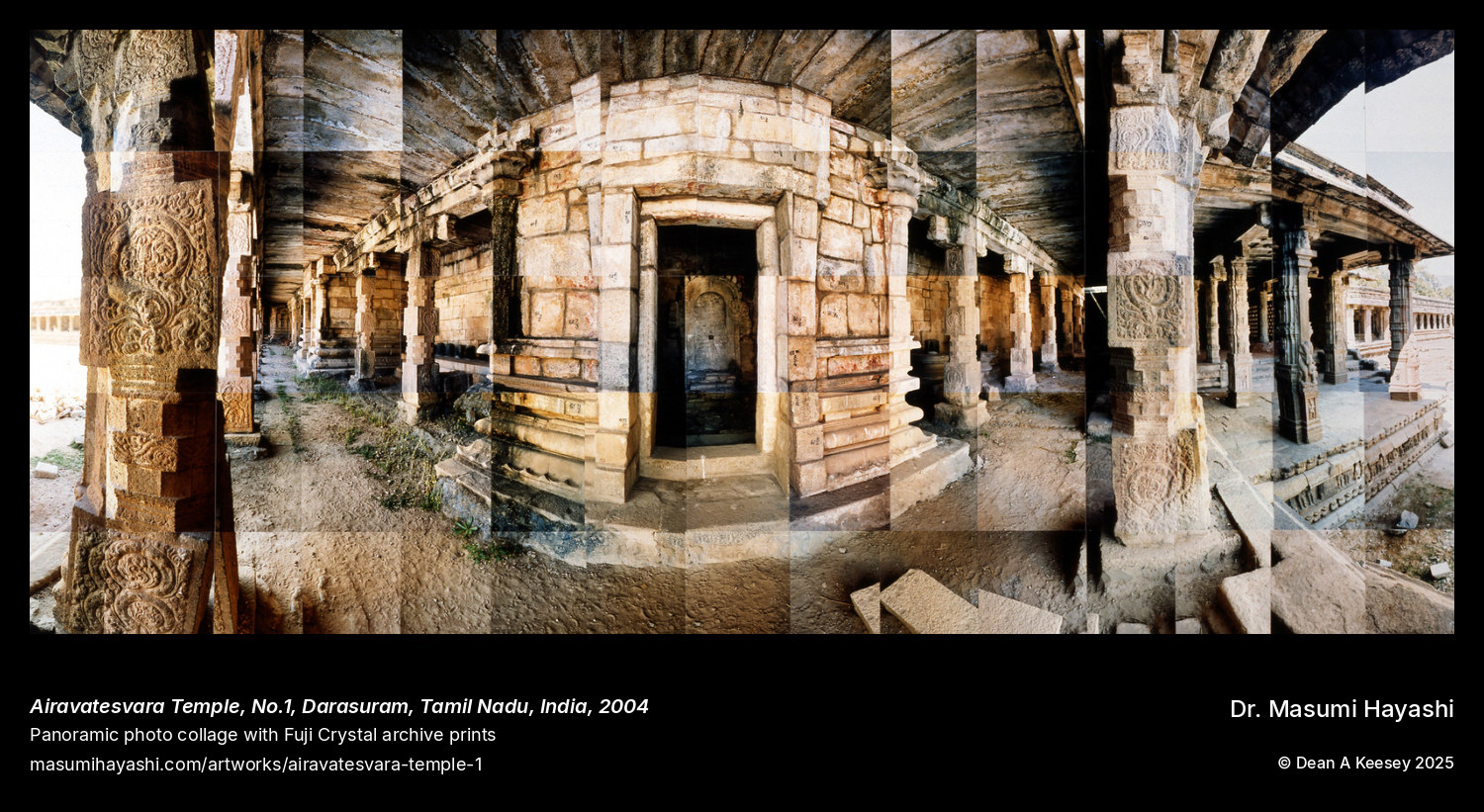
Airavatesvara Temple
Darasuram, Tamil Nadu, India
Panoramic Photo Collage
2004
23" x 50"
Airavatesvara Temple #2, Darasuram, Tamil Nadu, India
Overview
“Airavatesvara Temple #2” presents the vertical perspective on Rajaraja Chola II’s UNESCO World Heritage masterpiece in Darasuram, Tamil Nadu. Created in 2004 as the companion to the horizontal panorama of the same site, this 23-by-50-inch vertical work shifts focus from lateral architectural relationships to the soaring proportions of the temple’s vimana tower and the vertical sculptural programs characteristic of mature Chola temple design. The dramatic 2.17:1 aspect ratio compresses horizontal breadth while emphasizing architectural height, directing visual attention upward along the temple’s pyramidal superstructure and its intricate tiers of carved ornamentation.
As the second of two systematic perspectives documenting the Airavatesvara Temple, this vertical panorama completes Hayashi’s comprehensive spatial record of the 12th-century Chola monument. Where the horizontal companion captures courtyard relationships and the celebrated stone chariot pavilion’s lateral extension, this vertical work explores the temple’s elevation, revealing how Chola architects achieved visual monumentality through stacked architectural elements even within a relatively compact temple footprint. The format’s narrow width (23 inches) and substantial height (50 inches) create a viewing experience that mirrors devotional movement within the temple: the eye travels upward from ground-level sculptural detail through successive architectural tiers toward the vimana’s crowning element.
The 2004 creation date—coinciding with UNESCO’s formal inscription of the Great Living Chola Temples—positions both Airavatesvara works within a moment of renewed international attention to these monuments. Hayashi’s dual-perspective documentation serves as both artistic interpretation and cultural record, preserving comprehensive spatial information about architecture deemed universally significant while exploring the aesthetic possibilities inherent in alternative photographic framings of the same devotional space.
The vertical format’s dramatic proportions align this work with other extreme vertical panoramas in the Sacred Architectures series: “Jain Temple, Jaisalmer” (25×73 inches), “River Ganges, Varanasi” (19×62 inches), and “Kund Pava Square, Jaisalmer” (35×73 inches). These towering formats document the vertical emphasis of certain sacred architectures—soaring temple towers, cascading ghats, elaborate gopurams—requiring photographic strategies that can encompass architectural height while maintaining visual coherence.
Historical and Cultural Context
Vertical Architecture in Chola Temple Design
The Chola architectural tradition’s distinctive achievement lies partly in its sophisticated manipulation of vertical elements. Unlike some temple traditions that spread horizontally through courtyard expansion, Chola architects perfected the pyramidal vimana—a towering superstructure rising above the sanctum in diminishing tiers, each layer articulated with architectural detail and sculptural ornamentation. This vertical emphasis creates visual monumentality even in relatively compact temple plans, directing devotional attention upward toward the divine presence housed in the sanctum below.
The Airavatesvara Temple’s vimana, though smaller than the monumental towers of earlier Chola temples at Thanjavur (216 feet) and Gangaikonda Cholapuram (180 feet), demonstrates the mature Chola style’s refinement of vertical architectural expression. The tower rises through carefully proportioned tiers, each level defined by pilastered walls, sculpted niches housing deities, and projecting cornices that create rhythmic horizontal accents within the overall vertical thrust. This disciplined articulation of the vimana’s surface transforms what could be a simple pyramidal mass into a complex sculptural composition readable from ground level.
The vertical format of “Airavatesvara Temple #2” captures this architectural strategy, allowing viewers to perceive the vimana’s stacked organization, the diminishing scale of successive tiers, and the visual rhythm created by repeating horizontal elements within vertical ascent. Where horizontal panoramas risk flattening such vertical compositions, the 23-by-50-inch vertical format respects and emphasizes the architecture’s upward movement.
Sculptural Programs and Visual Theology
Chola temple vimanas function as three-dimensional theological texts, their sculptural programs presenting elaborate iconographic schemes that educate devotees while demonstrating royal patronage’s support for Hindu orthodoxy. The Airavatesvara Temple’s tower displays typical Chola iconography: directional deities (dikpalas) guarding cardinal points, various manifestations of Shiva in sculpted niches, celestial beings (apsaras) and mythical creatures articulating architectural transitions, and vegetal ornament signifying cosmic abundance.
This vertical distribution of sacred imagery creates what art historians term “visual theology”—doctrine communicated through architectural form and sculptural content rather than textual instruction. Devotees circumambulating the temple encounter this imagery sequentially, their physical movement around the structure coordinated with visual consumption of theological content. The vimana’s height ensures visibility from distance while its sculptural detail rewards close examination, creating multiple scales of visual engagement.
The vertical panoramic format potentially captures substantial portions of these sculptural programs in a single comprehensive view, offering what devotional circumambulation provides temporally—sequential encounter with iconographic content—as simultaneous spatial presentation. This transformation from temporal to spatial experience represents one of photography’s distinctive capabilities when documenting sacred architecture.
UNESCO Recognition and Preservation Context
The 2004 UNESCO World Heritage inscription that designated Airavatesvara alongside the Thanjavur and Gangaikonda temples recognized both architectural achievement and living cultural continuity. The “Great Living Chola Temples” designation emphasizes these monuments’ dual status as historical masterpieces and active devotional centers, a combination that creates complex preservation challenges.
UNESCO recognition brings international attention, increased tourism, and preservation resources, but also raises questions about managing living temples as cultural heritage sites. How do preservation authorities balance conservation requirements with ongoing religious use? How does international heritage designation affect local devotional practices and temple administration? These questions acquired particular urgency in 2004, the moment Hayashi documented the temple.
Her photographic work captures the temple during this transitional moment—recognized as world heritage but still primarily functioning as local Shaivite shrine, valued internationally for architectural excellence while maintaining regional devotional traditions, threatened by environmental degradation and tourism pressure while protected by emerging conservation frameworks. This complex temporal position adds historical specificity to what might otherwise seem timeless architectural documentation.
Format and Technical Analysis
Extreme Vertical Panorama
The 23-by-50-inch dimensions create a 2.17:1 aspect ratio, placing this work among the Sacred Architectures series’ more extreme vertical formats. While not reaching the dramatic proportions of “Jain Temple, Jaisalmer” (25×73 inches, 2.92:1) or “River Ganges, Varanasi” (19×62 inches, 3.26:1), the format nevertheless emphasizes vertical architectural elements while severely compressing horizontal breadth.
This compression creates distinctive viewing dynamics. The narrow width (23 inches) focuses attention on a relatively confined visual field—likely the temple’s vimana tower and immediate architectural context—while the substantial height (50 inches) allows extensive vertical development. The eye naturally travels upward through the image, following the architecture’s own vertical logic from ground plane through successive tiers to the vimana’s apex.
The format’s proportions also influence the work’s physical presence in exhibition contexts. The 50-inch height creates commanding vertical presence on gallery walls, the work asserting itself through height rather than breadth. This verticality distinguishes the piece from more conventional horizontal panoramas and draws viewer attention through its unusual proportions.
Complementary Documentation Strategy
The pairing of this vertical perspective (23×50 inches) with the horizontal companion (53×24 inches) demonstrates systematic two-work documentation methodology. The contrasting formats ensure comprehensive spatial coverage: horizontal breadth capturing courtyard relationships and lateral architectural extent, vertical emphasis documenting tower elevations and stacked architectural elements.
This dual-perspective strategy mirrors Hayashi’s treatment of other architecturally complex sites:
- Okunoin Cemetery, Koya (1996): Two works, both 17×53 inches vertical, documenting different areas of the vast cemetery
- Jaisalmer, Rajasthan (2000): Two vertical works of different heights (25×73” and 35×73”) capturing Jain temple and urban square
- Dharamsala, Himachal Pradesh (2004): Two works documenting different institutions (Norbulingka cultural center and Tsuglagkhang complex)
The Airavatesvara pair uniquely employs perpendicular formats—horizontal and vertical—rather than multiple works in the same orientation. This orthogonal approach ensures maximum visual distinction between the two perspectives while providing genuinely complementary spatial information.
Chromogenic Process and Color Management
Like its companion work, “Airavatesvara Temple #2” employs Fuji film stock, ensuring color consistency across both perspectives. The Fuji specification matters particularly for documenting Chola granite architecture, where subtle color variations in stone—ranging from honey gold to warm gray—contribute significantly to visual experience.
Fuji films of the mid-2000s period produced characteristically warm color palettes with rich saturation in reds and yellows, well-suited to Tamil Nadu’s intense tropical light and the warm tonalities of Chola granite. The vertical format’s narrower width might concentrate these color qualities, creating more saturated color fields than the horizontal panorama’s greater breadth.
The panoramic photo collage technique—assembling multiple individual photographs into unified panoramic views—requires careful color matching across individual frames. Variations in exposure, lighting angle, or atmospheric conditions between successive photographs must be harmonized to create visually seamless results. The vertical format’s extreme proportions suggest substantial numbers of individual photographs stacked vertically, making color consistency across the full 50-inch height a significant technical achievement.
Series Context and Comparative Analysis
Vertical Panoramas in Sacred Architectures
The vertical orientation positions this work within a distinctive subset of the Sacred Architectures series emphasizing upward architectural movement. Other major vertical panoramas include:
- “Jain Temple, Jaisalmer” (2000): 25×73 inches documenting ornate Jain temple tower
- “River Ganges, Varanasi” (2000): 19×62 inches capturing the sacred river’s vertical ghats
- “Kund Pava Square, Jaisalmer” (2000): 35×73 inches documenting urban sacred architecture
- “City of the Dead #1 and #2, Okunoin” (1996): Both 17×53 inches exploring cemetery depth
These vertical works tend to document subjects with strong vertical organization: temple towers ascending through multiple tiers, stairways cascading down riverbanks, cemetery paths receding into forested hillsides. The format responds to architectural verticality, adapting photographic strategy to subject characteristics.
The Airavatesvara vertical work’s relatively moderate height (50 inches versus 73 inches for the tallest works) suggests a temple vimana of substantial but not overwhelming scale. This moderation aligns with the temple’s architectural character—impressive but intimate, refined rather than monumental, achieving effect through artistic excellence rather than sheer size.
Tamil Nadu Documentation Pattern
Within Hayashi’s Tamil Nadu temple documentation, the Airavatesvara pair represents the only dual-perspective treatment of a single site. The Meenakshi works, though multiple, document different areas of the vast temple complex rather than offering complementary perspectives on the same architectural elements. Similarly, “Rameswaram Temple #1” appears as a standalone work without companion perspectives.
This unique treatment suggests Hayashi recognized Airavatesvara’s particular suitability for dual-format documentation. Perhaps the temple’s relatively compact scale allowed comprehensive coverage through just two perspectives, whereas larger complexes like Meenakshi or Rameswaram would require many viewpoints for equivalent spatial documentation. Or perhaps the Chola temple’s architectural clarity—its distinct vimana tower and chariot mandapa functioning as visually separable elements—invited horizontal and vertical treatments emphasizing these different architectural components.
The dual-format approach also creates interpretive possibilities for curators and collectors. The works can be exhibited together as complementary documentation, displayed separately to emphasize different formal qualities, or used didactically to demonstrate how photographic format shapes architectural interpretation. This flexibility enhances the works’ institutional value.
Chola versus Khmer Verticality
Comparing this Chola temple documentation with Hayashi’s works depicting Khmer architecture at Angkor reveals different approaches to vertical sacred architecture. Khmer temples like Angkor Wat (documented in “Angkor Wat No. 1, Siem Reap, Cambodia,” 2000) employ tiered pyramidal structures resembling Chola vimanas, both traditions drawing on shared Indic architectural concepts.
Yet distinctions emerge: Khmer temples tend toward more dramatic vertical scale (Angkor Wat’s central tower rises 213 feet), more horizontal spread through extensive gallery systems, and sandstone construction allowing different carving techniques than Tamil granite. These architectural differences shape photographic documentation—the formats, perspectives, and compositional strategies appropriate to Chola temples may differ from those suited to Khmer monuments.
The Sacred Architectures series’ inclusion of both traditions invites such comparative analysis. How do different regional interpretations of broadly similar architectural concepts—tiered pyramidal towers, enclosed courtyards, extensive sculptural programs—generate distinct visual and spatial experiences? How does photographic documentation reveal or obscure these differences?
Edition Status and Institutional Context
Current Edition Status
The edition tracking presents slight inconsistency requiring clarification: the inventory fields indicate no current inventory (inInventory: false, inventoryFramed: 0, inventoryUnframed: 0), yet the edition tracking lists “Inventory - framed.” This discrepancy suggests either:
- The framed edition was sold, donated, or transferred after initial inventory recording
- Database updating hasn’t fully reflected current disposition
- The work remains in inventory but under different classification
The contrast with “Airavatesvara Temple #1”—which clearly shows both framed and unframed editions in inventory—suggests the vertical perspective may have found earlier placement, possibly reflecting collector or institutional preference for dramatic vertical formats or the work’s potentially sold status indicating market validation.
Clarifying this edition status matters for institutional planning and provenance documentation. If the work has indeed been placed, identifying that location establishes precedent for institutional interest and provides comparative market information. If it remains in inventory under different classification, correcting database records ensures accurate availability information for potential acquisitions.
Institutional Appeal of Vertical Format
The dramatic 23-by-50-inch vertical format offers distinctive exhibition possibilities. The unusual proportions create memorable visual presence, the work asserting itself through height and unconventional aspect ratio rather than horizontal breadth. This distinctiveness can benefit institutional collections by:
- Creating visual variety: Vertical works break up gallery walls dominated by horizontal formats
- Demonstrating technical sophistication: The extreme panoramic proportions showcase Hayashi’s mastery of complex photographic assemblage
- Offering didactic opportunities: Paired exhibition with the horizontal companion demonstrates how format shapes architectural interpretation
- Maximizing wall space efficiency: Vertical formats work well in galleries with limited horizontal wall space but substantial vertical clearance
Museums focused on architectural photography, Asian religious art, or UNESCO World Heritage documentation would find particular value in this vertical perspective, especially if acquired alongside its horizontal companion to provide comprehensive spatial documentation of a significant Chola monument.
Conservation Considerations
The 50-inch height creates moderate conservation challenges—requiring careful handling and storage but remaining manageable compared to the series’ tallest works (73 inches). Standard conservation framing for works of this size typically employs:
- Reinforced backing: Preventing stress on the print from its own weight when wall-mounted
- UV-filtering glazing: Protecting chromogenic prints from light-induced fading
- Museum-quality matting: Providing visual breathing room while preventing direct contact between print and glazing
- Climate-controlled storage: Maintaining stable temperature and humidity when not exhibited
The vertical orientation requires special attention to mounting systems, ensuring the frame’s weight distributes properly and doesn’t stress the print. Professional conservation framers typically use multiple hanging points for works of this height, distributing weight more evenly than single-point suspension.
The Fuji-based chromogenic print process of the mid-2000s benefits from improved archival stability compared to earlier color photographic materials, but still requires protection from environmental stressors. Institutions acquiring this work should budget for professional conservation framing and appropriate storage systems.
Cultural Significance and Artistic Achievement
“Airavatesvara Temple #2” represents Masumi Hayashi’s exploration of how photographic format shapes architectural interpretation. The dramatic vertical proportions—compressing horizontal breadth while emphasizing upward movement—transform architectural experience into photographic form, the camera’s vertical scan mimicking devotional attention drawn upward along the temple’s pyramidal tower. This format-as-interpretation approach demonstrates sophisticated understanding of photography’s capacity not merely to record architecture but to analyze and reinterpret built space through formal photographic strategies.
The work’s pairing with a contrasting horizontal perspective establishes comprehensive spatial documentation while generating interpretive possibilities. Together, the two works ask: What different meanings emerge when the same architecture is viewed through horizontal expansion versus vertical compression? How does format direct attention to different architectural elements—lateral relationships versus vertical elevation, courtyard organization versus tower composition? These questions elevate Hayashi’s practice beyond documentary recording toward critical architectural analysis through photographic means.
As documentation of UNESCO World Heritage architecture, the work participates in international efforts to preserve and interpret monuments of universal cultural significance. The 2004 creation date—coinciding with the Great Living Chola Temples’ World Heritage inscription—adds documentary specificity: this is Airavatesvara at a particular historical moment, recognized as globally significant while maintaining local devotional function, threatened by environmental degradation while protected by emerging conservation frameworks. The photographic record thus captures not timeless architecture but historically specific cultural heritage.
The vertical format’s visual drama—the narrow width and substantial height creating commanding presence—demonstrates how contemporary artistic photography can honor historical architecture without resorting to conventional documentary approaches. Hayashi’s extreme panoramic proportions transform architectural subject into formal photographic investigation, the unusual aspect ratios inviting viewers to question how photographic format constructs spatial meaning and shapes architectural interpretation.
Collection Information
Year: 2004 Location: Darasuram, Tamil Nadu, India Medium: Panoramic Photo Collage Dimensions: 23 × 50 inches Film Stock: Fuji Edition: 1 of 5
- Status uncertain - inventory records require clarification
- Unknown
- Unknown
- Unknown
- Unknown
Note: Edition tracking shows “Inventory - framed” but current inventory fields indicate the work may have been transferred. Verification recommended to clarify current disposition and update provenance records accordingly.