Airavatesvara Temple
Darasuram, Tamil Nadu, India
Panoramic Photo Collage
2004
53" x 24"
Airavatesvara Temple #1, Darasuram, Tamil Nadu, India
Overview
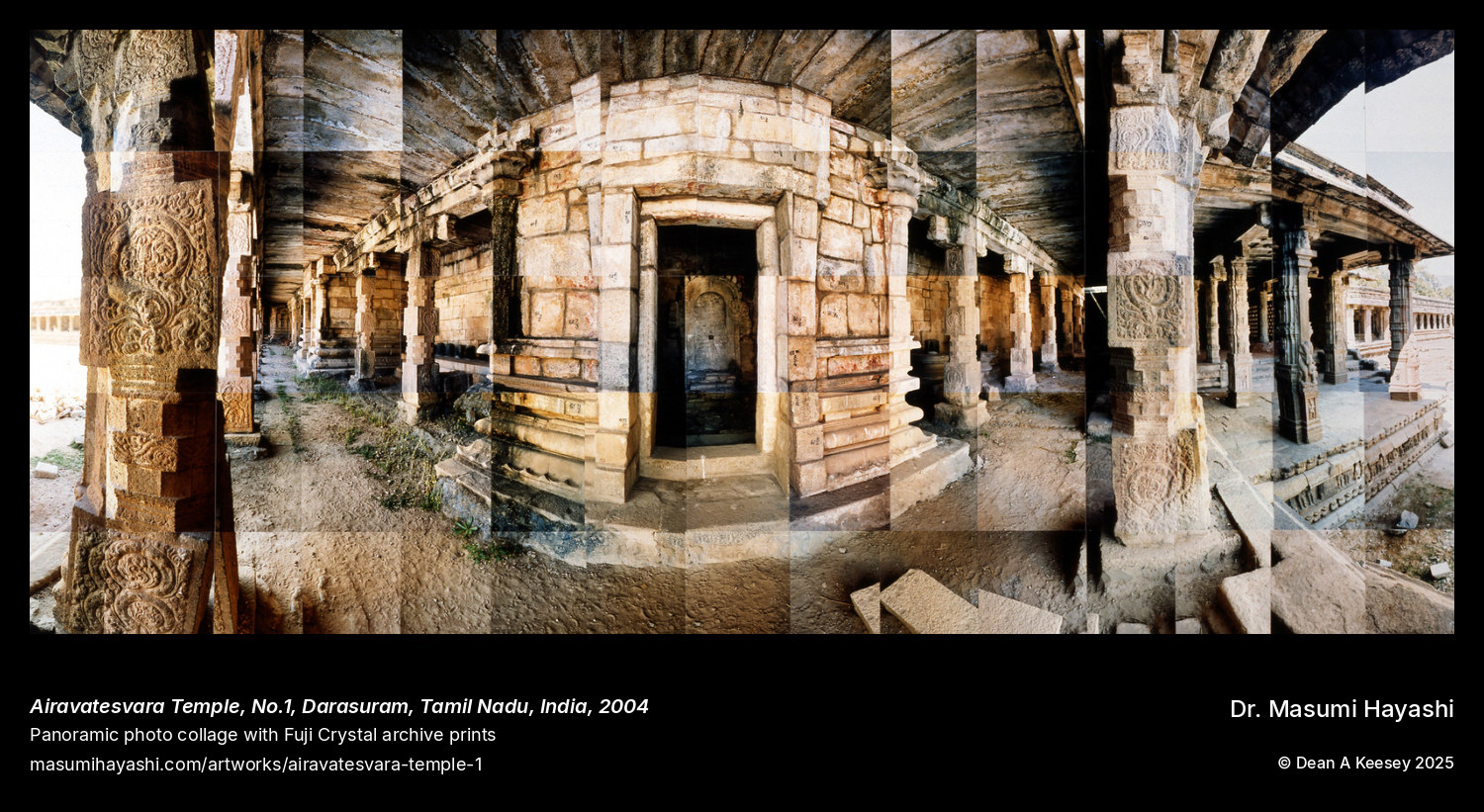
“Airavatesvara Temple #1” documents the UNESCO World Heritage masterpiece of Chola dynasty architecture in Darasuram, Tamil Nadu. Created in 2004 during Masumi Hayashi’s intensive Tamil Nadu temple documentation campaign, this 53-by-24-inch horizontal panorama captures the exquisite proportions and sculptural richness of Rajaraja Chola II’s 12th-century architectural jewel. The work represents the first of two perspectives on this relatively intimate but supremely refined Chola temple, offering a comprehensive view that reveals both the temple’s celebrated chariot-shaped mandapa and its extraordinary integration of architecture, sculpture, and musical innovation.
As part of the Sacred Architectures series, this work extends Hayashi’s documentation of Tamil temple traditions beyond the massive pillar halls of Meenakshi and Rameswaram to explore the Chola dynasty’s earlier, more compact architectural achievements. Where those later Nayak-period temples overwhelm through sheer scale, Airavatesvara captivates through refined proportion, intricate carving, and architectural playfulness. The horizontal format—spanning 53 inches in width—allows Hayashi to encompass the temple’s famous stone chariot pavilion and its surrounding sculptural program, revealing how Chola architects achieved monumentality through artistic excellence rather than physical size.
The 2004 creation date positions this work within a prolific year of Tamil Nadu temple documentation that also produced “Rameswaram Temple #1” and the second Airavatesvara perspective. Taken together, these 2004 Tamil works establish Hayashi’s comprehensive approach to the region’s sacred architecture: the massive Rameswaram pilgrimage complex, the refined Chola masterpiece of Airavatesvara, and the folk traditions of Muthiah Ayyanar Temple (documented two years earlier). This range demonstrates her commitment to documenting the full spectrum of Tamil religious expression—from elite royal patronage to village guardian deity worship.
The Fuji film specification connects this work to Hayashi’s broader technical practices in the mid-2000s, maintaining consistency with other Tamil Nadu documentation from the same period while reflecting different lighting conditions and color palettes than the 2000 turn-of-millennium journey works.
Historical and Cultural Context
The Great Living Chola Temples
The Airavatesvara Temple forms the third component of UNESCO’s “Great Living Chola Temples” World Heritage designation (inscribed 2004), alongside the Brihadisvara temples at Thanjavur and Gangaikonda Cholapuram. This recognition acknowledges the Chola dynasty’s unparalleled architectural achievements during their political and cultural zenith between the 10th and 13th centuries. While Thanjavur’s temple (built by Rajaraja Chola I, completed 1010 CE) represents the monumental grandeur of early Chola architecture and Gangaikonda’s temple (built by Rajendra Chola I, circa 1035 CE) displays imperial ambition, Airavatesvara represents the dynasty’s refinement and artistic maturity under Rajaraja Chola II (reigned 1146-1173 CE).
The UNESCO designation emphasizes these temples as “living” monuments—not museum artifacts but active centers of Hindu worship maintaining unbroken traditions across nine centuries. The Airavatesvara Temple, though smaller than its companions, continues daily puja rituals and annual festivals, particularly the celebration of Airavata (Indra’s white elephant) who according to legend regained his white color by bathing in the temple’s sacred tank. This narrative connection between mythology, architecture, and ongoing ritual practice exemplifies the “living temple” concept central to UNESCO’s recognition.
The 2004 World Heritage inscription coincides exactly with Hayashi’s photographic documentation, suggesting her work captured the temple during a moment of renewed international attention and potentially heightened preservation activity. Her panoramic approach serves as both artistic interpretation and cultural document, preserving the temple’s spatial relationships and sculptural richness at a specific historical moment.
Chola Dynasty Architectural Innovation
The Chola architectural tradition, spanning roughly 300 years from the 10th through 13th centuries, represents one of the most sophisticated developments in Hindu temple design. Chola architects perfected the “Dravida” or Southern style of temple construction, characterized by pyramidal towers (vimanas), enclosed courtyards, elaborate gopurams (gateway towers), and extensive sculptural programs integrated into architectural surfaces.
Airavatesvara Temple showcases the mature Chola style’s distinctive features: the compact plan focusing devotional attention on a relatively small sanctum, the integration of sculpture and architecture into a unified aesthetic program, and the incorporation of innovative elements like musical steps and chariot-shaped pavilions. Unlike the earlier monumental Chola temples at Thanjavur and Gangaikonda, which overwhelm through sheer scale, Airavatesvara achieves its effect through exquisite proportion and exhaustive surface articulation.
The temple’s most celebrated feature—the stone chariot pavilion fronting the main shrine—demonstrates Chola architects’ sculptural virtuosity. The entire mandapa is conceived as Shiva’s chariot, complete with intricately carved wheels, prancing horses, and elaborate architectural details that transform structural necessity into mythological narrative. This architectural playfulness, combined with extraordinary technical precision, exemplifies the confident maturity of 12th-century Chola artistry.
The temple’s musical steps—granite stairs that produce musical tones when struck—represent another distinctive innovation. This integration of acoustic design into sacred architecture reflects the Chola understanding of temples as multisensory devotional environments, engaging sight, sound, and spatial experience in coordinated worship practice.
Darasuram and Regional Context
Darasuram, located near Kumbakonam in Tamil Nadu’s Thanjavur district, functioned as an important Chola administrative and cultural center during the 12th century. The town’s proximity to Kumbakonam—a major pilgrimage center known for its concentration of temples and sacred water bodies—positioned Airavatesvara within a dense network of Chola religious architecture. This regional temple concentration allowed Chola kings to demonstrate royal devotion while consolidating political authority through architectural patronage.
The temple’s relatively modest scale compared to earlier Chola monuments reflects changing political circumstances in the 12th century, as the dynasty faced increasing challenges from rival kingdoms. Yet the extraordinary quality of artistic execution suggests that declining political power did not diminish cultural sophistication. If anything, Airavatesvara represents a shift from architectural monumentality to sculptural refinement, from overwhelming scale to meticulous craftsmanship.
The temple’s dedication to Shiva as Airavatesvara (the lord worshipped by Airavata, Indra’s elephant) connects it to broader networks of Shaivite devotion across Tamil Nadu while establishing its own distinctive mythological identity. This balance between universal Shaivite theology and local narrative specificity characterizes Tamil temple traditions more broadly.
Format and Technical Analysis
Horizontal Panoramic Strategy
The 53-by-24-inch horizontal format represents a relatively wide panoramic proportion (2.21:1 aspect ratio), allowing Hayashi to encompass substantial architectural breadth while maintaining clear detail across the temple’s sculptural surfaces. This horizontal orientation—in contrast to the extreme vertical panoramas of works like “Jain Temple, Jaisalmer” (25×73 inches, 2.92:1) or “River Ganges, Varanasi” (19×62 inches, 3.26:1)—suggests documentation of horizontal architectural elements: courtyard relationships, mandapa structures, and the visual relationships between different temple components.
The format’s width accommodates the stone chariot pavilion’s lateral extension, likely capturing the full sculptural program of horses, wheels, and architectural ornamentation that defines the mandapa’s chariot conceit. Where vertical formats emphasize soaring towers and compressed spatial depth, this horizontal panorama spreads laterally, inviting visual scanning across intricate surfaces rather than vertical eye movement along ascending architectural elements.
The 24-inch height maintains sufficient vertical dimension to capture architectural elevations, gopuram profiles, and the relationship between ground plane and temple superstructure. This balanced proportion suggests a relatively comprehensive view that neither compresses vertical elements (as in extremely wide panoramas) nor truncates horizontal relationships (as in narrow vertical formats).
Dual-Perspective Documentation
The existence of “Airavatesvara Temple #2” (23×50 inches, vertical orientation) alongside this horizontal work establishes a systematic two-work documentation strategy. This approach mirrors Hayashi’s treatment of other significant sites: the two Okunoin cemetery works (both 17×53 inches, 1996), the two Jaisalmer works (both vertical but different heights, 2000), and the Dharamsala pair (Norbulingka and Tsuglagkhang, both 2004).
The contrasting formats—horizontal #1 versus vertical #2—suggest complementary perspectives on the same architectural complex. While this horizontal panorama likely captures courtyard relationships, mandapa structures, and lateral architectural extent, the vertical companion (23×50 inches, 2.17:1) presumably documents the temple’s vimana tower, vertical sculptural programs, and the soaring proportions characteristic of Chola temple design.
This dual-perspective approach provides comprehensive spatial documentation impossible within a single viewpoint. It also generates comparative formal analysis: how does the same architectural complex function visually when experienced through horizontal expansion versus vertical compression? What different aesthetic and devotional meanings emerge from these alternative framings?
Fuji Film Stock and Color Palette
The Fuji film specification maintains consistency with other Tamil Nadu temple documentation from the 2000-2004 period, ensuring comparable color rendition across works documenting Meenakshi, Rameswaram, and Airavatesvara. Fuji films of this era tended toward warm color palettes with rich reds and yellows, particularly well-suited to capturing the honey-colored granite characteristic of Chola temple construction.
The Chola preference for granite—harder and more durable than the sandstone common in North Indian temple architecture—produces distinctive visual qualities: smoother surfaces allowing finer carving detail, warmer color tonalities ranging from honey to gray, and greater resistance to weathering. Fuji film’s warm bias would accentuate these granite qualities, emphasizing the golden afternoon light that bathes Tamil temples and the subtle color variations within different granite types.
The light quality in Darasuram—filtered through Tamil Nadu’s tropical atmosphere with its characteristic haze and intense sunshine—creates different photographic conditions than the northern Indian sites of the 2000 journey or the Japanese locations of the mid-1990s works. Hayashi’s consistent use of Fuji film across these varying conditions suggests deliberate color management, maintaining series coherence while adapting to regional lighting variations.
Series Context and Comparative Analysis
Tamil Nadu Temple Documentation
“Airavatesvara Temple #1” forms part of Hayashi’s systematic documentation of Tamil Nadu’s sacred architecture, a regional concentration spanning multiple temple traditions and historical periods:
- Chola Dynasty: Airavatesvara #1 and #2 (both 2004) document 12th-century royal patronage
- Nayak Period: “Man & God, Meenakshi Temple” (2001) and related Meenakshi works document 16th-17th century massive pillar halls
- Multiple Eras: “Rameswaram Temple #1” (2004) documents an architectural palimpsest spanning many centuries
- Folk Traditions: “Muthiah Ayyanar Temple” (2002) documents village guardian deity worship outside brahmanical traditions
This comprehensive approach documents the full historical and social range of Tamil sacred architecture. The inclusion of Airavatesvara—a UNESCO World Heritage site representing architectural excellence at royal patronage’s peak—alongside folk village shrines demonstrates Hayashi’s commitment to documenting both elite and vernacular religious expression.
The chronological clustering of these Tamil works (2001-2004) suggests sustained engagement with the region’s temple traditions, possibly across multiple photographic journeys. The pairing of Chola refinement (Airavatesvara) with Nayak monumentality (Meenakshi, Rameswaram) creates productive comparative possibilities: how did Tamil temple architecture evolve from the compact perfection of 12th-century Chola temples to the overwhelming scale of 16th-17th century Nayak construction?
Architectural Scale and Intimacy
Airavatesvara’s modest scale—particularly compared to the massive Meenakshi and Rameswaram complexes—positions it as among the Sacred Architectures series’ more intimate temple subjects. Where Meenakshi’s thousand-pillar hall and Rameswaram’s 197-meter corridors create almost overwhelming spatial experiences, Airavatesvara’s tighter proportions and focused artistic program offer different qualities: contemplative rather than overwhelming, refined rather than monumental, intellectually engaging rather than physically immersive.
This scale variation across the series suggests Hayashi’s interest in documenting the full range of sacred architectural experience. Not all religious architecture operates through monumentality; some traditions achieve spiritual power through perfected proportion, exquisite surface treatment, and concentrated artistic attention. Airavatesvara exemplifies this alternative approach to sacred space.
The temple’s human scale—its architectural elements remaining visibly comprehensible rather than transcending immediate perception—also facilitates detailed photographic documentation of sculptural programs. Where massive temples risk reducing sculpture to decorative pattern at panoramic scale, Airavatesvara’s tighter dimensions allow individual carvings to remain visually legible within the panoramic frame.
UNESCO World Heritage Documentation
The 2004 creation date’s coincidence with UNESCO World Heritage inscription positions this work within a small subset of the Sacred Architectures series documenting officially recognized monuments of universal cultural value. Other UNESCO sites in the series include Angkor Wat and associated Khmer temples (inscribed 1992), Ellora Caves (inscribed 1983), and Khajuraho temples (inscribed 1986).
This UNESCO dimension adds interpretive layers to Hayashi’s photographic practice. Her documentation serves multiple functions: artistic interpretation of sacred space, cultural preservation of architectural heritage, and visual record of sites deemed internationally significant. The panoramic format’s comprehensive spatial documentation takes on archival dimensions when applied to World Heritage sites, creating visual records that balance artistic vision with documentary responsibility.
The “living temple” designation particularly resonates with Hayashi’s photographic approach. Her panoramas typically avoid the empty, museum-like documentation common in architectural photography, instead capturing temples as actively inhabited devotional spaces. While specific details require direct observation of individual works, her practice generally acknowledges sacred architecture’s ongoing religious function rather than treating temples as aesthetic objects separated from living practice.
Edition Status and Institutional Context
Current Edition Locations
The edition tracking indicates retention of both framed and unframed impressions in inventory, suggesting two of the five authorized editions remain available:
Unknown editions: Three additional impressions unaccounted for in current records
This retention of two impressions (one framed, one unframed) from a five-edition run suggests either limited distribution or sales, potentially reflecting the work’s creation during Hayashi’s later career period (2004) when institutional recognition and market presence were still developing. The framed/unframed pairing also provides flexibility for different presentation contexts—museum exhibitions typically preferring framed works while certain collectors or institutions might select unframed impressions.
The companion work “Airavatesvara Temple #2” shows contrasting edition status: inventory records indicate “Inventory - framed” but the inInventory field reads false, suggesting this edition may have been sold, donated, or transferred. This discrepancy warrants verification but might indicate separate paths for the two related works—the vertical perspective finding placement while the horizontal panorama remains available.
Institutional Placement Potential
The work’s UNESCO World Heritage subject matter, combined with its documentation of Chola architectural masterworks, positions it favorably for institutional collections focused on:
- Indian art and architecture: Museums with South Asian collections would value documentation of UNESCO-recognized Chola monuments
- World Heritage documentation: Institutions collecting photographic records of internationally significant cultural sites
- Architectural photography: Collections emphasizing innovative photographic approaches to built environment documentation
- Religious architecture studies: Academic institutions teaching comparative religious architecture or South Asian temple traditions
The existence of the dual-perspective documentation (horizontal #1 and vertical #2) creates acquisition possibilities for institutions interested in comprehensive spatial documentation. Museums might acquire both works as a pair, offering visitors complementary viewpoints on the same architectural complex and demonstrating Hayashi’s systematic documentation methodology.
Conservation and Display Considerations
The 53-by-24-inch horizontal format presents moderate conservation challenges—large enough to require careful handling and substantial wall space but more manageable than the extreme vertical panoramas reaching 73 inches in height. The dimensions suggest the work would function effectively in various exhibition contexts: as a standalone focal piece, within thematic groupings of Tamil temple documentation, or in comparative displays with other Sacred Architectures series works.
The Fuji film-based chromogenic print process requires standard photographic conservation protocols: controlled temperature and humidity, limited light exposure, and protection from atmospheric pollutants. The relatively recent creation date (2004) means the work benefits from modern conservation knowledge and materials science, with film stocks and printing papers of this era demonstrating improved archival stability compared to earlier photographic materials.
Framing considerations for this horizontal panorama must balance several factors: providing adequate visual breathing room around the image while avoiding frames so wide they become unwieldy, using materials and techniques appropriate for long-term preservation, and maintaining consistency with other Sacred Architectures series works to facilitate cohesive exhibition presentation.
Cultural Significance and Artistic Achievement
“Airavatesvara Temple #1” represents Masumi Hayashi’s photographic encounter with one of Indian temple architecture’s supreme achievements—a 12th-century masterpiece that balances monumental conception with intimate scale, royal patronage with artistic refinement, and architectural innovation with traditional devotional function. The work documents not merely a building but a cultural achievement: the Chola dynasty’s perfection of South Indian temple design, the integration of sculpture and architecture into unified aesthetic programs, and the creation of sacred spaces that have sustained living religious practice across nine centuries.
The horizontal panoramic format—spanning 53 inches to encompass the temple’s chariot pavilion, sculptural programs, and spatial relationships—demonstrates Hayashi’s sophisticated adaptation of photographic technique to architectural subject. Where conventional photography fragments such sites into isolated views, the panoramic approach maintains spatial integrity, revealing how Chola architects orchestrated complex relationships between architectural elements, sculptural surfaces, and devotional movement patterns.
As part of the broader Sacred Architectures series, this work contributes to Hayashi’s comprehensive documentation of Asian temple traditions. The inclusion of Chola architectural refinement alongside Nayak monumentality, folk village shrines, and Japanese Buddhist sites establishes her practice as genuinely comparative—not privileging any single tradition but documenting the full range of approaches to creating sacred space. This comparative breadth, combined with technical sophistication and sustained engagement with individual sites, positions the Sacred Architectures series as significant contribution to both fine art photography and cultural documentation.
The work’s creation in 2004—coinciding with UNESCO World Heritage recognition of the Great Living Chola Temples—adds historical specificity to Hayashi’s photographic project. Her documentation captures these monuments at a particular moment: recognized as universally significant cultural achievements while maintaining unbroken devotional traditions, threatened by environmental degradation and tourism pressure while protected by international preservation frameworks, ancient in origin but continuously renewed through living religious practice. This temporal complexity—the intersection of past and present, tradition and modernity, local devotion and global recognition—animates the Sacred Architectures series’ sustained investigation of sacred space.
Collection Information
Year: 2004 Location: Darasuram, Tamil Nadu, India Medium: Panoramic Photo Collage Dimensions: 53 × 24 inches Film Stock: Fuji Edition: 1 of 5
- Inventory - unframed
- Unknown
- Unknown
- Unknown
- Unknown