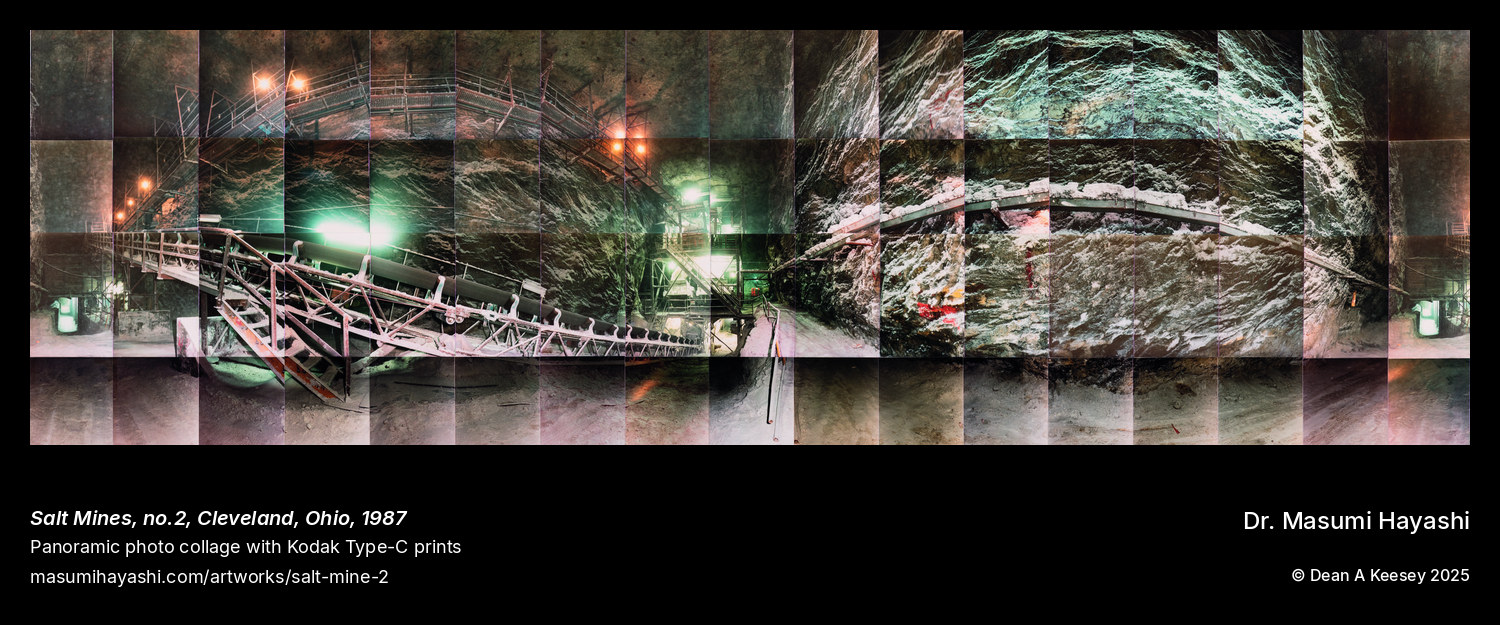
Salt Mines, no.2
Cleveland, OH, USA
Panoramic photo collage with Kodak Type-C prints
1987
19 x 56
This 19-by-56-inch horizontal panorama documents the salt mining operations beneath Cleveland—an industrial activity that continues to the present day, extracting salt deposits laid down 400 million years ago when ancient seas covered the region. The nearly five-foot width captures surface infrastructure accessing the mines extending under Lake Erie.
Created in 1987, the work documents an industry distinct from the steel mills and manufacturing plants dominating Hayashi’s Cleveland series. Salt mining represents extractive industry—removing mineral wealth from the earth rather than processing materials into manufactured goods. The salt beds underlying Cleveland and extending under Lake Erie have been mined since the 1960s, their product primarily used for winter road treatment.
The “No. 2” designation suggests Hayashi created multiple salt mine studies, documenting different aspects of the mining operation’s surface facilities. Unlike the steel mills and power houses whose above-ground presence dominates the landscape, salt mining occurs underground—the surface infrastructure providing access to workings extending miles beneath the city and lake.
Cleveland’s salt mines continue operating today, making this one of few industrial subjects in Hayashi’s series to have survived the deindustrialization she documented. The mines’ persistence reflects their fundamentally different economic logic: extracting irreplaceable mineral deposits rather than manufacturing goods that could be produced anywhere labor and capital could be assembled.
The horizontal format captures the mining operation’s surface extent, the photo collage technique fragmenting industrial infrastructure that provides access to invisible underground workings. This panorama documents the intersection of geological time—ancient salt deposits—with industrial time—twentieth-century extraction technology—beneath a city experiencing its own historical transformation.