Sandon, Ghost Town
Sandon, BC, Canada
Panoramic photo collage with Fuji Crystal Archive prints
1900
18 x 36
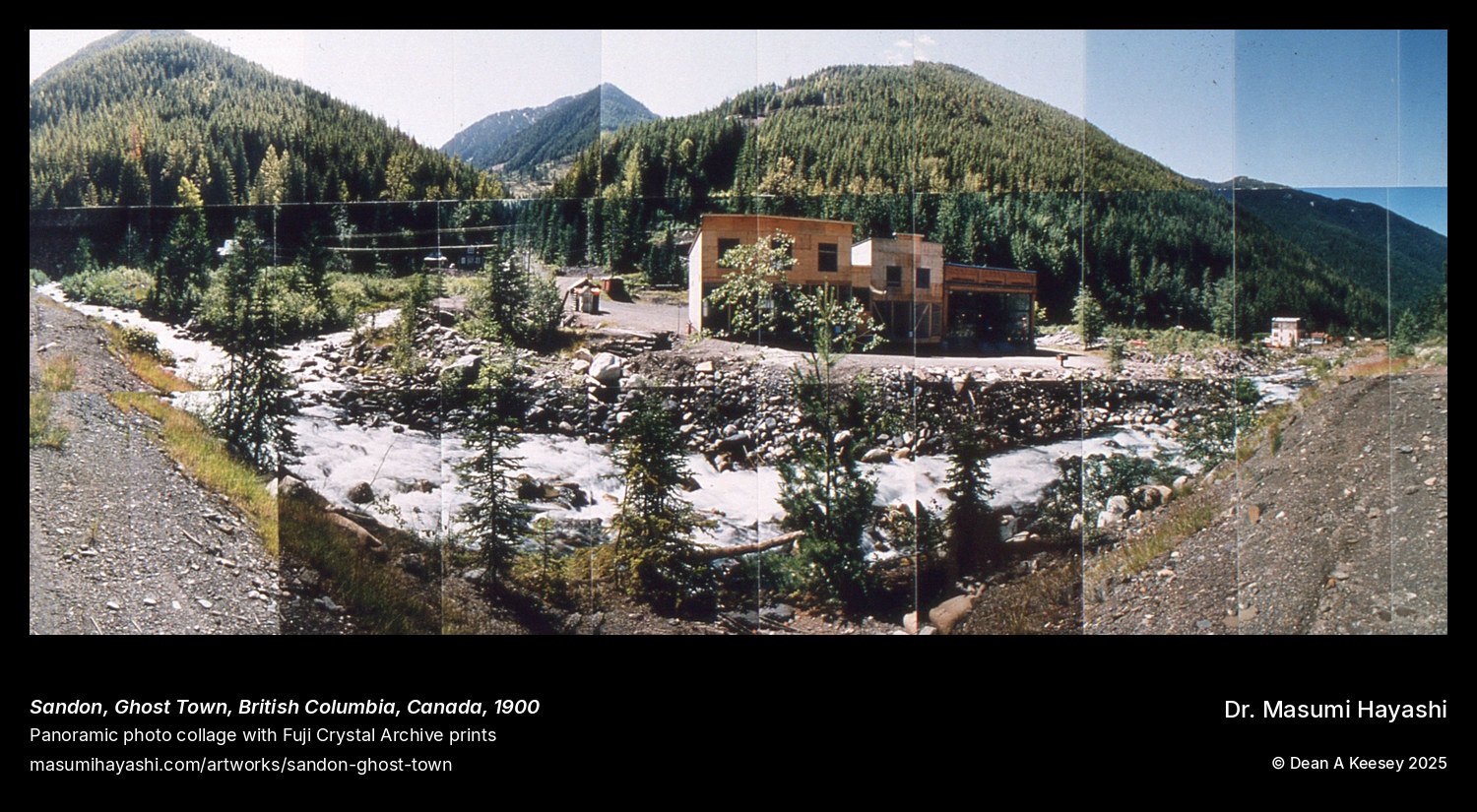
This 18-by-36-inch horizontal panorama documents Sandon, a ghost town in British Columbia’s Slocan Valley that served as an internment site for Japanese Canadians during World War II. The three-foot width captures the scale of this once-thriving mining town repurposed for wartime incarceration.
Sandon’s history embodies multiple layers of abandonment and displacement. Founded during the 1890s silver mining boom, the town had largely emptied by the 1930s as mineral wealth was exhausted. The Canadian government then repurposed these empty buildings to house Japanese Canadians forcibly removed from coastal areas—one displaced population occupying the remnants of another extractive enterprise.
The ghost town setting created particularly difficult conditions: aging mining-era structures inadequately maintained, infrastructure built for temporary extractive occupation rather than permanent habitation, isolation compounded by deteriorating roads and limited services. Japanese Canadians imprisoned in Sandon endured harsh winters in buildings never designed for year-round family occupation.
The horizontal format captures Sandon’s linear layout along Carpenter Creek, the town’s single main street revealing both mining-era commercial ambition and wartime repurposing. The photo collage technique fragments this palimpsest landscape where mining history and incarceration overlap.
Sandon has remained a ghost town since the war, neither fully abandoned nor substantially repopulated. The buildings that housed imprisoned Japanese Canadians continue their slow decay, physical evidence of multiple displacements layered in a single remote valley location. This panorama documents that layered history of extraction and incarceration.
This work documents Canadian Concentration Camps, one of the concentration camps where Japanese Americans were incarcerated during World War II.
Part of the American Concentration Camps project