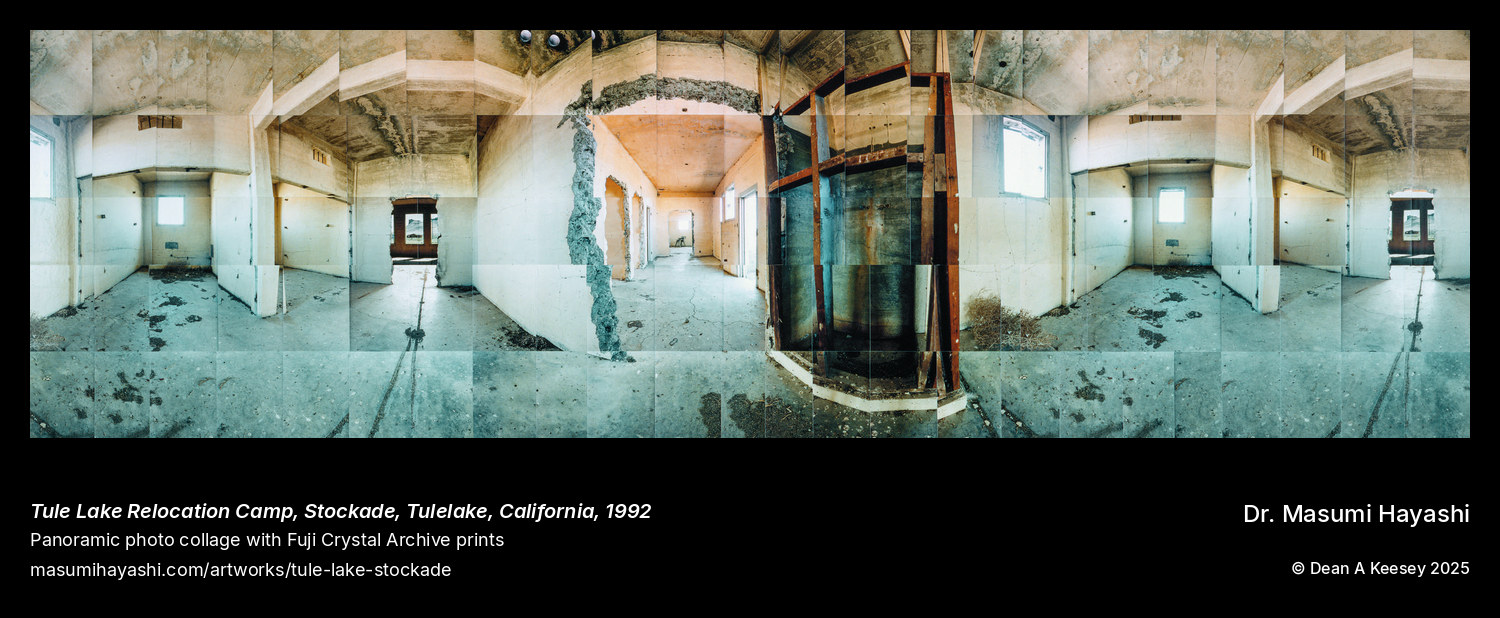
Tule Lake Internment Camp, Stockade
Tule Lake, California, USA
Panoramic photo collage with Fuji Crystal Archive prints
1992
27" x 79"
Research: Tule Lake Relocation Camp
Location: Modoc County, California, 35 miles southeast of Klamath Falls, Oregon.
Land: Bureau of Reclamation land.
Size: 7,400 acres, with a main firebreak area of 1,000 acres.
Peak population: 18,789
Date of peak: December 25, 1944
Opening date: May 27, 1942
Closing Dates:
Main Camp: March 20, 1946
Climate: High desert plateau at 4,000 feet elevation. Winters were cold with occasional snow. Summer temperatures could reach 100 degrees, but evenings were cool. The area was subject to strong winds and dust storms.
Population Origins:
Of the 18,789 Americans held prisoner here...
4,984 prisoners were from Sacramento, CA
2,703 prisoners were from King County, WA
1,052 prisoners were from Pierce County, WA
967 prisoners were from Placer County, CA
2,974 prisoners were from Other Northern California and Washington areas
Project Director(s): Elmer L. Shirrell, Harvey M. Coverley, Raymond R. Best
Community Analysts: Marvin K. Opler and John de Young
Newspaper(s): Tulean Dispatch (June 15, 1942 - October 30, 1943), Newell Star (November 1, 1943 - March 1946)
% who answered question 28 of the loyalty questionnaire positively: 84.2%
Number of segregees from other camps: approximately 12,000
Industry: The camp had extensive agricultural operations, producing food for its own consumption and for other camps. Industries included: a factory making wooden furniture and other items, a dehydration plant for vegetables, and various craft workshops.
History: Tule Lake became a maximum security segregation center in 1943, designated to house those deemed 'disloyal' based on their answers to the controversial loyalty questionnaire.
The camp was the largest and most controversial of the ten WRA camps, known for its resistance movements and civil disobedience.
After segregation, the camp was surrounded by an additional fence and guard towers, and military police presence was increased.
The camp experienced several strikes and protests, including a major incident in November 1943 that led to martial law being declared.
Many of the segregees were kibei (American-born Japanese educated in Japan) who had answered 'no-no' to questions 27 and 28 on the loyalty questionnaire.
The camp remained open the longest of all WRA camps, finally closing on March 20, 1946.
Tule Lake's agricultural program was one of the most successful, with over 2,800 acres under cultivation.
Sources: Japanese American History: An A to Z Reference, 1868 to the Present, by Brian Niiya. New York: Facts on File, 1993.
Barbara Takei and Judy Tachibana, Tule Lake Revisited: A Brief History and Guide to the Tule Lake Concentration Camp Site (2001)
Roger Daniels, Concentration Camps USA: Japanese Americans and World War II (1971)
Dorothy S. Thomas and Richard S. Nishimoto, The Spoilage (1946)