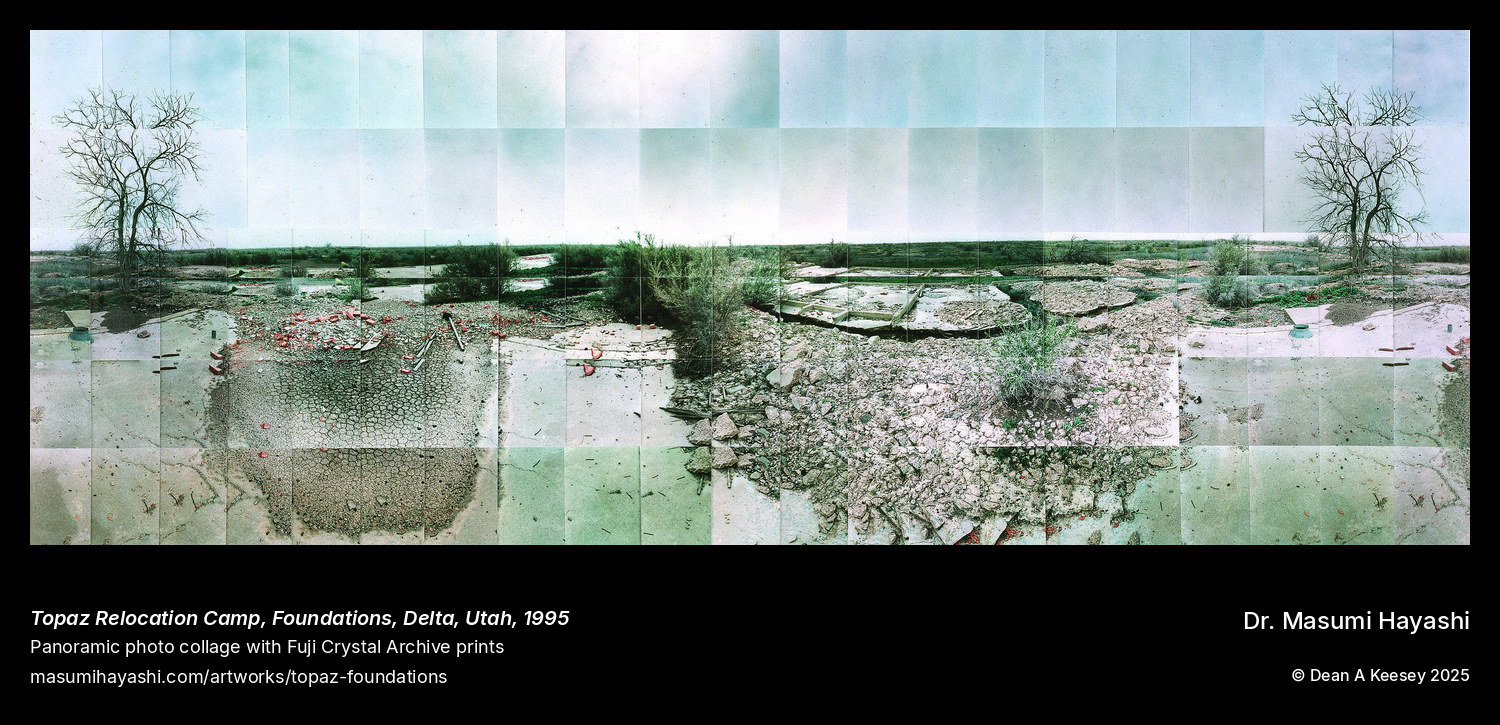
Topaz Relocation Camp, Foundations
Delta, UT, USA
Panoramic photo collage with Fuji Crystal Archive prints
1995
31 x 72
This monumental 31-by-72-inch horizontal panorama documents the concrete foundations of Topaz Relocation Center—rectangular outlines emerging from Utah desert marking where 11,000 Japanese Americans were imprisoned from 1942 to 1945. The six-foot width captures the grid logic of incarceration architecture: barracks arranged in blocks, each block containing twelve identical structures, the systematic dehumanization visible in the repetitive geometry of surviving foundation slabs.
Created in 1995 and later donated to the Topaz Museum, the work represents Hayashi’s sustained engagement with her own heritage—her parents and extended family were among those forcibly removed from their West Coast homes following Executive Order 9066. The donation acknowledges that documentation belongs with the community it commemorates, the artwork serving educational purpose alongside artistic achievement.
Topaz, officially the “Central Utah Relocation Center,” confined Japanese Americans from the San Francisco Bay Area in a high desert valley where winter temperatures plunged below zero and summer dust storms created respiratory illness. The camp’s remote location—sixteen miles from the nearest town—exemplified the government’s strategy of placing prisons beyond public visibility and scrutiny.
The foundations document what buildings looked like: rectangular barracks measuring 20 by 100 feet divided into six rooms, each room housing a family regardless of size. The geometric precision visible in surviving concrete contrasts with the chaos inflicted upon internees’ lives—businesses sold for fractions of value, personal possessions abandoned, family structures stressed by communal living where children ate in mess halls separate from parents.
The horizontal format captures the camp’s vast scale—one square mile of developed area, hundreds of buildings, thousands of lives constrained within barbed wire visible in period photographs. The foundations’ emergence from desert scrub documents both historical trauma and nature’s gradual reclamation of sites built for temporary human storage.