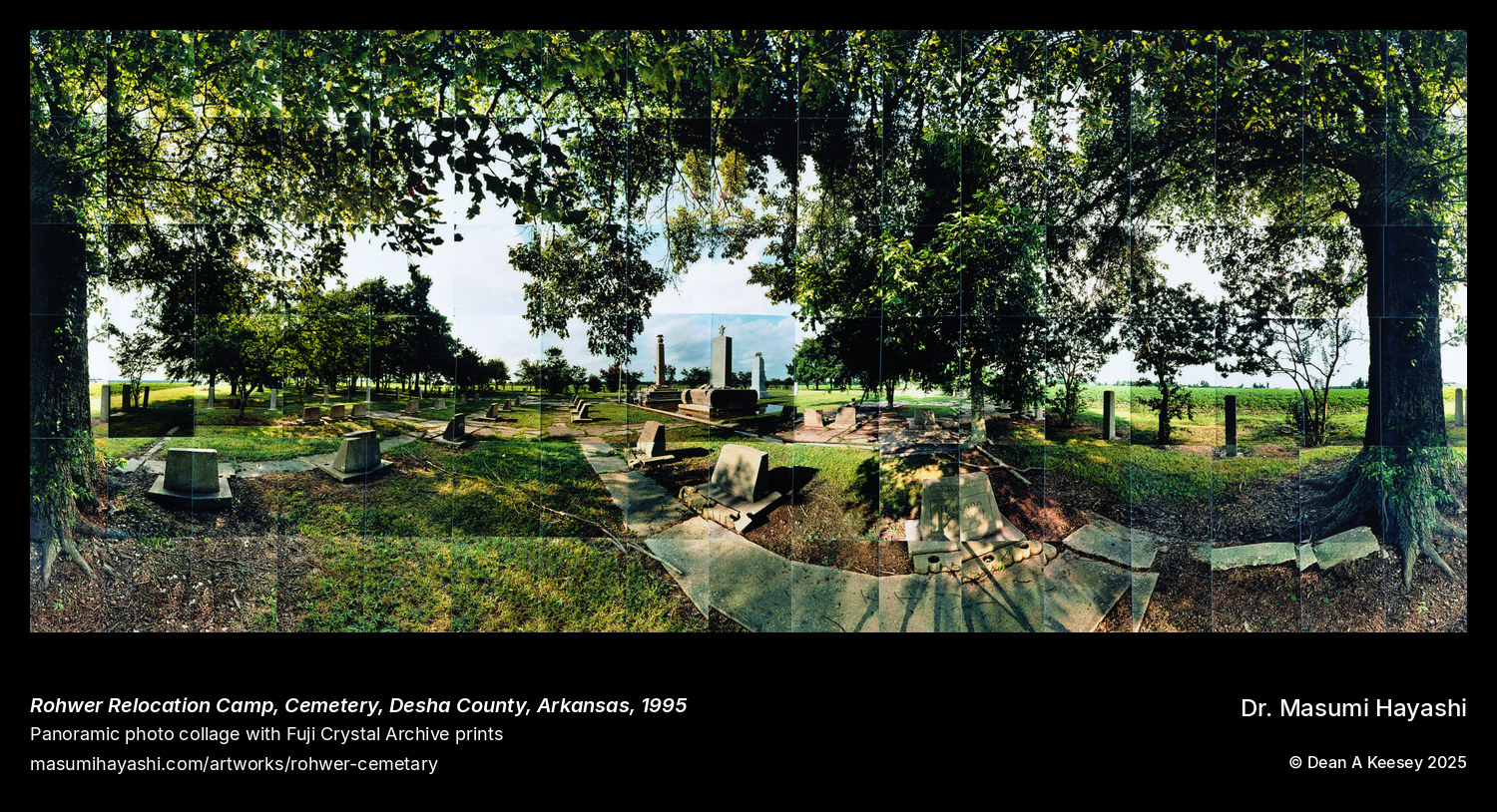
Rohwer Relocation Camp, Cemetery
Desha County, AZ, USA
Panoramic photo collage with Fuji Crystal Archive prints
1995
33 x 65
This horizontal 33-by-65-inch panorama documents the cemetery at Rohwer Relocation Center—the burial ground where Japanese Americans who died during incarceration rest in Arkansas soil far from their West Coast homes. The over-five-foot width captures the formal layout of grave markers, the dead interred with ceremony despite the constitutional violation that brought them to die in the South.
Created in 1995, the work documents the permanent consequence of incarceration—citizens who entered camps alive but left as remains, their deaths resulting from medical conditions, age, accidents, or the accumulated stress of forced removal and confinement. The cemetery’s persistence contrasts with vanished camp infrastructure, the dead anchoring memory when other physical evidence disappeared.
Rohwer confined over 8,000 Japanese Americans in the Mississippi Delta’s swampland from 1942 to 1945. The location’s humidity, insects, and flooding created conditions vastly different from the California homes internees left. Many elderly died far from communities where they had lived for decades, their funerals conducted in concentration camps their families never chose to visit.
The cemetery contains approximately 24 graves, some marked with traditional Japanese monuments hand-carved by internees, others with government-issue markers. The presence of military veterans’ graves creates particular poignancy—Japanese American soldiers killed in combat during the war were buried in the same cemetery as their families imprisoned at home.
The horizontal format captures the cemetery’s careful organization, the dignity accorded the dead despite indignity imposed upon the living. The markers stand in rows, the visual order contrasting with the chaos inflicted upon internees’ lives.
Rohwer’s cemetery became a National Historic Landmark in 1992, federal recognition acknowledging that the dead of incarceration deserve honor even as their imprisonment represented constitutional violation.
This work documents Rohwer, one of the concentration camps where Japanese Americans were incarcerated during World War II.
Part of the American Concentration Camps project
More from Japanese-American Internment Camps
Gila River Relocation Camp, Dog Grave
Gila River Relocation Camp, Foundations
Gila River Relocation Camp, Monument
Gila River Relocation Camp, Sewer
Granada (Amache) Relocation Camp, Foundations