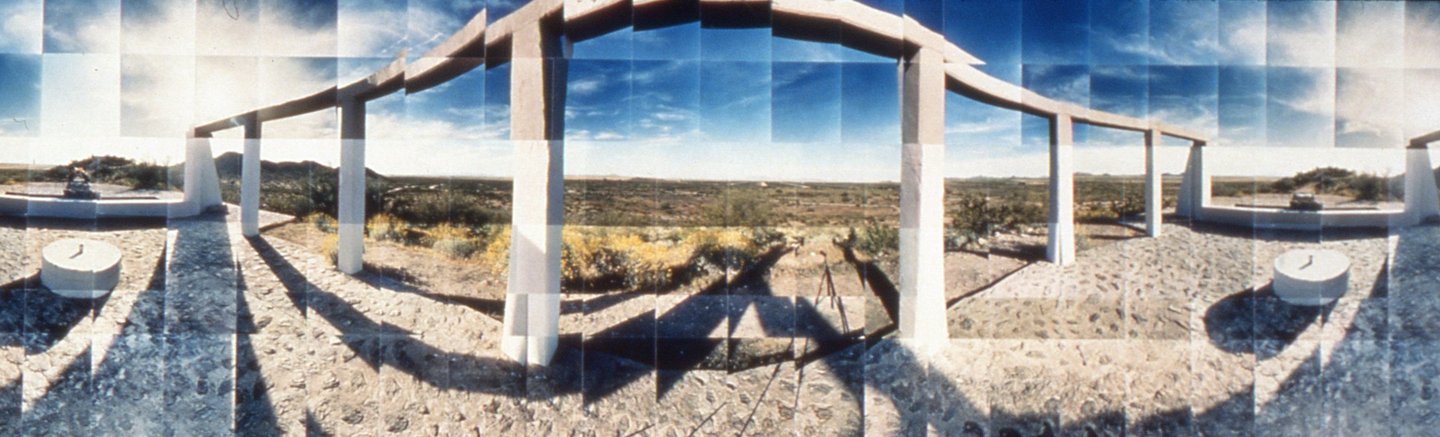
Manzanar Relocation Camp, Guard Gates
Inyo County, CA, USA
Panoramic photo collage with Fuji Crystal Archive prints
1993
27 x 65
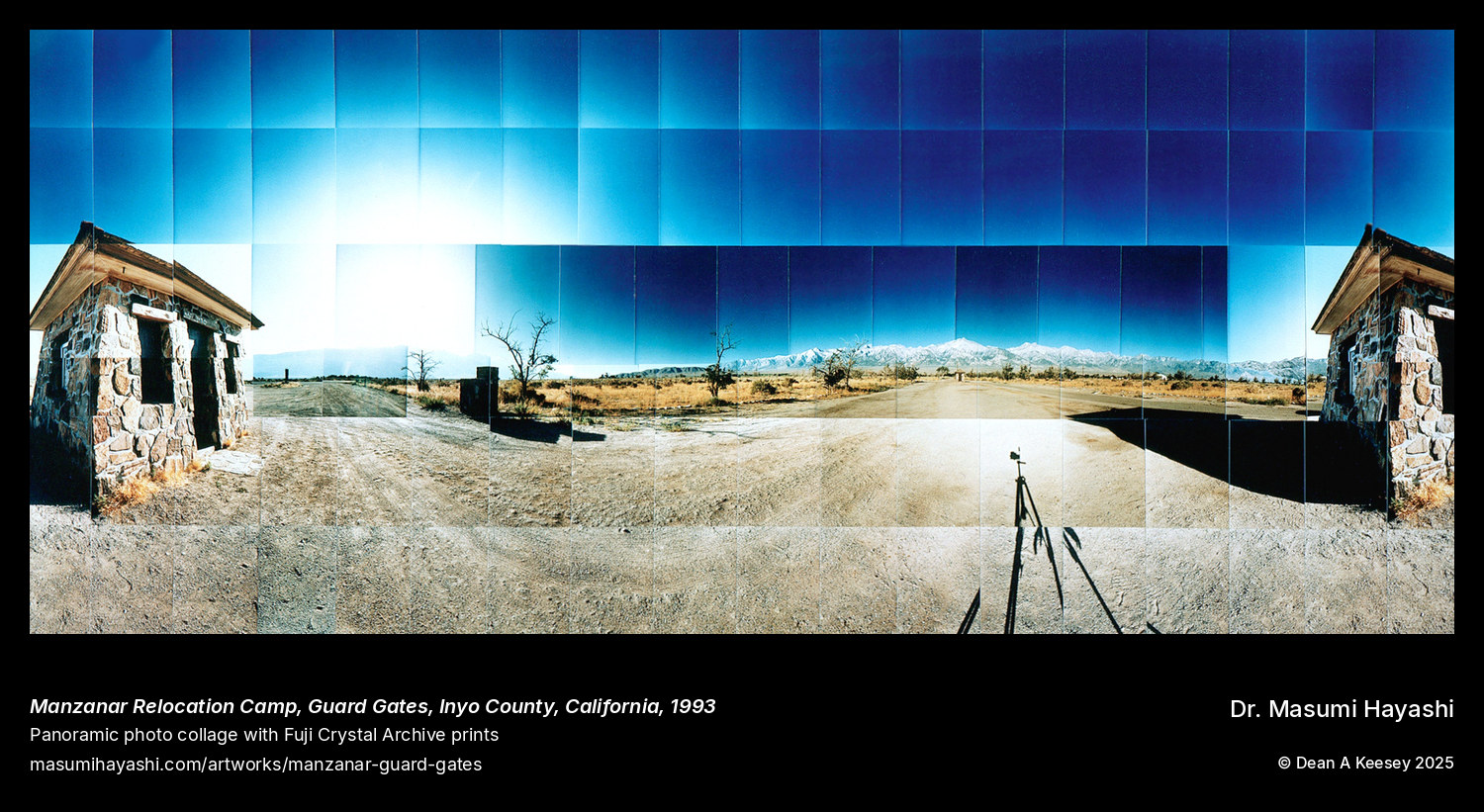
This horizontal 27-by-65-inch panorama documents the guard gates at Manzanar Relocation Center—the entry control point reconstructed as part of National Historic Site preservation, where internees passed between imprisonment and the outside world that continued normally while citizens were confined. The over-five-foot width captures the gateway architecture that managed movement into and out of the camp, the physical threshold between constitutional violation and ordinary American life.
Created in 1993, the work documents the control apparatus that defined incarceration: guard stations, identification procedures, the bureaucratic management of imprisoned citizens’ interaction with the outside world. The reconstructed gates now welcome visitors seeking understanding of injustice their nation committed against its own people.
Manzanar’s guard gates served multiple functions: controlling internee entry and exit, managing visitor access, processing work crews leaving for agricultural labor, and presenting military presence to anyone approaching the camp. The architecture announced governmental power—the gate structure communicating that those within were subject to authority those outside took for granted.
The gates’ reconstruction represents preservation philosophy: rather than simply marking absence, the National Park Service rebuilt control point architecture to convey the experience of entering incarceration. Visitors today pass through gates that approximate what internees experienced, the reconstructed threshold providing visceral understanding that documentary text cannot achieve.
The horizontal format captures the gates’ span across entry road, the architectural apparatus of control stretching to encompass all approaching traffic. The Sierra Nevada’s eastern escarpment rises beyond, creating spectacular backdrop that mocked the circumstances confining thousands within barbed wire beneath snow-capped peaks.
The work documents the intersection of preservation and interpretation: reconstructed architecture serving educational purpose, the rebuilt gates enabling contemporary visitors to approach understanding of what internees experienced.
This work documents Manzanar, one of the concentration camps where Japanese Americans were incarcerated during World War II.
Part of the American Concentration Camps project
More from Japanese-American Internment Camps
Gila River Relocation Camp, Dog Grave
Gila River Relocation Camp, Foundations
Gila River Relocation Camp, Monument
Gila River Relocation Camp, Sewer
Granada (Amache) Relocation Camp, Foundations