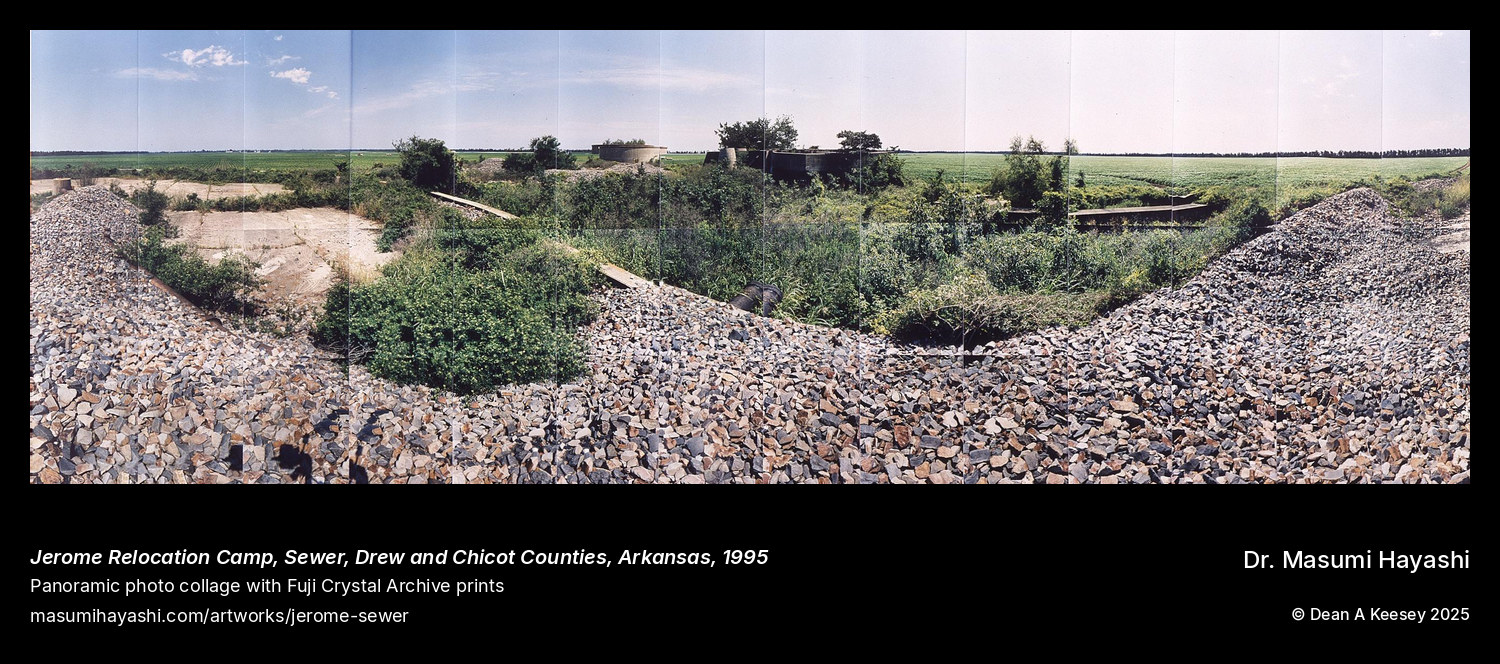
Jerome Internment Camp, Sewer
Jerome, Arkansas, USA
Panoramic photo collage with Fuji Crystal Archive prints
1990
23" x 45"
Research: Jerome Relocation Camp
Location: Southeastern Arkansas, near the town of Jerome.
Size: 10,000 acres; the center was divided into two camps: North and South.
Peak population: 8,497
Date of peak: October 30, 1942
Opening date: October 6, 1942
Closing Dates:
North Camp: June 30, 1944
South Camp: June 30, 1944
Climate: Humid subtropical climate: Hot, humid summers with temperatures reaching 100+ degrees. Swampy lowlands prone to flooding. Heavy rainfall and high humidity created difficult living conditions.
Population Origins:
Of the 8,497 Americans held prisoner here...
3,952 prisoners were from Los Angeles, CA
1,972 prisoners were from Fresno, CA
1,797 prisoners were from Santa Barbara, CA
815 prisoners were from San Joaquin, CA
695 prisoners were from Contra Costa and Ventura Counties, CA
Project Director(s): John J. McCloy, Eastburn Smith, Robert B. Cozzens, L.H. Bennett, Douglas M.Todd
Community Analysts: James H. Barnett and G.Gordon Brown
Newspaper(s): Jerome News Courier (September 12, 1942 - September 5, 1945), Jerome Bulletin (September 8 - 25, 1945)
% who answered question 28 of the loyalty questionnaire positively: 85.5%
Number and percentage of eligible citizen males inducted directly into ARMED FORCES: 487 (6.0%)
Industry: A camouflage net factory operated from Fall 1942, to May 1943; a model warship factory produced 900 models for the navy.
History: Jerome was built on Farm Security Administration land in the swampy lowlands of the Mississippi Delta region. The site was poorly suited for habitation, with inadequate drainage and frequent flooding.
Jerome had a substantial agricultural program despite the challenging terrain. The camp farmed several thousand acres, producing vegetables for camp consumption and shipment to other centers. Livestock operations included cattle, hogs, chickens, and dairy cows.
Jerome saw four project directors in its first eight months. The fourth, LH Bennett, remained director from December 12, 1942 to July 31, 1945.
The camp was marred by inadequate housing, as people poured into a center which was not yet complete. As a result, Americans were housed in every conceivable space, in nearly constant 100 degree temperatures, until construction could be completed. Schools opened in October 1942 despite the almost total lack of supplies and furniture.
On November 30, 1942, Takeo Tada was beaten by a group of men. He had been employed by both the Turlock 'Assembly Center' and Jerome administrations and was targeted as an 'inu' (dog) by those angry over a delay in clothing allocations and at the administration in general. Hearings resulted in a 30 day jail sentance for the admitted perpetrator, amid a tense atmosphere where much of the camp population supported the attacker.
Inadequate sanitation and sewage facilities coupled with the swampy conditions, humidity, and heat led to outbreaks of diarrhea, dysentery, and other illnesses.
When Eleanor Roosevelt was to visit one of the camps in the Spring of 1943, Jerome was the one chosen, undoubtably because it had the best appearance.
Source: Japanese American History: An A to Z Reference, 1868 to the Present, by Brian Niiya. New York: Facts on File, 1993. This information is provided with the permission from the Japanese American National Museum and Brian Niiya, 1997.