Pittsburgh Plate Glass
Pittsburgh, PA, USA
Panoramic photo collage with Kodak Type-C prints
1990
28 x 59
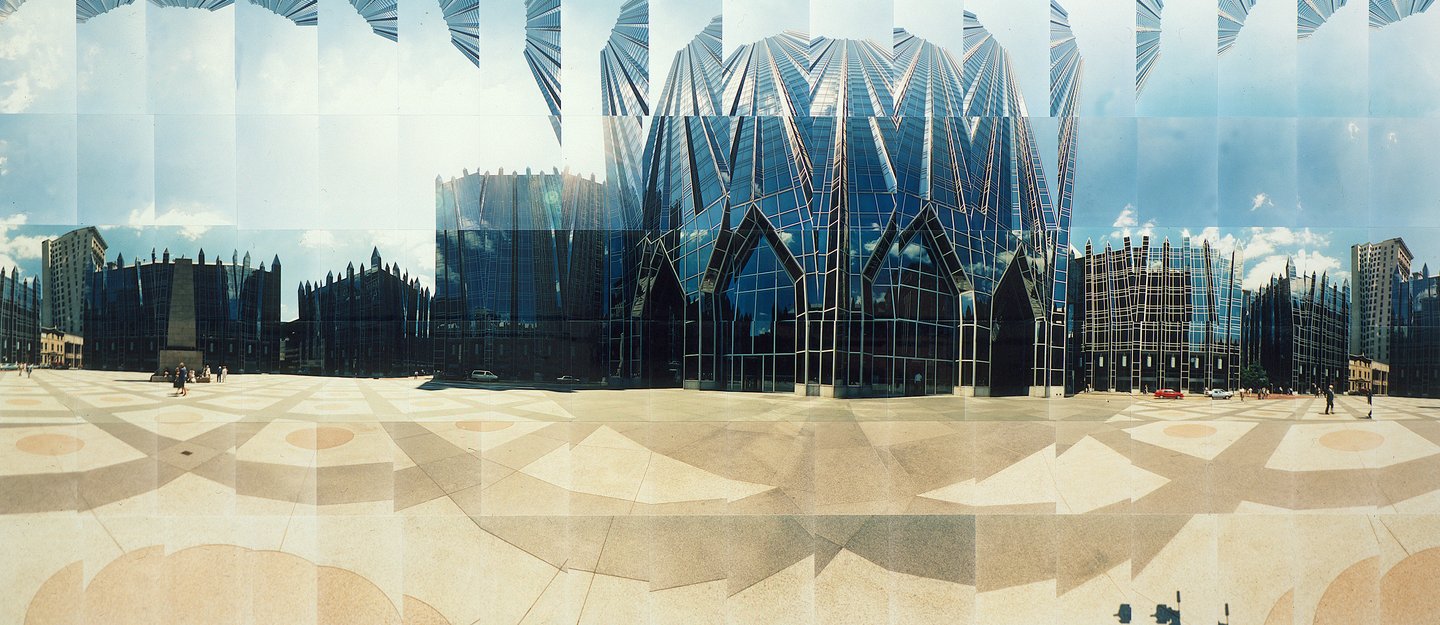
This 28-by-59-inch horizontal panorama documents PPG Place in Pittsburgh—the neo-Gothic glass tower complex that Pittsburgh Plate Glass Company built as its corporate headquarters, announcing the company’s glass manufacturing prowess through architecture composed almost entirely of its own product. The nearly five-foot width captures the crystalline forms that dominate Pittsburgh’s skyline.
Created in 1990, the work documents one of postmodern architecture’s most distinctive corporate complexes. Designed by Philip Johnson and John Burgee, PPG Place opened in 1984 as a cluster of glass towers echoing Gothic cathedral silhouettes, their reflective surfaces demonstrating the very material PPG manufactured. The buildings represent corporate identity made architectural statement.
The glass surfaces that define PPG Place create particular challenges for photography: reflections change with viewing angle, time of day, and weather conditions, the buildings’ appearance continuously shifting. Hayashi’s photo collage technique proves uniquely suited to this subject, the multiple exposures capturing varying reflections that a single photograph could not contain.
The horizontal format captures the complex’s clustered towers spreading across the site rather than emphasizing a single dominant structure. The neo-Gothic forms—spires, pinnacles, and pointed arches translated into reflective glass—create a skyline presence that references medieval architecture while celebrating modern manufacturing.
PPG Place represented Pittsburgh’s post-industrial reinvention: a glass manufacturer building corporate headquarters as the steel industry that had defined Pittsburgh collapsed. The complex announced that Pittsburgh’s future lay in materials and technology rather than the heavy industry that had built the city.
More from City Works
Angel Island Immigration Station, Men’s Section
Big Sur Beach, No. 2, Big Sur, California
Case Western Reserve University, Lewis Building (Gehry)
Cleveland Stadium, Cleveland, Ohio
Cultural Gardens #1, Lithuanian