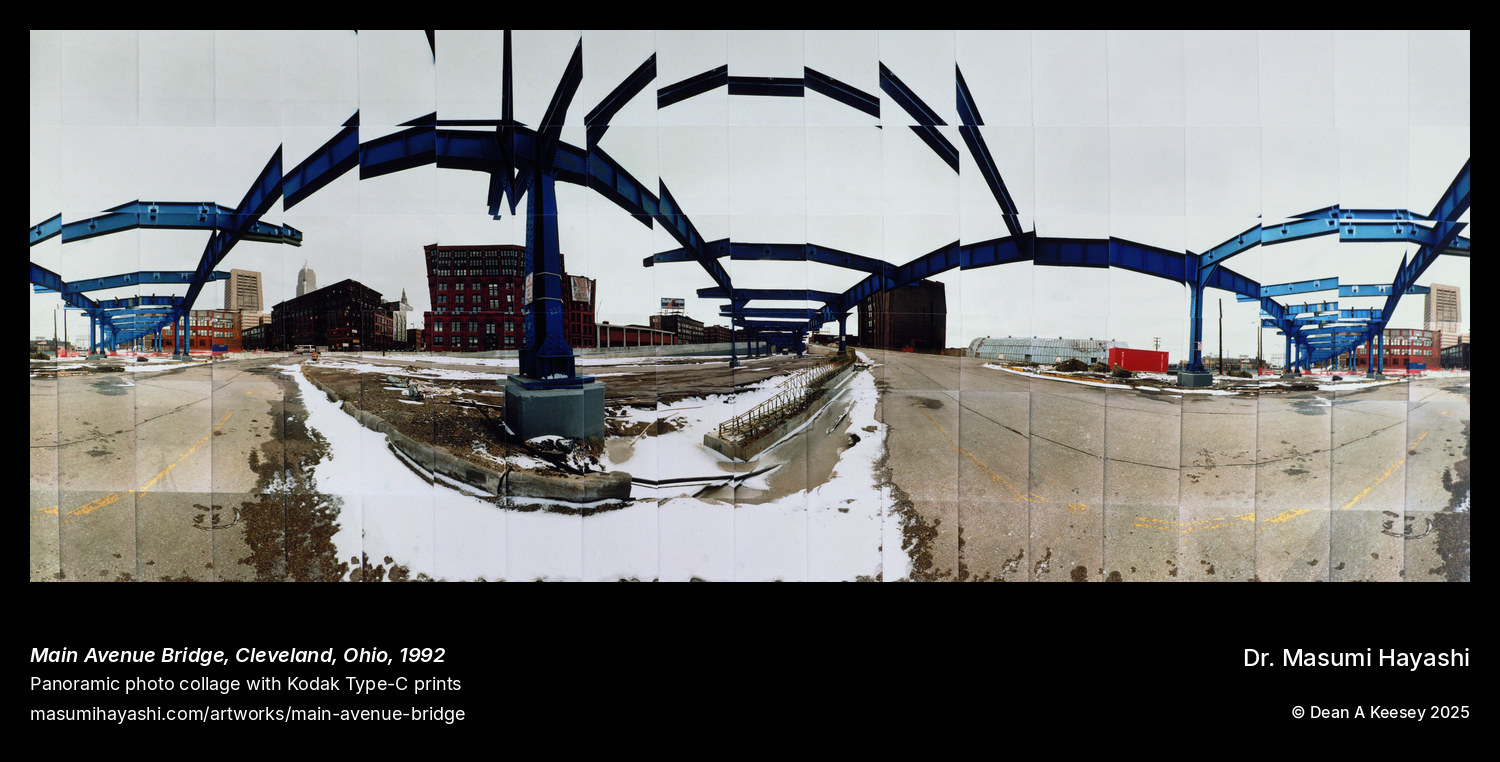
Main Avenue Bridge, Cleveland, Ohio
Cleveland, OH, USA
Panoramic Photo Collage
1992
26 x 66
Main Avenue Bridge, Cleveland, Ohio
Masumi Hayashi’s 1992 panoramic photo collage Main Avenue Bridge, Cleveland, Ohio documents one of Cleveland’s historic Cuyahoga River bridges connecting the city’s eastside and westside neighborhoods across the industrial valley known as the Flats. This 26×66-inch wide horizontal panorama captures the bridge’s steel truss architecture, urban infrastructure character, and role as utilitarian connector facilitating cross-valley transportation while overlooking Cleveland’s industrial riverfront—steel mills, ore docks, and manufacturing facilities that defined the city’s 20th-century economic identity.
The work’s 20% documented distribution (Jeffrey Gund NYC collector acquiring Edition 1, 1 unframed inventory edition retained, though “sold” status suggests additional undocumented placements) and New York collector acquisition demonstrated Cleveland infrastructure’s appeal beyond local market—NYC collector’s interest validating bridge documentation as significant urban photography transcending mere regional documentation, while modest retention pattern suggested bridge subject lacked compelling narrative of more successfully distributed Cleveland works (Cultural Gardens, transit stations, entertainment palaces).
Historical Context: Cleveland’s Bridge Network
Cleveland’s geography—bisected by the Cuyahoga River’s dramatic valley separating eastside from westside—necessitated extensive bridge network enabling city’s functional unity despite topographic division. Main Avenue Bridge, among numerous Cuyahoga River crossings (Hope Memorial Bridge, Superior Avenue Bridge, Detroit-Superior Bridge), served primarily local traffic connecting residential neighborhoods rather than functioning as major arterial like downtown’s monumental spans.
By 1992 when Hayashi documented Main Avenue Bridge, Cleveland’s bridges occupied transitional moment: aging infrastructure requiring maintenance or replacement, declining industrial activity reducing bridge traffic as steel mills closed, yet emerging recognition of bridges’ architectural significance and role in Cleveland’s industrial heritage inspiring preservation advocacy and historical documentation before obsolescence led to demolition or radical alteration.
Format & Infrastructure Documentation
The 26×66-inch dimensions (1:2.5 ratio) created horizontal panorama suited to bridge’s linear span crossing river valley, while collage technique enabled representing bridge’s structural complexity—truss patterns, steel framework, spatial relationships between bridge deck and supporting structures—through fragmented viewpoints capturing multiple perspectives simultaneously.
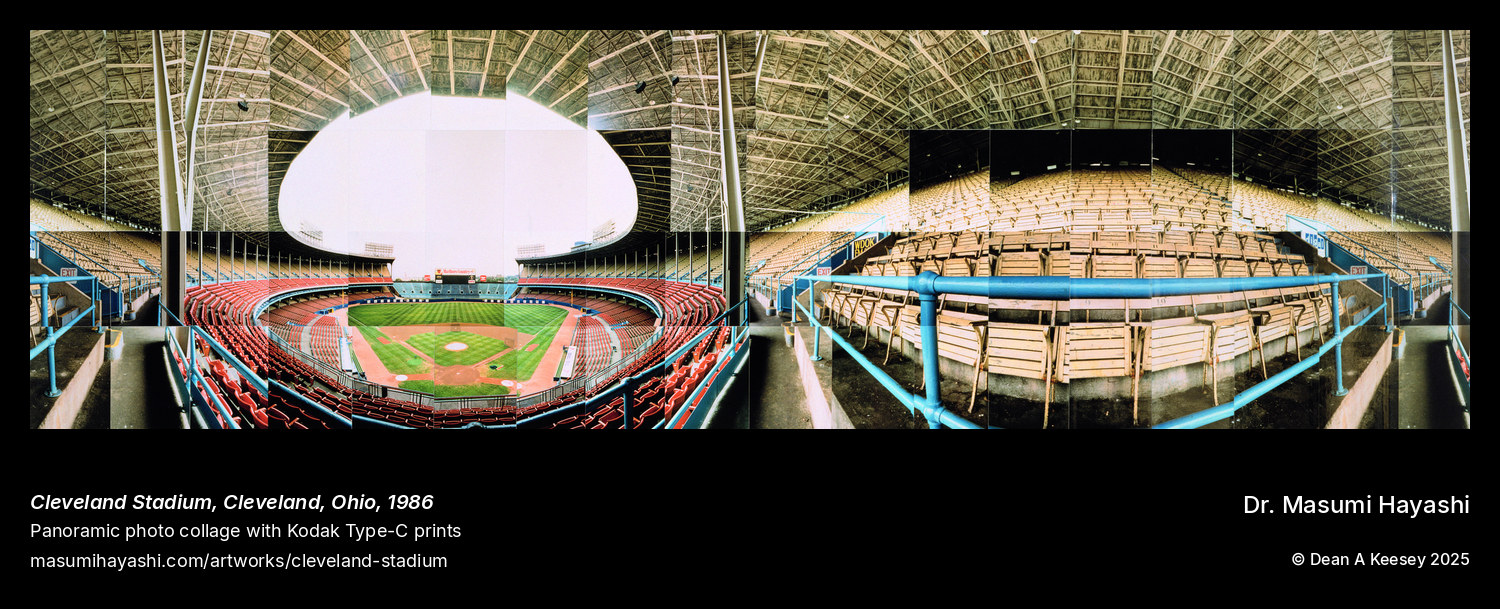
The work joined Cleveland Stadium, W. 25th Street Station, and Edgewater Park in systematic Cleveland infrastructure documentation—bridges, transit stations, parks, and civic monuments creating comprehensive visual archive of city’s built environment supporting daily life yet often overlooked in favor of architectural landmarks or cultural institutions receiving greater attention despite comparable functional significance.
NYC Collector: Cross-Market Appeal
Jeffrey Gund’s NYC acquisition represented significant cross-market validation—New York collector acquiring Cleveland bridge documentation suggested work’s urban infrastructure themes and photographic approach resonated beyond local Cleveland market where community connection drove many acquisitions. This pattern mirrored Progressive Corporation’s Wall Street acquisition (Cleveland company collecting NYC financial district) demonstrating how infrastructure documentation could appeal to collectors interested in urban themes regardless of specific geographic location.
Related Works
- W. 25th Street Station (02026) - Cleveland transit infrastructure
- Cleveland Stadium (02001) - Cleveland civic infrastructure
- Wall Street, NYC (02027) - Urban infrastructure, NYC collector parallel
- LA Subway series - Transit infrastructure documentation
- Post-Industrial Landscapes: Cleveland Flats works - Industrial riverfront
Series Context
Main Avenue Bridge represents City Works series’ engagement with Cleveland’s utilitarian infrastructure through bridge documentation capturing cross-valley connector facilitating urban circulation. The work’s NYC collector acquisition validated infrastructure documentation’s broader appeal while modest distribution suggested bridge subject lacked narrative compelling enough to match more successfully distributed Cleveland heritage works, positioning it as solid infrastructure documentation yet commercially challenged compared to works with clearer cultural or preservation narratives.
Dimensions: 26 × 66 inches (wide horizontal panorama, 1:2.5 ratio) Year: 1992 Medium: Panoramic Photo Collage Film: 3.5 × 5 Kodak Edition: 1 of 5
Distribution: 20% documented (1 NYC collector, 1 inventory), “sold” suggests additional placements Private Collector: Jeffrey Gund, NYC (cross-market validation) Location: Main Avenue Bridge, Cuyahoga River crossing, Cleveland, Ohio Series: City Works (02) Infrastructure Function: Eastside-westside connector across industrial valley (the Flats) Bridge Context: One of multiple Cuyahoga River bridges, local traffic rather than major arterial Cleveland Heritage: Industrial riverfront infrastructure documentation Market Pattern: NYC collector acquisition demonstrates cross-market infrastructure appeal