L.A. Subway, No. 1, Los Angeles, California
Los Angeles, CA, USA
Panoramic Photo Collage
1991
22 x 60
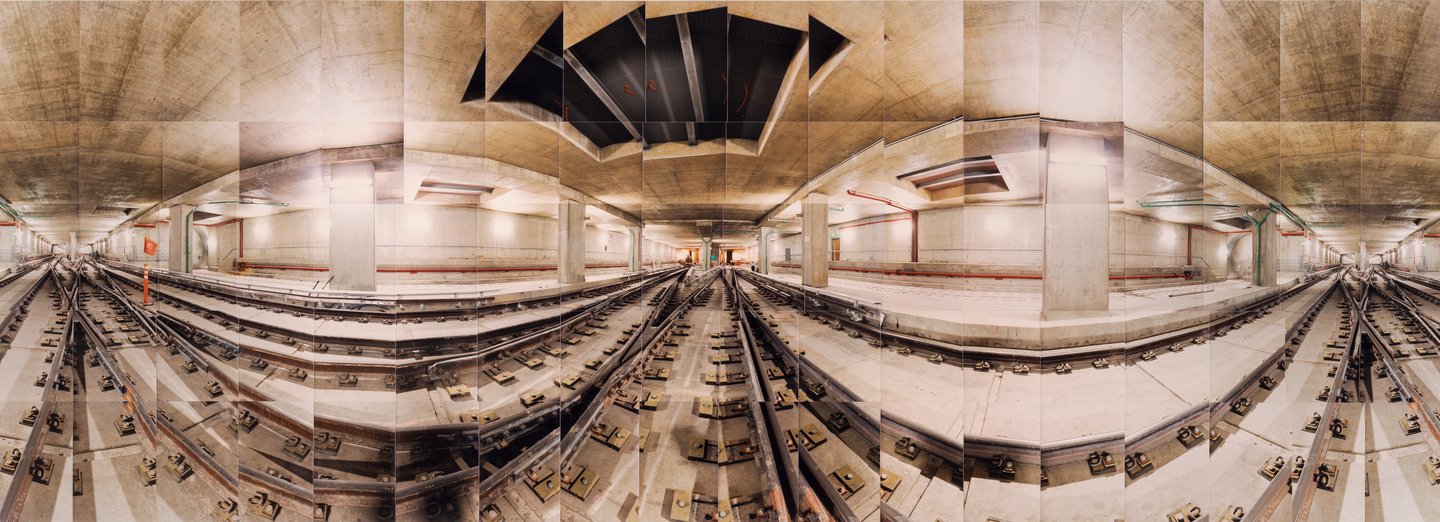
L.A. Subway, No. 1, Los Angeles, California
Masumi Hayashi’s 1991 panoramic photo collage L.A. Subway, No. 1, Los Angeles, California inaugurates her two-part documentation of Los Angeles’s historic Metro Rail Red Line—the city’s first modern subway system representing LA’s ambitious transformation from automobile-dependent sprawl toward multimodal urban transit. This 22×60-inch wide horizontal panorama captures underground station architecture and infrastructure during the system’s construction phase, employing Hayashi’s photo collage technique to document major urban infrastructure investment that challenged LA’s car-centric identity while creating new subterranean urban spaces beneath America’s quintessential horizontal city.
Historical Context: LA’s Subway Revolution
The Los Angeles Metro Rail Red Line, inaugurated in 1993 after decades of planning and construction, represented revolutionary transformation for America’s most automobile-dependent metropolis. Los Angeles, synonymous with freeway culture and suburban sprawl since the 1950s destruction of the Pacific Electric Railway’s extensive streetcar network, undertook massive investment in rapid transit infrastructure—boring subway tunnels beneath downtown, constructing underground stations, and creating public transportation alternatives challenging the city’s car-dominated transportation paradigm.
The Red Line’s development reflected multiple converging factors: traffic congestion reaching crisis levels, air quality concerns from automobile emissions, federal transit funding incentivizing rail investment, and urban planning movements promoting dense, transit-oriented development over continued suburban sprawl. The project faced substantial technical challenges—tunneling through seismically active areas, coordinating construction minimizing disruption to downtown businesses, and overcoming public skepticism about subway viability in a city culturally defined by automobile freedom and horizontal spatial organization.
Hayashi’s 1991 documentation captured the subway during construction or early operational phases—stations newly completed, infrastructure gleaming and unused, spaces representing LA’s urban future yet still disconnected from the city’s automobile-dominated present. This temporal positioning made her photography historically significant: documenting transitional moments when major infrastructure investment created new urban spaces and mobility possibilities whose full integration into city life remained uncertain and contested.
Format & Underground Spaces
The 22×60-inch dimensions (1:2.7 ratio) created wide horizontal format suited to subway station architecture—platforms extending longitudinally, tunnels creating horizontal spatial progression, underground spaces organized around horizontal circulation rather than vertical monumentality. The format paralleled passenger experience: moving horizontally through underground spaces, platforms and tunnels creating linear spatial sequences distinct from vertical orientation typical of above-ground urban architecture.
The panoramic collage technique also addressed documentation challenges in underground spaces: limited sightlines, artificial lighting, spatial compression—conditions where Hayashi’s fragmented, assembled compositions could represent spatial experiences more effectively than conventional single-point perspective photography constrained by underground environments’ physical limitations.
LA Subway Series as Paired Documentation
The creation of two separate LA Subway works (No. 1: 22×60”, No. 2: 28×79”) suggested systematic documentation approach similar to Love Canal’s two-work treatment—single subjects warranting multiple perspectives capturing different spatial dimensions or architectural features. The paired works enabled comprehensive documentation while creating series identity elevating the LA Subway from individual pieces to recognized multi-work project, potentially enhancing market appeal and collector interest.
The
Related Works
- L.A. Subway, No. 2 (02012) - Companion documentation, similar premium positioning
- L.A. Downtown, 1987 (02010) - LA urban documentation
- Union Terminal, Cincinnati (03023) - Historic transportation architecture comparison
Series Context
L.A. Subway, No. 1 inaugurates Hayashi’s documentation of Los Angeles’s revolutionary transit infrastructure, employing wide horizontal panoramas to capture underground station architecture while chronicling LA’s transformation from automobile monoculture toward multimodal urban transit. The work’s premium pricing and complete distribution positioned it as highly successful urban infrastructure documentation meriting collector acquisition and validating Hayashi’s positioning of transit photography as significant contemporary art engaging urban transformation themes.
Dimensions: 22 × 60 inches (wide horizontal panorama, 1:2.7 ratio) Year: 1991 Medium: Panoramic Photo Collage Film: 3.5 × 5 Kodak Edition: 1 of 5