L.A. Downtown, 1987, Los Angeles, California | Masumi Hayashi Foundation
Back to Gallery
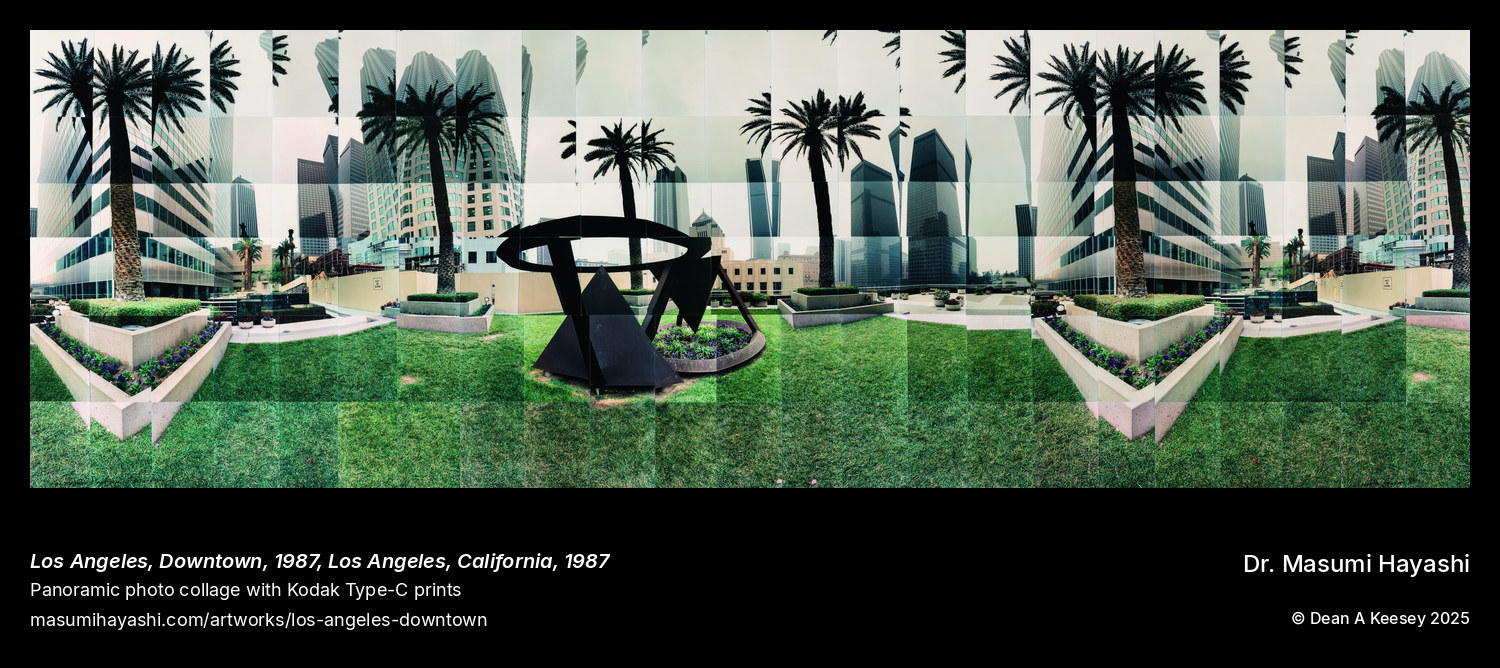
Picture of L.A. Downtown, 1987, Los Angeles, California by Dr. Masumi Hayashi

L.A. Downtown, 1987, Los Angeles, California

Los Angeles, CA, USA

Panoramic Photo Collage

1990

29 x 83

L.A. Downtown, 1987, Los Angeles, California

Masumi Hayashi’s 1990 panoramic photo collage L.A. Downtown, 1987, Los Angeles, California documents Los Angeles’s downtown urban core through monumental 29×83-inch panorama (nearly 7 feet wide!) capturing the district’s architectural density, high-rise development, and urban transformation during 1980s revitalization following decades of post-war decline. The work’s title enigma—“1987” designation despite 1990 creation date—suggests either documentation of 1987 state (photographed 1987, assembled/printed 1990) or retroactive titling commemorating specific historical moment when LA downtown entered renaissance period transforming neglected urban center into residential, cultural, and commercial destination.

The work’s 20% documented distribution (1 framed inventory edition cataloged, though “sold” status suggests additional undocumented placements) and monumental format positioned LA Downtown as ambitious yet commercially challenged work—the 83-inch width (matching Wall Street’s 82” monumentality) demonstrated technical ambition and subject significance, yet modest retention/documentation pattern suggested LA downtown documentation lacked market appeal of more iconic LA subjects (Watts Towers’ [price redacted] complete success, LA Subway’s [price redacted] 100% distribution) or Cleveland heritage works benefiting from artist’s home community connections.

Historical Context: LA Downtown Renaissance (1980s-1990s)

Los Angeles’s downtown, America’s quintessential “there is no there there” non-center, experienced dramatic 1980s-1990s transformation reversing post-1950s suburban flight, retail collapse, and perception as dangerous, abandoned urban wasteland avoided by Angelenos favoring Westside, beach communities, and suburban sprawl. Multiple factors drove downtown renaissance:

Corporate Investment: Major bank headquarters (First Interstate, Security Pacific, Wells Fargo) constructed high-rise towers establishing downtown as regional financial center, while corporate relocations brought white-collar employment reversing decades of job flight.

Cultural Development: 1980s museum boom (MOCA 1983, Disney Hall planning) and historic theater district renovation (Orpheum, Palace, State theaters) created cultural anchors attracting arts audiences downtown, while Grand Avenue cultural corridor planning envisioned cultural district rivaling Lincoln Center.

Residential Conversion: 1980s loft conversions in historic Broadway and Spring Street commercial buildings pioneered downtown living, followed by 1990s adaptive reuse accelerating residential development transforming daytime office district into 24-hour urban neighborhood.

Transit Investment: Blue Line light rail (1990) and Red Line subway (1993) connected downtown to suburbs and airport, enabling car-free commuting while validating downtown’s urban center status through transportation infrastructure investment.

By 1990 when Hayashi documented downtown (or assembled 1987 photographs), the district occupied transitional moment—renaissance underway yet incomplete, new development coexisting with persistent vacancy and social challenges (homelessness, crime, retail gaps), creating urban landscape in flux between abandonment and revitalization.

Format: Monumental 83-Inch Width

The 29×83-inch dimensions (1:2.9 ratio, 83 inches = 6.9 feet wide!) created one of Hayashi’s most monumentally scaled City Works panoramas—exceeded only by Cultural Gardens Hebrew (96”), approaching Wall Street (82”) and LA Subway No. 2 (79”). This exceptional horizontal extent suited LA downtown’s linear development along Broadway/Spring Street corridors and captured urban density through sweeping vista compressing multiple city blocks, high-rise towers, and street-level activity into unified panoramic composition.

The monumental scale also reflected subject ambition: documenting major American city’s downtown warranted format matching metropolitan significance, yet the scale simultaneously created acquisition barriers—few collectors possessed wall space accommodating 7-foot-wide artwork, while framing and shipping costs escalated with extreme dimensions, potentially constraining market despite impressive visual impact.

Title/Date Discrepancy: “1987” vs. 1990 Creation

The work’s curious titling—“L.A. Downtown, 1987” yet cataloged with 1990 creation date—invites several interpretations:

Photographic Documentation Date: Hayashi possibly photographed LA downtown 1987, then assembled/printed panoramic collage 1990—title commemorating documentation year rather than artwork completion, similar to archival photograph practices where image date reflects capture rather than printing.

Historical Moment Commemoration: 1987 might mark specific downtown renaissance milestone—major building completion, cultural opening, or urban transformation moment—making title function as historical marker rather than merely creation date.

Inventory Tracking Confusion: The cataloging notation “Inventory - framed (‘1987’)” suggests possible confusion where frame label, inventory tag, or documentation used 1987 designation creating ambiguity whether date referenced photography, completion, or other milestone.

Retrospective Titling: Hayashi might have retroactively titled work years after creation, using 1987 to situate work historically within downtown’s transformation narrative rather than reflecting actual creation timeline.

Modest Distribution & Documentation Gaps

The cataloging shows only 1 edition documented (inventory framed) yet “sold” status implies additional distributions occurred but lack documentation—pattern resembling Public Square Night’s ambiguous edition tracking where early works or private sales outside gallery representation created incomplete provenance records. Several factors potentially constrained LA Downtown distribution:

Geographic Distance: Unlike Cleveland works connecting to home community, LA documentation required West Coast market penetration where Hayashi lacked institutional relationships facilitating Cleveland’s superior placement rates—LA Subway’s success potentially reflected transit infrastructure’s universal appeal versus downtown urban documentation’s more specialized interest.

Subject Specificity: LA downtown lacked iconic landmark status of Watts Towers or narrative clarity of LA Subway’s transit infrastructure—general downtown documentation competed with abundant LA urban photography without clear curatorial hook distinguishing Hayashi’s approach from generic cityscape imagery.

Monumental Format Challenges: 83-inch width created practical acquisition barriers—storage, framing, shipping, and display requirements limiting market to collectors with significant wall space, institutional budgets, and logistical capacity managing oversized artworks.

Competition with LA Subway Success: Both LA Subway works achieved 100% distribution at [price redacted] premium pricing—collectors choosing between multiple LA works might prioritize subway’s clearer narrative and iconic LA Metro Rail Red Line subject over general downtown documentation.

  • Wall Street, NYC (02027) - Comparable 82” monumental width, financial district, [price redacted] tier
  • LA Subway series (02011-02012) - LA infrastructure, superior 100% distribution, [price redacted] tier
  • Dealey Plaza, Dallas (02007) - Major city documentation, [price redacted] tier, modest distribution
  • Public Square Night, Cleveland (02021) - Early work with distribution ambiguities
  • Post-Industrial Landscapes: Century Freeway series - LA urban infrastructure documentation

Series Context

L.A. Downtown, 1987 represents City Works series’ engagement with major American city downtown transformation through monumental 83-inch panoramic format, yet the work’s modest documented distribution and title/date ambiguities positioned it as commercially challenging piece where extreme scale, geographic distance from Cleveland base, and subject matter’s lack of iconic specificity constrained acquisition despite technical ambition and historical documentation significance capturing LA’s urban renaissance transitional moment.


Dimensions: 29 × 83 inches (monumental panorama, 6.9 feet wide!, 1:2.9 ratio) Year: 1990 (creation) / “1987” (title designation - date discrepancy) Medium: Panoramic Photo Collage Film: 3.5 × 5 Kodak Edition: 1 of 5

Distribution: 20% documented (1 framed inventory edition), though “sold” status suggests additional undocumented placements Location: Downtown Los Angeles, California (financial district, Broadway corridor) Series: City Works (02) Historical Moment: LA downtown renaissance (1980s-1990s transformation) Scale Significance: Among largest City Works formats (83” width = 6.9 feet, exceeded only by Hebrew Garden 96”) Title Mystery: “1987” designation despite 1990 creation date (photography year vs. completion year?) Market Challenge: Monumental format + geographic distance + subject specificity limited distribution LA Context: Third LA work (with Watts Towers, LA Subway pair) showing varied LA subject approach Documentation Gap: Incomplete edition tracking suggests early work or private sales outside gallery representation

Donate