Cultural Gardens
Cleveland, OH, USA
Panoramic Photo Collage
1987
39 x 61
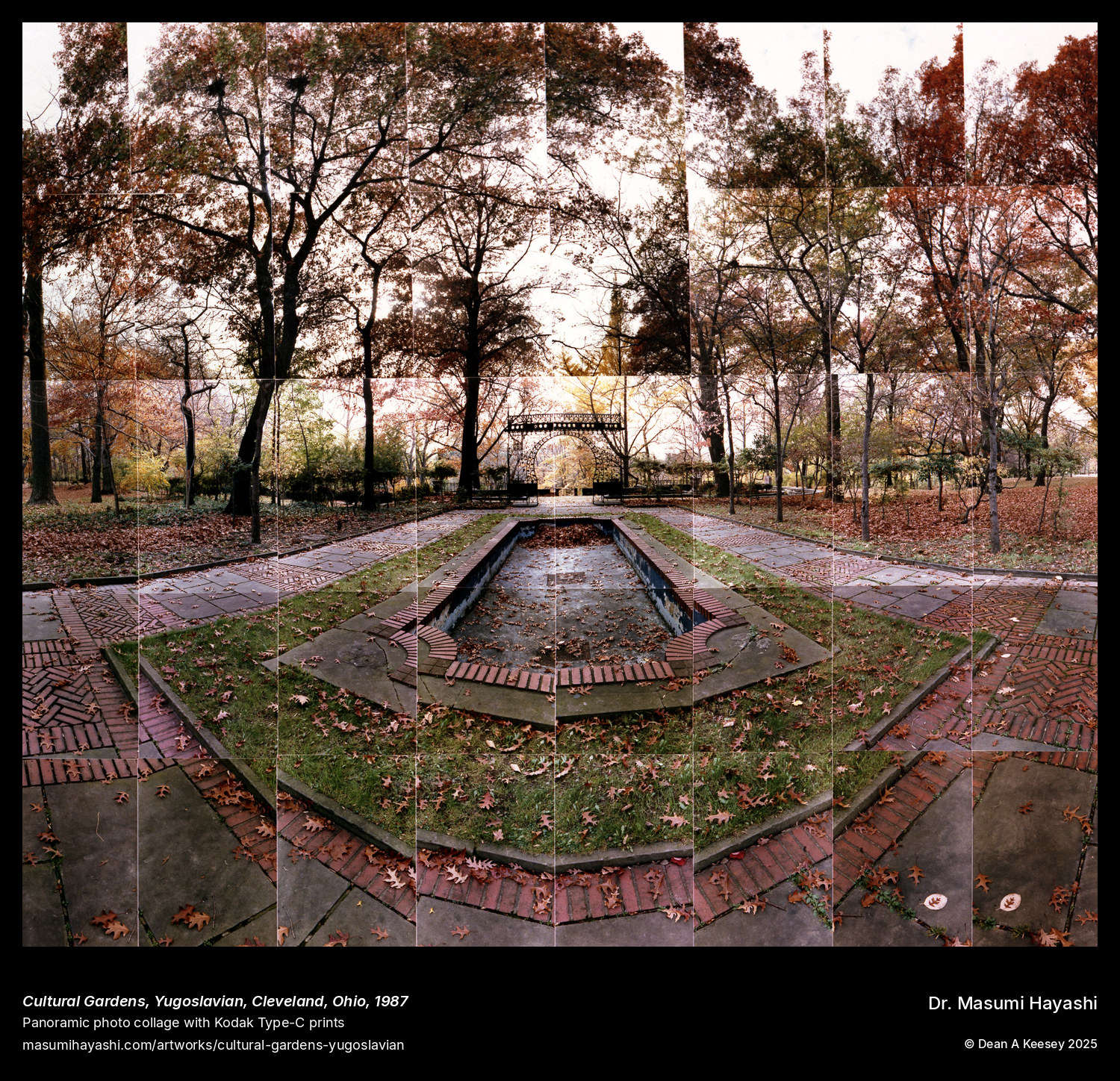
Cultural Gardens #2, Yugoslavian, Cleveland, Ohio
Masumi Hayashi’s 1987 panoramic photo collage Cultural Gardens #2, Yugoslavian, Cleveland, Ohio continues her three-part documentation of Cleveland’s Cultural Gardens, capturing the Yugoslavian Garden’s distinctive architectural and landscape features within a 39×61-inch wide horizontal format. Created during the same 1987 documentation campaign that produced the Lithuanian Garden work, this piece documents Cleveland’s Yugoslavian-American community’s civic presence through their Cultural Garden contribution—a landscape monument celebrating South Slavic cultural heritage while affirming immigrants’ belonging within Cleveland’s multicultural civic identity.
The work’s 2016 Cleveland State University donation (one of two framed inventory editions) positioned it alongside the Lithuanian Garden work in CSU’s institutional collection, creating permanent university holdings of multiple Cultural Gardens documentations.
Historical Context: Yugoslavian-American Cleveland
Cleveland’s Yugoslavian-American community, encompassing immigrants from regions that comprised Yugoslavia (Slovenia, Croatia, Serbia, Bosnia, Macedonia, Montenegro), established significant presence during late 19th and early 20th-century immigration waves. The Yugoslavian Garden’s establishment represented community efforts to create unified cultural representation transcending regional differences—“Yugoslavian” identity emerging in American diaspora contexts where South Slavic immigrants from different regions found common ground through shared immigration experiences and linguistic/cultural similarities.
The garden’s designation as “Yugoslavian” rather than specific national identities (Croatian, Serbian, Slovenian) reflected historical period (1930s-1940s garden establishment) when Yugoslavia existed as unified nation, before 1990s dissolution into independent states created complex questions about garden nomenclature and community representation. By Hayashi’s 1987 documentation, Yugoslavia remained unified yet facing tensions that would culminate in violent fragmentation—making her photography historically significant as capturing the garden during Yugoslavia’s final intact decade.
Format: Less Extreme Horizontal
The 39×61-inch dimensions (1:1.6 ratio) created wider horizontal format than typical square or moderate panoramas, yet less extreme than the Lithuanian Garden’s 1:3.7 ratio. This intermediate width suggested the Yugoslavian Garden’s spatial characteristics differed from the Lithuanian Garden’s linear extent—possibly featuring more concentrated architectural monuments or cross-axial organization where width mattered less than capturing specific architectural elements within balanced compositional frameworks.
Series Function & CSU Collection
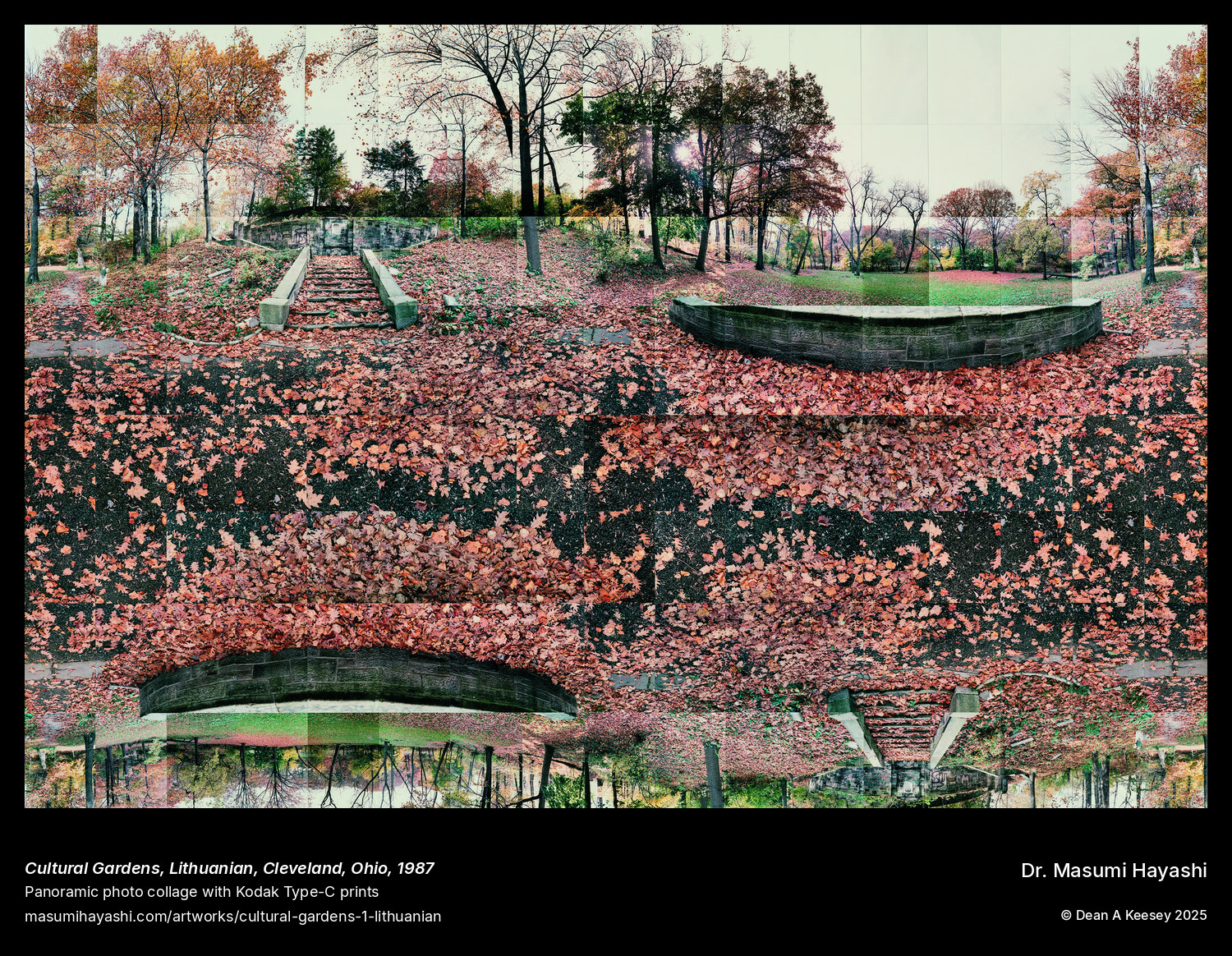
As second work in the Cultural Gardens trilogy, the Yugoslavian Garden documentation reinforced Hayashi’s systematic sampling approach: documenting multiple gardens to represent the broader Cultural Gardens system’s diversity while creating serial visual testimony to different ethnic communities’ landscape expressions. The 1987 date’s alignment with Lithuanian Garden #1 suggested concentrated documentation campaign where Hayashi photographed multiple gardens during single period, creating cohesive series documentation.
Related Works
- Cultural Gardens #1, Lithuanian (02003) - CSU collection, same documentation year
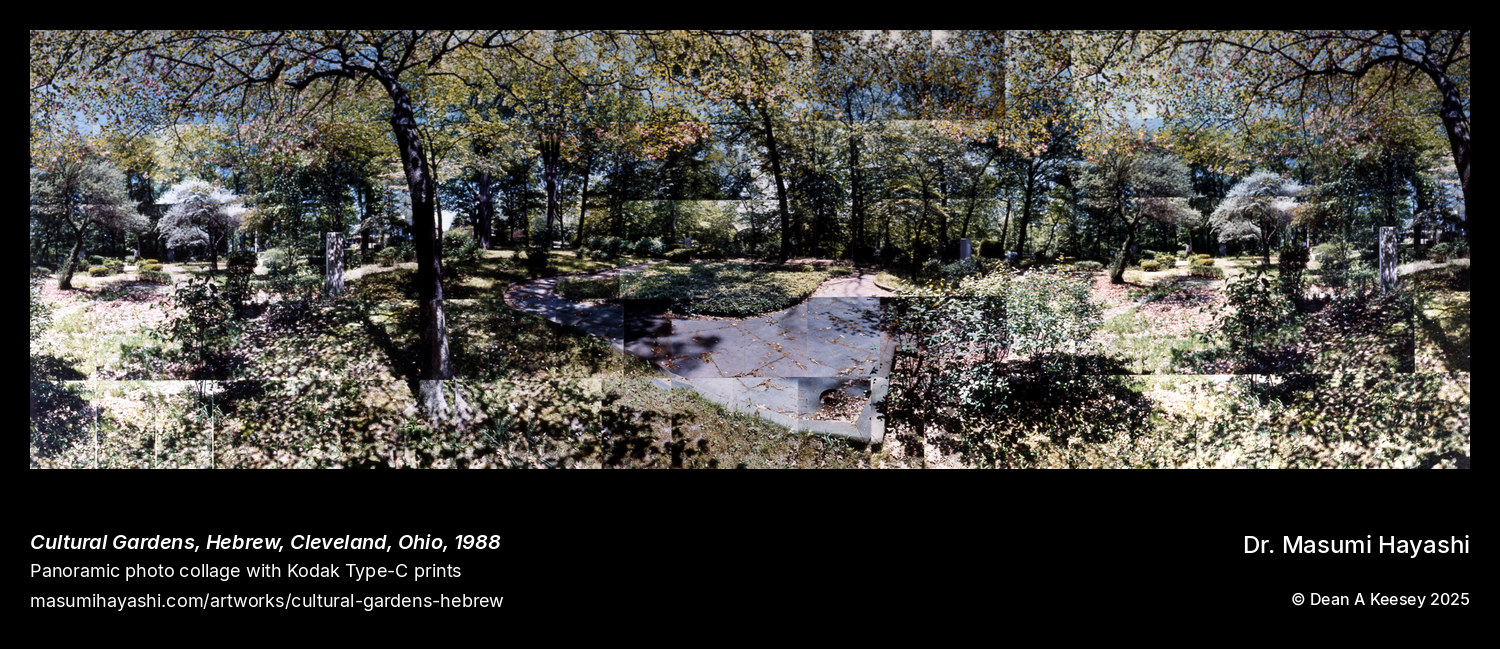
- Cultural Gardens #3, Hebrew (02005) - Series completion
- Cleveland Stadium (02001) - Cleveland civic heritage
- Old Arcade, Cleveland (02016) - Cleveland architectural landmark
Series Context
Cultural Gardens #2 continues Hayashi’s systematic documentation of Cleveland’s unique multicultural landscape park, sampling different ethnic community gardens to represent the broader system’s scope while creating visual testimony to immigrant communities’ civic contributions. The CSU donation positioned the work within institutional collections supporting Cleveland multicultural education and heritage preservation.
Dimensions: 39 × 61 inches (wide horizontal panorama, 1:1.6 ratio) Year: 1987 Medium: Panoramic Photo Collage Film: 3.5 × 5 Kodak Edition: 1 of 5
Distribution: 40% (2 framed inventory editions, 1 CSU donation noted) Institutional Collection: Cleveland State University (2016 donation - 1 of 2 inventory editions) Location: Yugoslavian Cultural Garden, Martin Luther King Jr. Boulevard, Cleveland, Ohio Series: City Works (02) / Cultural Gardens subseries Historical Note: Documented during Yugoslavia’s final unified decade before 1990s dissolution