Cultural Gardens
Cleveland, OH, USA
Panoramic Photo Collage
1987
22 x 81
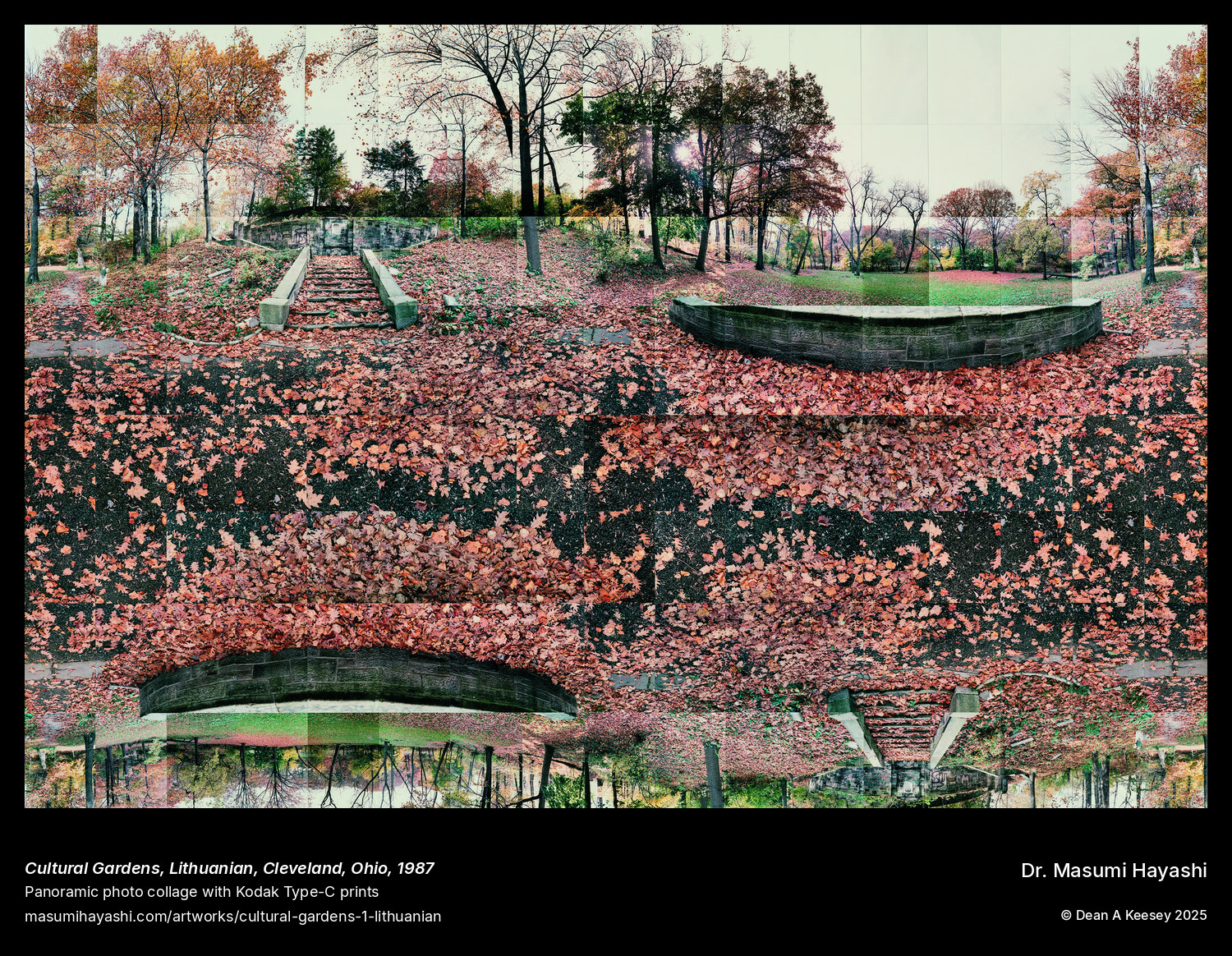
Cultural Gardens #1, Lithuanian, Cleveland, Ohio
Masumi Hayashi’s 1987 panoramic photo collage Cultural Gardens #1, Lithuanian, Cleveland, Ohio inaugurates her three-part documentation of Cleveland’s Cultural Gardens—a unique 249-acre linear park system stretching along Martin Luther King Jr. Boulevard (formerly Liberty Boulevard) featuring gardens dedicated to ethnic and national groups that shaped Cleveland’s multicultural identity. This 22×81-inch dramatically wide horizontal panorama captures the Lithuanian Garden’s architectural and landscape features, employing Hayashi’s signature photo collage technique to represent the garden’s spatial extent while celebrating Cleveland’s Lithuanian-American community’s contributions to the city’s cultural heritage.
The work’s 2016 donation to Cleveland State University positioned the Cultural Gardens series within institutional collections supporting Cleveland regional art and multicultural documentation. CSU’s acquisition validated Hayashi’s panoramic work as significant contemporary art meriting permanent institutional preservation while anchoring the series firmly in Cleveland’s civic and educational contexts—a regional university collecting documentation of Cleveland’s defining multicultural landmarks, affirming the Cultural Gardens’ significance as living monuments to immigrant communities that built modern Cleveland.
Historical Context: Cleveland’s Cultural Gardens
Cleveland’s Cultural Gardens, established beginning in 1916, represent one of America’s most ambitious and enduring experiments in multicultural public landscape design—a linear park system where immigrant and ethnic communities created individual gardens celebrating their cultural heritage while collectively forming a unified “garden of gardens” expressing Cleveland’s identity as immigrant destination and multicultural crossroads. The gardens stretch nearly four miles along the city’s eastern edge, with over 30 cultural gardens (as of 2024) representing communities from Lithuanian and Hebrew to Italian, Polish, German, Hungarian, Ukrainian, and dozens more nationalities that shaped Cleveland’s demographic and cultural character.
The Lithuanian Garden, documented in Hayashi’s first Cultural Gardens work, reflects Lithuanian-Americans’ significant presence in Cleveland’s immigrant history. Lithuanian immigration to Cleveland surged during the late 19th and early 20th centuries, with Cleveland developing one of America’s largest Lithuanian-American communities concentrated in neighborhoods along the city’s near west and east sides. The Lithuanian Garden’s establishment represented community efforts to preserve cultural heritage while demonstrating civic belonging—immigrant communities claiming permanent places in Cleveland’s civic landscape through garden dedications expressing both ethnic pride and American civic participation.
The Cultural Gardens’ spatial organization as linear park creates distinctive landscape experiences: visitors progress through gardens sequentially, encountering different cultural expressions while experiencing conceptual unity in the gardens’ collective presence along a shared boulevard. This linear organization differs from isolated ethnic enclaves or scattered cultural monuments, instead creating integrated multicultural landscape where diversity coexists within unified civic framework—physical expression of pluralist ideals where distinct cultural identities maintain integrity while contributing to collective urban identity.
By the 1980s when Hayashi began documenting the Cultural Gardens, the landscapes faced maintenance challenges reflecting Cleveland’s post-industrial economic decline: aging infrastructure, deferred maintenance budgets, and demographic shifts as second and third-generation immigrants moved to suburbs, diminishing community resources for garden upkeep. Yet the gardens retained powerful symbolic significance as monuments to Cleveland’s immigrant heritage and multicultural identity, even as physical conditions deteriorated and visitation declined from mid-century peaks.
Hayashi’s 1987-1988 Cultural Gardens documentation captured the landscapes during this transitional period—still significant civic treasures yet facing uncertain futures as maintenance challenges mounted and Cleveland grappled with post-industrial transformation. Her photography preserved visual testimony to the gardens’ state during the late 1980s, creating permanent records valuable for understanding Cleveland’s multicultural heritage and landscape preservation challenges in post-industrial cities.
Format Analysis: Extreme Horizontal Panoramas
The Cultural Gardens series employed dramatically wide horizontal panoramas reflecting the gardens’ linear spatial organization along Martin Luther King Jr. Boulevard:
Lithuanian Garden (22×81”): 1:3.7 ratio creating extreme width emphasizing the garden’s longitudinal extent along the boulevard, with horizontal format paralleling visitors’ linear progression through the landscape.
Yugoslavian Garden (39×61”): 1:1.6 ratio creating wider but less extreme horizontal, suggesting this garden’s spatial characteristics differed from Lithuanian Garden’s linear organization—possibly featuring more concentrated architectural elements or cross-axial organization requiring less extreme horizontal emphasis.
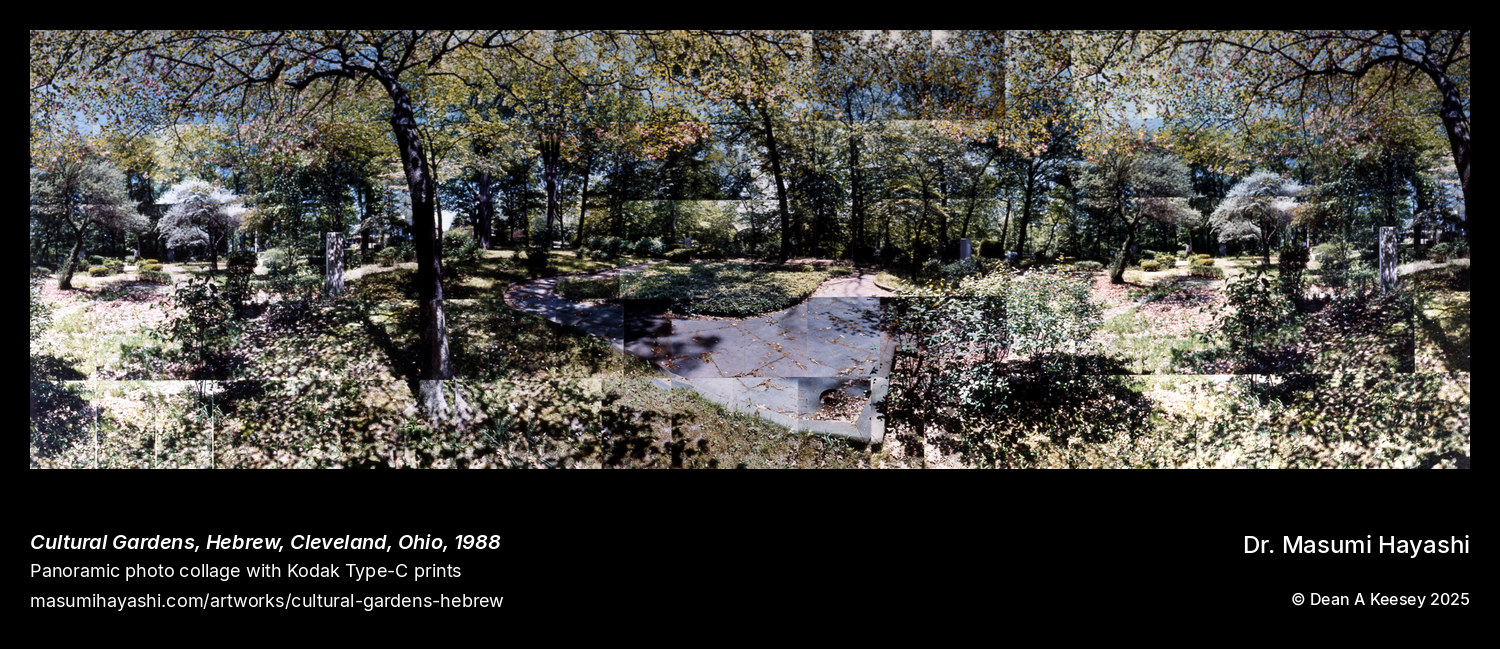
Hebrew Garden (30×96”): 1:3.2 ratio creating 8-foot-wide panorama (96 inches!)—among Hayashi’s largest documented works—reflecting the Hebrew Garden’s monumental scale and architectural complexity as one of the Cultural Gardens’ most elaborate installations.
These extreme widths created exhibition challenges (requiring substantial wall space) while serving conceptual purposes: the formats’ spatial extent paralleled gardens’ actual spatial organization, with photograph dimensions approaching landscape scales. The horizontal emphasis also reflected gardens’ primary experience as pedestrian procession—walking through landscapes horizontally rather than viewing them from aerial perspectives or static viewpoints, with panoramic compositions recreating sequential visual experience of progressing through garden spaces.
Artistic Significance: Multicultural Heritage Documentation
The Cultural Gardens series represented Hayashi’s systematic documentation of Cleveland’s defining multicultural landscape—installations expressing immigrant communities’ contributions to urban identity while celebrating diversity as civic asset rather than social problem. The series’ three gardens (Lithuanian, Yugoslavian, Hebrew) sampled the broader Cultural Gardens system, providing visual testimony to different ethnic communities’ landscape expressions while suggesting the larger system’s scope through serial documentation.
The series also engaged Hayashi’s own identity as Japanese-American artist: documenting immigrant heritage landscapes resonated with her extensive work on Japanese American internment camps and Asian-American cultural sites. The Cultural Gardens documentation implicitly contrasted different immigrant experiences: European ethnic groups celebrated through permanent civic gardens versus Japanese Americans’ wartime incarceration—divergent treatments reflecting racial hierarchies shaping which immigrant communities received civic recognition versus which faced exclusion and imprisonment.
The CSU donation positioned the Cultural Gardens works within Cleveland’s institutional memory systems—university collections preserving regional cultural heritage for educational use and scholarly research. This institutional placement ensured long-term preservation and potential exhibition opportunities, maximizing the works’ function as visual testimony to Cleveland’s multicultural identity and landscape heritage.
Cleveland State University Collection
The 2016 CSU donation of Cultural Gardens #1 (and notations suggesting #2’s potential donation) positioned the series within significant institutional collections supporting Cleveland regional art and multicultural documentation. CSU, Cleveland’s urban public university serving diverse student populations including substantial immigrant and first-generation college students, provides ideal institutional home for works documenting Cleveland’s immigrant heritage—creating educational opportunities connecting students to Cleveland’s multicultural history through visual art engaging their own cultural backgrounds.
Institutional donation also provided tax benefits for the Gentile Family estate while ensuring permanent preservation and potential public access through university exhibitions and educational programs. This donation strategy balanced estate management needs (reducing inventory requiring storage and insurance) with maximizing works’ cultural impact through institutional placements supporting educational missions aligned with the works’ documentary and cultural heritage functions.
Related Works
- Cultural Gardens #2, Yugoslavian, Cleveland (02004)
- Cultural Gardens #3, Hebrew, Cleveland (02005)
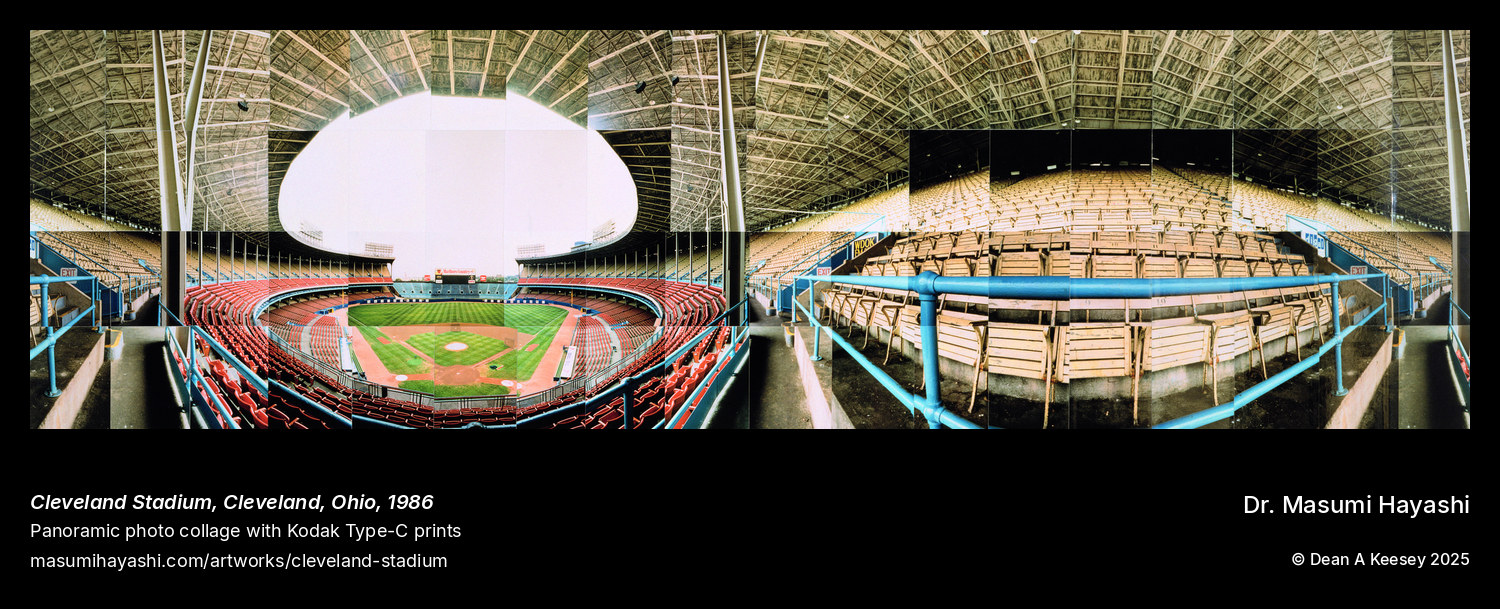
- Cleveland Stadium, Cleveland (02001) - Cleveland civic monument documentation
- Old Arcade, Cleveland (02016) - Cleveland architectural heritage
- Terminal Tower series - Cleveland landmark documentation
Series Context
Cultural Gardens #1 inaugurates Hayashi’s three-part documentation of Cleveland’s unique multicultural landscape park system, employing extreme horizontal panoramas to capture gardens’ linear spatial organization while celebrating immigrant communities’ contributions to Cleveland’s urban identity. The work’s CSU donation and complete distribution positioned it as successful Cleveland heritage documentation meriting institutional preservation and broad collector interest—distinguishing the Cultural Gardens series as among Hayashi’s most successfully distributed Cleveland works.
Dimensions: 22 × 81 inches (extreme horizontal panorama, 1:3.7 ratio) Year: 1987 Medium: Panoramic Photo Collage Film: 3. Boulevard, Cleveland, Ohio Series: City Works (02) / Cultural Gardens subseries Cultural Significance: Documentation of Cleveland’s unique multicultural landscape heritage Documentary Function: Visual testimony to immigrant communities’ civic contributions and cultural landscape preservation