Cleveland Stadium, Cleveland, Ohio
Cleveland, OH, USA
Panoramic Photo Collage
1986
18 x 61
Cleveland Stadium, Cleveland, Ohio
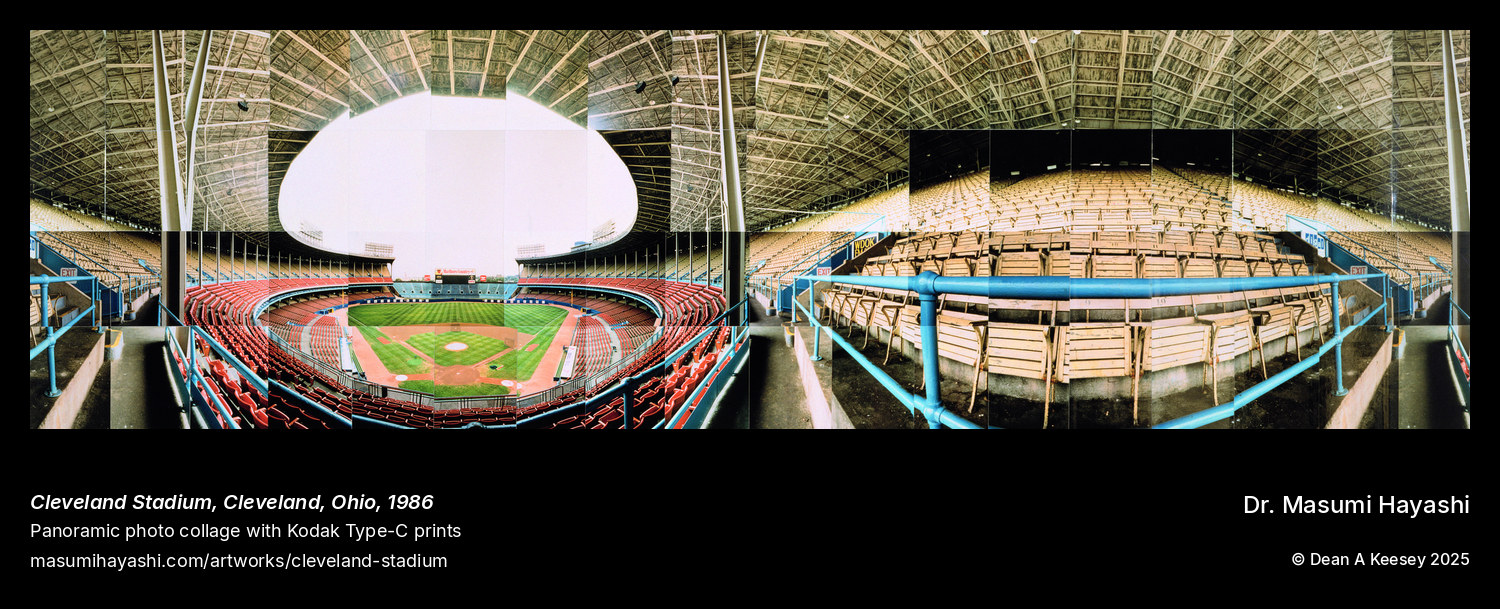
Masumi Hayashi’s 1986 panoramic photo collage Cleveland Stadium, Cleveland, Ohio documents one of American sports architecture’s most iconic mid-century structures—a massive lakefront stadium that housed the Cleveland Indians baseball team and Browns football franchise for decades, serving as Cleveland’s civic gathering space and architectural landmark from its 1931 opening through its 1996 demolition. Created during the stadium’s late operational years when preservation debates were emerging yet demolition remained years away, this 18×61-inch wide horizontal panorama captures the facility at full scale, employing Hayashi’s characteristic photo collage technique to represent the stadium’s vast architectural extent within a single unified composition.
The work’s acquisition by Progressive Corporation—one of Cleveland’s major corporate headquarters and a Fortune 500 insurance company—positioned Cleveland Stadium within networks of corporate art collecting supporting regional artists documenting local architectural and cultural landmarks. Corporate acquisition validated Hayashi’s panoramic photo collage as significant contemporary art meriting institutional collection, while also anchoring the work within Cleveland’s civic identity: a major local corporation acquiring documentation of an iconic civic structure, affirming the stadium’s significance as collective memory and shared urban experience rather than merely functional sports infrastructure. plus framed and unframed inventory editions, 3 of 5 editions) suggested modest distribution exceeding completely-retained works yet falling short of broadly-distributed pieces—reflecting market dynamics where corporate institutional acquisition absorbed one edition while collector interest remained limited, leaving substantial inventory retained by the artist and estate.
Historical Context: Cleveland Stadium as Civic Monument
Cleveland Stadium, officially Cleveland Municipal Stadium, opened in 1931 as one of America’s largest sports facilities—a 78,000-seat concrete behemoth constructed during the Depression era as a public works project combining municipal ambition, architectural monumentality, and civic pride. Located on Cleveland’s lakefront along Lake Erie, the stadium occupied prime waterfront real estate reflecting 1930s urban planning priorities that positioned large-scale public infrastructure along waterfronts before environmental movements and urban design evolution reoriented waterfront development toward mixed-use, pedestrian-scaled environments.
The facility’s architectural scale dwarfed human dimensions—massive concrete grandstands extending hundreds of feet, creating spatial experiences of sublime vastness typical of early-to-mid-20th-century stadium architecture prioritizing capacity and monumentality over intimate spectator experience. This architectural gigantism reflected particular historical moments: Depression-era public works demonstrating governmental capacity through large-scale construction, postwar prosperity enabling mass attendance at sporting events, and modernist architectural sensibilities celebrating monumental concrete structures as expressions of progress and civic achievement.
The stadium served dual functions hosting both Cleveland Indians baseball (1932-1993) and Cleveland Browns football (1946-1995), creating shared civic memories across generations of Clevelanders who attended games, concerts, and civic events within its vast concrete confines. This functional duality created complex spatial challenges: baseball required different field dimensions and sightlines than football, resulting in compromised spectator experience for both sports—seats too distant from baseball action, awkward angles for football viewing—yet the facility’s civic significance transcended functional limitations through its role as Cleveland’s primary gathering space for mass events.
By the mid-1980s when Hayashi documented the stadium, preservation debates were emerging alongside discussions of replacement facilities. The concrete structure showed aging signs—deteriorating infrastructure, outdated amenities lacking luxury suites and modern concessions demanded by professional sports economics, and lakefront location increasingly viewed as underutilizing prime waterfront land. Yet the facility retained powerful civic symbolism: generations of Cleveland sports memories, architectural monumentality representing civic ambition, and democratic public space accessible to working-class fans increasingly priced out of newer luxury-oriented stadiums.
Hayashi’s 1986 documentation captured the stadium during this transitional moment—still operational and civic-central, yet facing uncertain futures as replacement facility discussions gained momentum. Her photography preserved visual testimony to the structure before its eventual 1996 demolition, creating permanent records of architectural and civic heritage that disappeared from Cleveland’s landscape within a decade of her documentation.
Format & Composition: The Wide Horizontal Panorama
Cleveland Stadium’s 18×61-inch dimensions created a dramatically wide horizontal panorama (approximately 1:3.4 ratio) that paralleled the stadium’s horizontal architectural extent—massive grandstands stretching across landscapes, creating compositions where width overwhelmed height. This extreme horizontal format served specific conceptual and practical purposes for documenting large-scale sports architecture:
Architectural Scale Representation: The 3.4:1 width-to-height ratio enabled documentation of the stadium’s vast horizontal extent within single compositions, capturing the facility’s architectural scale in ways that standard photographic formats or tighter panoramas couldn’t achieve. The extreme width paralleled viewers’ embodied experience of stadium vastness—turning heads to scan massive structures extending beyond normal sight lines.
Spatial Compression: Panoramic photo collage’s technique of assembling multiple photographs into unified compositions created spatial compression—collapsing three-dimensional architectural volumes and depths into two-dimensional horizontal compositions. This compression paralleled stadium experience: spectators occupying single viewpoints yet visually consuming vast architectural spaces extending in all directions, with panoramic vision fragmenting and reassembling architectural entirety.
Horizontal Monumentality: The wide format emphasized horizontal rather than vertical monumentality—Cleveland Stadium’s architectural character derived from extensive grandstands rather than height, creating ground-hugging massiveness distinct from vertical skyscrapers or towers. The format choice acknowledged this horizontal character, refusing to force stadium architecture into vertical compositions inappropriate to its spatial logic.
Cinematic Viewing Experience: The extreme width created cinematic viewing experiences—audiences scanning across compositions like film sequences, with horizontal movement through the image paralleling temporal progression through stadium spaces. This cinematic quality suited sports architecture documentation, where facilities hosted time-based events (games unfolding across hours) within spatially extensive environments.
The format also created practical exhibition challenges: 61-inch widths required substantial wall space, limiting installation options and potentially reducing exhibition opportunities. Yet this practical limitation reinforced conceptual commitments: documenting stadium architecture at scales approaching experiential reality required accepting display challenges, privileging representational fidelity over exhibition convenience.
Artistic Significance: Documenting Civic Heritage
Cleveland Stadium represented Hayashi’s documentation of Cleveland’s civic architectural heritage—structures defining urban identity and collective memory yet facing demolition or transformation pressures. The work functioned as elegiac preservation: creating permanent visual records of architecture destined for disappearance, acknowledging loss while celebrating structures’ historical and cultural significance during their remaining operational years.
The stadium’s documentation also engaged questions about architectural preservation and adaptive reuse: what constitutes preservation when massive concrete structures become functionally obsolete? Cleveland Stadium’s eventual demolition reflected preservation movement limitations—some structures resist adaptive reuse due to scale, obsolescence, or land value pressures, making documentation the only feasible preservation form. Hayashi’s work acknowledged this preservation paradox: photography as memorial when physical preservation proves impractical.
The Progressive Corporation acquisition positioned Cleveland Stadium within corporate collecting practices supporting regional artists documenting local landmarks—corporations building art collections that affirmed civic identity while supporting artist communities. This collecting pattern served multiple corporate functions: demonstrating civic commitment through art patronage, building corporate art assets potentially appreciating in value, and creating workplace environments connecting employees to regional identity and heritage.
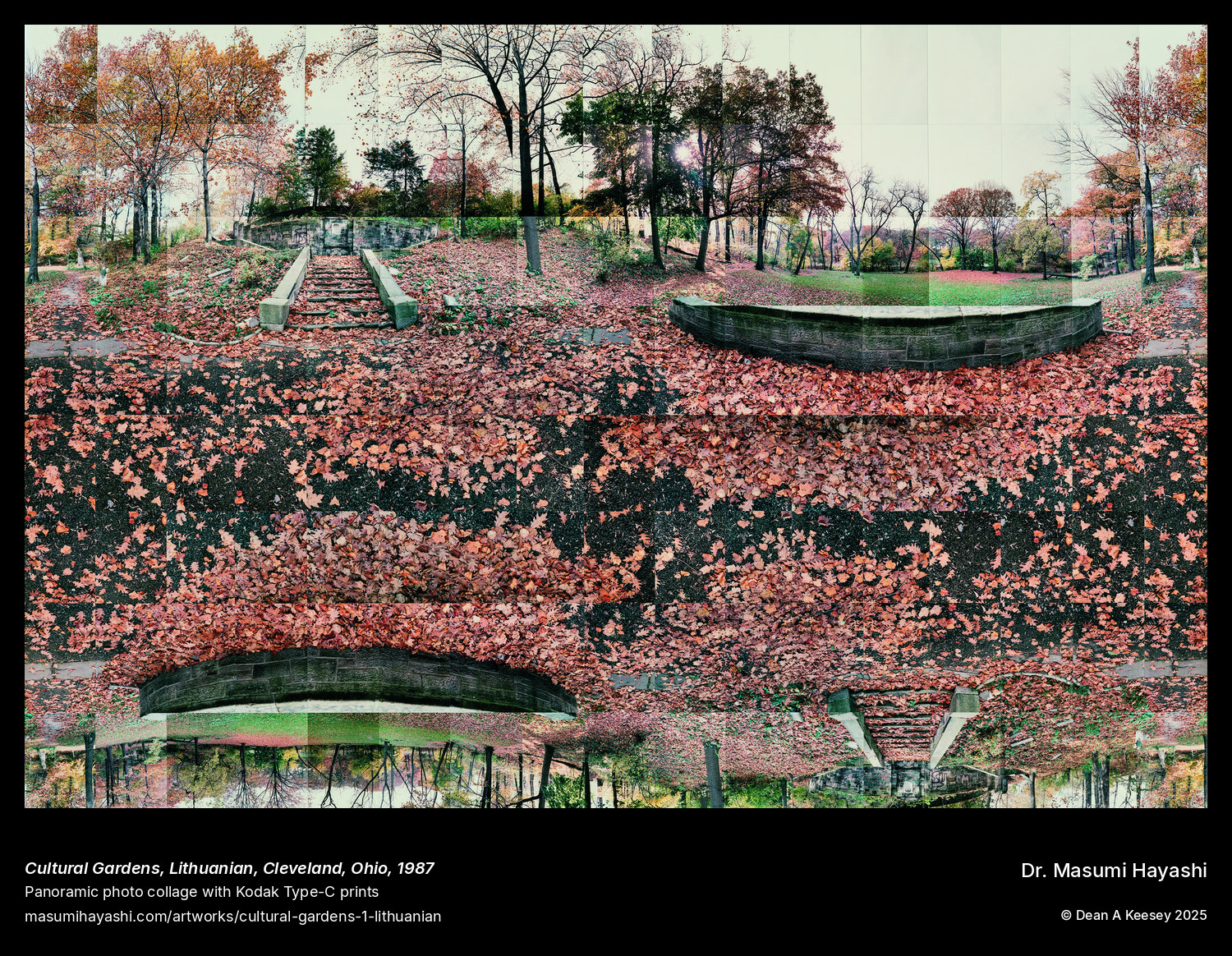
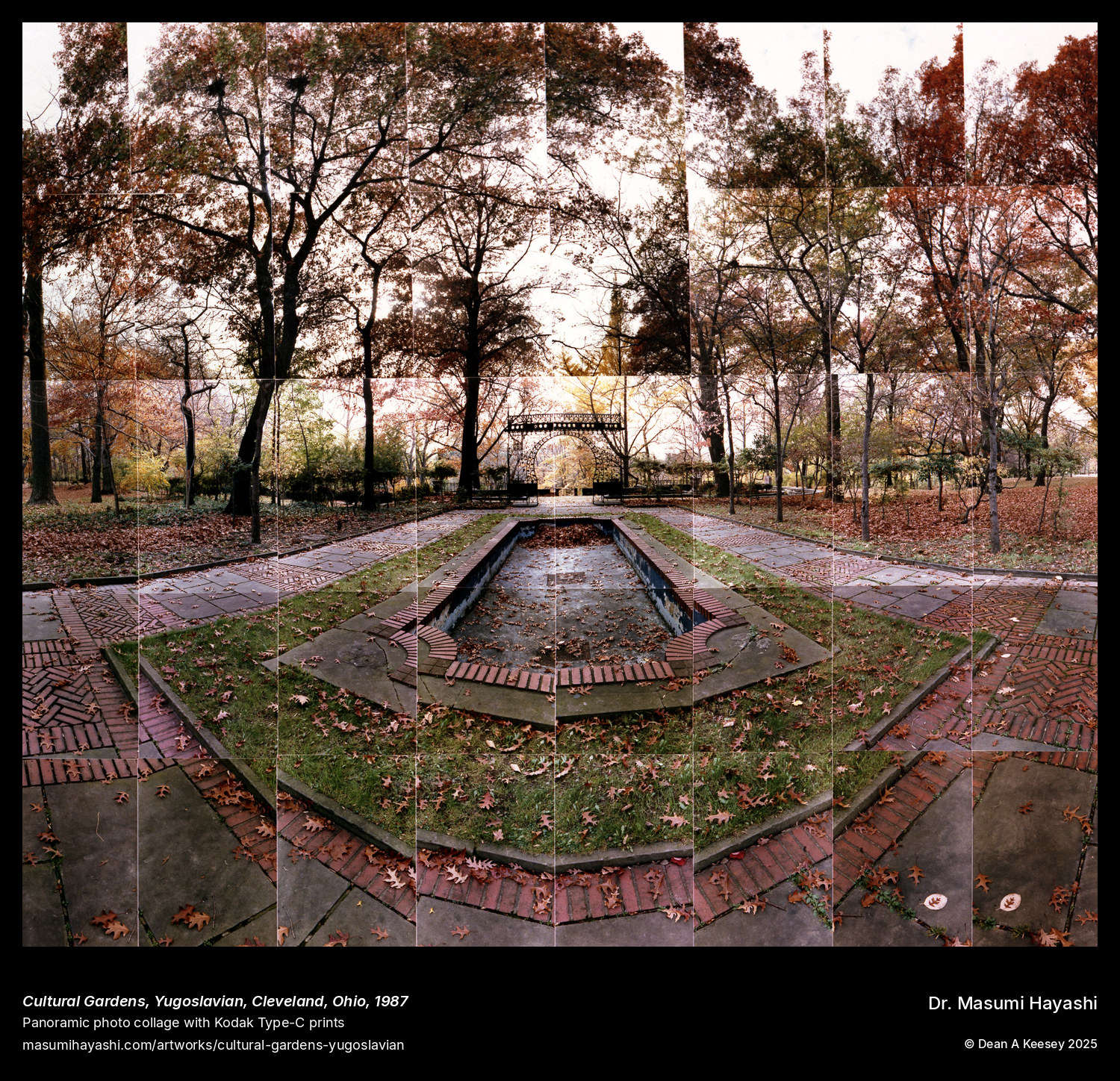
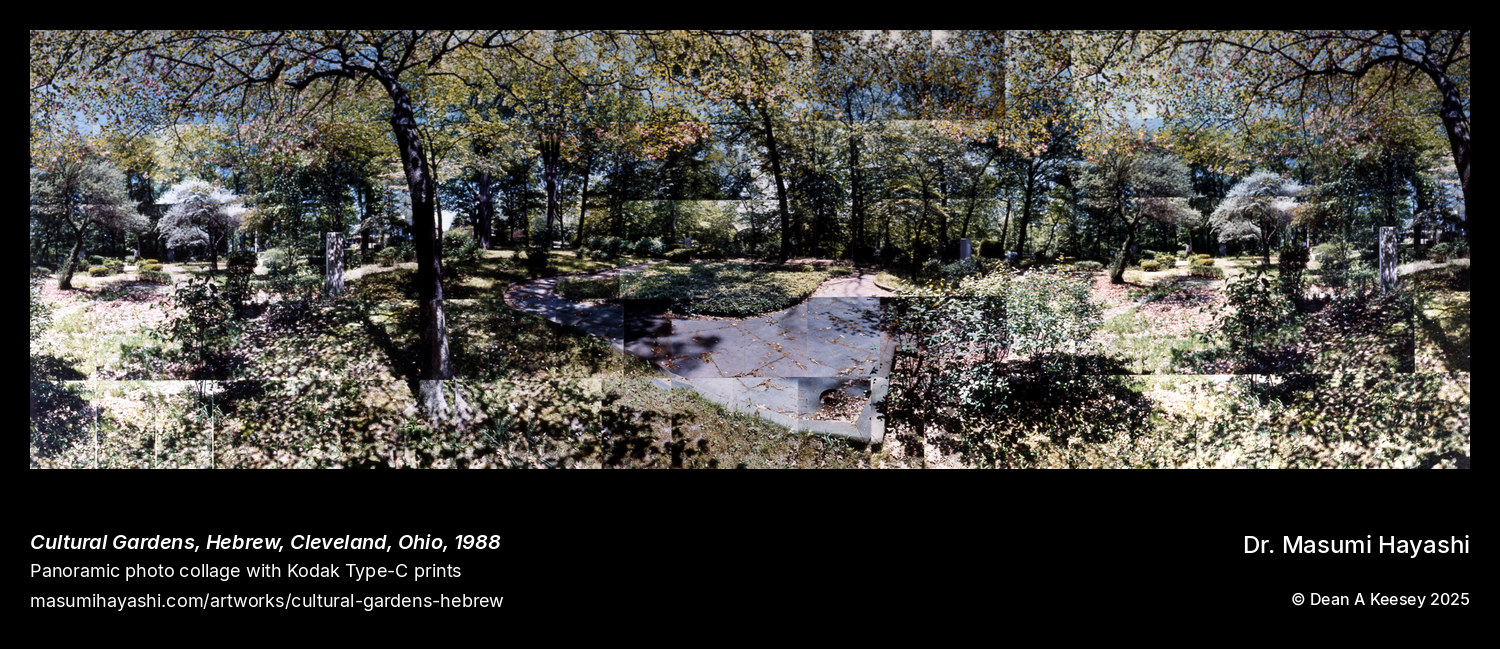
The work’s Cleveland focus also reflected Hayashi’s sustained engagement with her home city’s architecture, infrastructure, and urban transformation. Cleveland Stadium joined other Cleveland works including Cultural Gardens series, Old Arcade, Terminal Tower, Main Avenue Bridge, and Edgewater Park as systematic documentation of the city’s architectural and cultural landmarks—creating a comprehensive visual archive of Cleveland’s built environment during the 1980s-1990s transformation period when deindustrialization, urban renewal, and preservation debates reshaped the city’s physical and cultural landscape.
Progressive Corporation Collection
Progressive Corporation’s acquisition of Cleveland Stadium positioned the work within significant corporate collecting networks while anchoring it firmly in Cleveland civic context. Progressive, headquartered in Mayfield Village (Cleveland suburb), grew from regional auto insurance provider to Fortune 500 corporation during the 1980s-2000s, building substantial corporate art collections including contemporary photography, regional artists, and works documenting Cleveland architecture and culture.
Corporate acquisition provided multiple benefits beyond purchase revenue: institutional validation elevating the work’s status, permanent placement ensuring long-term preservation and potential public access, and association with major Cleveland corporation reinforcing the work’s civic significance. Progressive’s collection strategy emphasized regional connections—acquiring works by Cleveland-area artists and documentation of local landmarks—creating corporate identity intertwined with Cleveland civic pride and cultural heritage.
The acquisition also created potential exhibition opportunities: corporate collections often lent works to museums for exhibitions, enabling broader public access than private collections while maintaining corporate ownership. This lending pattern meant Progressive’s acquisition didn’t necessarily remove Cleveland Stadium from exhibition circulation, instead providing stable institutional home while supporting exhibition opportunities advancing Hayashi’s career and Cleveland Stadium’s documentation mission.
Contemporary Relevance: Stadium Architecture & Urban Waterfront Evolution
Cleveland Stadium gained renewed significance during subsequent decades as debates intensified about stadium architecture, public financing of sports facilities, and waterfront development priorities. The facility’s 1996 demolition and replacement with Jacobs Field (now Progressive Field, 1994) and Browns Stadium (now FirstEnergy Stadium, 1999) illustrated shifts in stadium economics and urban planning: newer facilities featured reduced capacity (creating scarcity increasing ticket prices), luxury suites generating premium revenues, and designs prioritizing intimate spectator experience over monumental scale.
The lakefront location’s redevelopment into the Great Lakes Science Center and Rock & Roll Hall of Fame illustrated waterfront transformation priorities: replacing single-use sports infrastructure with mixed-use cultural and recreational facilities creating year-round activity rather than episodic game-day crowds. This waterfront evolution reflected broader urban planning movements reclaiming industrial-era waterfront lands for public access, cultural institutions, and pedestrian environments—priorities emerging during the 1980s-1990s when Hayashi documented Cleveland Stadium.
The facility’s demolition also prompted reflection about architectural preservation boundaries: when do massive concrete structures merit preservation despite functional obsolescence? Cleveland Stadium lacked the ornamental richness or architectural innovation justifying preservation as landmark buildings, yet its civic significance as shared memory space created preservation arguments transcending purely architectural criteria. The demolition illustrated how preservation movements struggle with large-scale 20th-century structures lacking aesthetic qualities or adaptive reuse potential yet possessing powerful cultural resonance.
Hayashi’s 1986 documentation preserved visual evidence of Cleveland Stadium before demolition, creating permanent records valuable for Cleveland architectural history, sports history scholarship, and urban planning research examining stadium architecture’s evolution and waterfront development transformation. The work functions as visual testimony to civic architecture that defined urban identity for generations yet ultimately proved incompatible with contemporary urban development priorities and sports facility economics.
Educational Significance: Sports Architecture & Civic Memory
Cleveland Stadium serves as teaching tool for understanding sports architecture evolution, civic infrastructure, and urban waterfront transformation:
Stadium Architecture History: The work illustrates mid-century stadium design priorities emphasizing capacity and monumentality, contrasting with contemporary stadiums prioritizing luxury amenities and intimate spectator experiences.
Public Works & Civic Pride: Cleveland Stadium’s Depression-era construction as municipal project demonstrates how large-scale public infrastructure expressed civic ambition and governmental capacity through monumental architecture.
Preservation Challenges: The facility’s demolition despite civic significance illustrates preservation movement limitations: large-scale concrete structures resisting adaptive reuse and facing economic pressures favoring replacement with more profitable facilities.
Waterfront Evolution: The lakefront site’s redevelopment illustrates urban planning shifts from single-use sports infrastructure to mixed-use cultural and recreational facilities creating year-round waterfront activation.
Corporate Art Collecting: Progressive Corporation’s acquisition demonstrates corporate collecting practices supporting regional artists while building collections affirming civic identity and corporate community connections.
The work’s corporate collection placement ensured ongoing institutional preservation while potentially enabling exhibition opportunities introducing broader audiences to Hayashi’s architectural documentation and Cleveland’s civic heritage.
Master Catalogue Provenance Notes
The master catalogue’s notation “@Tregoning (house)” created provenance ambiguity: did Tregoning own an edition subsequently acquired by Progressive, or did Progressive acquire directly from Hayashi with Tregoning serving as intermediary? The notation suggested complex transaction chains where gallery representation, private collectors, or corporate art advisors facilitated acquisitions involving multiple parties before final institutional placements.
The tracking of Progressive Corp. acquisition alongside framed and unframed inventory editions (3 total, 60% accounted) left 2 editions unlocated—suggesting either sales to unnamed collectors not captured in catalogue records, editions never produced despite “1 of 5” designation, or informal distributions through artist exchanges bypassing formal inventory systems.
The “sold” designation confirmed commercial transaction occurred (likely Progressive acquisition), distinguishing Cleveland Stadium from purely inventory-retained works while acknowledging incomplete provenance documentation preventing comprehensive edition tracking.
Legacy URLs
(To be updated during website consolidation)
- masumimuseum.com: [To be determined]
- masumihayashi.com: [To be determined]
Related Works
- Terminal Tower series, Cleveland - Cleveland architectural landmark documentation
- Old Arcade, Cleveland (02016) - Historic Cleveland architecture
- Main Avenue Bridge, Cleveland (02013) - Cleveland infrastructure documentation
- Edgewater Park series, Cleveland - Cleveland lakefront documentation
- Cultural Gardens series, Cleveland - Cleveland cultural landscape documentation
Series Context
Cleveland Stadium belongs to Hayashi’s City Works series (02), representing documentation of urban infrastructure, civic architecture, and cultural landmarks. The work’s wide horizontal panorama and Progressive Corporation acquisition positioned it as significant Cleveland civic heritage documentation—preserving visual testimony to iconic sports architecture that defined the city’s collective identity for six decades before demolition created permanent loss of physical structure, leaving photography as primary preservation medium for architectural and cultural memory.
Dimensions: 18 × 61 inches (wide horizontal panorama, 1:3.4 ratio) Year: 1986 (early City Works series) Medium: Panoramic Photo Collage Film: 3.5 × 5 Kodak Edition: 1 of 5
Distribution: 60% (Progressive Corp., framed inventory, unframed inventory) Corporate Collection: Progressive Corporation, Cleveland, Ohio Location: Cleveland Stadium (Cleveland Municipal Stadium), Cleveland lakefront, Ohio, USA Series: City Works (02) Architectural Significance: Iconic 1931 Depression-era stadium (78,000 capacity), demolished 1996 Civic Function: Cleveland Indians baseball (1932-1993), Cleveland Browns football (1946-1995) Documentary Function: Elegiac preservation of civic architecture destined for demolition, visual testimony to shared urban memory