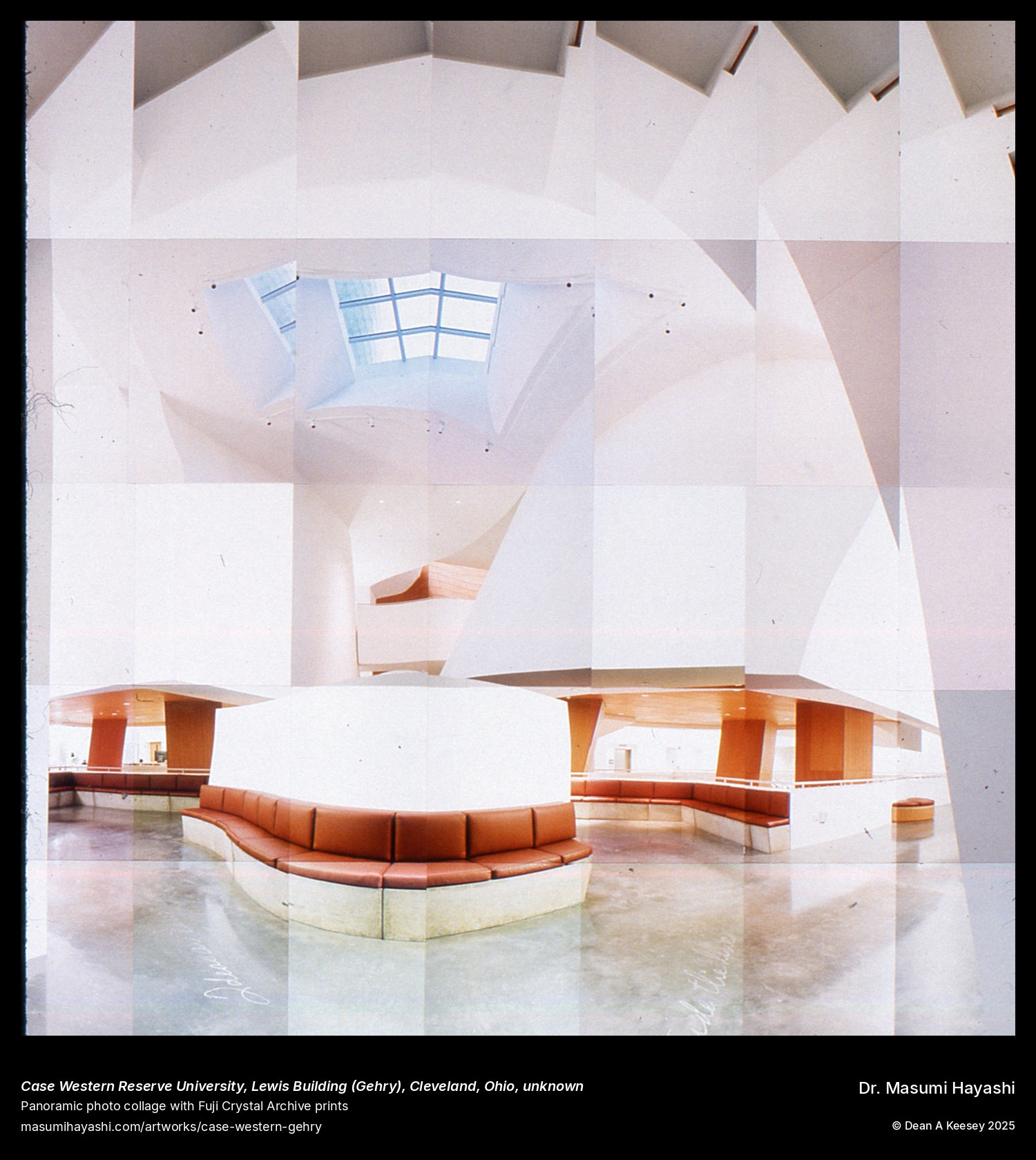
Case Western Reserve University, Lewis Building (Gehry)
Cleveland, OH, USA
Panoramic photo collage with Fuji Crystal Archive prints
30 x 23 1/2
This 30-by-23½-inch near-square vertical panorama documents the Peter B. Lewis Building at Case Western Reserve University—Frank Gehry’s contribution to Cleveland’s architectural landscape and one of the city’s most significant contemporary structures. The vertical format suits documentation of Gehry’s characteristically sculptural architecture rising above its academic campus setting.
The Lewis Building, completed in 2002, represents Gehry’s signature deconstructivist approach: ribbons of stainless steel cladding wrapping around an asymmetrical form that defies conventional building logic. The structure houses the Weatherhead School of Management, its unconventional exterior reflecting the innovative thinking the business school promotes. Hayashi’s photo collage technique proves particularly suited to documenting Gehry’s architecture, the fragmented multiple perspectives echoing the building’s own rejection of single-point-of-view design.
Cleveland’s acquisition of a Gehry building represented significant cultural aspiration for a city still recovering from deindustrialization. The commission—funded by insurance executive Peter B. Lewis—brought world-class contemporary architecture to a campus whose earlier buildings reflected more traditional academic design. The Lewis Building announced Cleveland’s continued relevance despite manufacturing decline.
The near-square format concentrates the composition on the building’s sculptural presence, the vertical orientation emphasizing how Gehry’s metallic forms rise and twist against the sky. The photo collage technique fragments the reflective surfaces that make Gehry’s buildings notoriously difficult to photograph, the multiple exposures capturing varying reflections that change with viewing angle and light conditions.
This work documents Cleveland’s architectural ambition during its post-industrial reinvention, the Gehry building representing investment in education and design as paths forward from manufacturing.
More from City Works
Big Sur Beach, No. 2, Big Sur, California
Angel Island Immigration Station, Men’s Section
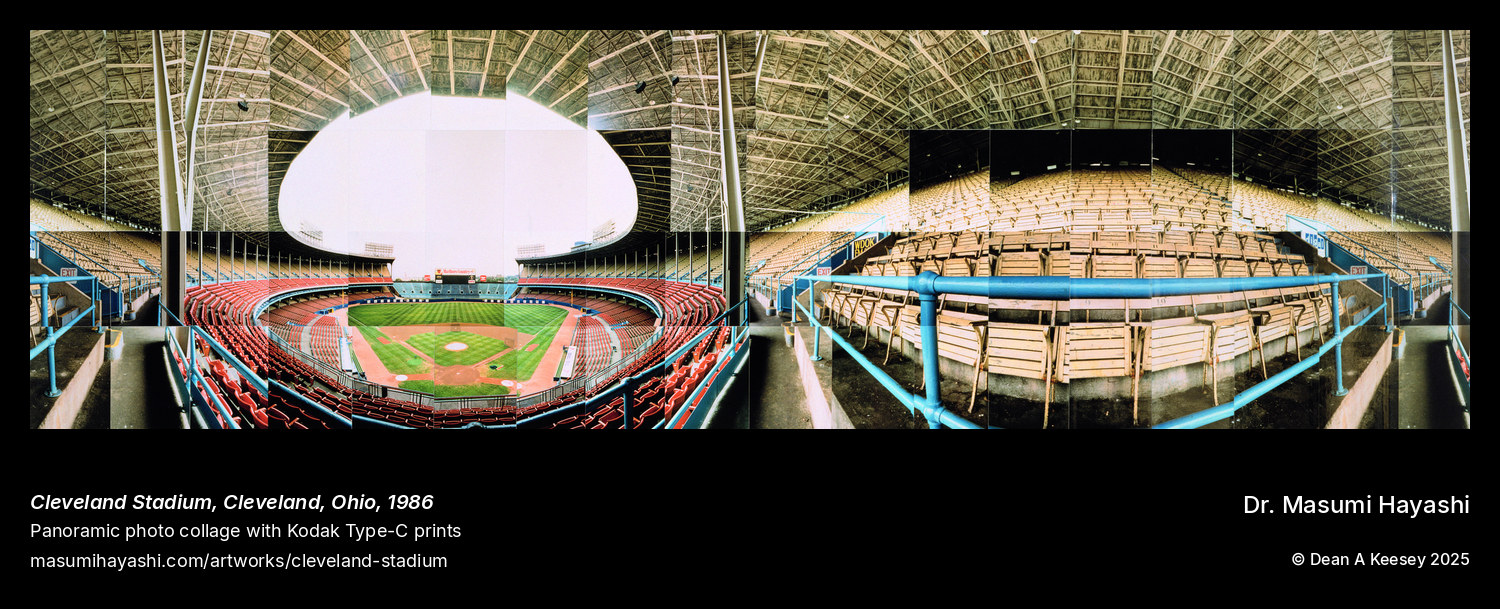
Cleveland Stadium, Cleveland, Ohio
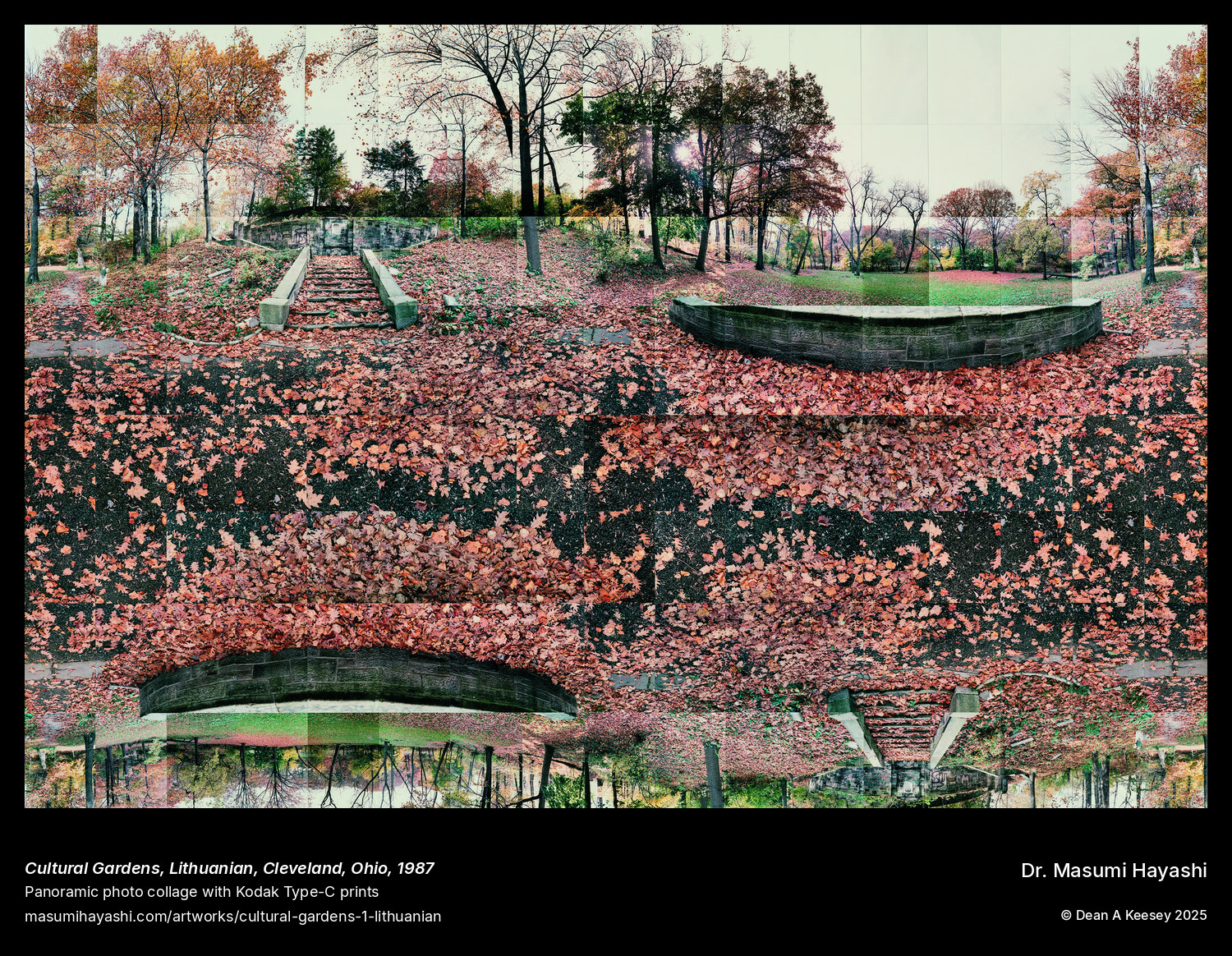
Cultural Gardens #1, Lithuanian
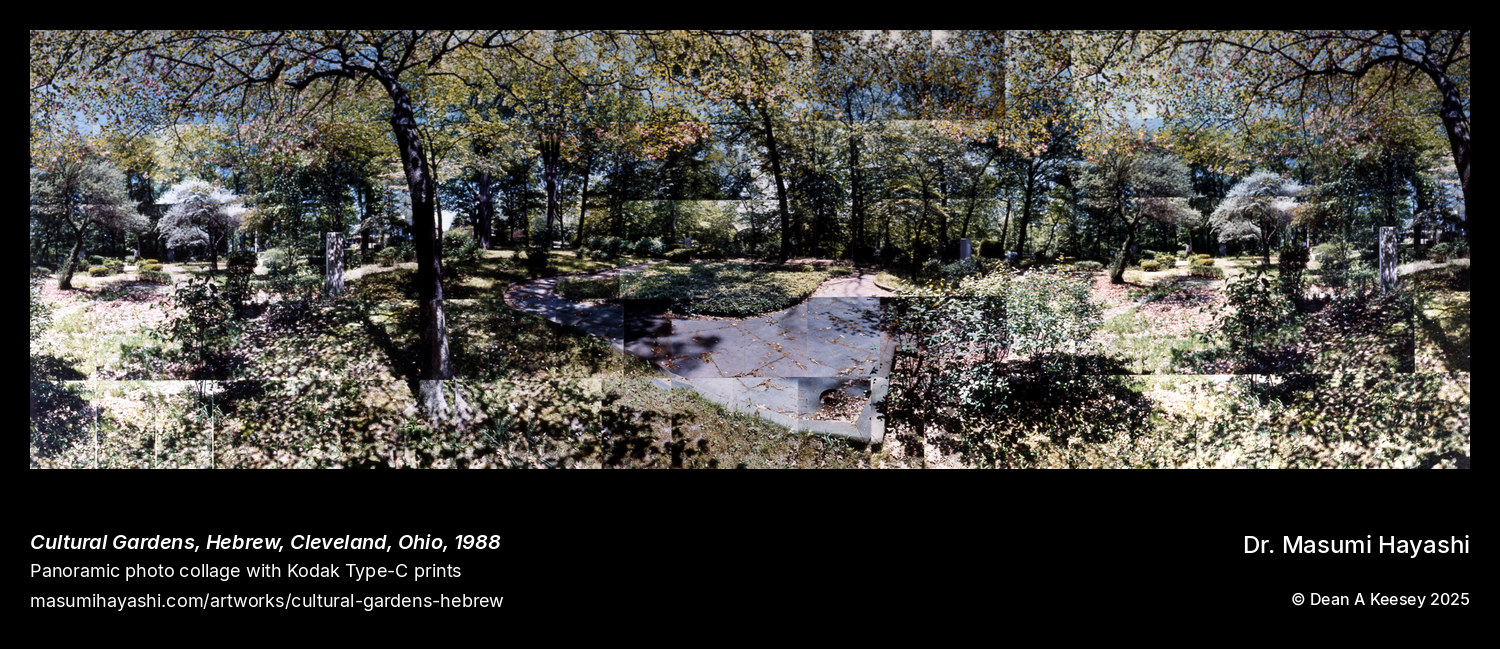
Cultural Gardens #3, Hebrew