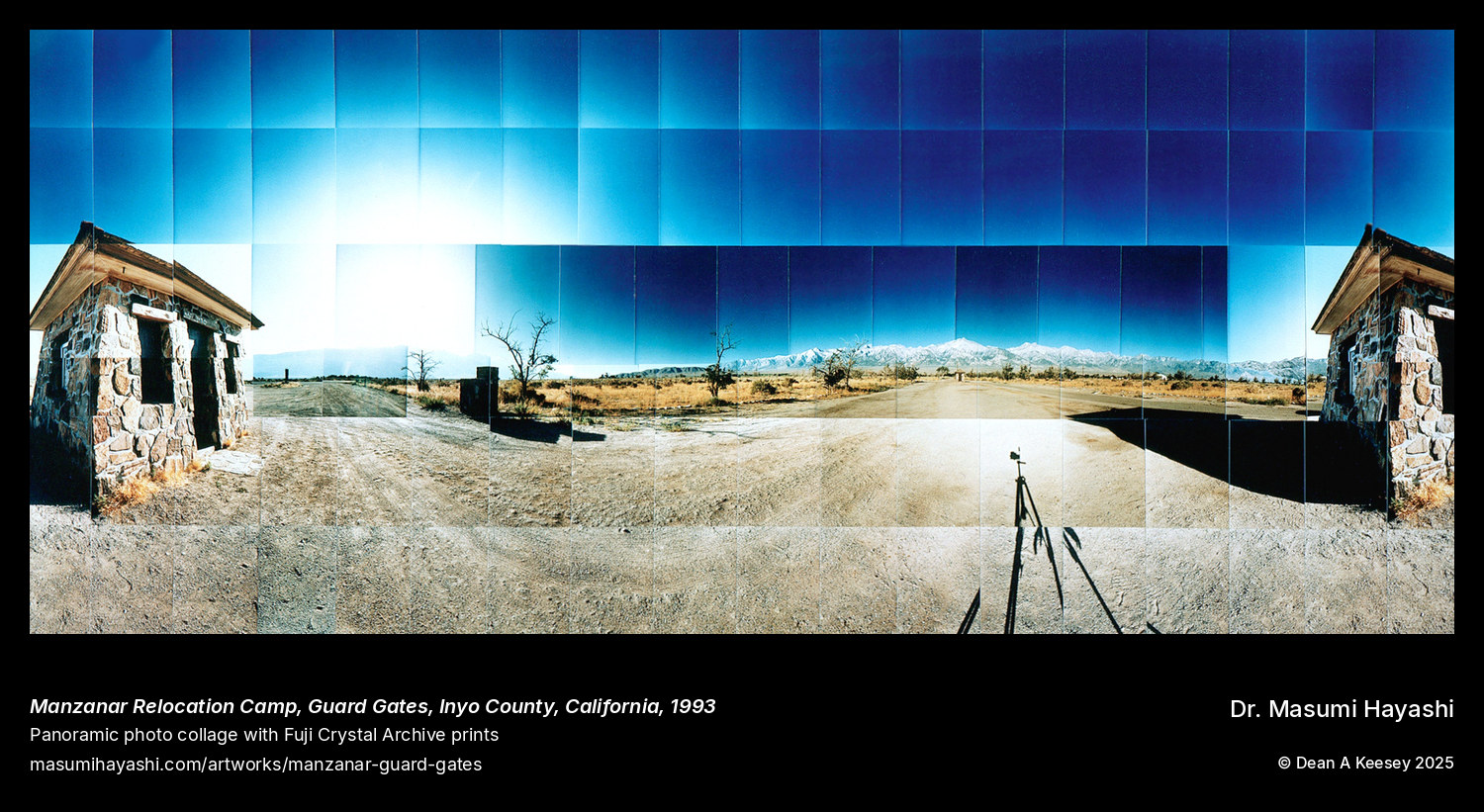
"These photographs are about beauty and irony, history and memory. The panoramic photo collages are a reconstruction of space, a remapping of space.
"Art is my life and when I have something to say, all that I'm interested in comes through in my art."
The Panoramic Photo Collage Technique
The photo collages represent the sites of Japanese American internment camps during World War II. Created from multiple exposures shot from a single perspective and rotated 360 degrees, these works aim to preserve both the physical remains and emotional/historical significance of these sites that are rapidly disappearing from the American landscape.
"The camera becomes my eyes... I have become the object. By viewing the collage, my experience and understanding of the place becomes yours."
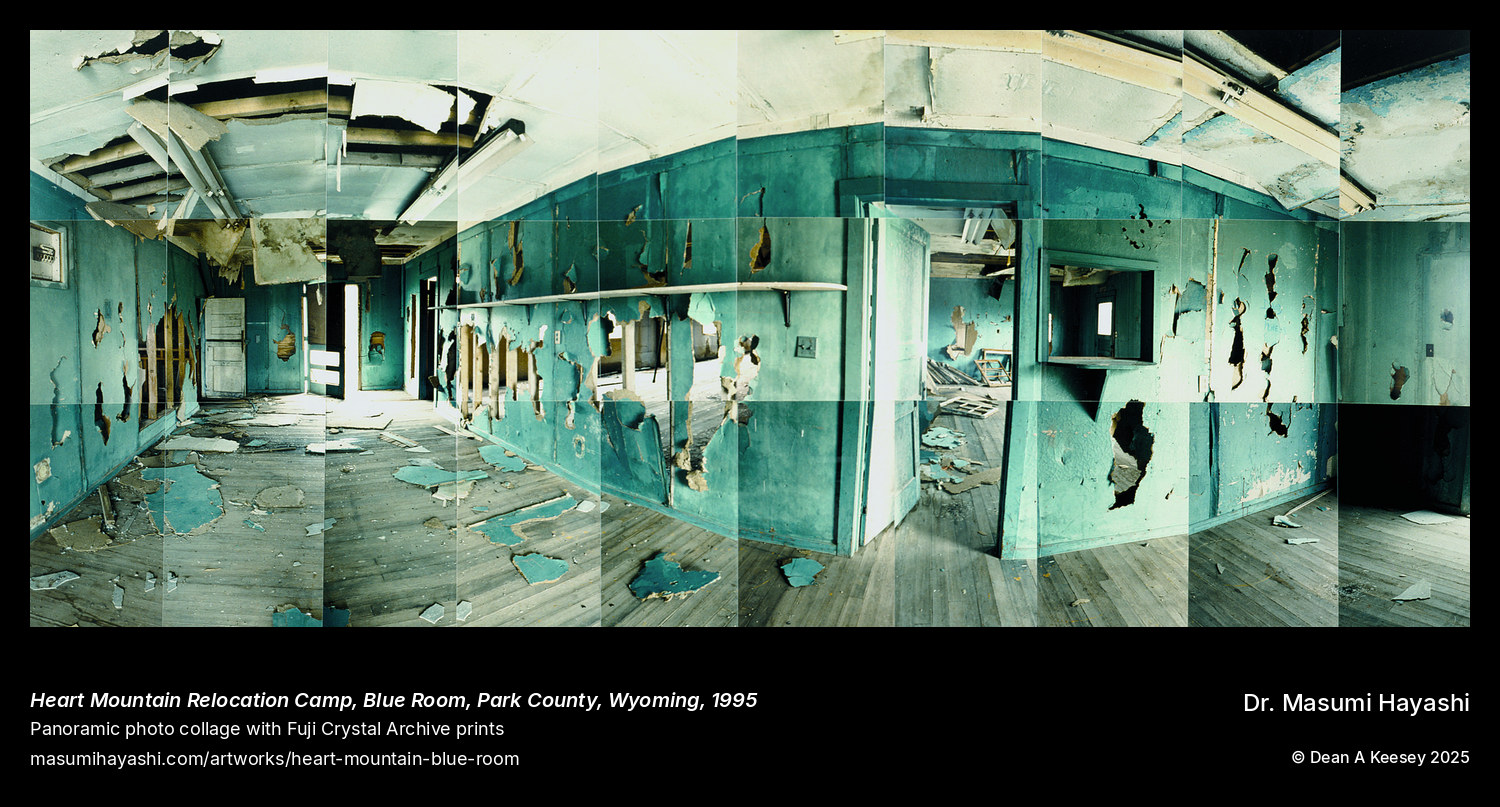
Remapping Space
"The concept of two-point perspective is questioned as the sequential, circular image is flattened on a two-dimensional surface and collaged. The normal two-point vanishing point can have three and four. The concept of a straight line connecting two points becomes a curved line connecting two vanishing points (flat walls become curved walls). Two-dimensional space is remapped, reconstructed."
Historical Context
This body of work reflects on the experience of 120,000 Japanese Americans who were interned during World War II. As a sansei (third-generation Japanese American), I have a personal connection to this work that informs my artistic vision.
These landscape photographs reflect history, memory, and archaeology. The photographic project began in 1990 and has grown to include audio interviews of internees, family album snapshots of internees and their stories, and photo collage portraits of the Japanese American survivors.
Beauty and Tension
"I meant these photographs to be appreciated for their beauty on one level yet, on another, to create irony and tension."
The visual tension between the landscapes' physical beauty and their dark historical context speaks to themes of memory and justice. The panoramic format allows viewers to experience these sites as I experienced them—not as distant historical artifacts, but as present, palpable spaces that continue to resonate with meaning.
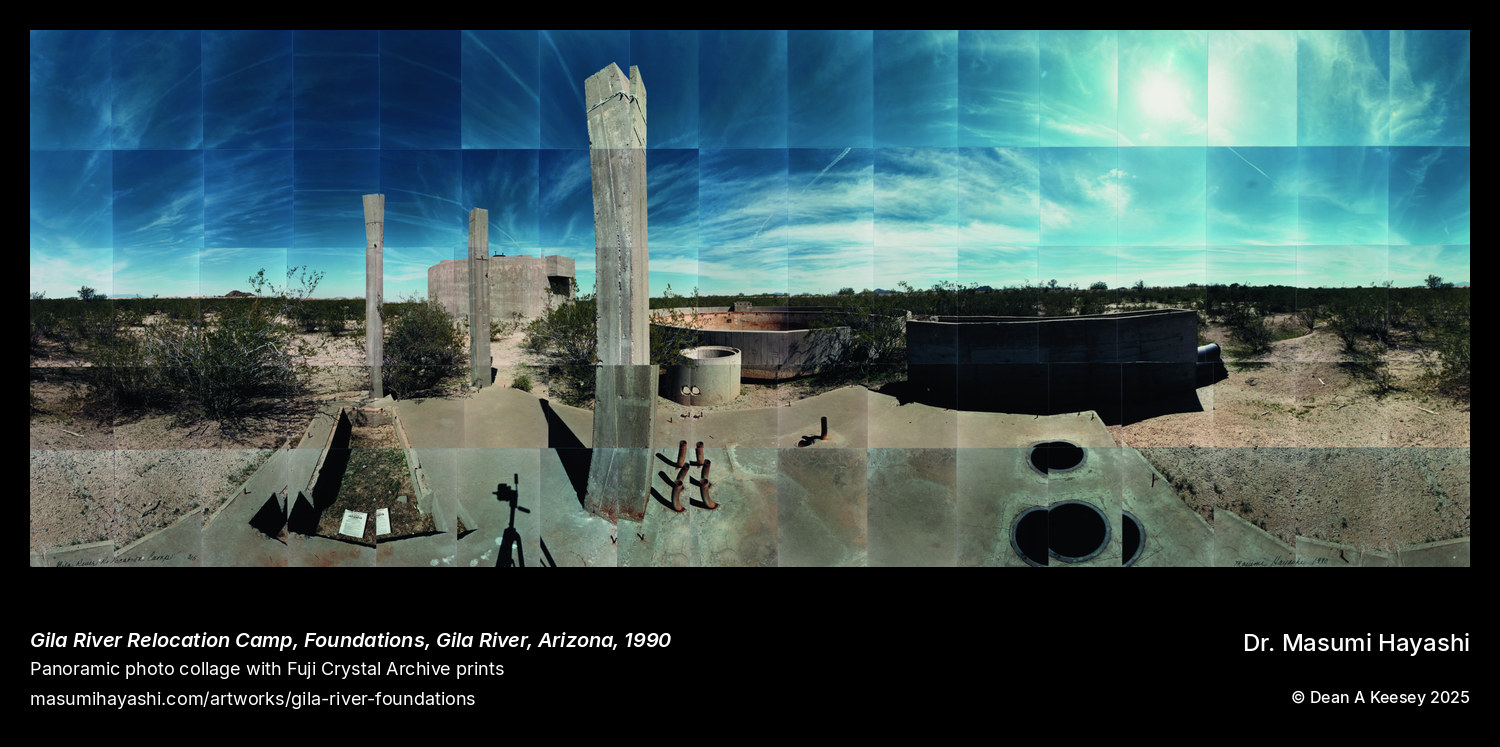
The Act of Witnessing
To photograph these sites is an act of witnessing. To view these photographs is to become a witness. The circular, encompassing view places the viewer within the space, not merely observing from outside. This is intentional—we cannot understand these histories from a distance. We must enter into them, allow ourselves to be encompassed by them.
Legacy
Through her art, Hayashi awakened people "gently but insistently to societal ills," applying "photography's most seductive traits—believability and formal beauty—to explore disturbing subjects."
Her panoramic photo collages stand as permanent visual records of places that represent both trauma and resilience in American and world history, capturing what she called "memory, justice, and the enduring human spirit in the face of adversity."